Every year, in the seventh or eighth lunar month, the rivers of the Red River Delta rise, and the old people say the same thing they have always said: the sea is angry again, and the mountain is standing firm again. This is the rhythm of Sơn Tinh, the Mountain Spirit, lord of Tản Viên, and the story of how his marriage to a Hùng king's daughter became the reason Vietnam floods.
The Lord of Tản Viên
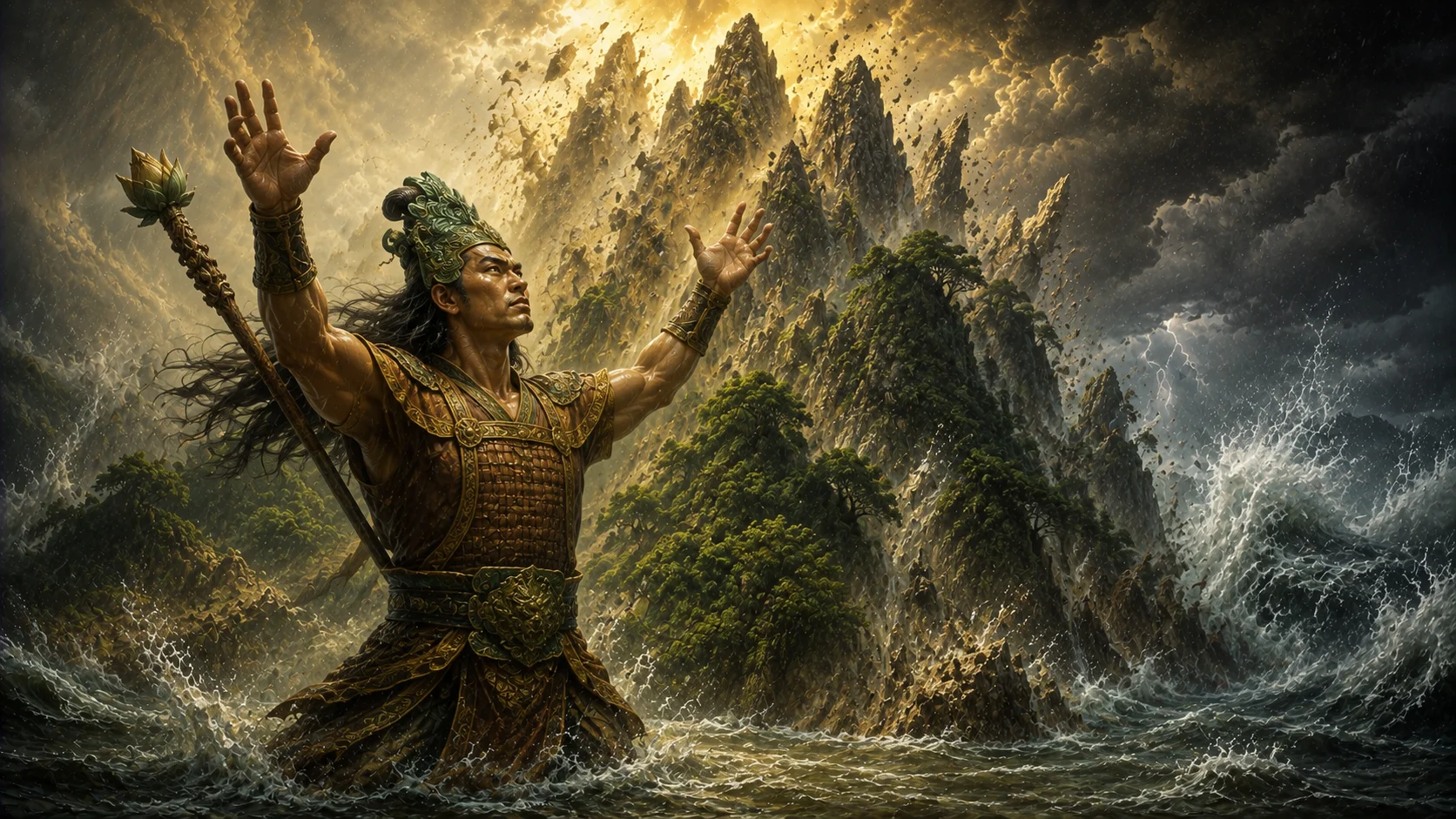
Sơn Tinh is the deity of Tản Viên Mountain, also known as Ba Vì Mountain, rising over the plains of what is now northern Vietnam. He is counted among the most widely known figures in the whole of Vietnamese mythology, and his story survives in one of the oldest written collections of Vietnamese legend, the fifteenth-century Lĩnh Nam Chích Quái — the "Wondrous Tales of Lĩnh Nam" — as well as in the Việt Điện U Linh Tập. Generations of Vietnamese schoolchildren have met him first in the national primary literature curriculum, which makes him, more than almost any other spirit in the country's folk religion, a figure everyone already half-knows before they ever visit a temple.
He rules the mountains, the forests, and the high ground — everything that stands above the water and holds its shape against the rain. In some local retellings he is not born a god at all, but begins as an orphan named Nguyễn Tuấn, raised among the hills of the Tản Viên region, who comes into possession of a miraculous staff capable of reviving the dead and bending the will of nature. Long before any princess enters the story, he is already a culture-hero in these tellings — teaching the upland communities around him the arts of wet-rice cultivation, of fishing, of hunting, carrying knowledge down from the high forest to the people who lived beneath it.
A Bride Price Built From the Mountains
The center of his legend is the courtship of Mỵ Nương, daughter of the eighteenth Hùng King, ruler of the ancient kingdom of Văn Lang. The Hùng kings are themselves the semi-legendary founding dynasty of Vietnam, their line woven into the same national origin story that gives the country the myth of Lạc Long Quân and Âu Cơ — so from its very first scene, this is a story about the nation as much as about a wedding.
Two suitors come before the king: Sơn Tinh, spirit of the mountains, and Thủy Tinh, the Water Spirit who commands the rivers, the seas, and the storms. Both are powerful. Both are worthy. The king cannot choose between them, and so he does what a ruler does when a decision is too dangerous to make outright — he sets a test disguised as generosity. Whichever suitor arrives first the next morning bearing the wedding gifts will win Mỵ Nương's hand.
The bride price he names is a strange and specific list: sticky rice cooked in banks of sweet-tasting elephant tusks, nine tusked elephants, nine nine-spurred cocks, and nine nine-maned horses. Read carefully, it is not a neutral request at all — every item on it is a mountain good, a forest good, the kind of rare and specific treasure that only a lord of the highlands could gather quickly. Whether the king favored Sơn Tinh knowingly or not, the terms of the contest were never even. Sơn Tinh, master of the mountains and the creatures within them, calls in what is his by right, and by morning he arrives at the palace with everything asked of him.
Thủy Tinh's Fury
Thủy Tinh arrives too late. He finds the bride already given, the contest already decided, and the humiliation of having lost a fair fight to an opponent who was never really fighting on equal ground. His answer is not grief but rage. As the Water Spirit — sea god and storm-bringer — he does what water always threatens to do to land: he rises.
He summons torrential rain, calls up the rivers, and drives the floodwaters toward Tản Viên itself. He commands the fish and the creatures of the sea to attack the mountain directly, throwing the full weight of his domain against the home of his rival. It is not a single battle but a siege — water against stone, endlessly repeated, each wave meant to finally reach the summit and take back what was lost.
It never does. Sơn Tinh answers each rise of the flood by raising Tản Viên higher still, using his mastery over earth and stone to keep the mountain's peak always above the water. No matter how high Thủy Tinh drives the flood, the mountain grows to meet him and then exceeds him. Some tellings widen the battlefield further, giving Sơn Tinh command not only of his own power but of an army — forest spirits, mountain animals, and the upland peoples of the Ba Vì region standing beside him against the rising water, a detail that quietly honors the real multi-ethnic communities who have always lived on those slopes.
A War Without an Ending
What makes this story different from most contests between rival gods is that it never actually resolves. Thủy Tinh does not accept defeat and withdraw forever. He returns — every year, around the same season, in the seventh or eighth lunar month — to try again. And every year, Sơn Tinh raises the mountain again, and the water is turned back again. The two of them are locked into a war with no final battle, only an endless rematch.
This is the detail that turns a marriage story into something much larger: an explanation for the world itself. The seasonal floods of the Red River Delta, the yearly rise of the waters that farmers there have always had to plan their lives around, are cast in this telling as the visible trace of Thủy Tinh's unending vendetta. When the rains come and the rivers swell, it is not simply weather. It is jealousy, still burning, still throwing itself against a mountain that will not fall.
Reading the Flood as History
Vietnamese folklorists have long read this myth as something more than poetry — as a kind of encoded memory. The endless duel between mountain and water lines up, symbolically, with the very real and very old struggle of early communities along the Red River to control flooding well enough to grow wet rice at all. In this reading, Sơn Tinh's repeated raising of Tản Viên is a mythic memory of dike-building: generation after generation of ancestors piling earth higher against the same river, the same seasonal threat, year after year, exactly as the story describes.
Seen this way, the legend is not only entertainment for children learning to read. It is a record, however transformed, of how a civilization built on the edge of a flood-prone delta made sense of its own survival — turning an engineering struggle into a love triangle, and a love triangle into a god who simply never stops holding the line.
Tản Viên Sơn Thánh, Saint of the Mountain
Outside the marriage legend, Sơn Tinh carries another name and another kind of reverence. As Tản Viên Sơn Thánh, the "Saint of Tản Viên Mountain," he is venerated as one of the Tứ Bất Tử — the Four Immortals of Vietnamese folk religion, standing alongside Thánh Gióng, Chử Đồng Tử, and the Mother Goddess Liễu Hạnh. This is a different register of belief than the marriage story alone: not just a character in a chronicle but a living object of worship, prayed to, visited, and honored in an unbroken thread that runs from the fifteenth-century compilations straight into the present.
That worship is not abstract. It has an address. Ba Vì Mountain, identified across the tradition as Sơn Tinh's own home, remains a sacred site and an active pilgrimage destination in what is now Hanoi's Ba Vì district. A cluster of temples — Đền Thượng, Đền Trung, and Đền Hạ, the Upper, Middle, and Lower Temples — climb the mountain's slopes, each dedicated to Tản Viên Sơn Thánh, each still visited by people who come not to read about a myth but to stand somewhere it is still believed to be true.
Two Domains, One Balance
Strip away the palace and the wedding gifts, and what remains is a very old opposition: mountain against water, solid ground against the force that erodes it. Sơn Tinh's domain is the mountains, the highlands, the terrestrial stability that agriculture depends on. Thủy Tinh's is the sea, the storm, the destructive potential that same agriculture always has to survive. Neither spirit is fully villain or hero in the way a simpler story might insist — Thủy Tinh's rage is understandable, even sympathetic, the fury of someone who lost a contest that was rigged against him from the start. But the story does not ask its listeners to take his side. It asks them to recognize, every flood season, which side has held.
A Legend Still Being Told
What keeps Sơn Tinh, Thủy Tinh alive is not only its place in old chronicles but its refusal to end. A myth that explained a single flood would be a story about the past. A myth that explains every flood, forever, recurring on the same lunar calendar its listeners still use, stays alive because the weather keeps proving it right. Each monsoon season is, in effect, a retelling — water rising against the same mountain, the mountain rising to meet it, the outcome never in doubt but the contest never finished either.
That is, perhaps, the real inheritance of this legend: not a moral about jealousy or a lesson about fairness in courtship, but a way of living beside a river that floods every year without despairing over it. The mountain has always held. The temples on Ba Vì still stand facing the water it was built to hold back, and the story of the spirit who raised that mountain, gift by gift and flood by flood, is still the first version of Vietnam's landscape that most of its people ever learn.
Sources & traditions
- EncyclopediaWikipedia — Tản Viên Sơn Thánh
- TraditionVietnamese folk and village traditions
Myths change from area to area and from time to time. This chronicle follows the most widely told versions; tellings in other villages, regions and eras may differ.