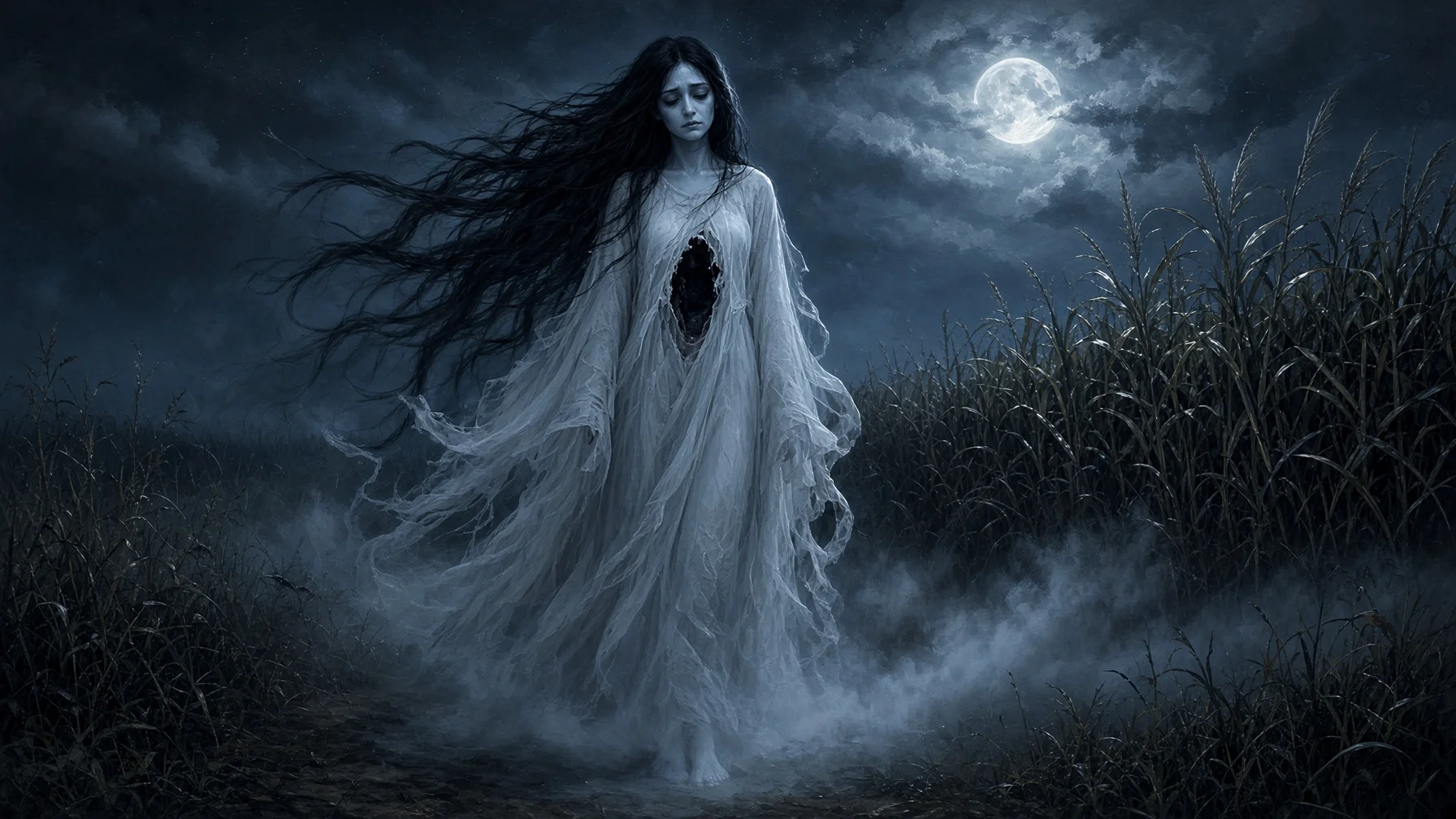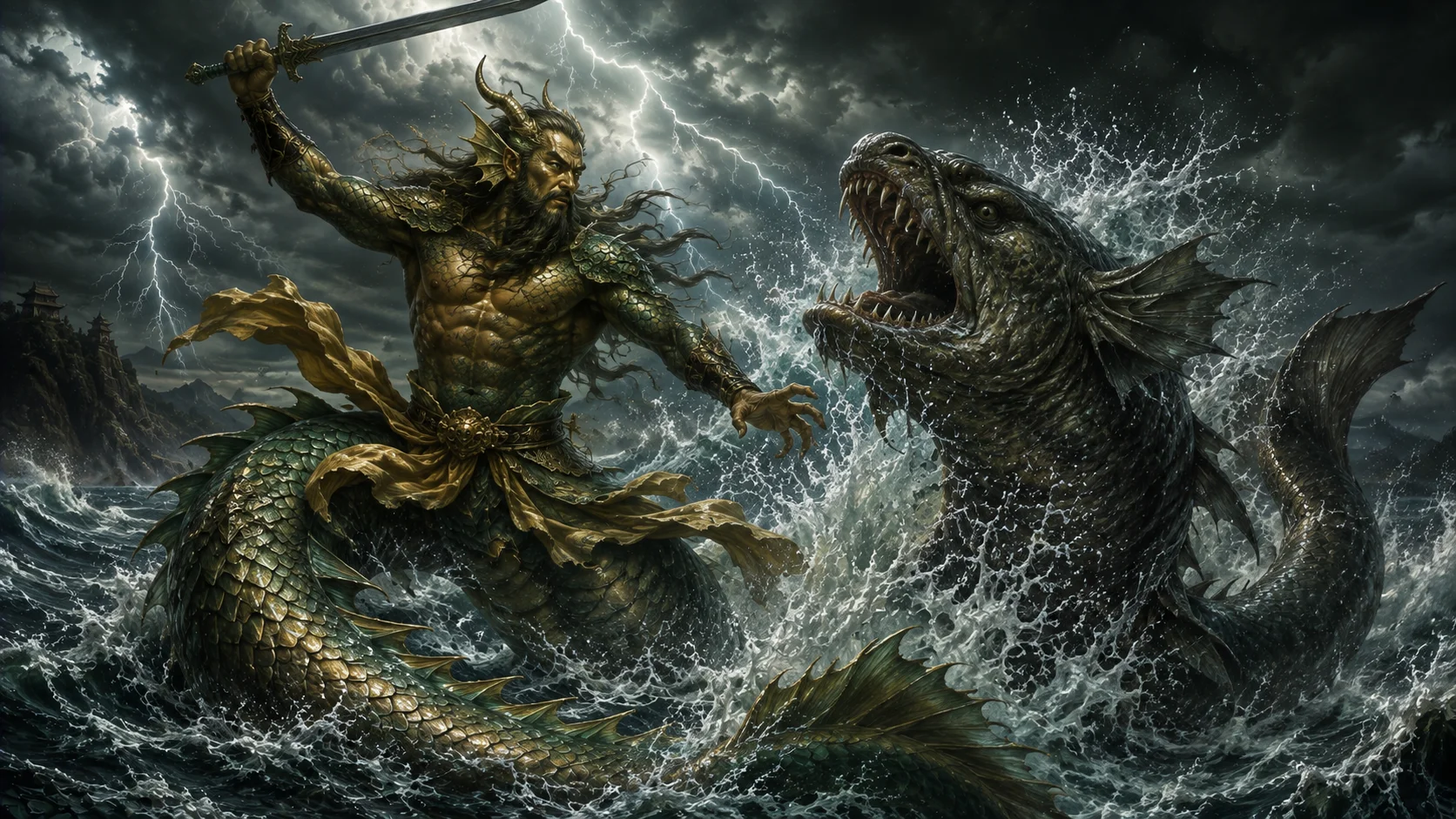
Lạc Long Quân is the dragon lord of Vietnamese foundation legend, a sovereign of water and sea whose union with a mountain fairy is remembered as the origin of the Vietnamese people themselves. Recorded in the fifteenth-century chronicle Lĩnh Nam Chích Quái ("Wondrous Tales of Lĩnh Nam"), his story sits at the root of how Vietnamese people have long understood their own beginning — as the offspring of two worlds, water and mountain, joined and then, just as meaningfully, parted.
Born of Dragon Blood
Lạc Long Quân's lineage is itself a meeting of realms. He is described as the son of Kinh Dương Vương and the daughter of the Dragon King, which makes him dragon-descended on both the paternal and maternal sides of his birth — a being suited by blood to rule the waters, seas, and rivers that the chronicle assigns to him. Where his forebear Kinh Dương Vương connects the lineage to the land, the Dragon King's daughter roots it in the deep water-realm beneath rivers and sea, and Lạc Long Quân inherits both currents at once. He governs as a water sovereign, a dragon lord whose domain is the element that Vietnam's rice-growing, river-threaded landscape has always depended upon and feared in equal measure.
The Fairy of the Mountains
Where Lạc Long Quân belongs to water, Âu Cơ belongs to height. She is remembered as an immortal mountain fairy — a tiên — descended from the lineage of Thần Nông, the Divine Farmer, and her nature is bound to mountains and highland country the way her husband's is bound to sea and river. The pairing of a dragon lord and a mountain fairy is not incidental to the legend; it is the legend's central image, two forces of the Vietnamese landscape given human, marriageable form. Their meeting and marriage stand in for a larger claim: that the peoples of the lowlands and the peoples of the highlands share one origin.
The Sac of One Hundred Eggs
From this marriage of dragon and fairy came the legend's most striking image. Âu Cơ is said to have given birth to a sac containing one hundred eggs, and from that sac hatched one hundred sons. These hundred sons are named in tradition as the ancestors of the Bách Việt, the "Hundred Việt" peoples — an origin story that accounts, in a single mythic birth, for the plurality and kinship of an entire people.
A Parting Between Sea and Mountain
The marriage of Lạc Long Quân and Âu Cơ did not remain a permanent union in the same household. According to the legend, the two eventually separated, and their hundred sons divided between them: fifty followed their mother Âu Cơ into the mountains, and fifty followed their father Lạc Long Quân toward the coastal and sea regions. This is remembered as the mythic account of why the Vietnamese highland peoples and the Vietnamese lowland peoples, despite their different terrains and customs, are held to share one ancestry.
Children of the Dragon, Grandchildren of the Fairy
This dual inheritance is carried today in a phrase still spoken of the Vietnamese people as a whole: con Rồng cháu Tiên, "children of the Dragon, grandchildren of the Fairy." The phrase compresses the legend — Lạc Long Quân's dragon nature, Âu Cơ's fairy nature, the hundred sons born of their union — into a single line of self-description, one that has outlasted the particulars of the chronicle itself.
The Eldest Son and the First Kingdom
Among the hundred sons, the eldest is remembered as the one who became Hùng Vương, first in the line of Hùng kings who are said to have founded Văn Lang, Vietnam's legendary first state. In this way the legend of Lạc Long Quân and Âu Cơ flows directly into the founding of a kingdom, anchoring the mythic origin of the Vietnamese people to the mythic origin of Vietnamese statehood in a single continuous lineage.
Tản Viên Sơn Thánh, Highest of the Mountain Spirits
The kingdom founded by the Hùng line is also the setting for other figures central to Vietnamese folk religion, among them Sơn Tinh, the Mountain Spirit. Sơn Tinh is counted among the Tứ Bất Tử, the Four Immortals of Vietnamese folk religion, and is associated with Tản Viên mountain — also known as Ba Vì — in the region of present-day Hanoi. Under the name Tản Viên Sơn Thánh, the Saint of Tản Viên Mountain, he is regarded as the highest-ranking among Vietnam's mountain and nature spirits, and Tản Viên itself is still counted among the nation's most sacred peaks, its temples maintained in his honor to this day.
The Contest for Mỵ Nương
Sơn Tinh's best-known story is his rivalry with the water spirit Thủy Tinh for the hand of Princess Mỵ Nương, daughter of the eighteenth Hùng King. Both suitors were asked to bring betrothal gifts, and Sơn Tinh arrived first bearing a rhinoceros with nine horns, an elephant with nine tusks, and a cock with nine spurs. His victory won him Mỵ Nương as his bride — and provoked Thủy Tinh's fury, since the water spirit arrived only after the marriage was already settled.
A Flood Renewed Each Year
Thủy Tinh's response to his loss was to attack, and Vietnamese oral tradition remembers the resulting battle between mountain and water as recurring rather than settled once and for all. This ongoing contest between Sơn Tinh and Thủy Tinh is widely interpreted as a mythological explanation for the annual flooding of the Red River Delta. Folklore credits Sơn Tinh with teaching local people flood-control and irrigation techniques, reflecting his role as a protector against Thủy Tinh's floods.
The Child Who Became a Giant: Thánh Gióng
A second of the Four Immortals, Thánh Gióng — also called Phù Đổng Thiên Vương — is remembered as a child-hero born in Phù Đổng village, in Gia Lâm, under the reign of the sixth Hùng King. The legend holds that the boy neither spoke nor walked until he was three years old, until a royal call went out for help against invading Ân forces. At that call he suddenly grew into a giant warrior, riding an iron horse and wielding first an iron staff and then an uprooted bamboo grove, both said to have been forged for him by the king's smiths.
Ascension at Sóc Sơn
Having defeated the invaders, Thánh Gióng is said to have ridden his horse to the top of Sóc Sơn mountain and ascended to heaven. He stands in Vietnamese tradition as a symbol of patriotic resistance against foreign invasion, and he is still honored annually at the Gióng Festival — Hội Gióng — held at the temples of Phù Đổng and Sóc Sơn near Hanoi, which UNESCO inscribed on its Intangible Cultural Heritage list in 2010.
Chử Đồng Tử and a Single Loincloth
The third of the Four Immortals, Chử Đồng Tử, comes from Hưng Yên province and is known for his extreme poverty — he reportedly owned only a single loincloth, shared with his father. When Princess Tiên Dung, daughter of the eighteenth Hùng King, came ashore to bathe, Chử Đồng Tử hid naked in the sand. She discovered him there, and, taking it as a fated union, married him against her father's wishes.
A Patron Born of the Riverbank
From this beginning, Chử Đồng Tử's legend grows into magic and commerce alike. He is said to have learned magical Taoist arts from a traveling monk named Phật Quang, receiving a magic staff and hat later used to conjure a palace overnight and to help people. His travels and market-founding activities along the Red River are reflected in his veneration as a patron of commerce and trade in Vietnamese folk religion.
Liễu Hạnh, Mother of the Realm
The fourth of the Four Immortals, and the only woman among them, is Liễu Hạnh — Princess Liễu Hạnh, or Mẫu Liễu Hạnh — a figure central to the Đạo Mẫu, or Mother Goddess, tradition of Vietnamese folk religion. She is worshipped as Mẫu Thượng Thiên, the Mother of the Realm presiding over the heavenly domain within the Tứ Phủ, the Four Palaces pantheon. Her legend holds that she was a daughter of the Jade Emperor, Ngọc Hoàng, banished to earth for breaking a jade cup, and that she reincarnated multiple times, notably as a woman of Vân Cát village in Nam Định province.
Pilgrimage at Phủ Dầy
Liễu Hạnh's worship centers on the Phủ Dầy temple complex in Nam Định, a major pilgrimage site, where the annual Phủ Dầy Festival, held in the third lunar month, honors her. Vietnamese literature and the lên đồng spirit-mediumship rituals of folk religion celebrate her as a protector of women, poets, and scholars, and remember her wit through the poetic exchanges attributed to her with the scholar Phùng Khắc Khoan.
One Chronicle, Many Threads
Lạc Long Quân and Âu Cơ, Sơn Tinh and Tản Viên, Thánh Gióng, Chử Đồng Tử, and Liễu Hạnh all derive primarily from the same textual sources — the Lĩnh Nam Chích Quái and the earlier Việt Điện U Linh Tập — key texts through which Vietnamese mythology has been preserved and transmitted. Together, these figures trace a dragon lord and a mountain fairy at the root of the Vietnamese people, their hundred sons dividing between sea and mountain, and a line of guardian spirits — of water, of war, of trade, and of the heavens — associated with the land and traditions that followed.
Sources & traditions
- EncyclopediaWikipedia — Lạc Long Quân
- TraditionVietnamese folk and village traditions
Myths change from area to area and from time to time. This chronicle follows the most widely told versions; tellings in other villages, regions and eras may differ.