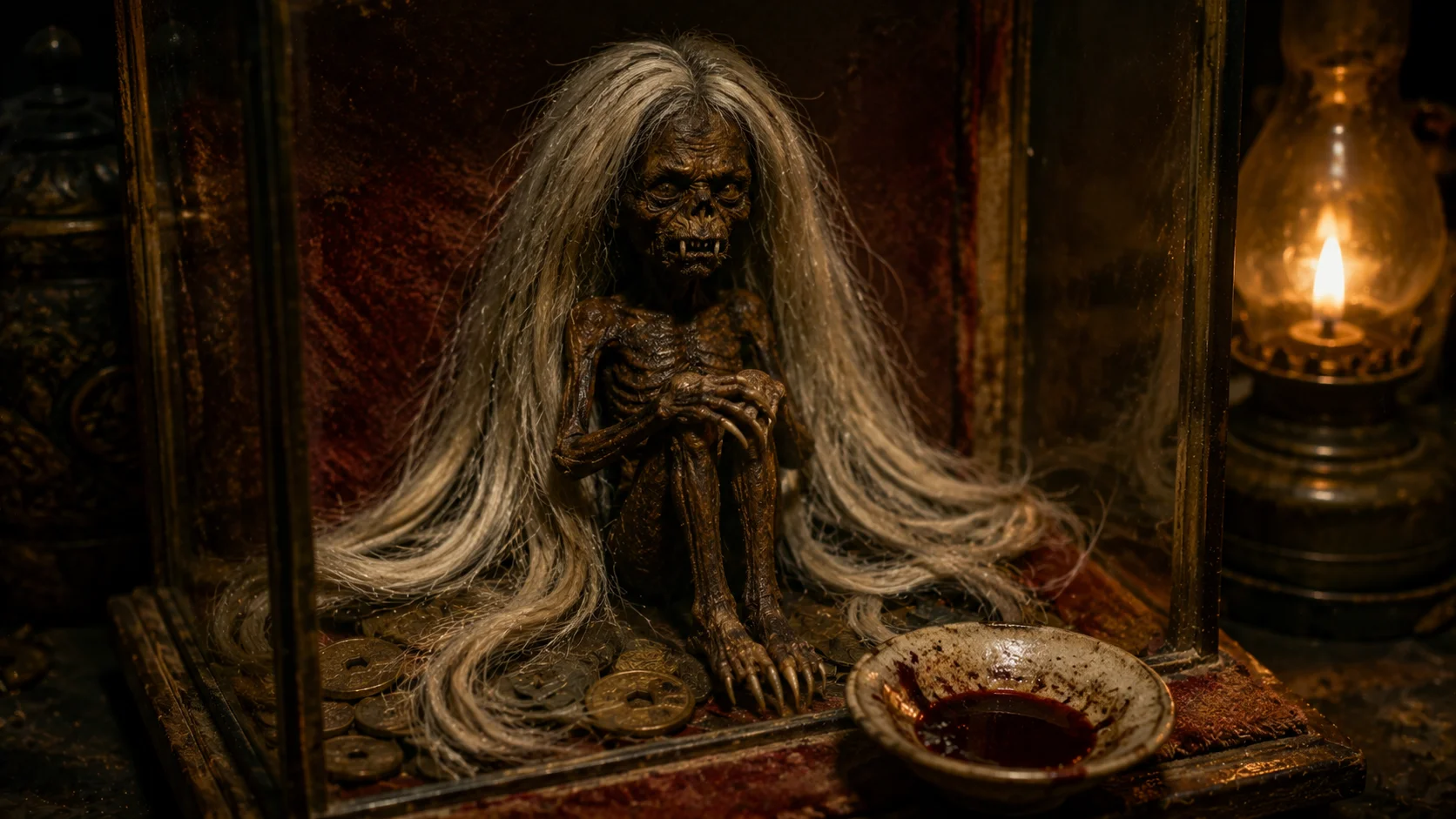
Chử Đồng Tử stands among the Tứ Bất Tử — the Four Immortals of Vietnamese folk religion — yet his legend begins not in a palace or on a sacred mountain but in the mud flats of the Red River, where a boy so poor he owned no clothes at all became, through a chain of strange mercies, a saint of commerce and the Taoist arts. His story, preserved in the fifteenth-century compilation Lĩnh Nam Chích Quái ("Wondrous Tales of Lĩnh Nam"), is unlike the others gathered under that title. Lạc Long Quân and Âu Cơ speak to the founding of a people; Sơn Tinh speaks to the mastery of flood and mountain; Thánh Gióng speaks to the defense of the realm. Chử Đồng Tử speaks to something smaller and in some ways more intimate — what happens when the lowest person in a kingdom is noticed, not punished, by the highest.
A Household Reduced to One Loincloth
Every version of the tale opens with the same unsparing image. In a village on the banks of the Red River in what is now Hưng Yên province, a father and his son lived in such reduced circumstances that between the two of them they possessed a single garment. When the father needed to appear before others, the son went without; when the son needed to leave the house, the father did the same. It is a detail almost too stark to be comfortable, and that is precisely its function in the story — Vietnamese oral tradition rarely lingers on poverty this literally unless the poverty is about to be answered by something extraordinary. The household had, by any measure available to its neighbors, nothing: no land worth naming, no surplus, not even a second piece of cloth between two people.
It is against that single stark image of shared poverty — not any single dramatic event — that the rest of Chử Đồng Tử's story has to be read. He goes on, by the tradition's account, to spend his days by the river fishing and laboring however the banks allowed, with no garment of his own, hiding by day in the sand near the water. The legend does not dwell on how this arrangement came to be beyond the poverty itself; what matters for what follows is simply that a man with nothing at all was about to be found by someone with everything.
A Princess Bathing Where a Beggar Hides
The eighteenth Hùng King had a daughter, Princess Tiên Dung. On one of her river journeys her barge came ashore near the stretch of sand where Chử Đồng Tử made his solitary life. Wanting to bathe, she had a curtained enclosure raised on the bank — and, whether by ill fortune or by a design neither of them could have guessed at the time, the very patch of sand she chose was the same patch where Chử Đồng Tử had buried himself to hide his nakedness from passing boats.
The water Tiên Dung poured over herself washed the sand away and uncovered him. The moment could easily have ended in humiliation for a penniless man discovered naked before a king's daughter — the sort of encounter that in most legal and social codes of the period would have brought only shame and punishment. Tiên Dung read it differently. Where a lesser telling would have her recoil, this one has her recognize something like fate in the collision: she took the meeting as a sign of destined union, an encounter neither of them could have engineered, and treated it as such rather than as a disgrace to be concealed or punished.
A Marriage the Palace Never Sanctioned
Tiên Dung declared that heaven itself had arranged the meeting and that she would marry Chử Đồng Tử. There was no dowry to negotiate, no rank to reconcile, nothing about the match that resembled a royal alliance in the ordinary sense — and that is exactly the point the story insists on. The marriage went forward against her father's wishes: the Hùng King had not sanctioned it, and by the standards of his court his daughter had bound herself to a man who possessed nothing, not even clothing.
Tiên Dung did not retract the marriage. The couple built a life together along the river, trading and working the water in the humble manner Chử Đồng Tử had always known. The legend treats this choice as the second proof of his worth, layered on top of the first: a king's daughter married the poorest man on the riverbank and did not undo it. It is a story that Vietnamese tradition has long read as praising loyalty and the recognition of a person's true nature over the outward markers — wealth, birth, clothing — that usually decide such things.
The Traveling Monk's Gift
Life along the river as traders gave the couple a modest sufficiency, and it was during this period that Chử Đồng Tử encountered a traveling monk named Phật Quang. Accounts differ on the particulars of the meeting, but the consistent thread is that Phật Quang taught him the Taoist arts as he passed through — not as a resident master presiding over a fixed school, but as one wandering figure who found another. What Chử Đồng Tử learned was not the swordcraft of a warrior or the statecraft of a minister, but the disciplines of a Taoist adept: meditation, the cultivation of inner power, and command over instruments of magic.
Before Phật Quang moved on, he gave Chử Đồng Tử two objects that would carry the rest of the legend: a staff and a conical hat. Ordinary in appearance, they were described as holding power far beyond their materials — tools capable of producing food, shelter, even entire structures, for anyone who used them with the right understanding. Chử Đồng Tử carried them back to the riverside life he shared with Tiên Dung, and it was there that their true nature revealed itself.
A Palace Raised in a Single Night
The most vivid image in the entire cycle belongs to this moment: Chử Đồng Tử and Tiên Dung, using the staff and the hat given to him by the monk, conjured an entire palace complex out of nothing over the course of one night. Where a fisherman's hut had stood, walls and halls and courtyards appeared by morning, populated by servants and furnishings befitting royalty — built not through labor or wealth accumulated over years but through the sudden application of a power earned through discipline and study rather than birth.
The image resonated precisely because it inverted everything the earlier chapters of the story had established. The man who once had no clothing at all now commanded a residence that rivaled the court that had never sanctioned his marriage. Vietnamese tradition has treated this overnight palace less as a claim to literal history than as a statement about what the Taoist arts, rightly pursued, were believed capable of granting a sincere practitioner — and about the reversal of fortune the story had been building toward from its very first, threadbare image.
A Patron of Commerce and Trade
Of the Four Immortals, Chử Đồng Tử is the one most closely tied in later folk religion to the ordinary business of buying, selling, and traveling for a living. That association traces directly back to the years he and Tiên Dung spent as river traders — a period that runs through the whole of the legend, from the poverty of its opening to the founding of markets along the Red River later credited to him. Communities along the river and its trading routes came to venerate him as a guardian of merchants and of the markets that grew up in places associated with his travels, a deity who understood scarcity because he had lived at its absolute floor.
This is part of what distinguishes his cult from the other Immortals. Sơn Tinh is invoked against flood, Thánh Gióng against invasion, Liễu Hạnh as protector of women, poets, and the Đạo Mẫu pantheon's heavenly realm. Chử Đồng Tử is invoked by people whose livelihoods depend on the river's traffic and the market's fortune — an unusually direct line from a specific biography of poverty and trade to the specific kind of protection later generations sought from him.
Temples on the Red River's Banks
The geography of the legend remains marked on the map of Hưng Yên province, where shrines and temple complexes dedicated to Chử Đồng Tử and Tiên Dung stand along the river associated with their story. These sites draw pilgrims and local worshippers particularly around festival days connected to the couple, when communities reenact elements of the legend and make offerings tied to prosperity in trade and household fortune. The temples function, as much of Vietnamese folk religion does, not as monuments to a closed and finished myth but as living points of contact between a community and the figures it continues to honor.
That the shrines cluster specifically along the river rather than on a mountain peak or a battlefield is itself part of the story's meaning. Chử Đồng Tử's sanctity was never bound to a single dramatic summit the way Sơn Tinh's is bound to Tản Viên; it is bound instead to the water he fished, the sand he hid in, and the trading routes he and Tiên Dung once traveled as ordinary people before either of them touched anything resembling power.
A Different Shape of Immortality
Set beside the other three Immortals, Chử Đồng Tử's path to sainthood is the most quietly radical. Lạc Long Quân and Âu Cơ are dragon and fairy by origin, already outside the ordinary run of human birth. Sơn Tinh is a mountain spirit whose contest with Thủy Tinh plays out on a cosmic scale, explaining the very flooding of the delta. Thánh Gióng is marked from infancy by a destiny that only needs a national crisis to trigger it — and it is Thánh Gióng alone, among these figures, whose story ends with a literal ascension to heaven, riding to the top of Sóc Sơn mountain once his task was done. Chử Đồng Tử has none of that built-in exceptionality, and his story does not end the same way. He begins as the poorest, least regarded person the tale can describe — a man who owned nothing and hid from sight — and rises through the sequence of a life of shared poverty, a princess's refusal to be ashamed of what fate handed her, and a teacher willing to share the deepest disciplines of his practice with a fisherman he happened to meet on the road.
It is a story, in other words, about elevation earned rather than elevation inherited or granted by a final miraculous departure — which may be exactly why Vietnamese tradition kept it alive alongside legends of dragons and mountain gods: it offered a version of sainthood built on a fisherman's patience, a princess's clear sight, and a monk's willingness to teach, rather than on conquest or a dramatic exit from the world.
Tiên Dung's Half of the Legend
It would be a mistake to read the story as belonging to Chử Đồng Tử alone. Every turning point in the legend depends equally on Tiên Dung's choices — her decision to read the encounter on the riverbank as destiny rather than disgrace, her willingness to marry against her father's wishes and remain married once she had, and her presence beside her husband when the staff and hat conjured the palace overnight. The Hùng King's daughter set aside her father's approval for a life on the water with a man who had nothing, and the legend rewards that choice as fully as it rewards Chử Đồng Tử's own. Their shared life together, trader to trader and then within a conjured palace, is the tradition's way of insisting that the story belonged to both of them equally — to the man the river had hidden and the woman who chose to see him.
A Legend Still Kept by the River
Among the Tứ Bất Tử, Chử Đồng Tử endures less as a distant cosmological figure than as a saint whose story can be walked, in a sense, along the actual banks where it is set. The shrines of Hưng Yên, the festival days observed there, and the ongoing association with trade and river commerce keep the legend tied to a living landscape rather than to myth alone. In a mythology whose other great figures preside over the founding of a people, the shape of a mountain, or the defense of a kingdom, Chử Đồng Tử's more modest claim — that the poorest man on the riverbank and a king's daughter could recognize each other as fated, and that discipline honestly earned could raise a palace from sand — has proven no less durable for its intimacy.
Sources & traditions
- EncyclopediaWikipedia — Chử Đồng Tử
- TraditionVietnamese folk and village traditions
Myths change from area to area and from time to time. This chronicle follows the most widely told versions; tellings in other villages, regions and eras may differ.