Âu Cơ is remembered in Vietnamese tradition as the fairy mother of a people, the mountain-born immortal whose union with the dragon lord Lạc Long Quân produced the founding miracle at the root of every telling of Vietnam's origin: a single sac of one hundred eggs, and from it, a nation. The chronicle survives chiefly through the fifteenth-century compilation Lĩnh Nam Chích Quái, "Wondrous Tales of Lĩnh Nam."
A Daughter of the Highland Lineage
Âu Cơ is described as an immortal, a tiên, tracing her descent from the line of Thần Nông, the Divine Farmer whose name in itself signals the deep antiquity ascribed to her origins. Where Lạc Long Quân belongs to the water — a dragon lord ruling the sea and its rivers, son of Kinh Dương Vương and a princess of the Dragon King's own court — Âu Cơ belongs to the mountains and the highlands. She is not a river spirit or a coastal guardian; she is of the peaks, of cloud and forest and the cool upper air, and that distinction is not incidental to the story. Everything that follows — the marriage, the eggs, the eventual parting — turns on the fact that these two figures represent two different Vietnams before there was a Vietnam to represent: the lowland world of water and the highland world of stone and forest, brought together for one generation and then, by necessity, drawn apart again.
The Meeting of Dragon and Fairy
The old chronicle gives little narrative ornament to how the fairy of the mountains and the lord of the sea came to marry, but the pairing itself carried enormous symbolic weight for the tradition that preserved it. It is a union of opposites in the most literal cosmological sense available to the storytellers who first shaped it — water and mountain, the two terrains that between them make up the whole of the land later called Văn Lang. Vietnamese households still speak of themselves as con Rồng cháu Tiên, "children of the Dragon, grandchildren of the Fairy," a phrase repeated for centuries as a genealogical claim that every person tracing their ancestry to this land descends from this improbable marriage between a creature of the sea and a spirit of the mountain fastness.
The Sac of a Hundred Eggs
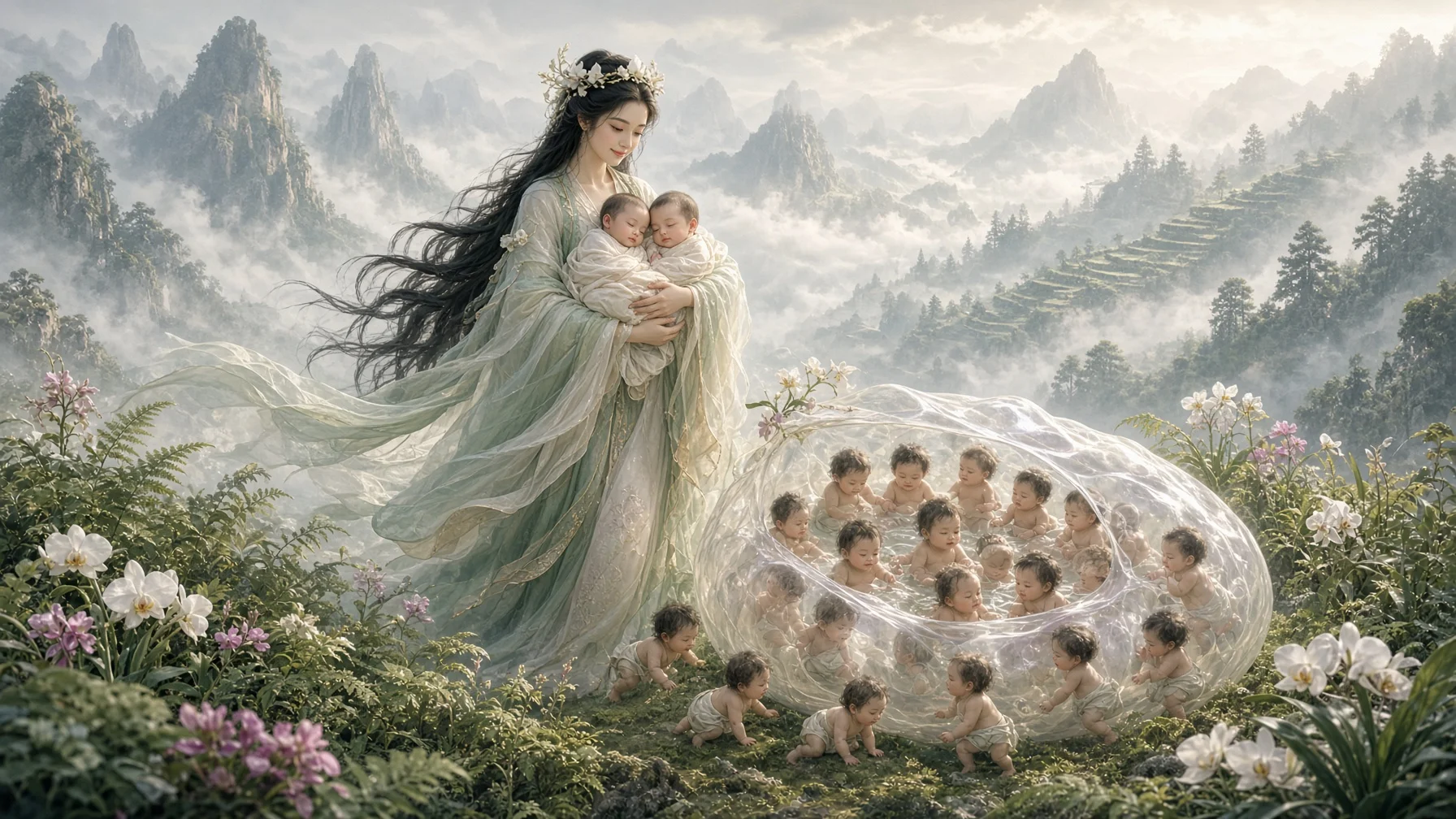
What makes Âu Cơ's story unmistakable among the world's foundation myths is the specific, almost biological strangeness of the miracle attributed to her: she did not bear a hundred children in the ordinary sense, but a single sac containing one hundred eggs, which in time hatched into one hundred sons. There is no attempt in the surviving chronicle to soften this into something more conventionally human. The number itself — a full hundred, not a round handful of heroic sons as in so many other founding legends — signals abundance on a scale meant to account for an entire people at once. These hundred sons are named, in the tradition, as the direct ancestors of the Bách Việt, "the hundred Việt," a term used historically for the related peoples of what is now southern China and northern Vietnam.
Two Realms, One Mother
The marriage between the mountain fairy and the dragon lord did not last, and the chronicle treats their separation not as tragedy but as the necessary second act of the founding story. Lạc Long Quân, the tradition says, could not remain long from the sea that was his true nature, and Âu Cơ likewise belonged to the highlands rather than the coast. And so, having raised their hundred sons together, they parted — Âu Cơ leading fifty of her sons up into the mountains, Lạc Long Quân leading the other fifty down toward the coastal and sea regions. It is a division drawn with startling geographic precision for a myth this old: not a scattering, but an exact halving, fifty and fifty, mother's line and father's line, mountain and shore. Vietnamese tradition has long read this parting as an explanation, cast in mythic terms, for the very shape of the country's population — a highland people and a lowland people who nonetheless share, in the oldest telling available, one mother and one father between them.
The Eldest Son and the First Kings
Of the hundred sons who trace their descent to Âu Cơ, one holds a place above all the rest in the historical imagination: the eldest, said to have become Hùng Vương, first in the long line of Hùng kings who founded Văn Lang, the kingdom the tradition names as Vietnam's first state. Âu Cơ is, in this framing, a matriarch in the strict genealogical sense — the woman from whom the founding king himself is said to have descended.
Mother of a Mountain People, and the Company She Keeps
Âu Cơ's decision to lead fifty sons into the highlands sets her alongside Vietnam's other great mountain figure, Sơn Tinh, the Mountain Spirit venerated as Tản Viên Sơn Thánh and honored as the highest-ranking of the country's mountain and nature deities. Where Âu Cơ gives the highland peoples their mythic mother, Sơn Tinh gives the mountains themselves a protector and a will: he is credited in folklore with teaching local people flood-control and irrigation techniques, guarding the same highland world Âu Cơ's sons settled. Sơn Tinh's own legend, in which he wins the hand of Princess Mỵ Nương away from the water spirit Thủy Tinh by arriving first with a nine-horned rhinoceros, a nine-tusked elephant, and a nine-spurred cock, and then withstands Thủy Tinh's furious, recurring floods, has long been read as a mythological account of the Red River Delta's seasonal flooding — mountain against water, echoing the same tension already built into Âu Cơ's own marriage and parting.
The Hùng Court and Its Circle of Immortals
The line of Hùng kings that Âu Cơ's eldest son is said to have founded recurs throughout Vietnamese mythology as the backdrop against which its other great legends unfold. It is under the eighteenth Hùng king's reign that Sơn Tinh competes for Princess Mỵ Nương, and under the sixth Hùng king's reign that the boy later known as Thánh Gióng is born in Phù Đổng village — a child who did not speak or walk until the age of three, and who then grew in a single day into a giant warrior to drive back invading forces, riding an iron horse and wielding, in some tellings, an entire uprooted grove of bamboo before ascending to heaven from the top of Sóc Sơn mountain. The court of the same dynasty appears again in the story of Chử Đồng Tử, the destitute young man of Hưng Yên who married Princess Tiên Dung and later learned the mystic arts that let him summon a palace overnight. That these separate legends all orbit the same royal line traces every one of them back, however many generations removed, to the mother who is said to have begun it: Âu Cơ.
The Four Immortals and Âu Cơ's Place Beside Them
Vietnamese folk religion names a specific group of four figures as its Tứ Bất Tử, the Four Immortals — Sơn Tinh, Thánh Gióng, Chử Đồng Tử, and the goddess Liễu Hạnh, the sole woman among them. Liễu Hạnh's legend holds that she was a daughter of the Jade Emperor, Ngọc Hoàng, banished to earth for breaking a jade cup, and reincarnated more than once, notably as a woman born in Vân Cát village, Nam Định province. She is worshipped as Mẫu Thượng Thiên, "Mother of the Realm," presiding over the heavenly tier of the Tứ Phủ pantheon at the great pilgrimage complex of Phủ Dầy, and is remembered in Vietnamese literature and lên đồng spirit-mediumship ritual for her wit in poetic exchanges with the scholar Phùng Khắc Khoan. Âu Cơ is not formally counted among this quartet of Four Immortals; the sources draw no further connection between the two women, and none should be assumed beyond the fact that both occupy a maternal or protective role within Vietnamese religious life, in otherwise distinct traditions separated by many centuries.
A Myth Recorded, Not Invented
It is worth remembering that Âu Cơ's story does not survive as a piece of anonymous folk drift but as a deliberately recorded chronicle, set down in the Lĩnh Nam Chích Quái alongside the earlier Việt Điện U Linh Tập, texts that a Vietnamese literate elite compiled precisely because these stories were already understood to matter to the identity of the country. The scribes who wrote these accounts down in the fifteenth century were fixing, in durable written form, a story that oral tradition had evidently been carrying for a long time before that.
The Enduring Weight of the Hundred Eggs
What has kept Âu Cơ's story alive, generation after generation, is not merely its strangeness but its usefulness as a way of holding difference and unity in the same breath. A country with highland minorities and lowland majorities, mountain villages and river-delta cities, coastal fishing communities and terraced hill farms, tells itself a founding story in which all of these separate inheritances trace back to one mother's single act of birth. The parting of Âu Cơ and Lạc Long Quân is not remembered as a family broken but as a family that spread outward to fill an entire land, fifty going up into cloud and stone, fifty going down toward tide and current — two halves of one origin, kept whole by the story even where geography and history have long since pulled them apart.
A Fairy Mother Still Spoken Of
Âu Cơ is rarely given the temple architecture and annual festival calendar that surrounds figures like Sơn Tinh at Tản Viên or Liễu Hạnh at Phủ Dầy, and her worship tends to sit within the larger reverence paid to the Hùng kings and to the idea of ancestral origin generally, rather than forming a cult built around her alone. Yet in another sense she needs no separate shrine, because she is invoked every time a Vietnamese person calls themselves a child of the Dragon and grandchild of the Fairy — a phrase carrying her hundred eggs and her long climb into the mountains forward into the present, much as the old chronicle first set it down.
Sources & traditions
- EncyclopediaWikipedia — Âu Cơ
- TraditionVietnamese folk and village traditions
Myths change from area to area and from time to time. This chronicle follows the most widely told versions; tellings in other villages, regions and eras may differ.