Of all the entities catalogued in Javanese supernatural folklore, few provoke the mixture of fascination and clinical skepticism that surrounds the jenglot. Unlike the ghosts of the wronged dead or the shapeshifting spirits that haunt old trees and abandoned houses, the jenglot presents itself as a physical object — a small, mummified, doll-sized humanoid figure, rarely more than ten to twenty centimeters long, with a fanged mouth, clawed hands, and a mane of long, often startlingly healthy-looking hair. It does not appear in the wayang canon alongside deities such as Batara Guru or heroic epics of gods and giants. It belongs instead to a much more recent and much stranger corner of Indonesian folklore: the world of paranormal collectors, faith healers, and the traveling exhibition circuit of the late twentieth century.
A Curiosity Born of the Modern Media Age
The jenglot's public story is unusually short for a figure now spoken of as ancient. It entered Indonesian popular consciousness in the 1990s and 2000s, propelled largely through television and print coverage of paranormal practitioners who displayed specimens as proof of a hidden spiritual world coexisting with the visible one. Chief among these popularizers was the paranormal figure Ki Kusumo, whose exhibitions and media appearances did more than perhaps any other single source to fix the jenglot's image in the national imagination: a shriveled, sharp-toothed humanoid, kept in a small box or glass case, said to have been discovered in caves, ancient tombs, or deep forest, and now residing in the care of a collector who understood how to keep it content.
This origin story matters because it marks the jenglot as different in kind from figures whose roots disappear into centuries of oral tradition. There is no equivalent jenglot legend recorded in the classical Javanese court chronicles, no mention in the wayang repertoire beside the panakawan or the gods of Kahyangan Suralaya, and no analog to the generations-deep agrarian ritual life that surrounds a figure like Dewi Sri. The jenglot is, by the account of its own believers, a discovery rather than an inheritance — an object unearthed, not a spirit remembered.
The Body of the Thing Itself
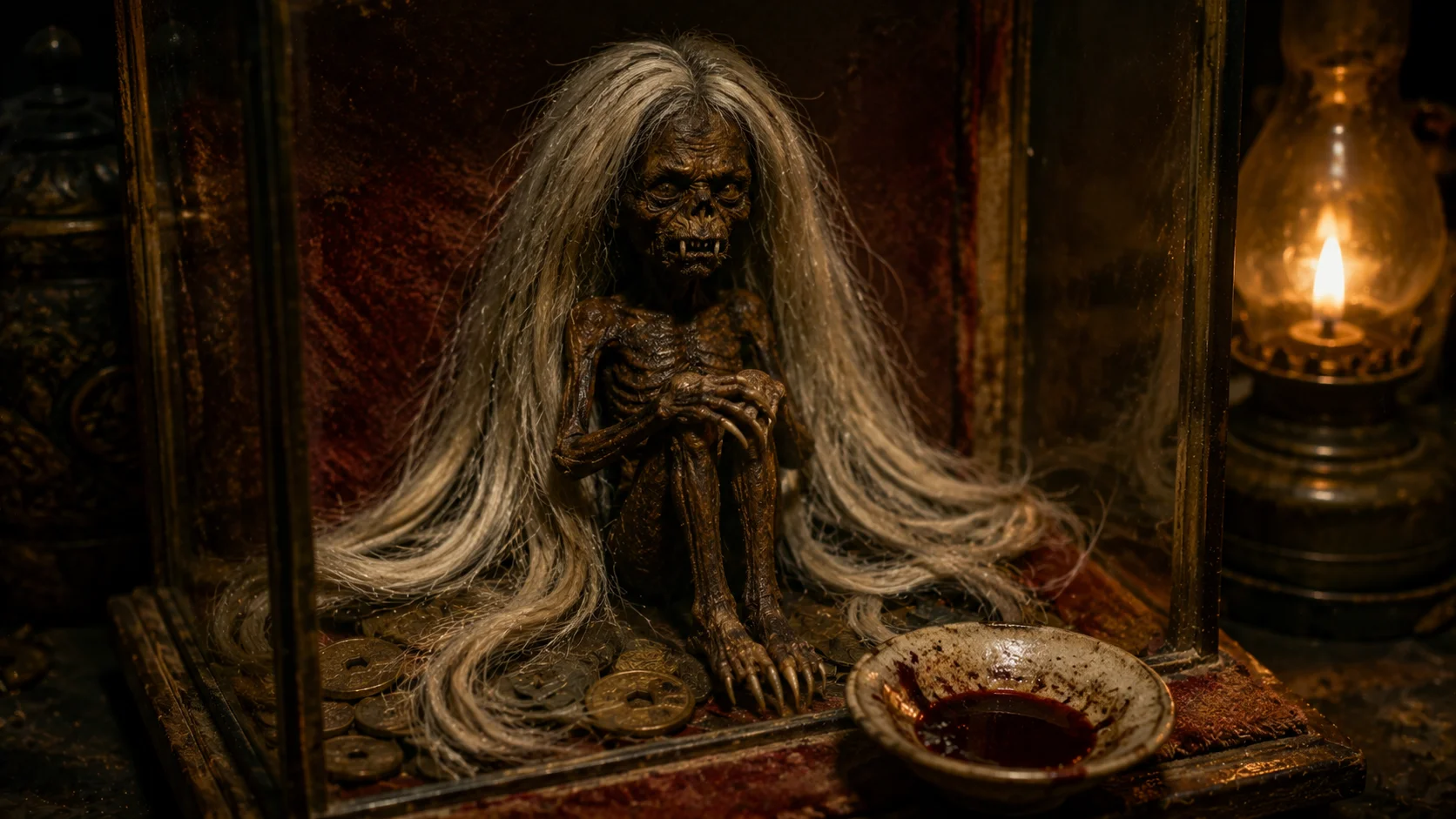
What made the jenglot so immediately compelling as a media subject was its sheer physical presence. Where a ghost story asks an audience to imagine, a jenglot specimen could simply be held up to a camera. Descriptions of the type are remarkably consistent across the exhibitions and reports that circulated during its peak popularity: a humanoid torso and head, proportioned like a shrunken adult body rather than an infant's, with a face fixed in a snarling or meditative expression, a mouth revealing two prominent fangs, and hands ending in sharp, elongated claws. The hair is the detail that recurs most often in eyewitness description — long, dark, and seemingly untouched by the desiccation that has clearly overtaken the rest of the body, lending the object an uncanny sense of continued vitality despite its mummified, leathery skin.
Believers held that the jenglot was not a carving or a preserved corpse in the ordinary sense but the shrunken remains of a person — sometimes described as an ancient meditating ascetic or spiritual practitioner — whose body had been transformed by intense spiritual discipline into this diminished, hardened form. Others described it less as a human remnant and more as a vessel: an object that housed or attracted a spirit, giving that entity a physical anchor in the world of the living. Under either account, the jenglot was never regarded as inert. It was treated as something that had to be managed, fed, and respected, not merely displayed.
Blood as Currency Between Worlds
The single most persistent claim attached to the jenglot is its need for blood. Owners and paranormal practitioners described a ritual obligation to feed the specimen periodically — most often with a few drops of human blood, though some accounts substituted flower-scented water or other offerings as a gentler alternative — in order to keep whatever resided within the object satisfied and to preserve the good fortune, protection, or spiritual potency it was believed to confer on its keeper. Neglecting this feeding was said to risk provoking the entity: bad luck, illness, or a vague sense of disturbance in the household were the typical consequences attributed to a hungry or offended jenglot.
This feeding requirement placed the jenglot squarely within a broader Indonesian folk category of objects believed to hold living spiritual power — a category that also includes certain keris blades, heirloom stones, and other pusaka understood to demand ongoing ritual maintenance rather than passive ownership. The jenglot's blood-feeding, however, was more visceral and more widely sensationalized than most heirloom customs, in part because it lent itself so well to dramatic retelling: a small, ancient, fanged thing, kept alive on human blood in a wooden box in someone's home, was a story built for the television era it emerged into.
Under the Microscope
The jenglot's claim to supernatural or ancient human origin did not go unexamined. As interest in the phenomenon grew, several specimens were submitted for forensic and scientific examination at Indonesian academic institutions, with notable rounds of analysis reported in the years around 2003 to 2007. The findings were consistently deflating for believers hoping for confirmation of an ancient mummified human. Rather than shrunken human remains, researchers who examined submitted specimens found jenglot bodies constructed from a combination of animal parts, synthetic materials, and human or animal hair fixed onto a carved base — assembled objects, in other words, built to resemble the described form rather than biological remnants of any single transformed being.
This scientific verdict did not extinguish belief in the jenglot so much as it split the phenomenon into two coexisting tracks that still run in parallel today. On one track, skeptics and researchers treat the jenglot as a manufactured curiosity — a craft object built to satisfy, and profit from, a public appetite for tangible proof of the supernatural. On the other, believers and practitioners continue to treat certain specimens, particularly those tied to specific paranormal lineages or claimed discovery stories, as genuinely potent regardless of what any single laboratory examination concluded about any single sample. The gap between these two tracks is itself part of the jenglot's cultural significance: it is one of the few Indonesian folklore figures whose existence has been directly, repeatedly, and publicly tested against physical evidence.
A Different Kind of Folklore Object
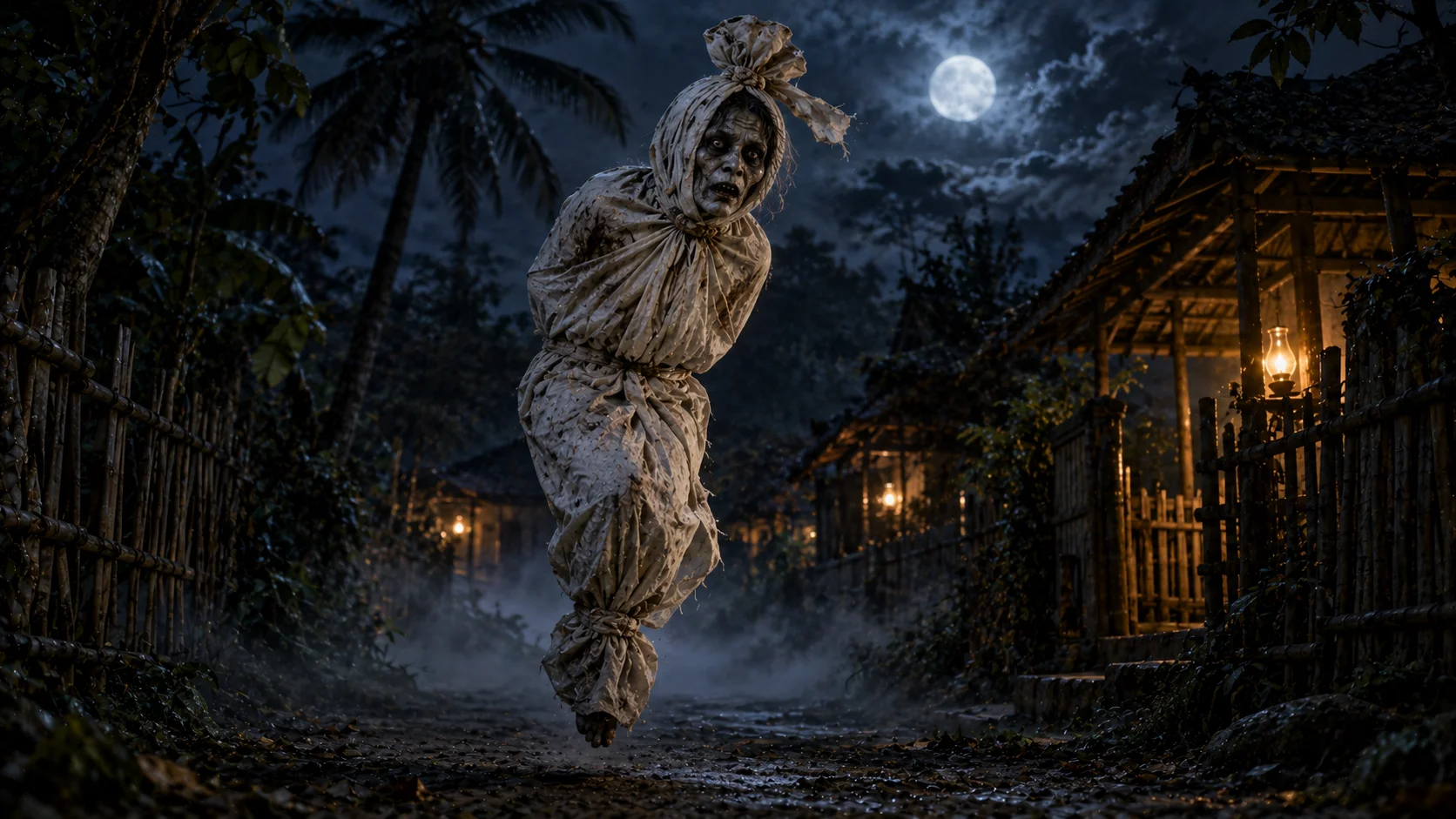
It is worth placing the jenglot beside its neighbors in the wider landscape of Javanese and Indonesian ghost lore to see how unusual its shape really is. A figure like Wewe Gombel exists as narrative and warning — a spirit whose story teaches a lesson about the treatment of children, encountered through fear and rumor rather than through a physical specimen anyone could hold. A figure like Genderuwo is likewise defined by behavior and encounter: shapeshifting, foul odor, activity on particular nights of the Javanese calendar, deterred by the scent of frangipani. Even Pocong, though tied to a very concrete physical image — the shrouded corpse hopping because its burial ties were never undone — exists as a spirit-state resulting from a ritual failure, not as an object a collector could purchase, box, and exhibit.
The jenglot breaks this pattern entirely. It is not primarily a story told about an encounter; it is a thing claimed to be in someone's possession, subject to purchase, trade, exhibition, and — uniquely among these figures — scientific testing. This is part of why the jenglot phenomenon sits at the intersection of folklore, media spectacle, and outright fraud in a way that ghost narratives generally do not. A story cannot be forensically examined. An object can.
The Collector's Economy
Alongside the belief system that grew up around the jenglot, a parallel economy of collection and trade emerged. Specimens changed hands among paranormal enthusiasts and practitioners, with claimed rarity, claimed age, and claimed potency all factoring into value in a market that operated largely outside any formal appraisal system. Exhibitions functioned simultaneously as demonstrations of spiritual authenticity and as advertising for the collectors and healers who owned the pieces on display — a dynamic that gave every party involved in publicizing a specimen a direct incentive to affirm its supernatural nature, regardless of the specimen's actual construction.
This commercial dimension is not incidental to understanding the jenglot; it is close to the center of the phenomenon. The peak of jenglot publicity coincided precisely with a period of heavy tabloid and television interest in the paranormal across Indonesia, and the jenglot's visual drama — visible, photographable, holdable — made it an unusually effective subject for that coverage compared to spirits that could only ever be described secondhand.
Belief Persisting Alongside Explanation
What makes the jenglot worth taking seriously as a subject of folklore study, rather than dismissing outright once forensic findings are known, is the durability of belief in the face of explanation. Scientific conclusions that a given specimen was assembled from animal parts and hair did little to dislodge the broader cultural habit of treating jenglot-type objects as spiritually significant. This is a familiar pattern in the study of folk belief: physical debunking of a particular artifact rarely dissolves the underlying framework of meaning that made the artifact compelling in the first place. The idea that certain objects can house or attract spiritual presence, and that such presence carries obligations — feeding, respect, careful handling — long predates the jenglot specifically and continues to shape how people interpret unusual objects regardless of any single verdict from a university laboratory.
Understood this way, the jenglot is less a hoax that fooled a credulous public and more a modern expression of a much older set of beliefs about objects, spirits, and reciprocal obligation, expressed through the particular media conditions of Indonesia in the 1990s and 2000s. The blood-feeding requirement in particular echoes broader regional ideas about maintaining relationships with unseen forces through offering and exchange, even as the specific vessel — a small mummified humanoid figure with claws and fangs — appears to be a genuinely recent invention rather than an inherited image from deep tradition.
A Figure Without Ancestors or Descendants
One of the more striking features of the jenglot, when set against the broader landscape catalogued elsewhere in this record, is its isolation. Figures such as Batara Guru or Dewi Sri sit within dense webs of related belief, ritual practice, and regional variation built up over centuries; the jenglot instead appears with no clear line of ancestry in the older textual or oral record and has generated comparatively little derivative folklore of its own. It has not become the subject of a cautionary tale in the manner of Wewe Gombel, nor tied to a royal legitimizing myth in the manner of Nyai Roro Kidul's alliance with the Mataram sultans. It remains, largely, exactly what it was when it entered public awareness: a claimed physical specimen, a set of practices around its care, and an unresolved argument between belief and forensic scrutiny.
That narrowness is itself informative. It marks the jenglot as a case study in how quickly a compelling physical object, amplified through media exposure and commercial incentive, can generate a body of belief and ritual practice that mimics the shape of much older folklore without sharing its depth of cultural embedding. Whether any given jenglot specimen is regarded today as sacred relic or crafted curiosity, its place in the record of Javanese and Indonesian supernatural belief is secure — not as an ancient figure rediscovered, but as a distinctly modern one, born at the exact moment folklore, faith, and mass media learned to feed each other.
Sources & traditions
- EncyclopediaWikipedia — Jenglot
- TraditionJavanese folk and village traditions (Indonesia)
Myths change from area to area and from time to time. This chronicle follows the most widely told versions; tellings in other villages, regions and eras may differ.