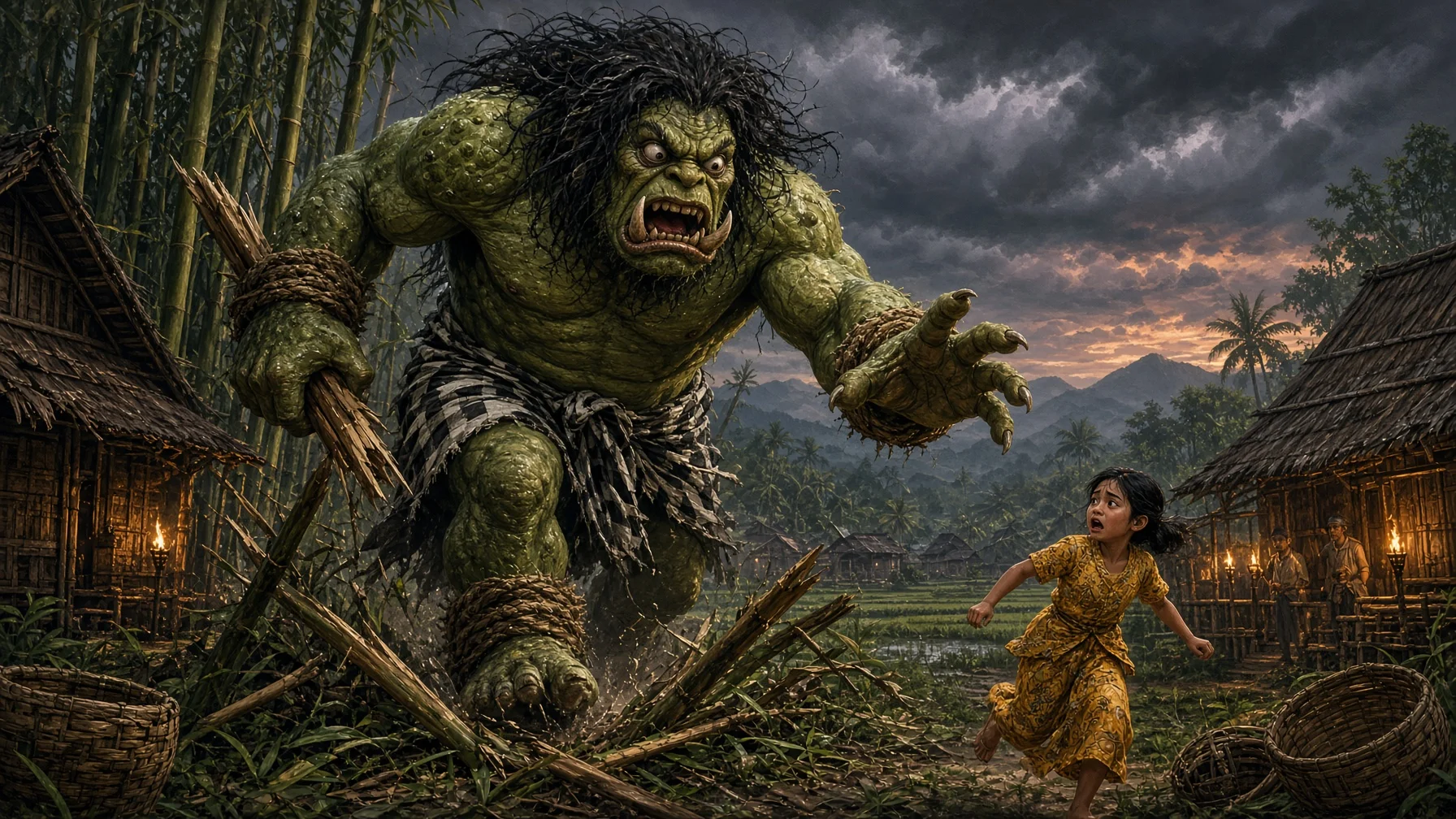
Few figures in Javanese oral tradition are as instantly recognizable to a child as the Buto Ijo — the "Green Giant," a towering raksasa whose emerald hide, jutting fangs, and bottomless hunger have made him the archetypal ogre of the Central Javanese storytelling canon. He is best known as the antagonist of the beloved tale of Timun Mas, "Golden Cucumber," where his bargain with a childless farmer sets in motion one of the region's most enduring chase narratives. But Buto Ijo is more than a single story's villain. He belongs to a lineage of buta and raksasa figures inherited in part from Hindu-Javanese demon traditions and reworked, over generations of village retelling, into a distinctly local shape — a monster who teaches, through fear, exactly what greed costs.
A Body Built to Frighten
Every detail of the Buto Ijo's appearance is designed to unsettle. His skin is the unnatural, saturated green of something that does not belong among ordinary people — neither the brown of tilled earth nor the color of any living creature a Javanese villager would meet in daylight. Storytellers describe him as huge beyond human proportion, with a jaw crowded by fangs and a voice that carries across rice terraces like a landslide. He is not merely large; he is large in the way that thunderclouds are large, a presence that changes the mood of a scene the moment he enters it.
The green coloring itself carries meaning beyond simple monstrousness. That color is thought to stand for two things at once: the giant's fundamentally otherworldly, monstrous nature, and — in some interpretations — greed or unchecked desire. A creature colored like nothing in the human world is a fitting vessel for a hunger that no human bargain can fully contain.
The Bargain That Began Everything
The Buto Ijo enters Javanese memory through a single transaction: a farmer and his wife, desperate for a child, receive a cucumber seed from the giant on the condition that when their daughter is grown, she will be given to him in return. This is the engine of the entire Timun Mas story — a debt incurred before the debtor is even born, a child's fate signed away for the promise of fertility. The girl who grows from that magical seed, Timun Mas herself, spends her whole childhood under the shadow of a promise she never made and a giant she has never met.
When the day of reckoning arrives and the farmer's family tries to delay or refuse the giant his due, Buto Ijo does not negotiate a second time. He comes to collect in person, and the quiet domestic tale of a farmer's household abruptly becomes a pursuit story, with the ogre crashing through the countryside after the very child his seed made possible.
Four Weapons Against a Giant
What makes the Timun Mas legend endure is not the giant's menace alone but the ingenuity of what defeats him. Before the chase begins, a hermit or sage equips the girl with a set of ordinary household items transformed into extraordinary defenses: cucumber seeds, needles, salt, and shrimp paste, known locally as terasi. Each is mundane on its own — the kind of thing found in any Javanese kitchen or garden — and each becomes, in the moment of throwing, a barrier that reshapes the landscape itself.
The cucumber seeds burst into a dense jungle that slows the giant's charge. The needles spring up as a bamboo forest, its sharpened stalks forcing him to hack a path through. The salt dissolves into a vast ocean he must swim or wade across, and the shrimp paste becomes a boiling lake of mud that finally traps him for good. There is a logic to this progression that Javanese audiences have long appreciated: the obstacles escalate from inconvenience to impossibility, and the girl who could not resist the giant with her own strength defeats him instead through preparation, patience, and the wisdom of an elder who saw the danger coming long before she did.
The Sage Behind the Seeds
Timun Mas does not defeat Buto Ijo alone, and the story is careful never to pretend that she does. The hermit who arms her represents a recurring figure in Javanese narrative — the wise outsider whose spiritual insight exceeds the raw power of the monster and the ordinary helplessness of the family under threat. The girl succeeds not because she is stronger than a raksasa — no child could be — but because she has been given tools suited exactly to what a raksasa cannot survive: burying, piercing, drowning, and scalding, delivered one after another with no chance to recover between them.
Roots in an Older Demon Tradition
Buto Ijo does not appear from nowhere in the Javanese imagination. Like other buta and raksasa figures in Javanese wayang, he derives partly from Hindu-Javanese demon (asura/raksasa) traditions absorbed into local Central Javanese oral storytelling. This absorption is characteristic of Javanese folklore more broadly: figures with roots in imported religious literature are reworked over time into forms that serve local village concerns, local landscapes, and local moral lessons.
Buto Ijo himself is one clear example of that pattern: a creature of appetite, ultimately defeated not by a stronger appetite but by a child's preparation and cunning.
A Debt Owed Before Birth
Look closely at the shape of the Timun Mas story and a familiar anxiety surfaces: the fear of a bargain made on behalf of someone who cannot consent to it. The farmer and his wife accept the giant's seed for their own longing — the ache of childlessness — and the cost falls entirely on the daughter who results from it. What makes this version distinct is its resolution: the child does not simply suffer the consequences of her parents' bargain, she actively unmakes it, turning the tools of an outside protector against the very giant her parents' wish conjured into being.
A Monster Sized for a Village Audience
Part of what has kept Buto Ijo alive across generations of retelling is how legible his menace is to a young audience. He does not require elaborate cosmology to understand — a green giant who wants to eat you, or take you, is a threat immediately graspable by a child hearing the story for the first time. This immediacy is precisely what makes the tale useful as it is passed down: parents and grandparents telling the story of Timun Mas are not simply entertaining children, they are rehearsing a moral architecture in miniature — a promise recklessly made, a debt that comes due, and a resourceful escape built from ordinary things used with extraordinary intention.
The Giant's Ending
Buto Ijo's story ends decisively: he is trapped in a lake of scalding mud, and the tale closes there, without ambiguity about his fate or his return. The satisfaction of that ending — greed proposed, greed indulged, and greed finally and thoroughly defeated by preparation — is part of why the story has proven so durable as something told specifically to children, where a clean resolution matters.
Green Among a Wider Cast of Ogres
Buto Ijo is not the only raksasa figure to loom over Javanese storytelling, but he holds a distinct place among them for being tied so tightly to a single, specific, still-widely-told narrative rather than existing only as a general category of threat. His identity is his role in the Timun Mas story, and that story in turn is inseparable from the household objects that undo him. This specificity is part of what has allowed him to remain so vivid: he is not an abstract embodiment of evil so much as a very particular giant, defeated by a very particular set of tools, in a story whose details children can recite because they have heard them told exactly the same way, seed by seed and obstacle by obstacle, for as long as anyone in the household can remember.
Part of a Larger Pattern
Buto Ijo sits alongside figures like Semar, Nyi Pohaci/Dewi Sri, and other beings of Javanese tradition as part of a broader pattern in which indigenous animist belief, Hindu-Buddhist cosmology, and later Islamic influence were layered together over older mythological structures. Where Semar became a servant-clown who is secretly senior to the gods he serves, and Dewi Sri's death gave rise to the rice that sustains farming communities, Buto Ijo's role in that same layered tradition is narrower and more contained: a single, memorable cautionary figure attached to a single, memorable children's story about the price of an unwise bargain.
What the Giant Leaves Behind
Long after the boiling mud has closed over him, the shape of the Buto Ijo persists in how the Timun Mas story is told and retold as a lesson about appetite, bargains, and the price of shortcuts. He is remembered wherever a promise looks too easy, wherever a story needs a figure large enough — and green enough, and hungry enough — to embody the danger of taking exactly what one is offered without asking what will eventually be asked in return. He remains, within that one story, exactly what generations of Javanese storytellers made him: the Green Giant who demanded too much, and lost.
Sources & traditions
- TraditionJavanese folk and village traditions (Indonesia)
Myths change from area to area and from time to time. This chronicle follows the most widely told versions; tellings in other villages, regions and eras may differ.