The Genderuwo is one of the most widely feared and widely joked-about spirits in Javanese folklore: a hulking, ape-like presence said to inhabit old banyan trees, crumbling ruins, and the darkened corners of houses left too long unlit. Hairy from head to foot, thickly built, and humanoid in shape, the genderuwo occupies a strange middle ground in the Javanese supernatural imagination — neither as murderous as some village ghosts nor as sacred as the great deities of the wayang pantheon, but persistent, mischievous, and dangerous in a very particular way: it desires the living, and it is willing to wear a familiar face to get close to them.
A Shape Out of the Shadows
Descriptions of the genderuwo vary somewhat from region to region, but the core image is remarkably consistent across Central and East Java: a large, broad-shouldered figure covered in coarse hair, standing upright like a man but moving with an animal's silence. Its body is said to give off a strong, foul odor that lingers in a room long after the spirit itself has gone — a trait so closely tied to it that the smell alone is often taken as a sign of its presence.
The genderuwo is usually classified among Java's non-human spirit population — beings that were never people, sharing the everyday world with humans in a way ordinary folk take as simply part of how things are. It is rarely spoken of in the same breath as gentler nature spirits; the genderuwo carries a reputation for appetite and intrusion that sets it apart.
Dwelling Places of the Unseen
Old, especially large banyan trees (pohon beringin) are the genderuwo's most famous address. Java's banyans, with their sprawling aerial roots and centuries-old trunks, have long been treated as places apart, where children are warned not to linger after dusk. Abandoned buildings, disused wells, and dark, cluttered corners of otherwise ordinary homes are also named as favored haunts. A household that lets a room sit unused and unlit for too long, in older kejawen belief, may find that something has quietly moved in.
This attachment to neglected and liminal spaces gives the genderuwo a social function beyond simple fright: it discourages the kind of household disorder and abandonment that, in a more practical sense, invites decay, pests, and accident. A tidy, occupied, well-lit home is, not coincidentally, also a home the genderuwo is said to avoid.
The Borrowed Face
The trait that most distinguishes the genderuwo from Java's other spirits is its shapeshifting — and specifically, its habit of taking on the appearance of a person's own spouse in order to seduce or trick them. Stories describe the spirit slipping into a house at night in this borrowed shape, behaving convincingly enough that the deception goes unnoticed until later, sometimes only when the real spouse returns and an unexplained discrepancy comes to light.
This particular fear — a spirit that does not attack from outside but insinuates itself into the most trusted relationship in the house — gives the genderuwo a psychological weight that outlasts simple monster stories. It is less a creature to be fought off with force than one to be guarded against through discernment, attentiveness, and the maintenance of a well-ordered household.
Friday Nights and the Kliwon Calendar
Javanese belief tied to the kejawen calendar holds that the genderuwo is especially active on Friday nights that fall on Kliwon, one of the five days of the Javanese pasaran week cycle. Malam Jumat Kliwon (Kliwon Friday night) carries a reputation across Java as a time when caution around old trees, empty buildings, and unlit rooms is traditionally heightened. Communities that otherwise treat spirit stories lightly during the rest of the week often observe a genuine seriousness around this particular calendrical convergence, lighting extra lamps, avoiding certain roads, or simply choosing to stay indoors.
The Scent That Turns It Away
Javanese folk protection against the genderuwo centers on scent, fittingly for a spirit so often identified by its own smell. The frangipani flower, known locally as kamboja, is named as a deterrent, along with incense burned in doorways or corners of a house believed to be vulnerable.
These small, practical rituals — a lit incense stick, a planted frangipani, a lamp left burning in a dark room — reflect a broader pattern in Javanese spiritual life, in which protection against the unseen is woven into ordinary domestic habits rather than treated as a separate, extraordinary practice.
A Spirit Among Spirits
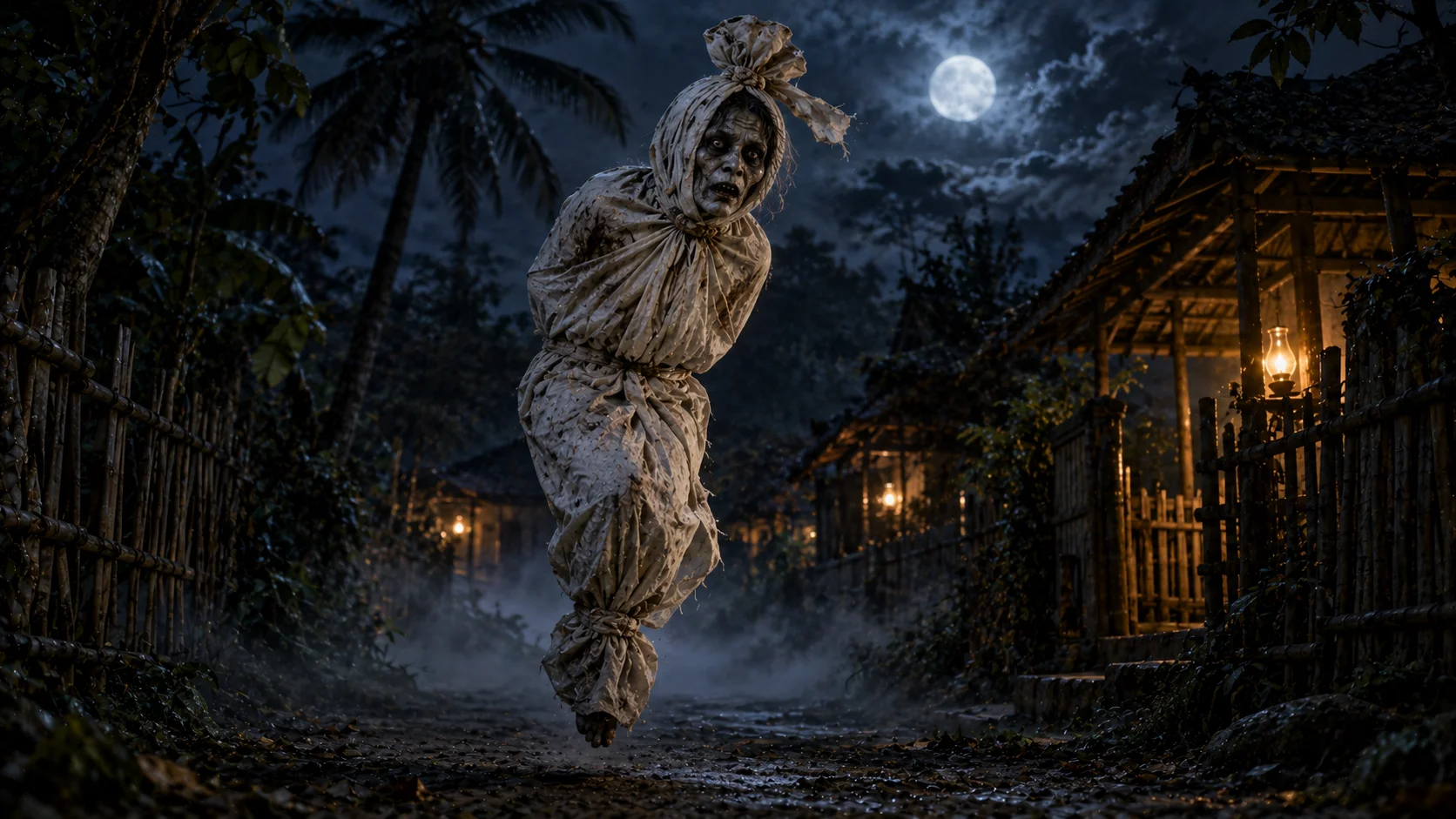
The genderuwo does not stand alone in Java's crowded supernatural landscape; it is one figure within a rich array of spirits, each with its own territory and warning attached. Where the genderuwo haunts trees and neglected houses with an appetite for the living, other Javanese spirits patrol different fears entirely. Wewe Gombel, the Central Javanese ghost of a woman who died childless or was wronged by her husband, is said to take neglected or abused children into her banyan-tree home rather than seduce adults, returning them once their parents repent. Buto Ijo, the green ogre of the Timun Mas tale, demands a human life as payment for a magical bargain. And the pocong, bound in its burial shroud because the ties were not untied in time, embodies an entirely different anxiety: not seduction or neglect, but a funeral rite left incomplete.
Beneath the Great Gods
Spirits like the genderuwo occupy a very different tier of the Javanese cosmological order than the wayang deities who rule from the heavens. At the apex of that heavenly order sits Batara Guru, the Javanese adaptation of Shiva as supreme god, enthroned atop Mount Semeru in the heavenly realm of Kahyangan Suralaya, four-armed and marked by the physical distortions that mythic tradition attaches to his union with his consort. Village-level spirits such as the genderuwo have no seat in that celestial hierarchy; they belong instead to the immediate, close-at-hand supernatural world that ordinary Javanese households navigate daily, a world felt in a smell in the dark or a familiar voice that seems slightly wrong, rather than one glimpsed in the grand cosmological dramas of the wayang stage.
The Household as Battleground
What makes genderuwo folklore endure is its intimacy. Unlike a giant ogre demanding tribute or a queen ruling a distant sea, the genderuwo's threat is domestic: it enters through the front door, wears the face already trusted, and exploits the ordinary darkness of an underlit room. This is folklore calibrated to the household rather than the battlefield or the shoreline, and its remedies are calibrated the same way — light a lamp, plant a fragrant tree, burn incense, stay attentive on the nights tradition marks as dangerous. In that sense the genderuwo functions as a kind of inverted guardian story: not a spirit that protects the home, but one whose feared intrusion teaches a family how to keep it whole.
Skepticism, Comedy, and Continuity
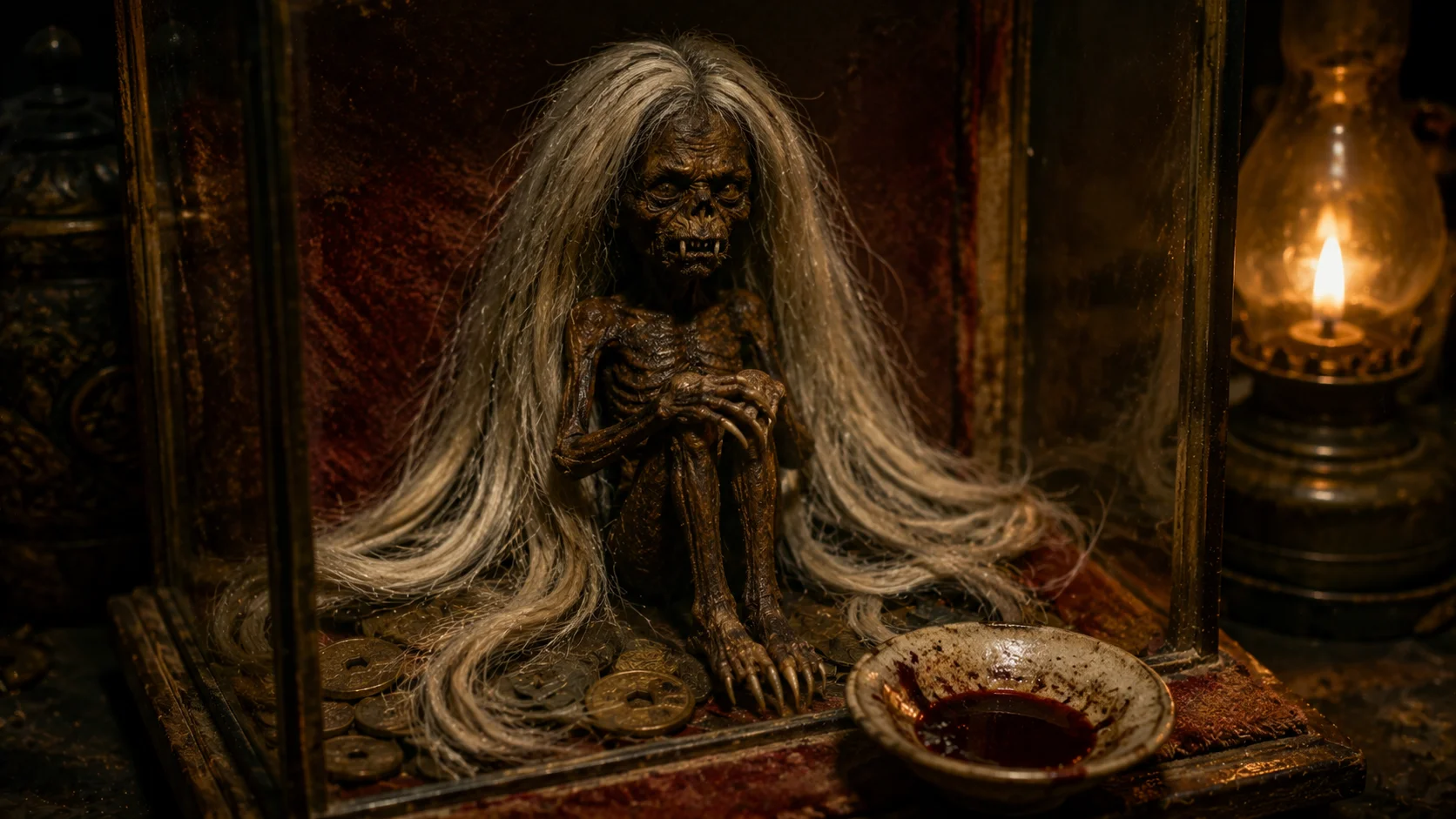
Like other Indonesian supernatural figures, the genderuwo's place in belief sits alongside skepticism, and its persistence in folk memory sits alongside modern entertainment retellings. This dual life echoes the trajectory of figures such as the jenglot, whose claimed physical specimens drew both paranormal fascination and forensic scrutiny in the 1990s and 2000s. The genderuwo has largely avoided that particular controversy, since it is understood as an unseen presence rather than a physical relic that could be examined in a laboratory, but the pattern of belief sitting alongside skepticism, and skepticism sitting alongside continued caution, is much the same.
A Living Warning
Centuries after it first appears in Javanese oral tradition, the genderuwo persists not because anyone can produce it, but because the fears it encodes — a home left dark and unattended, a spouse's trust exploited, a night when the ordinary rules seem to loosen — remain recognizable regardless of era. It survives in the instinct to keep a lamp lit past dusk, in the frangipani planted by an old gate, in the half-joking, half-serious warning passed from a grandparent to a child about what waits in the shadow of an old banyan tree on a Friday Kliwon night. That durability, more than any single retelling, is the truest measure of how deeply the genderuwo has rooted itself in Javanese memory.
Sources & traditions
- TraditionJavanese folk and village traditions (Indonesia)
Myths change from area to area and from time to time. This chronicle follows the most widely told versions; tellings in other villages, regions and eras may differ.