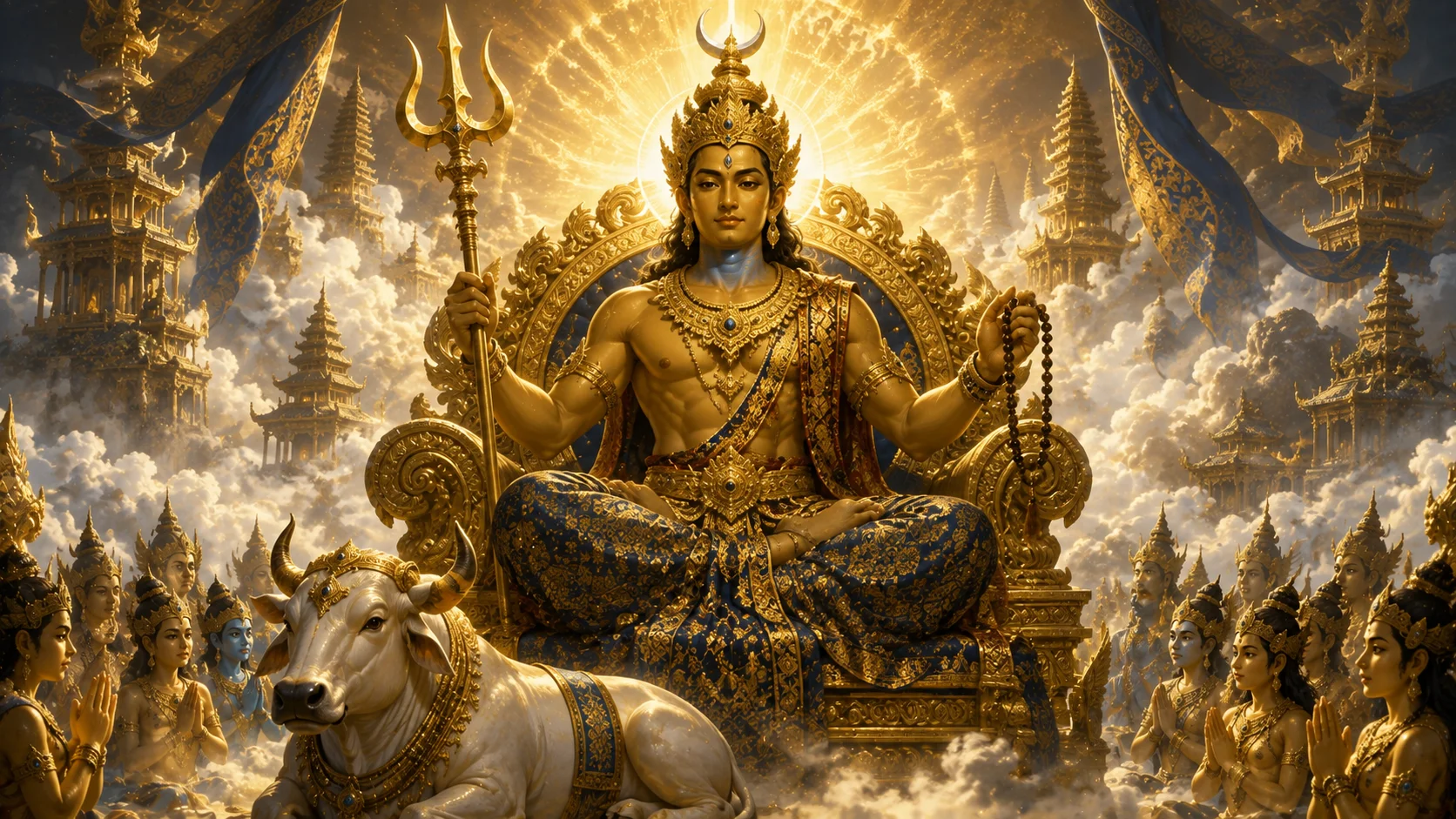
Batara Guru is the supreme god of Javanese mythology: highest deity and king of gods, the Javanese form of Shiva, lord of the heavens.
The Supreme God of Java
Batara Guru rules the heavens and presides over the assembly of gods from his throne in Kahyangan Suralaya, the celestial court said to crown the summit of Mount Semeru, the mountain the Javanese long regarded as the axis linking earth to the divine world above it. In this cosmology he is not a foreign import held at arm's length but a figure fully absorbed into local imagination: the Hindu god Shiva, carried across the sea by centuries of cultural exchange, remade in Java's own idiom until his origins mattered less than the role he came to occupy. He is addressed as father of gods and men, the one whose word sets the heavenly order in motion, and the one whose household — wives, sons, and rivalries — supplies much of the drama that Javanese storytellers still draw upon.
Shiva Remade in a Javanese Register
What makes Batara Guru distinct from his Indian counterpart is not doctrine but treatment. Where Shiva in Indian traditions carries an austere, ascetic majesty, Batara Guru enters Javanese narrative as a character with flaws, appetites, and a temper — a ruler who can be manipulated, angered, or humbled, which is precisely what allows him to anchor centuries of wayang plotting. The absorption was thorough enough that many Javanese today encounter him first through shadow theatre and only later, if at all, learn of his Shaivite root. That layering — an old god wearing new stories — is itself characteristic of how Java's religious history proceeded: successive traditions did not simply replace one another but settled on top of what came before, leaving Batara Guru positioned at the meeting point of Hindu cosmology and homegrown Javanese sensibility.
Marriage to Batari Uma and a Body Marked by Curse
Batara Guru's principal wife is Batari Uma, the Javanese counterpart to Durga, and their union is remembered less for domestic harmony than for the story of transformation it produced. Wayang tradition holds that a curse or a mythic ordeal tied to this marriage left Batara Guru physically altered — accounts describe him with four arms, and in various tellings a lame leg or a fanged, distorted face, departures from an idealized divine form that mark him as a god who has been through something, not merely a static icon of power. Puppeteers and audiences alike read these bodily marks as narrative shorthand: a god who looks perfect has no story, and Batara Guru's imperfections are precisely what give the panakawan and the wider wayang cosmos room to comment on him, tease him, and occasionally outmaneuver him.
Father to the Gods Who Govern the World
From this marriage and from his position atop the heavenly hierarchy, Batara Guru is named father to several of the most consequential deities in the wayang pantheon, including Batara Kala, Batara Brahma, and Batara Wisnu. Each of these sons carries forward a portion of his father's cosmic authority into a distinct domain, and their stories — of time, creation, and preservation — circle back again and again to Suralaya and to the judgments Batara Guru hands down as patriarch. Javanese narrative tradition treats this divine family less as a fixed genealogy to be memorized and more as a living cast, redeployed across different wayang cycles depending on which conflict or moral lesson a performance means to explore.
Lembu Andini, the Bull Who Carries a God
Batara Guru's mount, Lembu Andini, descends directly from Nandi, the bull that bears Shiva in Hindu iconography — yet even this inherited detail was given a distinctly Javanese treatment. Wayang puppet-makers adapted the bull's design and coloring to fit the visual language of Javanese shadow theatre, so that Lembu Andini reads unmistakably as a wayang creature rather than a transplanted Indian motif. The mount's presence beside Batara Guru in performance is a quiet reminder of how thoroughly Javanese artisans metabolized foreign material: they kept the association, kept the animal, and rebuilt everything about its presentation.
Dewi Sri and the Rice That Grew From a Goddess
Few figures in Java's countryside carry more everyday weight than Dewi Sri, goddess of rice, fertility, and the moon, whose presence in agrarian ritual life spans Java, Bali, Sunda, and the Osing communities of the eastern coast. The Sundanese telling of her origin, the story of Sri Pohaci, holds that Nyi Pohaci Sanghyang Asri was born from the tears or the very body of Batara Guru — in some versions instead hatched from a sacred egg laid by the heavenly serpent Antaboga — and that after she died as a young goddess, rice, coconut, and other useful plants sprang from where her body was laid to rest. It is a myth that ties the staple crop of an entire region back to celestial grief and sacrifice, giving rice cultivation a sacred weight that outlasts any single harvest season.
One Goddess, Two Names, One Living Devotion
In West Java the name Dewi Sri and the fuller ritual name Nyi Pohaci Sanghyang Sri are used almost interchangeably, though Sundanese oral tradition tends to treat Nyi Pohaci as the more complete, more reverent form of address. This is not academic hair-splitting; it reflects how communities actually speak to and about her. Traditional Javanese and Sundanese farmers historically built small shrines to the rice goddess at the edge of their fields, or set aside the last sheaf of the harvest — the pocong padi — as an offering placed in the rice barn, the lumbung, to secure her favor for the season to come. Dewi Sri is also remembered alongside her brother or consort Sadono, and the pair are commonly rendered as loro blonyo, paired wooden statues placed inside traditional Javanese homes as a standing blessing for prosperity and abundance — a devotional pairing that continues to matter to households far removed from the fields themselves.
Semar, the Servant Who Outranks the Gods
Semar stands apart from every other figure in the wayang canon because he has no origin in the Indian epics the shadow theatre otherwise draws from — he is a Javanese invention through and through, layered into the Mahabharata and Ramayana material during the long process of localizing those stories for Javanese audiences. Tradition identifies him as Sang Hyang Ismaya, elder brother to Batara Guru himself, which means the clown-servant who spends his stage life attending to mortal heroes is, by birth, senior to the supreme god of the heavens. That inversion is the entire point: Semar appears as a potbellied, dark-skinned, hermaphroditic figure of low servant status, yet Javanese audiences understand him as spiritually superior to every king and god he serves, a living embodiment of the idea that true power hides behind humility rather than announcing itself through rank.
The Panakawan and Their Quiet Authority
Semar leads the panakawan quartet — Semar, Gareng, Petruk, and Bagong — who serve the Pandawa heroes as advisors, commentators, and comic relief throughout a wayang performance. Their scenes function as release valves within otherwise weighty court and battlefield drama, but they are never merely light interludes: a panakawan sequence often carries the performance's sharpest moral or political observation, delivered through humor precisely because directness would be unthinkable coming from a servant to a king. Their relationship to Batara Guru, filtered through Semar's true identity as his elder brother, gives the entire wayang cosmos a built-in humility — a reminder, replayed in performance after performance, that heavenly rank and true wisdom are not the same thing.
Nyai Roro Kidul and the Kingdoms of Mataram
Along Java's southern coast, authority of a very different kind belongs to Nyai Roro Kidul, the spirit-queen said to rule the Indian Ocean. Javanese court legend recounts that Panembahan Senopati, founder of the Mataram Sultanate, forged a mystical marriage or alliance with her that has served ever since to legitimize the rule of his successors, the sultans of Yogyakarta and Surakarta. That bond is not treated as ancient history alone: the Sultan of Yogyakarta is said to still perform the annual Labuhan ceremony, offering items to her as tribute, a living ritual link between a reigning royal house and a spirit believed to govern the sea at its doorstep. One origin story holds that she began life as a princess, Kadita or Dewi Srengenge, cursed with a disfiguring skin disease and cast out, who threw herself into the ocean and rose from it as its ruling queen — a transformation from rejection to sovereignty that gives her cult its emotional core.
Green Clothing, Room 308, and a Coast Still Watching
Belief in Nyai Roro Kidul remains active enough to shape the built environment of the coast itself. Hotels at Parangtritis and the Samudra Beach Hotel in Pelabuhan Ratu traditionally reserve a specific room — often numbered 308 — for her, and visitors are warned against wearing green, a color said to draw her attention and carry the risk of being pulled into the surf. When the 2006 Yogyakarta earthquake and other calamities struck the south coast, some in the popular imagination — without official endorsement — read them as disturbances in her domain, a sign that this is not folklore treated as safely finished but a framework some Javanese still reach for when the sea and the earth turn violent.
Spirits of Field, House, and Shroud
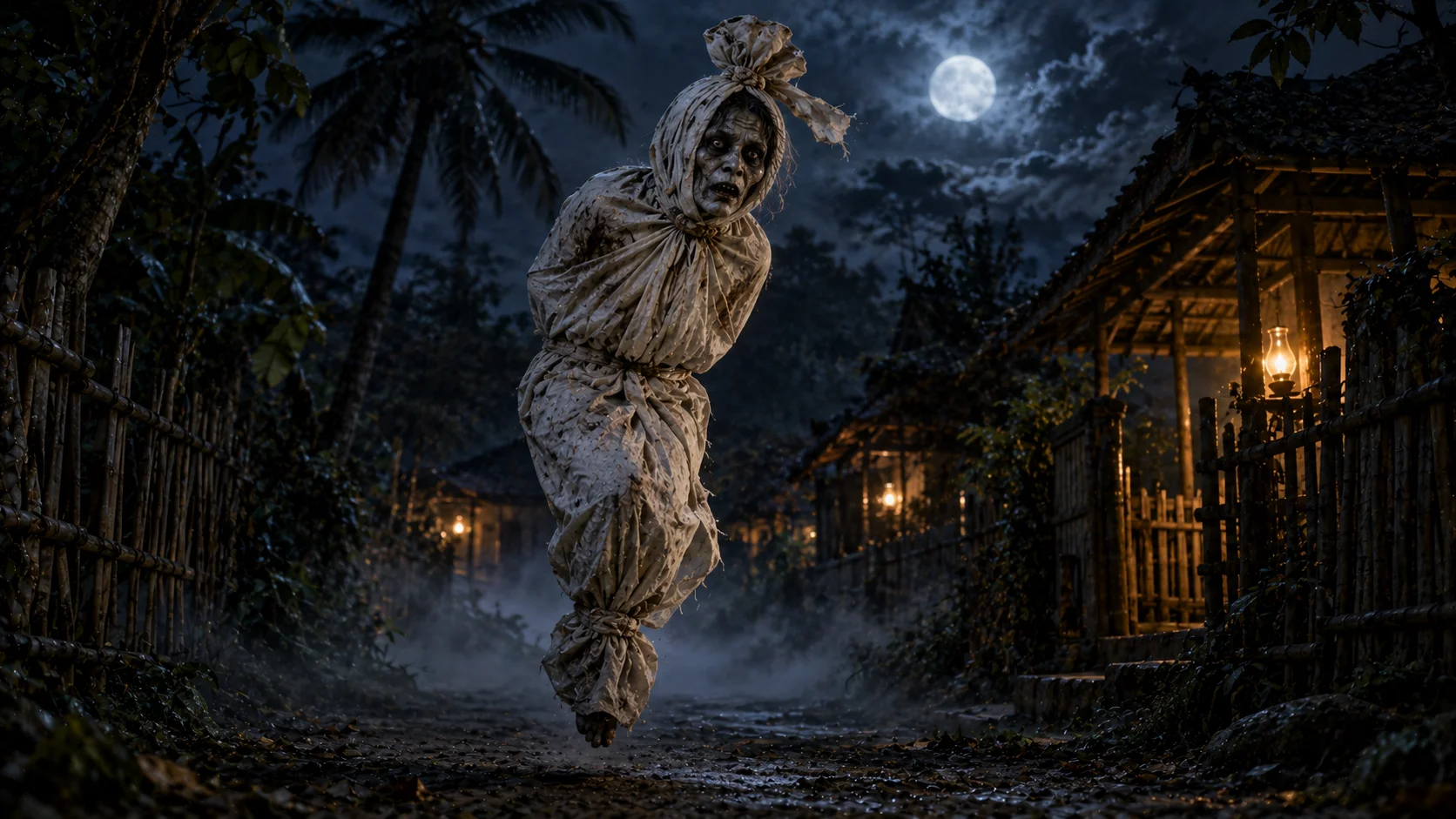
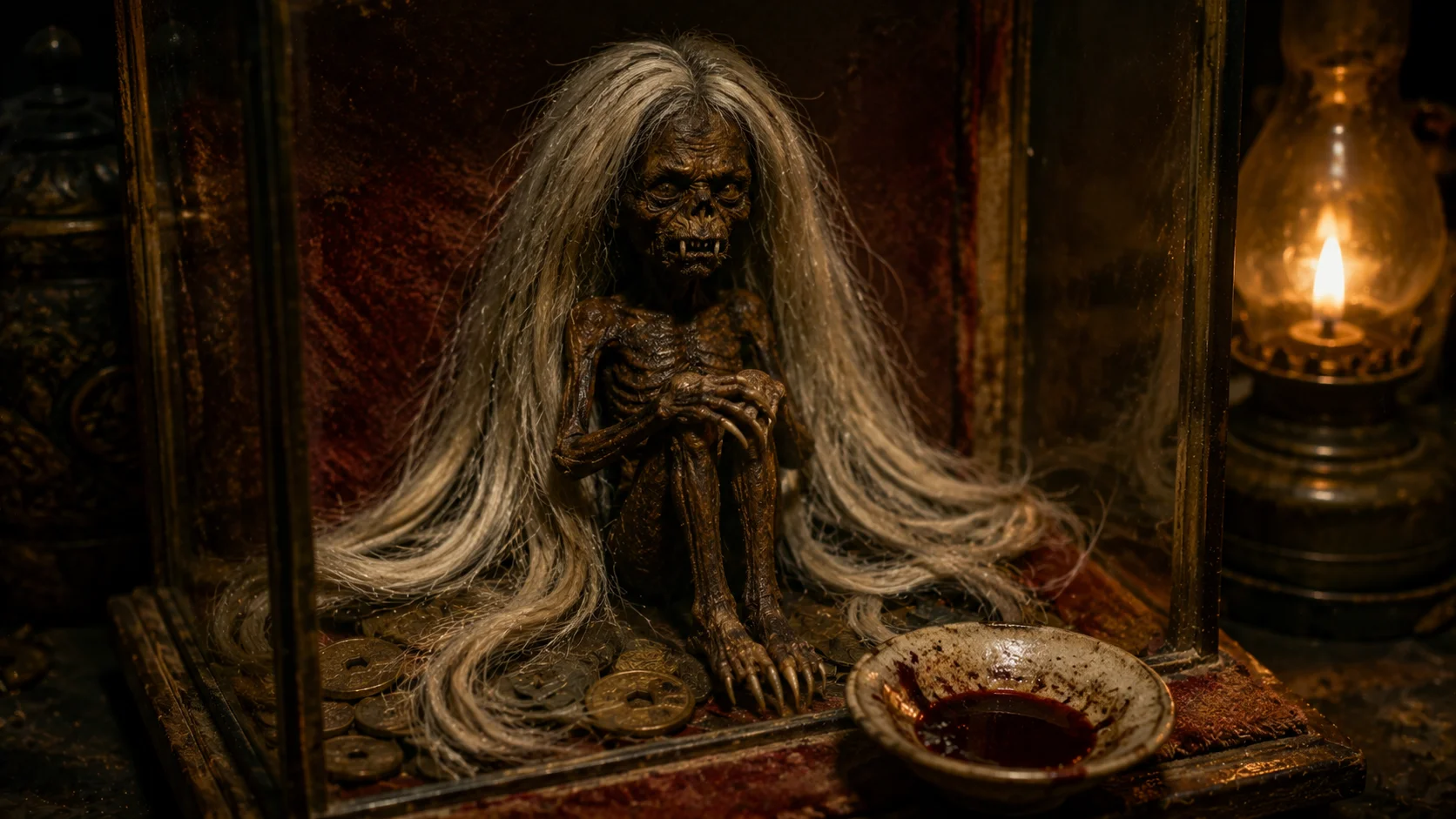
The wider Javanese supernatural landscape that surrounds Batara Guru's heavenly court is populated by figures far closer to daily life and its anxieties. Wewe Gombel, said to be the spirit of a woman who died childless or wronged by her husband, is remembered in Central Java as a figure who takes neglected or abused children into a banyan tree to care for them, returning them only once their parents repent — a ghost story built explicitly to police parental cruelty. Buto Ijo, the green ogre of the Timun Mas tale, demands a promised girl as payment for a magic cucumber seed, only to be defeated by seeds, needles, salt, and shrimp paste transformed into a field, a forest, a sea, and boiling mud. Genderuwo, a hairy and often foul-smelling shapeshifter, is said to take the form of a spouse to seduce the living, while Javanese belief holds frangipani flowers and incense can repel it, and marks Friday nights under the Kliwon calendar as its most active hour. Jenglot, publicized in Indonesian media from the 1990s onward, has been examined by forensic researchers who found several specimens made of animal parts, synthetic material, or human hair fixed to a carved base — a scientific counterpoint that has not stopped the belief from circulating. And pocong, the shrouded dead bound by burial cloth left improperly untied, draws directly on the Javanese-Islamic custom of tying and then removing three cloth strips from a corpse before burial, turning a real funerary obligation into the seed of a ghost story that still unsettles.
A Pantheon Still Spoken Of, Not Merely Studied
What runs through Batara Guru's court, Dewi Sri's rice fields, Semar's quiet superiority, and Nyai Roro Kidul's southern sea is a shared trait rare enough to be worth naming: none of it has fully receded into pure folklore. Royal ceremony, farming ritual, shadow theatre, and coastal caution all still draw, in different registers, on this same layered inheritance — Hindu cosmology absorbed, reshaped, and handed down through generations of Javanese storytellers who treated their gods not as distant abstractions but as characters worth arguing with, honoring, and occasionally laughing at.
Sources & traditions
- EncyclopediaWikipedia — Batara Guru
- TraditionJavanese folk and village traditions (Indonesia)
Myths change from area to area and from time to time. This chronicle follows the most widely told versions; tellings in other villages, regions and eras may differ.