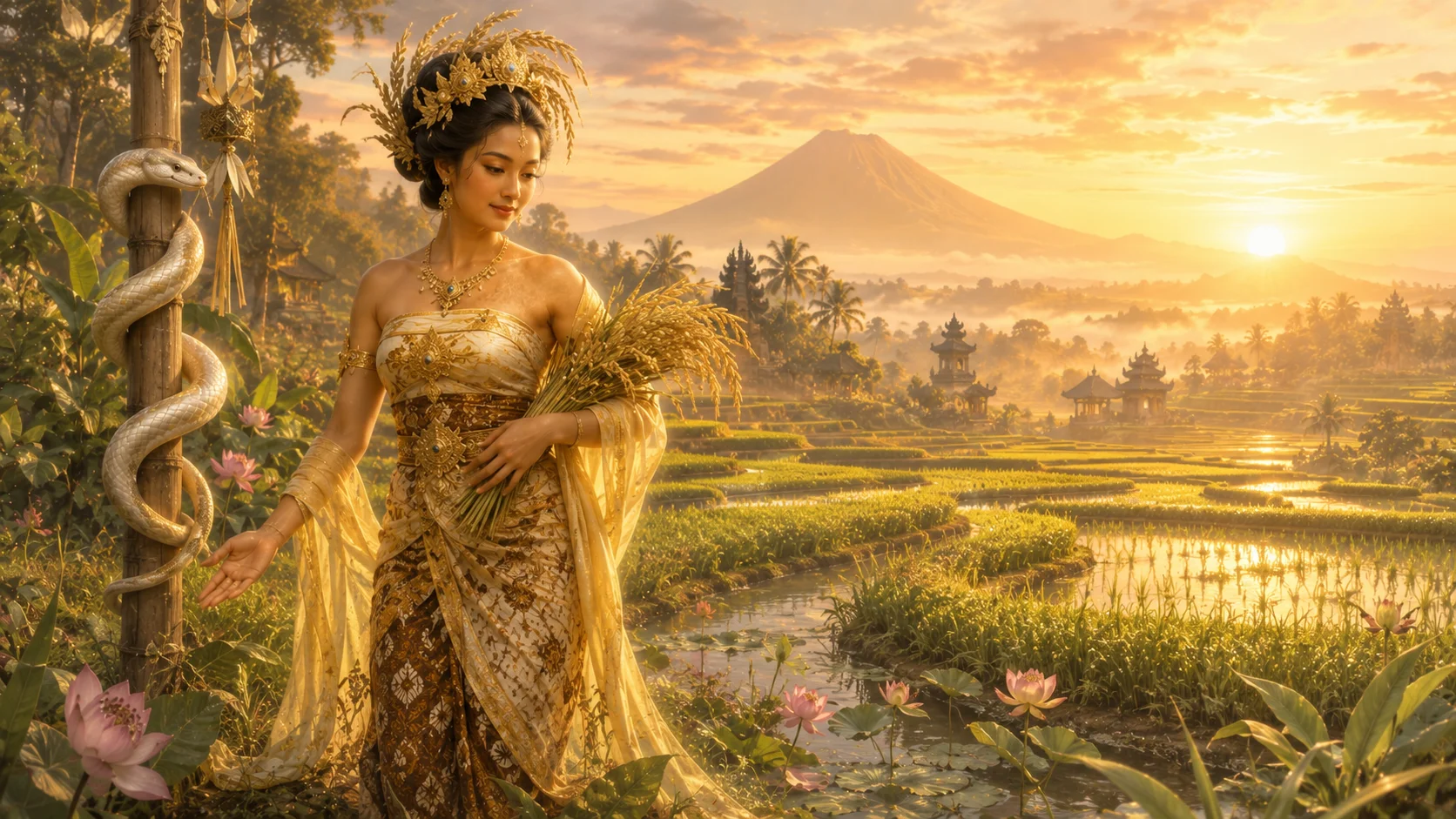
Dewi Sri is the rice-goddess of Java, Sunda, and Bali: divine mother of the rice plant, guardian of fertility and the household granary, and one of the most tenderly loved deities in the Indonesian archipelago. Long before her image was folded into the wayang pantheon beside Batara Guru and the gods of Kahyangan Suralaya, farmers across the lowlands of Java were already leaving offerings to her in the rice barn.
A Goddess Woven Into the Fields
Dewi Sri is not a distant sky-power invoked only in temple ritual; she is a presence felt in the paddy itself, in the smell of wet earth after the first rains, in the particular hush of a field just before harvest. She is goddess of rice, of agriculture, of abundance, and of the household that depends on both. Her domain includes the moon as well, tying the rhythm of planting and harvest to a wider cosmic clock that farming communities read as carefully as they read the soil.
Across West Java she is called, just as often, Nyi Pohaci or by her fuller ritual name, Nyi Pohaci Sanghyang Asri — the two names, Dewi Sri and Nyi Pohaci, used almost interchangeably for the same goddess, though Sundanese oral tradition treats "Nyi Pohaci" as the deeper, more sacred form of address, the one used inside ritual speech rather than casual reference. In Bali and among the Osing communities of eastern Java, she is likewise worshipped under the Dewi Sri and Nyi Pohaci names, and the devotion underneath those names does not diminish for the distance travelled.
Born of Sorrow, or Born of an Egg
The Sundanese myth known as Sri Pohaci gives her origin in more than one telling, and both are still repeated with equal seriousness. In one version, Nyi Pohaci Sanghyang Asri was born from the tears, or from the very body, of the great god Batara Guru himself — the Javanese name given to Shiva as he was carried into the wayang cosmology, ruler of the heavens atop the sacred mountain. In another, gentler telling favored in parts of the Sundanese countryside, she hatched instead from a sacred egg, laid by the heavenly serpent Naga, sometimes named Antaboga, coiled somewhere at the roots of the world. Farmers rarely feel the need to choose between the two stories; both point toward the same truth, that rice is not merely a crop but a fragment of divinity returned to the earth.
The Death That Fed a People
The heart of her myth, told from Java to Bali, is a story of death transformed into abundance. As an infant or young goddess, Dewi Sri died — the old tellings do not agree on how, and many leave the cause unspoken entirely. Rather than let her vanish, the gods buried her body in the earth, and from that grave grew everything a household needs to live: rice, coconut, and the other useful plants that sustain a family, all springing from her buried corpse. What might read in summary as a strange or even grim tale is, in practice, understood by the communities who tell it as the deepest possible statement of gratitude — that every grain eaten at a Javanese or Sundanese table is, in some sense, a piece of the goddess still giving of herself.
This is why rice, in these communities, was never treated as a mere commodity. To waste it carelessly carried the weight of disrespect toward a divine body, not just bad manners around food.
The Last Sheaf and the Barn Shrine
Traditional Javanese and Sundanese farming households built small shrines to Dewi Sri, or set aside the very last sheaf of the harvest — sometimes bound into a figure called the pocong padi — and carried it with particular care into the lumbung, the family rice barn, as an offering meant to keep her favor for the season to come. In some homes this practice survives even now, softened into custom rather than strict belief, but performed all the same, because a grandmother once insisted on it and no one saw the harm in continuing.
Loro Blonyo: The Rice Goddess and Her Consort
Dewi Sri is rarely imagined entirely alone. Javanese tradition pairs her with her brother, or in some households her consort, Sadono — also called Sedana — and together the two represent the twin blessings a family prays for: agricultural plenty and material wealth. Their most familiar form is the loro blonyo, a matched pair of carved wooden statues, dressed as bride and groom, placed in traditional Javanese homes for blessing. Far from being decorative antiques, these figures are understood to invite prosperity into the home simply by their seated presence.
Rice Among the Wayang Gods
Dewi Sri's story sits at an interesting angle to the grander wayang pantheon that grew up around figures like Batara Guru, ruler of Kahyangan Suralaya, married to Batari Uma and father to deities such as Batara Kala, Batara Brahma, and Batara Wisnu. Where those gods govern cosmic order, kingship, and the great moral dramas re-enacted in wayang kulit performance, Dewi Sri governs something quieter and, to a farming population, no less essential: whether the coming season's rice will fill the barn or fail the family. It is telling that in a court culture so thoroughly organized around royal legitimacy and heavenly hierarchy, the rice goddess retained her own independent devotion at ground level, in barns and kitchens rather than palace shrines.
A Goddess the Panakawan Would Recognize
The wayang tradition that carried Batara Guru and his heavenly family also gave Java the panakawan, the clown-servant quartet led by Semar — a distinctly Javanese addition layered onto the imported Mahabharata and Ramayana material, absent from the original Indian epics entirely. Semar, believed by many to be an indigenous deity in disguise, elder brother of Batara Guru himself, embodies a very Javanese instinct: that the humble, earthbound figure often carries more real power and wisdom than the gods above him. Dewi Sri's cult reflects the same instinct in a different register — a goddess whose worship happens not in the heavens but in the barn, not through grand ceremony but through the quiet placement of a sheaf of rice, and who is loved precisely because she is close rather than distant.
Rice, Ritual, and the Rhythm of the Agrarian Year
To understand Dewi Sri properly is to understand that the Javanese and Sundanese agrarian calendar was never purely practical. Planting, weeding, and harvest were bound up with a running relationship to her presence in the field. Even now, in villages where mechanized farming has changed the rhythm of the work itself, elements of this respect persist: an offering left quietly at the edge of a paddy, a reluctance to speak dismissively of the crop, a sense that the harvest is a gift received rather than simply a yield produced.
Her Place Beside the Sea Queen and the Spirits of the Land
Java's spiritual landscape holds many powerful female figures alongside Dewi Sri, from Nyai Roro Kidul, the spirit-queen said to rule the Indian Ocean off the southern coast and whose mystical alliance with the Mataram dynasty legitimized generations of Javanese kings, to more feared presences such as Wewe Gombel, the childless spirit of Central Java who is said to take in neglected children. Where those figures inspire awe tinged with fear, Dewi Sri inspires something closer to tenderness — she is prayed to not to be placated but to be thanked, and the offerings made to her look less like appeasement and more like a daughter being welcomed home each harvest season.
A Devotion That Outlasted Empires
Kingdoms rose and fell across Java — Hindu-Buddhist courts gave way to Islamic sultanates, and colonial administrations reshaped land tenure again and again — yet Dewi Sri's presence in the rice barn persisted through all of it with remarkably little disruption. Her worship required no royal patronage and no grand temple complex; it needed only a farming family, a harvest, and the instinct to treat the last sheaf of rice with care. That resilience says something the great court myths cannot: that the most enduring form of Javanese religion may not be the one performed for kings, but the one performed quietly, every season, for a goddess small enough to fit inside a barn and large enough to feed an entire people.
Living Memory in a Changing Java
Modern Java has industrialized much of its rice production, and fewer households today keep a loro blonyo pair by the door or set aside a pocong padi in the lumbung. Yet the language of respect Dewi Sri established has not disappeared so much as thinned into everyday habit — the discomfort many Javanese still feel at wasting rice, the instinctive care taken not to step over food laid on the floor, the lingering sense that rice is not quite like other things one eats. These small, half-remembered courtesies are the goddess's true surviving temple: not carved in wood or stone, but carried, almost without noticing, in the ordinary manners of a people who have not entirely forgotten why they were taught to treat their food this way.
Sources & traditions
- EncyclopediaWikipedia — Dewi Sri
- TraditionJavanese folk and village traditions (Indonesia)
Myths change from area to area and from time to time. This chronicle follows the most widely told versions; tellings in other villages, regions and eras may differ.