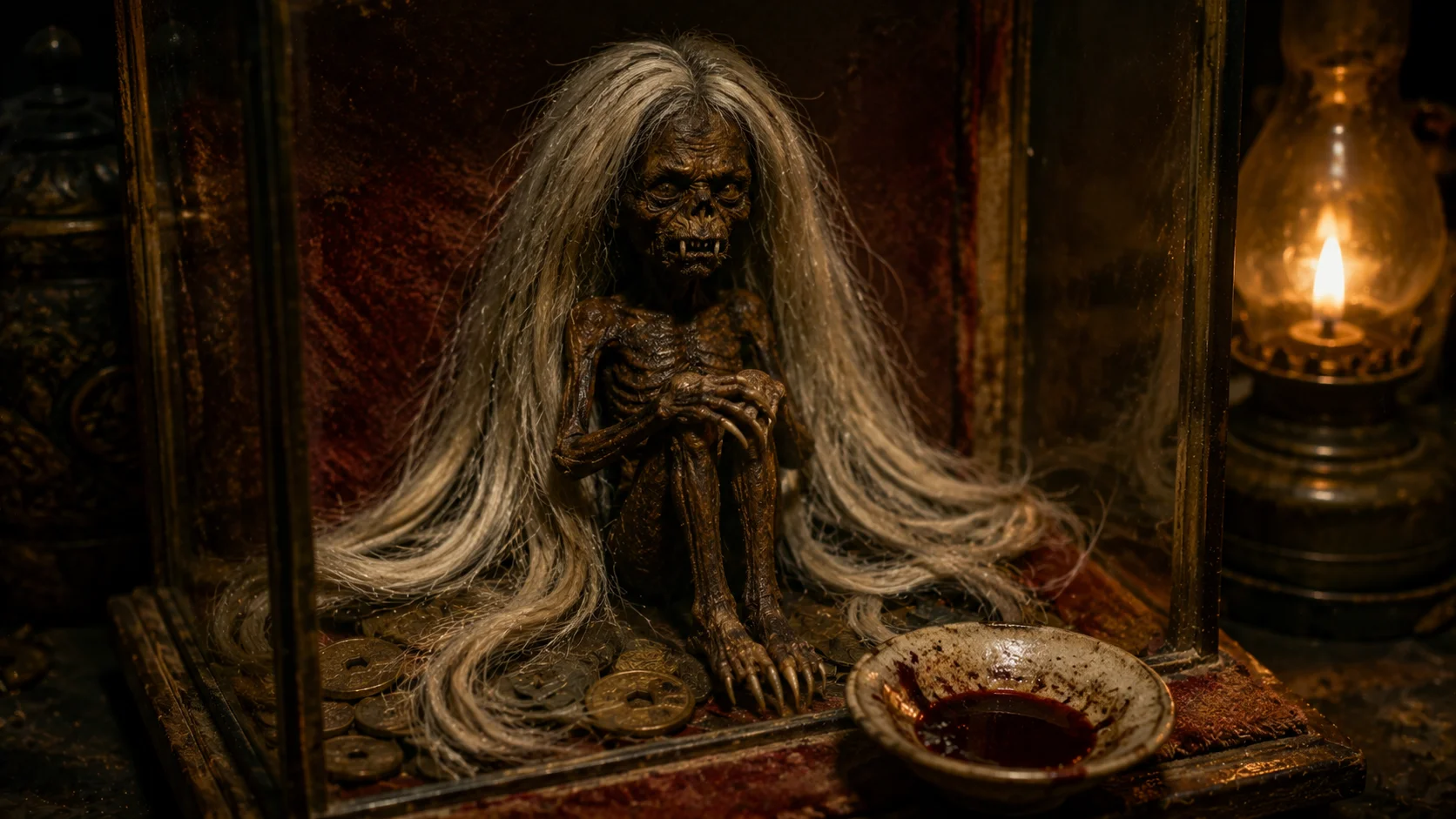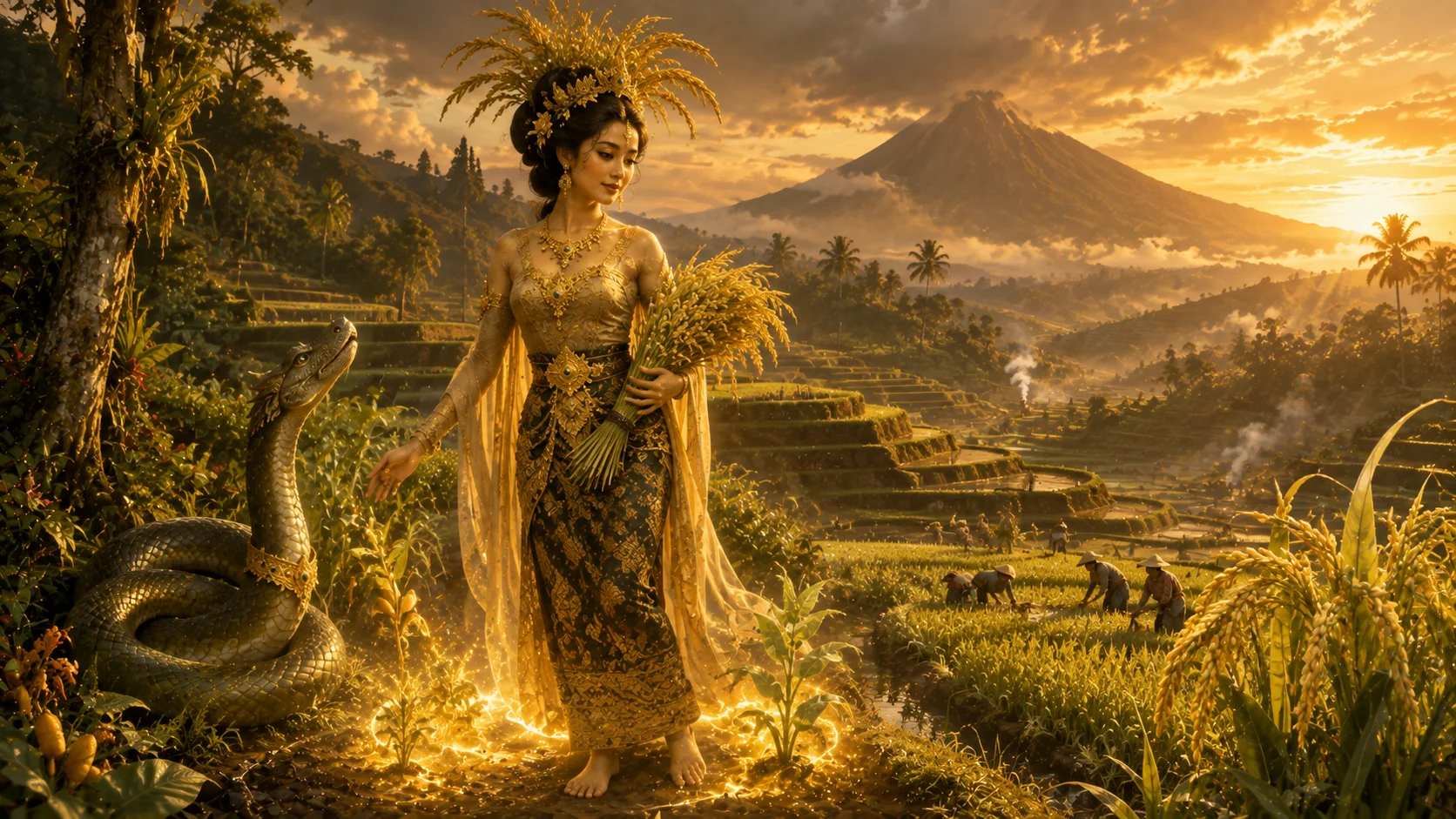
Nyi Pohaci is the name most properly given to Nyi Pohaci Sanghyang Sri — Dewi Sri, the Sundanese and Javanese rice-goddess, worshipped across the agrarian heartlands of West and Central Java as goddess of rice, fertility, and the moon. The name overlaps with another figure, too: Nyi Roro Kidul, the queen of the southern sea, is also called Nyi Pohaci in her rice-goddess aspect, even though "Nyi Pohaci" more properly refers to Dewi Sri herself. The two figures are linked in Sundanese and Javanese tradition but are not simply the same being under two names, and popular usage does not always keep the distinction clean. Whichever name is used, her presence is felt less in grand temples than in the quiet architecture of everyday village life: the small rice barn behind a farmhouse, the first sheaf set aside at harvest, the hush that falls over a field before the reaping begins.
Two Names, One Fertility Tradition
In Sundanese and Javanese cosmology, Dewi Sri and Nyi Roro Kidul both belong to the same broader fertility tradition, and the rice-goddess aspect that circulates under the name Nyi Pohaci sits at the overlap between them. Among Sundanese, Javanese, and Balinese farming communities alike, she is not a distant deity confined to myth-cycles and court literature but an active presence bound to the rice cycle itself — planting, flowering, ripening, and harvest each marked by her passage through the fields. Farmers historically addressed her directly, speaking to the rice as though it were her body still breathing in the stalks, still capable of being frightened, honored, or neglected.
This intimacy is what distinguishes her from more remote sky-gods and warrior-deities of the wider Hindu-Javanese pantheon. She is not approached through elaborate court ritual alone; she is approached through labor. The furrow, the transplanting of seedlings, the guarding of the crop against pests and drought — all of it is, in the traditional understanding, a form of relationship with her.
Born from a Teardrop of Batara Guru
The Sundanese origin text known as the Wawacan Sulanjana tells that Nyi Pohaci Sanghyang Sri was born from a single teardrop of the god Batara Guru — the Javanese name for Shiva in his role as supreme lord of the upper world. A tear is a striking origin for a goddess who will come to embody abundance: not a triumphant birth from thunder or fire, but something quiet, almost accidental, seeping from grief or overwhelming feeling into form.
The Poisoning of the Goddess
By the will of the gods, Nyi Pohaci Sanghyang Sri was poisoned and killed. The Wawacan Sulanjana gives no stated motive for this — the sources record only that the gods ordered it, not why — but it treats her death not as a tragic accident but as a decreed act, carried out so that rice, coconut, and other crops could grow from her buried body. There is something almost sacrificial in the structure of the tale: her body is not simply disposed of after death but is deliberately given back to the earth, buried so that what grows from it can feed the world she is leaving behind.
This is the turning point of the myth, and it asks something uncomfortable of the listener — that abundance is inseparable from loss, that the rice on the plate has its root in a death willed by the very powers who might have prevented it. Traditional retellings do not soften this. The poisoning is presented plainly, as the necessary hinge on which the origin of food itself turns.
Rice Grown from a Buried Body
From Nyi Pohaci's buried body, the staple crops of Sundanese and Javanese agriculture are said to emerge: rice foremost among them, along with coconut and other plants that sustain village life. Her body is dispersed into the very foods that will, from then on, keep the living alive. To eat rice, in this understanding, is to receive something that was once part of a goddess's body, freely given through death rather than through violence done by outsiders.
This pattern — a deity's death and dismemberment producing the crops that feed a people — is not unique to Java. Scholars recognize it as a widespread Southeast Asian mythic structure, known as the Hainuwele-type dema-deity motif after a similar figure in Indonesian mythology further east. That Nyi Pohaci's story shares this shape with myths told in distant island cultures suggests a deep, shared way of thinking about where food comes from: not simply grown, but given, at a cost.
The Rice Barn as Shrine
Traditional Javanese and Sundanese farmers did not leave this belief in the realm of story. They built the leuit — small raised rice barns — not merely as functional grain storage but as something closer to a modest shrine, a dwelling place suitable for a goddess whose body the stored rice was understood to still carry something of. The leuit's raised construction, keeping the grain dry and away from vermin, was practical; its treatment as a place worthy of respect was devotional.
Around this structure grew a whole etiquette of care: how rice should be stored, how it should be spoken of, how waste of it might offend the very goddess who had given her body for it. A grain of rice was never, in this worldview, only a grain of rice.
Seren Taun and the Thanksgiving Harvest
The ritual of seren taun — a harvest thanksgiving observed particularly in Sundanese farming regions — is the communal counterpart to the private reverence shown at the leuit. At harvest's end, when the fields have given up their crop, seren taun gathers the community to give formal thanks to Dewi Sri and Nyi Pohaci for the abundance received, and implicitly to renew the relationship for the season to come. It is a ceremony that treats the harvest not as a neutral agricultural outcome but as a gift that obligates gratitude in return.
These ceremonies persist in various forms into the present, carried by communities for whom rice remains not just a crop but a marker of cultural continuity — a living thread connecting present-day farming families to the mythic body from which, the old stories say, the very possibility of rice first emerged.
Semar, the Servant Who Outranks the Gods
No account of Javanese mythological imagination is complete without Semar, the central figure of the punakawan — the clown-servants of wayang kulit, the shadow puppet theater that has carried Javanese storytelling for centuries. Semar serves as advisor to noble heroes such as the Pandawa brothers, and on the surface he could not be less exalted: potbellied, androgynous in form, combining both male and female characteristics in a body that wayang audiences immediately recognize as comic rather than heroic.
Yet this lowly appearance conceals an extraordinary truth. Semar is understood, in Javanese cosmology, to be the earthly incarnation of the god Sang Hyang Ismaya — which makes him, despite his servant's station, spiritually senior to the very kings and gods he appears to serve. It is a reversal that Javanese audiences hold without contradiction: the fool on stage is, beneath the mask of foolishness, the wisest and most powerful being present.
A Uniquely Javanese Invention
Semar does not appear in the original Indian sources of the Mahabharata or Ramayana. He is a Javanese addition, woven into the imported epic material as it was absorbed and reshaped by indigenous religious sensibility. His presence is itself a kind of statement about how Java received Hindu-Buddhist civilization: not as a passive recipient copying foreign texts, but as a culture confident enough to insert its own most important spiritual figure into someone else's story and have him quietly become the wisest character in it.
Alongside Semar stand his sons and companions, Gareng, Petruk, and Bagong, and together this quartet of punakawan does more than provide comic relief between the epic's dramatic scenes. Through joke and clowning they voice folk wisdom, moral commentary, and even political criticism that would be far riskier to speak plainly through the mouths of kings and knights. Semar himself is closely tied to ngelmu, the esoteric spiritual knowledge at the heart of Javanese kejawen mysticism, and is often depicted as possessing greater spiritual power than any of the satria, the noble knights, he humbly serves.
Wewe Gombel, Who Gathers the Unloved
Javanese folklore is equally populated by spirits far removed from the dignity of Semar or the fertility of Nyi Pohaci. Wewe Gombel is among the most quietly devastating of these figures — a ghost said to kidnap children who have been neglected or mistreated, hiding them within her long, sagging breasts. Unlike many predatory spirits of the tradition, she does not harm the children she takes; she cares for them gently, in a way their own families had failed to do.
According to legend centered on Semarang in Central Java, Wewe Gombel began life as a woman — sometimes named Rara or Tuban — who died after being wrongly accused of adultery and driven from her home. In death she became a spirit bound to the forest and hill area of Gombel near Semarang, from which she takes her name, protecting abused children until their parents show genuine repentance.
The story's use in Javanese households was direct and functional: parents invoked Wewe Gombel as a cautionary tale specifically to discourage child neglect and domestic abuse, since she was said to target precisely the children whose own families had failed them. The horror of the ghost is, in this sense, inseparable from an ethic of care — a spirit story doing the work of a warning against cruelty.
Buto Ijo and the Price of a Cucumber Seed
Among the raksasa — giant ogre figures descended in part from Hindu-Javanese asura traditions absorbed into Central Javanese oral storytelling — Buto Ijo, the Green Giant, is best remembered through the tale of Timun Mas, the Golden Cucumber. In that story, Buto Ijo demands a farmer's magically-conceived daughter as payment for the cucumber seed that gave the couple their long-wanted child.
Timun Mas escapes him only through the intervention of a hermit's magical gifts: cucumber seeds, needles, salt, and shrimp paste, or terasi, each thrown behind her in flight and each transforming into an obstacle — a jungle, a bamboo forest, an ocean, a lake of boiling mud — that blocks the giant's pursuit long enough for her to survive. The green of Buto Ijo's name and depiction is often read as signifying both his monstrous, otherworldly nature and, in some interpretations, the unchecked greed that drives the whole story's conflict.
Pocong, Bound by an Untied Shroud
Where Buto Ijo belongs to the world of folktale, Pocong belongs to the more immediate world of Javanese and broader Indonesian and Malay ghost lore. Pocong is said to be the spirit of a dead person trapped within their Islamic burial shroud, the kain kafan, because the ties meant to bind it at the head, torso, and feet were never untied after burial. Javanese Islamic custom calls for family members to release these three knots before or during burial precisely to prevent this fate; folklore holds that a Pocong's spirit remains bound, unable to rest, until all three are finally released — which is also why the ghost is depicted hopping rather than walking, its feet still cinched together within the shroud.
Pocong is traditionally described as appearing in the period shortly after death, within the first forty days, before eventually disappearing — a timeline that ties the ghost directly to the mourning periods observed in Javanese Muslim communities. Both Pocong and Wewe Gombel have found new life in modern Indonesian horror cinema, which has popularized, and in the process somewhat reshaped, characterizations that were first carried through oral tradition alone.
Layers of Belief in a Single Landscape
Taken together, Nyi Pohaci and Dewi Sri, Semar, Buto Ijo, Wewe Gombel, and Pocong sketch the layered religious history of Java itself. Beneath them runs an older animist sensibility, in which rice fields, forests, and household spaces are inhabited by presences owed respect and care. Over this settled a rich Hindu-Buddhist cosmology, supplying gods like Batara Guru and demon-lineages like the raksasa. Later still came Islam, reshaping funerary custom and, with it, the shape of the ghosts believed to walk when that custom is neglected.
None of these layers erased what came before it. Instead, Javanese and Sundanese tradition folded each new influence into what already existed, so that a single village might hold together, without contradiction, a shrine to the rice-goddess whose body became food, a shadow-puppet servant who is secretly the wisest being alive, and a shrouded figure said to hop through the night until someone finally unties the knots that bind it.
Sources & traditions
- EncyclopediaWikipedia — Dewi Sri
- TraditionJavanese folk and village traditions (Indonesia)
Myths change from area to area and from time to time. This chronicle follows the most widely told versions; tellings in other villages, regions and eras may differ.