The Pocong is one of the most enduring figures in Javanese and broader Indonesian folklore: the restless spirit of a dead person, still bound inside the white burial shroud in which it was laid to rest, unable to leave the world of the living until the cloth that holds it is finally loosed.
The Ghost in the Shroud
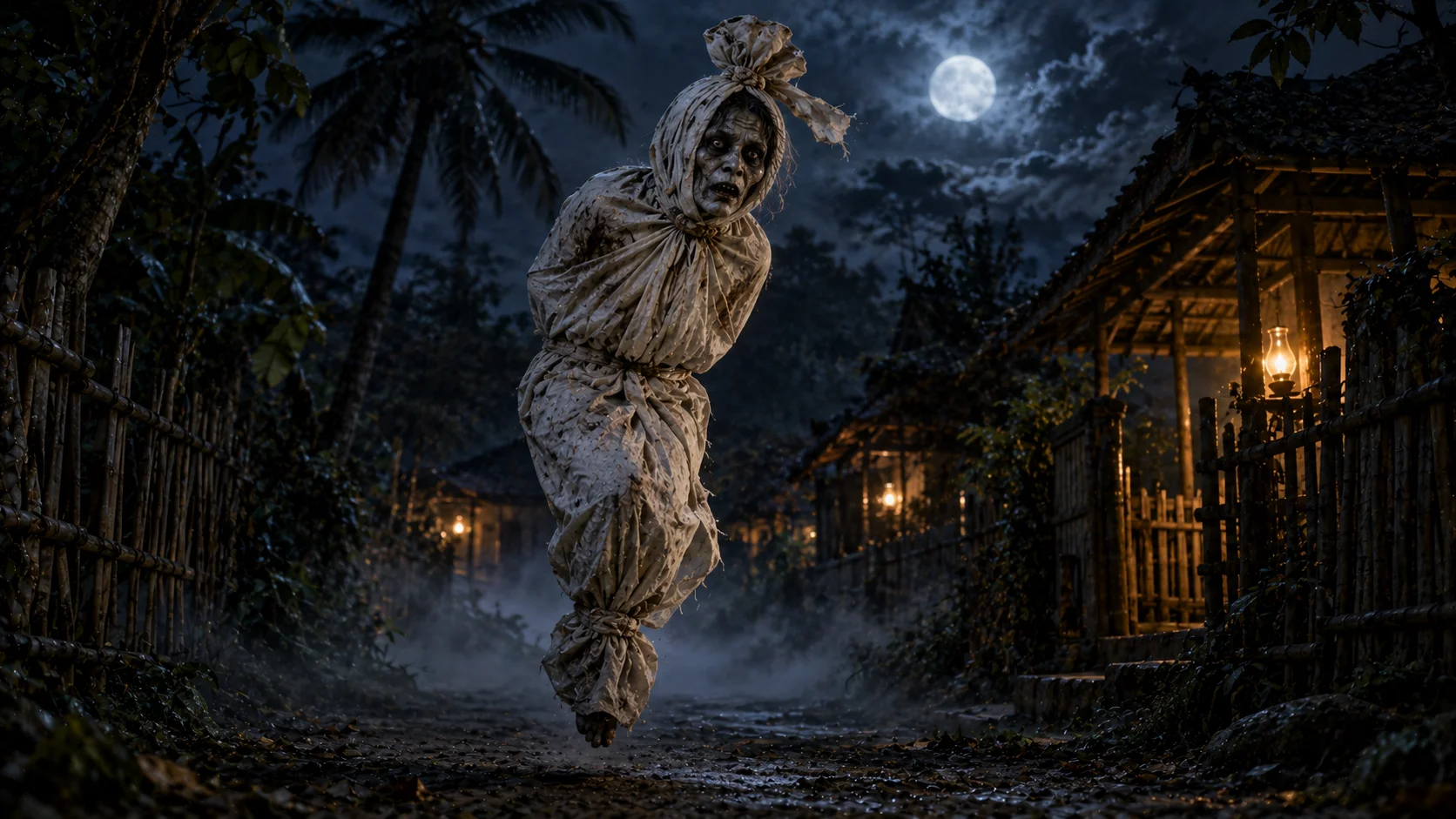
Unlike ghosts that appear as pale wandering figures or shifting shapes, the pocong has a very specific, very literal form: a corpse wrapped head to foot in kain kafan, the plain white cotton cloth used in Islamic burial across Java and much of Indonesia. Nothing about the pocong is abstract. It is a body, dressed exactly as its family last dressed it, still carrying the shape of the funeral rite that was supposed to send it onward.
In proper Javanese and Indonesian Islamic burial custom, the shroud is wound around the body and secured at three points — above the head, at the chest or waist, and below the feet — with simple ties known as simpul. These knots are never meant to be permanent. Folklore holds that they must be undone by the family within the correct ritual window after burial, so that the soul, or roh, can be released from its physical wrapping and allowed to continue on. When that step is neglected, forgotten, or performed incorrectly, the belief goes, the spirit remains fastened inside the cloth — and rises.
A Death Rite Left Unfinished
What makes the pocong distinct from many other ghosts in the regional imagination is that it is not born from a curse or a violent act alone. It is born from an omission. The pocong is fundamentally a story about ritual incompleteness: a funeral that was interrupted, a family that moved too fast or too slow, a knot that nobody thought to check. In Javanese belief this ties directly into the wider idea of roh gentayangan — wandering souls who linger among the living because something in their passage to the afterlife was left undone.
This is part of why the pocong occupies such a particular place in Javanese moral storytelling. It is not simply a figure to frighten children at night. It functions as a quiet, recurring reminder of obligation — that the living owe the dead a complete and careful send-off. Traditional practice surrounds death with a sequence of communal remembrance meals, or selamatan and tahlilan, held on the seventh, fortieth, hundredth, and thousandth day after death. The pocong myth sits comfortably alongside these customs as an expression of the same underlying value: that proper mourning and proper ritual are not optional courtesies, but responsibilities that determine whether a soul can rest.
Bound at the Ankles, Moving by Night
The pocong's most recognizable trait, told and retold in villages and city apartments alike, is the way it moves. Because the tie at the feet is believed to remain fastened even as the spirit stirs, the pocong cannot walk in any ordinary sense. Instead, storytellers describe it hopping, both feet bound together, covering ground in small awkward leaps rather than strides. It is an image that is almost comic on its surface and deeply unsettling underneath — a human shape stripped of the most basic human motion, reduced to bouncing through the dark like something newly born into a body it no longer knows how to use.
That single detail has done more than almost anything else to fix the pocong in popular memory. It gives the ghost a silhouette and a rhythm that is instantly identifiable, distinct from the graceful drifting of other spirits in the regional canon.
A Face Marked by Neglect
Where the pocong's movement is almost theatrical, its face is described in far grimmer terms. Folklore consistently paints it as swollen, discolored, blackened, or bloated — the visible signs of a body that was not properly cared for, or that has lingered too long between burial and release. This detail matters: the pocong's appearance is not simply meant to frighten for its own sake, it reflects the underlying moral logic of the myth. A corpse denied proper rites decays not only in body but in dignity, and that decay is what the living are meant to see and be moved by.
Graveyards, Empty Houses, and the Hour After Dark
Sightings in Javanese village folklore cluster around a familiar handful of settings: cemeteries, or kuburan, abandoned or long-empty houses, and the ground near a burial that took place only recently. Night is essential to nearly every telling — the pocong belongs to the hours when villages are quiet, when a lone traveler might be walking home past a graveyard wall, or when a family living near a fresh grave hears something moving outside.
These settings are not incidental. They map the myth directly onto real geography that every listener recognizes, which is part of what has kept pocong stories alive as genuine oral tradition rather than distant legend. The ghost is not said to live in some far-off mythic realm; it is said to appear exactly where a body was laid down, which is to say, somewhere ordinary and nearby.
When the Dead Come Asking
Among the more poignant threads in pocong storytelling is the tale of a spirit that returns not to terrify but to ask for help. In these accounts, a pocong appears before family members specifically to request that its shroud ties be loosened — sometimes appearing in a dream, sometimes said to be glimpsed directly near the home or grave. Once the ties are finally undone, whether symbolically or through a proper ritual performed by the correct religious figure, the spirit is believed to be released and able to depart in peace.
This version of the myth reframes the pocong less as a monster and more as a mourner still tied to unfinished business, echoing the wider category of spirits believed to persist because of a sudden, unnatural, or improperly mourned death. It is worth noting that rural custom generally treats the untying of grave shroud knots as work for a religious or traditional specialist — a modin or kyai — rather than something an ordinary family member should attempt alone. That deference reinforces the deeper cultural message running underneath the pocong myth: that death rites carry a communal and religious authority, not a private or improvised one.
A Product of Two Traditions Meeting
The pocong's identity is inseparable from the specific religious history of Java. Long before Islam reached the archipelago between the thirteenth and sixteenth centuries, Javanese belief was already populated with spirits rooted in indigenous animism, or kejawen. Islam's arrival did not erase these older frameworks; it wove into them. The pocong stands as one of the clearest products of that weaving — a ghost defined entirely by an Islamic burial practice, yet operating according to a much older Javanese logic of trapped souls, unfinished obligations, and spirits that linger when the proper order of things is disturbed.
This sets the pocong apart from other well-known figures in the same folkloric universe. The Kuntilanak, a vengeful female spirit often associated with women who died in childbirth, draws far more heavily on pre-Islamic and animist spirit belief, with comparatively little tied to formal burial ritual. The Genderuwo, a large and hairy male spirit, occupies yet another symbolic role entirely. Set beside these figures, the pocong is unusual for being so precisely anchored to a single religious custom — it could not exist, even in story, without the specific image of the burial shroud.
Neighbors in the Wider Hantu Family
The pocong is one part of a much larger taxonomy of hantu, or ghosts, that populate Indonesian and Javanese storytelling, each representing a different cause of death or a different unresolved grievance. Compilations of local ghost lore commonly place the pocong alongside figures such as the Wewe Gombel and the Sundel Bolong, each drawn from a distinct tragedy and carrying its own warning. What unites them is not appearance but function: all are ways of narrating what happens when death goes wrong, whether through violence, grief, injustice, or, in the pocong's case, an incomplete rite.
A Name Woven from the Wrapping Itself
The word "pocong" is generally traced to Javanese and Indonesian roots connected to being wrapped or bound — language that points directly at the burial cloth defining the figure. Nothing about the name is separate from the image; the ghost is, quite literally, named after the condition that creates it. That directness is part of why the myth has traveled so easily from oral storytelling into nearly every other medium Indonesian popular culture has to offer.
Color as Warning
Some tellings extend the myth with a layer of color symbolism. A pocong in plain white is generally treated as an ordinary case — a recently deceased soul still bound by ritual circumstance, unsettling but not necessarily malicious. Contemporary urban legend has added variants such as the pocong hitam, or black pocong, described as more dangerous and more feared than its white counterpart. These newer distinctions show the myth still actively growing, absorbing fresh anxieties the way oral traditions always have.
From Village Tale to Cinema Screen
Few figures from regional folklore have made as complete a leap into mass entertainment as the pocong. Beginning in the 2000s, Indonesian horror cinema turned the pocong into a recurring, even franchise-level antagonist, with a long run of films carrying its name. That cinematic afterlife has not always preserved the myth's original weight — many of these portrayals lean toward comedy as much as fear, softening a figure that began as a genuinely serious warning about ritual duty into something closer to a stock horror-movie jump scare.
Television has extended the same trend. Pocong stories appear regularly in Indonesian sinetron and in reality-style ghost hunting programs, cementing the figure as instantly recognizable well beyond anyone who grew up hearing the original village tellings. Some modern retellings have even given the pocong new tricks unknown to older folklore, including stories of it disguising itself as an ordinary person — famously, a hitchhiker asking for a ride — before revealing its true, bound form.
A Story Told Aloud, Still
For all its modern media presence, the pocong remains, at its root, a piece of oral tradition. It belongs to the same broad practice as campfire storytelling elsewhere in the world: tales exchanged during cerita horor or cerita seram sessions, late-night conversations where someone always seems to know a story about a graveyard, a recent funeral, or a knot that nobody remembered to untie. Folklore scholars generally classify the pocong within the wider cross-cultural category of the "restless dead," or revenant — a type of figure found in many traditions under many names, but given here a shape, a hop, and a set of knots that could only have come from Javanese and Islamic burial practice meeting on the same ground.
That layered origin is exactly what keeps the pocong from being a simple scare. It carries, underneath the shroud, a genuine cultural instruction: bury your dead properly, mourn them fully, and do not leave the knots for someone else to remember.
Sources & traditions
- EncyclopediaWikipedia — Pocong
- TraditionJavanese folk and village traditions (Indonesia)
Myths change from area to area and from time to time. This chronicle follows the most widely told versions; tellings in other villages, regions and eras may differ.