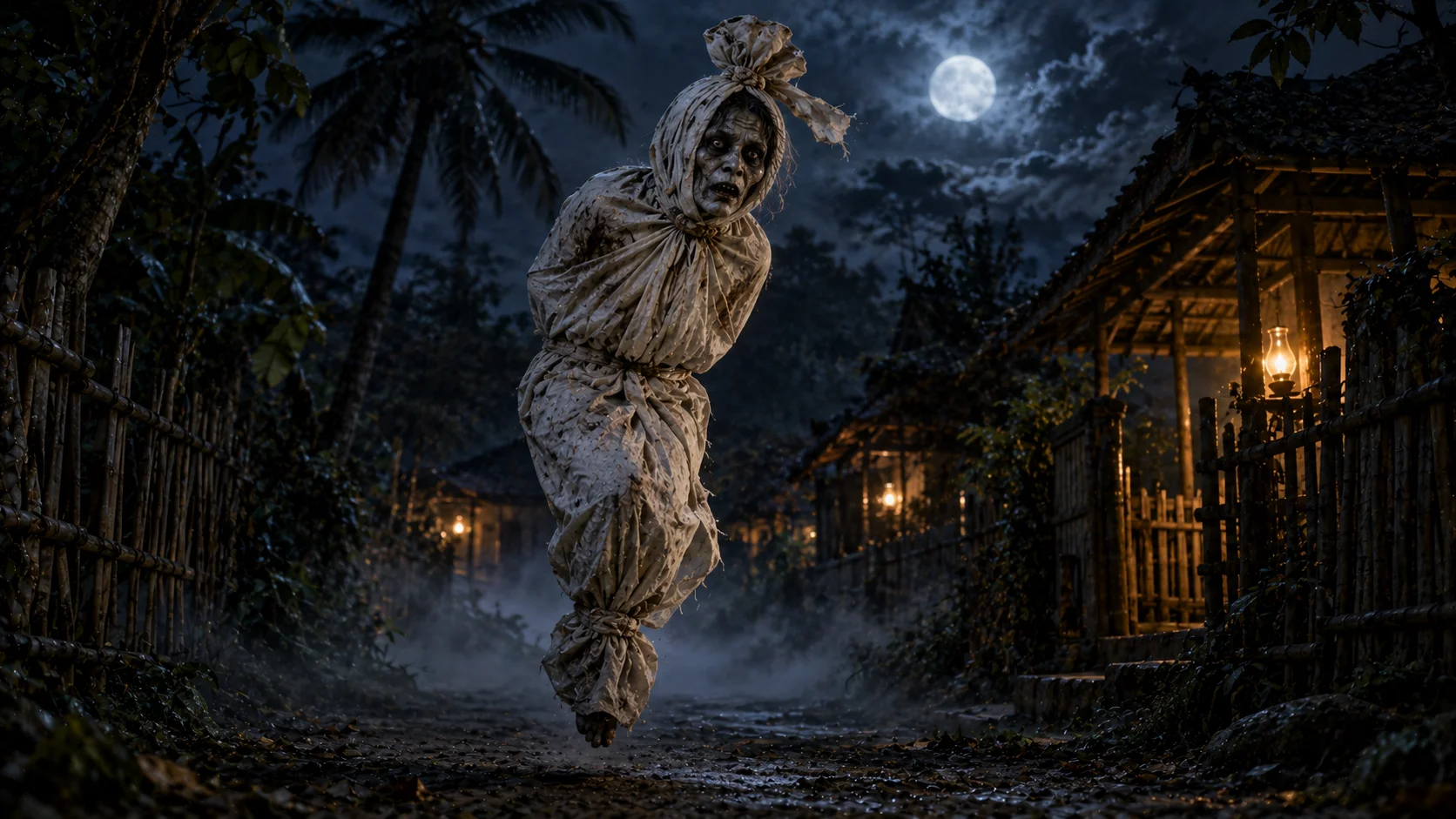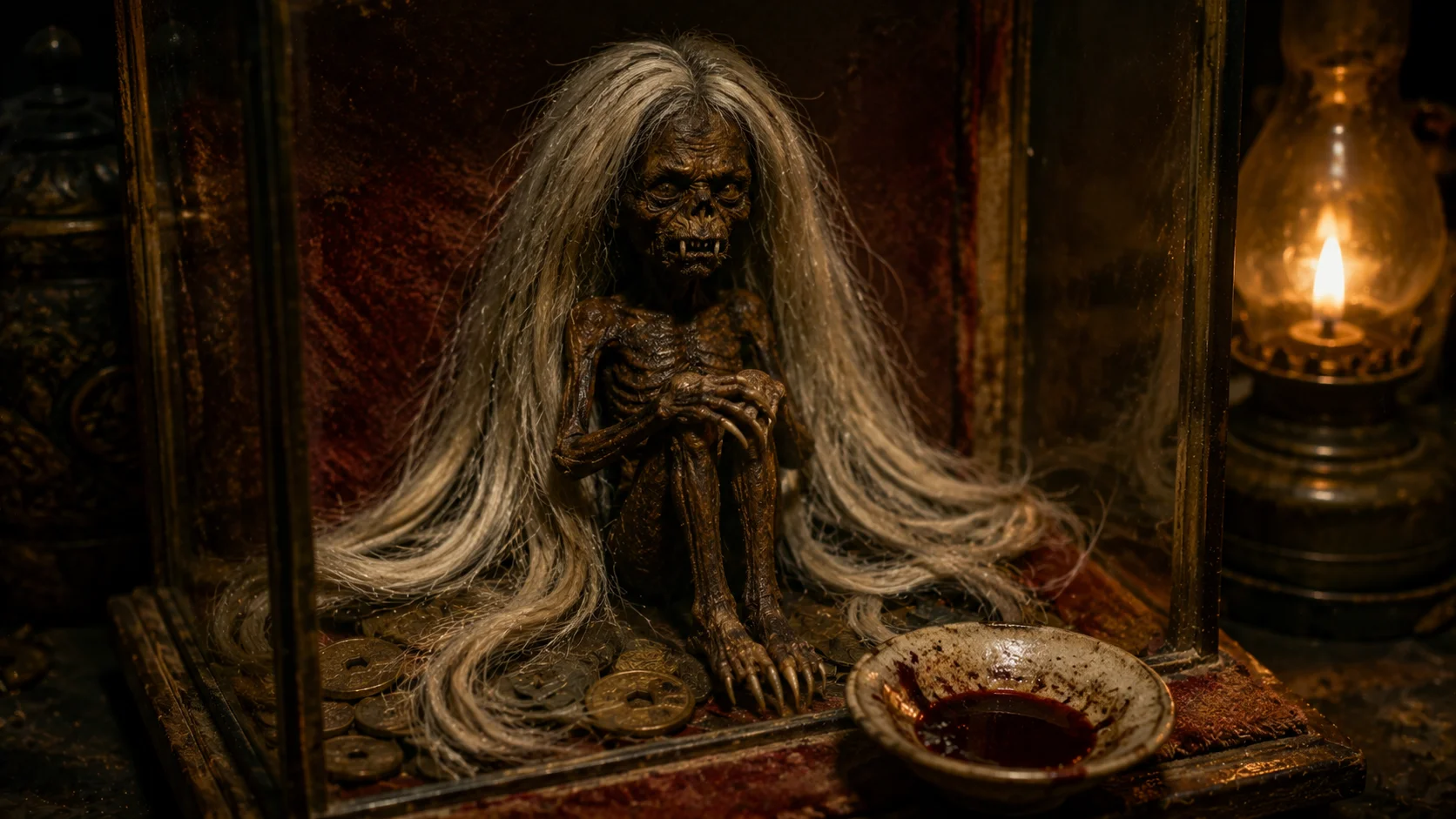
The Sundel Bolong is one of the most feared and most pitied ghosts in Javanese and broader Indonesian folklore: a woman of startling beauty, her hair loose and flowing to her waist, wrapped in a white burial shroud that she uses — carefully, deliberately — to conceal the one detail that gives her away. Between her shoulder blades, or low across her back, there is a hole. Through it, in the tellings that do not flinch, an onlooker can see her spine, or the pale glimpse of organs that should never be visible from outside a living body. She is beautiful from the front and unbearable from behind, and that single design of her haunting — loveliness concealing ruin — has made her one of the enduring figures of Indonesian horror for over a century of oral storytelling and more than four decades of film.
A Name Built From Shame and Wound
Her name is not poetic by accident. Sundel is a coarse, derogatory Javanese and Indonesian term historically applied to women in sex work, and bolong simply means "hole" or "perforated." Strung together, the name translates roughly to "the hollow-backed harlot," a title that was never meant kindly even in the ghost's own legend. That the name itself carries an insult is part of what folklorists find significant about her: she is a spirit defined, from the very first syllable of what people call her, by social judgment rather than by anything she did as a ghost. The cruelty embedded in the name predates any haunting — it was already there in how her community spoke of women like her while they were alive.
The Hole Between the Shoulder Blades
Every regional variant agrees on the central image even when the backstory shifts: a hole in the body, usually at the upper back, sometimes lower, through which the horror of her death remains visibly unhealed. In some tellings the hole is the fatal wound itself — the mark left by a stabbing or mutilation that ended her life. In others it is less a wound than a symbol, an outward sign of something taken from her that she can never recover: her chastity, her reputation, her place among the living. She does not display it. She hides it, with her unbound hair, with a trailing selendang scarf, or most often with the same white burial cloth, the kain kafan, in which she was presumably laid to rest. The horror-story convention that has made her famous on screen is the moment that concealment slips — a hand brushing hair aside, a shroud caught by wind — and the truth of her death becomes visible to whoever is standing close enough to have earned it.
Death That Would Not Stay Buried
The dominant origin story told across Java holds that she died while pregnant out of wedlock, or died violently in childbirth, her death compounded by the social disgrace attached to it. In a cosmology where dying in a state of profound shame, betrayal, or unfulfilled destiny is believed to prevent a soul from passing properly into the afterlife — the alam baka — such a death does not end cleanly. The spirit becomes gentayangan, a wanderer, unable to move on, tethered to the circumstances of an ending that was unjust or unresolved. This is not a uniquely Javanese idea; it echoes across the wider archipelago in the lore of the kuntilanak and the Malay pontianak, both of whom share the same root anxiety about women whose deaths in pregnancy or childbirth leave them suspended between worlds.
A Second Telling: Violation Made Visible
An alternate and darker strand of the myth frames her not as a woman who died in childbirth but as one who was sexually shamed, exploited, or abused in life — sometimes explicitly as a woman engaged in sex work, in keeping with the first half of her name. In this version, the hole in her back is not a birth wound but a mark of violation carried forward into death, the body's visible testimony to a defilement inflicted on her by others while she lived. Still other regional accounts sharpen this into something closer to a murder story outright: a woman stabbed or mutilated through the back, her death an act of violence rather than a natural tragedy, with the hole marking precisely where the blade went in. Whichever version is told in a given village or generation, the throughline never changes — her body carries, permanently and visibly, the proof of harm that was done to her and never answered for.
The Wronged Woman, Not the Wicked One
What separates Sundel Bolong from a simple monster is the moral architecture folklorists consistently find beneath her horror. She is spoken of, even by those who fear her, as perempuan yang didzalimi — a wronged woman. Her violence toward the living is framed less as malice for its own sake than as an overdue reckoning: men who betrayed their wives, men who mistreated women, men driven by lust rather than loyalty, are the ones she is said to punish. She belongs to a family of Southeast Asian female vengeance ghosts — alongside the kuntilanak, the pocong, and the wewe gombel — whose horror is built out of grief and injustice rather than pure evil. Scholars of Indonesian gender and folklore have pointed to her repeatedly as an example of how ghost stories can encode both the punishment and the pity a society directs at women associated with illegitimate pregnancy, sex work, or the breaking of chastity norms. She frightens, but she is also mourned in the telling — a monster built entirely out of what was done to a woman, not out of what she chose to become.
Beauty as the First Lure
Her method of haunting follows a consistent narrative logic. She appears first as devastatingly beautiful — flowing hair, pale skin, a graceful figure wrapped in flowing white — to men out walking alone at night, particularly unfaithful husbands or men known for lecherous behavior. She invites closeness. She lets desire do the work of drawing a man in. It is only once intimacy is attempted, once he has committed to wanting her, that the shroud slips or the hair falls aside and the hole is revealed, along with — in the more elaborate tellings — a wholly monstrous true form beneath the beautiful mask. The reveal is never random; it lands at the precise moment a man's own weakness has delivered him into her reach. In this way the myth functions as a moral warning embedded directly into its horror mechanics: lust and infidelity do not simply risk consequence in the abstract, they summon it.
Graveyards, Banyan Roots, and the Rural Night
Sundel Bolong belongs to the liminal hours and liminal places of Javanese rural life. She is a creature of graveyards, of abandoned houses left to rot at the edge of a village, of lonely roadsides after dark, and above all of the pohon beringin, the sprawling banyan tree whose hanging roots and deep shade have long marked it in Indonesian belief as a threshold between the human world and the spirit world. To walk past a banyan tree alone at night, in the logic of this folklore, is to walk past a door that might open. Some accounts add a further warning sign: a shrill, mocking cry or laughter carried on the night air near such places, said to be an omen that misfortune, or even death, awaits whoever hears it too close by.
Distinguishing Her From the Kuntilanak
Popular retellings frequently blur Sundel Bolong together with the kuntilanak, and it is easy to see why — both are vengeful female ghosts tied to death in pregnancy or childbirth, both appear as pale women with long dark hair, and both haunt the same nocturnal, rural landscape. Traditionalist accounts, however, are careful to separate them by their defining physical signature. The kuntilanak is known above all by the cry of an infant and a stark pale face, often glimpsed perched in trees. Sundel Bolong is known specifically and only by the hole in her back. Where the kuntilanak's horror is auditory and facial, Sundel Bolong's is anatomical and hidden — a wound she actively conceals rather than announces, which is precisely why the moment of its revealing carries so much narrative weight.
Suzzanna and the Making of a Modern Icon
No single work shaped the popular image of Sundel Bolong more than the 1981 film of the same name, directed by Sisworo Gautama Putra, which is widely regarded as the genre-defining screen depiction of the ghost. Its star, Suzzanna, became so closely identified with the role that she earned the enduring title "Queen of Horror" in Indonesian cinema, and Sundel Bolong became one of the recurring figures she returned to across a career built substantially on Indonesian horror. The character did not stay confined to that one film; she resurfaced across numerous Indonesian horror productions and television series from the 1980s through the 2000s, each adaptation carrying forward the same core visual grammar — the white shroud, the flowing hair, the concealed wound — while adjusting the surrounding plot to its own decade's anxieties and its own audience's tastes.
A Local Legend as Much as a Fixed Myth
Contemporary Indonesian media and folklore collections rarely treat Sundel Bolong as a single, static story with one fixed origin. More often she is invoked as a cautionary local legend attached to specific reputedly haunted sites — an old colonial-era plantation, a rural cemetery, an abandoned building with a bad reputation — where her story is retold with just enough local detail to feel like it belongs to that particular place. This flexibility is part of what has kept her alive in the culture for so long: she is less a single myth pinned to one century than a recurring shape that Javanese and Indonesian storytelling reaches for whenever it wants to talk about a death that was violent, unjust, or dishonored, and a woman who was not allowed to rest because of it.
Kin Across the Archipelago and Beyond
Folklorists studying Indonesian belief systems have grouped Sundel Bolong among a broader category of "incomplete body" ghosts — spirits defined by a visible physical lack that signals an unnatural or unresolved death, alongside figures such as the headless ghost found in other regional traditions. Some tellings draw the connection even wider, linking her to the concept of the hantu raya, a vengeful undead mother figure, and placing her in the same symbolic family as the Malay pontianak and the Filipino manananggal — two other Southeast Asian ghosts built around the idea of a woman's body split, marked, or divided by the trauma of death in childbirth or by violence. Across three different national folklores, in three different languages, the same fear resurfaces in nearly the same shape: a woman's body, broken by an unjust death, refusing to disappear quietly.
Why the Wound Still Speaks
What has kept Sundel Bolong potent for so many generations of Javanese storytelling is not simply the shock of the hole in her back — it is what that hole is made to mean every time the story is told again. She is a warning to men about the cost of infidelity and lust. She is an acknowledgment, however uncomfortable, of the real violence and real social punishment inflicted on women judged by their sexuality or their circumstances of death. And she is a reminder, carried forward through animist ideas about restless spirits older than any single film or retelling, that a death treated as shameful by the living does not simply end — it lingers, wrapped in white, waiting at the edge of the banyan tree's shadow for the story to be told once more.
Sources & traditions
- EncyclopediaWikipedia — Sundel bolong
- TraditionJavanese folk and village traditions (Indonesia)
Myths change from area to area and from time to time. This chronicle follows the most widely told versions; tellings in other villages, regions and eras may differ.