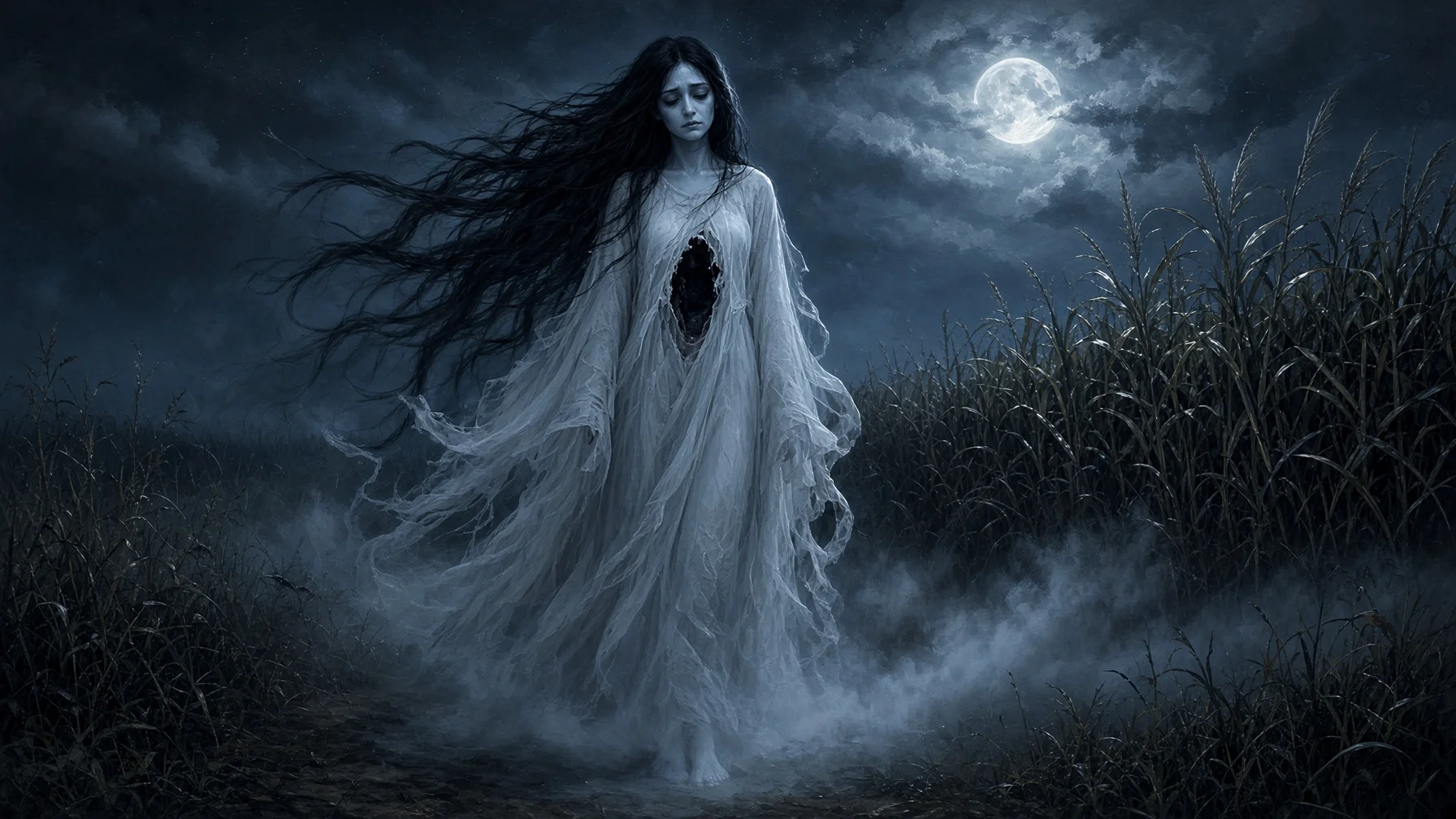
Liễu Hạnh stands alone among the Tứ Bất Tử, the Four Immortals of Vietnamese folk religion — the only woman among them, and in many ways the one closest to the living, breathing devotion of ordinary people today. Where Thánh Gióng rides skyward on his iron horse and Sơn Tinh holds his mountain against the flood, Liễu Hạnh's story is one of descent rather than ascent: a goddess who kept choosing to come down into the world of markets, marriages, poems, and grief, again and again, as though heaven itself could not hold her interest for long.
A Cup Broken in Heaven
The legend begins, as so many origin myths do, with a small transgression in a very large place. Liễu Hạnh is said to have been a daughter of the Jade Emperor (Ngọc Hoàng), dwelling among the palaces of the heavenly court. In one telling, she broke a jade cup — an accident, or perhaps a moment of carelessness that heaven judged more severely than the deed deserved. For this she was banished from the celestial realm and sent down to be born among mortals, stripped of her memory of what she had been.
It is a strange kind of punishment to modern ears — exile into human life as a penalty — but it sits comfortably within a Vietnamese cosmology where the boundary between the divine and the human was never meant to be permanent or absolute. Gods fall. Immortals marry farmers. The Jade Emperor's own daughter ends up haunting a provincial village in Nam Định, and nobody in the tradition finds this especially strange.
Born Again in Vân Cát
The most enduring version of her earthly life places her birth in Vân Cát village, in what is now Nam Định province, in the Red River Delta south of the capital. She is said to have reincarnated there as a woman, before her heavenly nature reasserted itself, only to return again in a later incarnation.
This pattern of repeated reincarnation is one of the most distinctive features of her myth. She is not a goddess who touches the earth once and departs, like a comet. She is cyclical, returning across generations, appearing in different guises in different corners of the country. Nam Định, and the village of Vân Cát in particular, remained the fixed geographic anchor of her legend and the site of her principal shrine complex.
The Scholar's Match
Among the stories told of her mortal sojourns, one of the most beloved involves a battle of wits rather than of arms: her poetic exchange with the real historical scholar-official Phùng Khắc Khoan. In these tales, Liễu Hạnh appears not as a silent object of devotion but as a sharp, quick-tongued woman capable of matching — and often besting — one of the era's most respected literary men in verse.
These exchanges are treasured in Vietnamese literary tradition for exactly this reason: they give the goddess a voice, a wit, and an intellectual authority that few other deities in the pantheon are granted. She is not merely worshipped for what she can grant petitioners; she is admired for who she was — clever, unimpressed by rank, and unwilling to lose an argument merely because her opponent held a scholar's degree and she, ostensibly, held none.
Mother of the Heavenly Realm
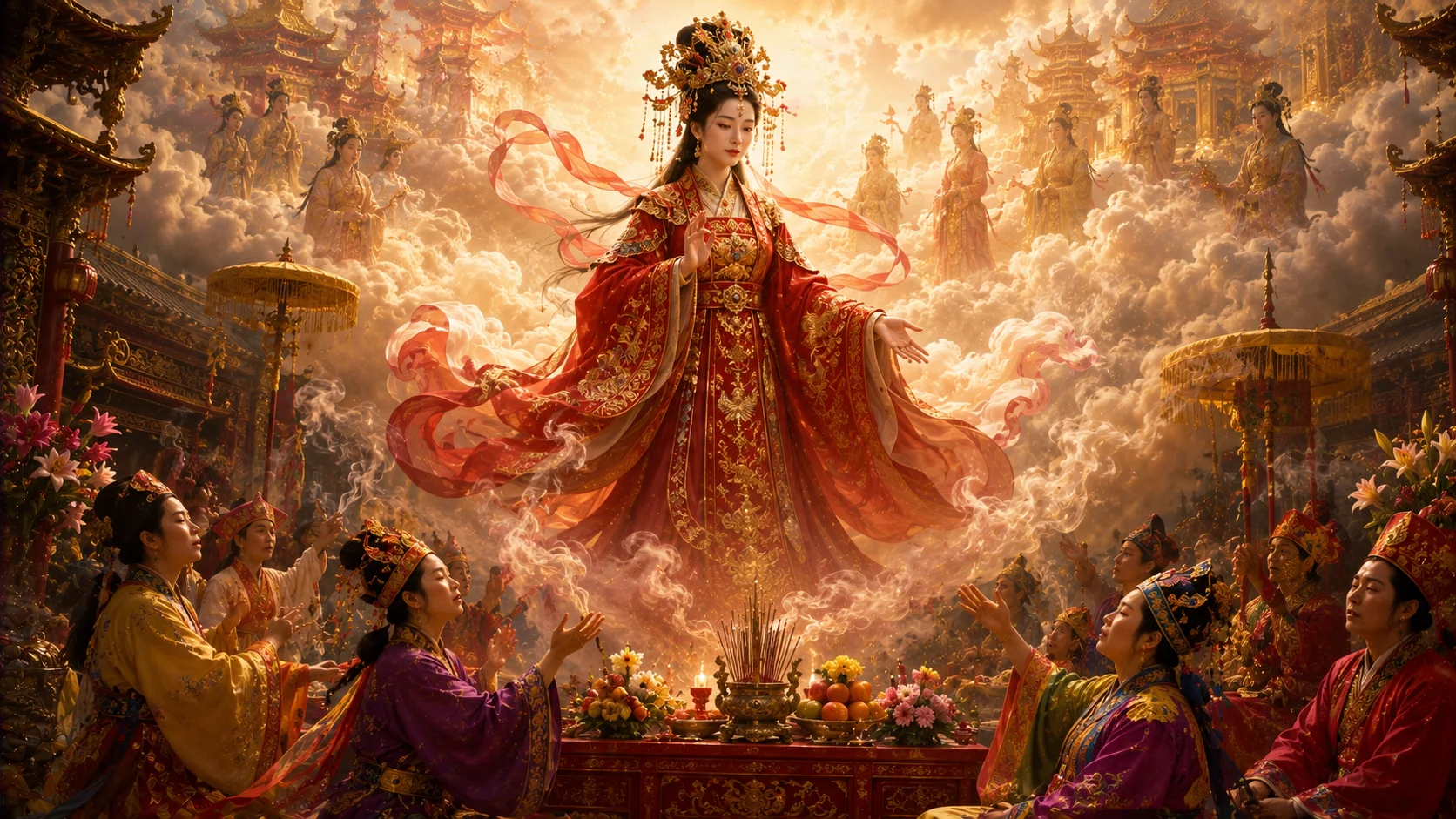
Within the elaborate structure of the Đạo Mẫu, the Mother Goddess religion that remains one of the most vital indigenous spiritual traditions of northern Vietnam, Liễu Hạnh occupies the highest seat. She is venerated as Mẫu Thượng Thiên, the Mother of the Heavenly Realm, presiding at the summit of the Tứ Phủ — the Four Palaces — that organize the Đạo Mẫu pantheon into heaven, earth, water, and mountains-and-forests.
This is no minor honor. The Tứ Phủ cosmology is intricate, populated by generals, princesses, and mandarin spirits arranged in careful hierarchy, and to stand at the top of the heavenly palace is to be, functionally, the presiding maternal power over the entire devotional system. Where Lạc Long Quân and Âu Cơ are revered as distant, foundational ancestors — the dragon and the fairy from whom the Vietnamese people descend — Liễu Hạnh is something closer and more immediate: a mother figure who can be approached directly, spoken to, and asked for help with the ordinary difficulties of a life.
Phủ Dầy and the Third Moon
The great center of her worship is the Phủ Dầy temple complex in Nam Định, built near the village associated with her birth. It is a major pilgrimage site in northern Vietnam.
Every year, in the third lunar month, the Phủ Dầy Festival draws pilgrims to honor her. It is a season thick with incense smoke, processions, and the particular hum of a place where religious devotion and communal festival blur into one another — stalls and ceremony side by side, as they so often are at the great festivals of Vietnamese folk religion. For many devotees, a visit to Phủ Dầy during the third month is not an occasional pilgrimage but an annual obligation, a thread that ties a family's year to the goddess's own calendar.
The Spirits Who Speak Through Her Mediums
Liễu Hạnh's presence in Vietnamese religious life is felt most vividly in lên đồng, the spirit mediumship ritual at the heart of Đạo Mẫu practice. In these ceremonies, mediums enter trance states and are said to be possessed in turn by different deities of the Tứ Phủ pantheon, each embodiment marked by its own costume, music, and gesture, moving through the hierarchy of spirits in a performance that is at once theater, prayer, and communion.
As the highest of the Mother Goddesses, an embodiment of Liễu Hạnh within a lên đồng session carries particular weight and is approached with particular reverence. The ritual is a living tradition, still practiced today, and it is worth naming plainly: this is not folklore preserved only in old chronicles but a devotional practice with active communities, temples, and mediums continuing to honor her in the present tense. Any account of Liễu Hạnh that treats her only as a literary artifact of the past misses the fact that people are still lighting incense to her this year, this month, this week.
Patroness of Women, Poets, and Scholars
Part of what makes Liễu Hạnh beloved rather than merely feared or formally honored is the specific character of her patronage. She is regarded as a protector of women, a guardian of poets, and a champion of scholars — an unusually literary and intellectual portfolio for a folk deity, and one that traces directly back to those verse exchanges with Phùng Khắc Khoan.
In a religious landscape where many spirits are approached chiefly for practical concerns — safe harvests, healthy children, protection from flood — Liễu Hạnh's association with wit, learning, and womanhood gives her cult a distinct emotional register. She is prayed to not only in crisis but in aspiration: by a woman hoping for a fair outcome in a difficult household, by a student before an examination, by a poet searching for the right line.
The Fourth Immortal, and the Odd One Among Equals
It is worth pausing on what it means that Liễu Hạnh sits among the Tứ Bất Tử at all. Thánh Gióng is a warrior who saves the nation from foreign invasion. Sơn Tinh is a mountain lord who holds back annual floods. Chử Đồng Tử rises from the depths of poverty — through his fated marriage to Princess Tiên Dung, who chose him against her father's wishes, and through the magical arts he later learned from the monk Phật Quang — to become a patron of trade. Each of the men is defined by a single decisive act or role, fixed and heroic.
Liễu Hạnh's immortality is built differently — not on one triumphant deed, but on repetition, transformation, and return. She dies and comes back. She is punished and forgiven. She is a princess of heaven and a woman of a Nam Định village in the same breath. Her power lies less in conquest than in persistence: the sense that the divine feminine does not vanish from the world but keeps finding ways back into it, generation after generation, as poet, wife, and goddess all at once.
Textual Roots in the Chronicles
Like the other members of the Tứ Bất Tử, the figures and stories that shape Liễu Hạnh's legend draw on Vietnam's foundational compilations of myth and spirit-lore, chiefly the fifteenth-century Lĩnh Nam Chích Quái — the "Wondrous Tales of Lĩnh Nam" — alongside the earlier Việt Điện U Linh Tập, a compendium of spirits and deities of the Vietnamese realm. These texts preserved, in written form, traditions that had almost certainly circulated orally for generations before being set down, giving later generations a durable record of a goddess whose worship might otherwise have been harder to trace across centuries of transmission.
A Living Devotion in the Delta
What distinguishes Liễu Hạnh's place in Vietnamese religious life today is the continuity between the old chronicle and the present ritual calendar. The temples of Phủ Dầy still stand and still fill with pilgrims each third lunar month. The lên đồng ceremonies still summon her presence through mediums, in a practice that remains a genuinely living part of Vietnamese religious culture rather than a chronicle curiosity. The Đạo Mẫu tradition she crowns is not a relic on display in a museum case but a system of belief that continues to organize how many Vietnamese families understand illness, fortune, motherhood, and the unseen forces that move through daily life.
To speak of Liễu Hạnh, then, is to speak of something still unfolding — a goddess whose myth insists, more than any other in the Tứ Bất Tử, that heaven and earth were never meant to stay separated for long, and that a broken jade cup, however heaven judged it, gave the human world a mother it has not stopped needing since.
Sources & traditions
- EncyclopediaWikipedia — Liễu Hạnh
- TraditionVietnamese folk and village traditions
Myths change from area to area and from time to time. This chronicle follows the most widely told versions; tellings in other villages, regions and eras may differ.