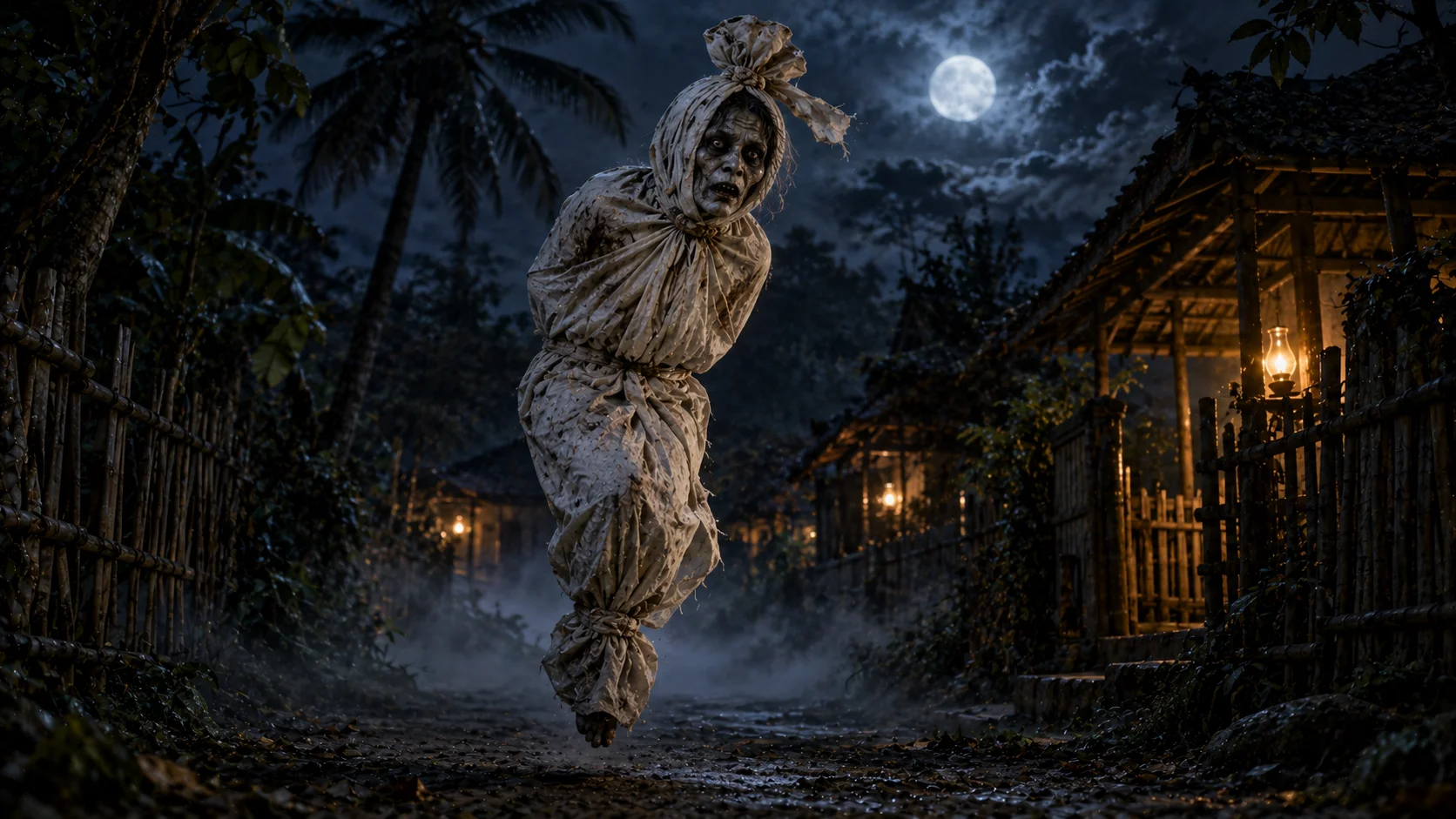
Tản Viên, also called Ba Vì, rises from the plain west of the Red River like a memory the land refuses to let go of. In Vietnamese folk cosmology it is not simply a mountain but a throne — the seat of Sơn Tinh, the Mountain Spirit, whom later tradition honors as Tản Viên Sơn Thánh, the Saint of Tản Viên Mountain and the highest-ranking deity among the country's spirits of earth and stone. To stand at its foot, in the old telling, was to stand at the edge of something that watched back.
A Peak Named for a God
Long before pagodas ringed its slopes, Tản Viên was already a name spoken with care. The mountain sits among the four immortals of Vietnamese folk religion, the Tứ Bất Tử, and of those four it is Sơn Tinh's dominion that endures most visibly on the land itself: you cannot point to Thánh Gióng's ascension or Chử Đồng Tử's vanished palace, but Tản Viên still stands, still visible from the plain, still climbed.
The Suitor Who Came from the Hills
The mountain's fame is inseparable from a single contest. When the eighteenth Hùng King sought a husband for his daughter, the princess Mỵ Nương, two suitors arrived on the same day, each formidable, each unwilling to yield. One was Sơn Tinh, spirit of the mountains; the other was Thủy Tinh, spirit of the waters. Unable to choose between them by presence alone, the king set a test disguised as a wedding gift list: a rhinoceros bearing nine horns, an elephant bearing nine tusks, and a cock crowned with nine spurs — creatures so particular that finding even one seemed impossible, let alone all three by morning.
Nine Horns, Nine Tusks, Nine Spurs
Sơn Tinh moved first, and moved faster. Whether by command over the beasts of the highlands or simply by not hesitating, he gathered the impossible dowry and reached the palace while the sun was still rising the next day. Thủy Tinh, arriving after him, found the princess already given away. The tale lingers on this detail — not strength decided the contest, nor rank, but a matter of hours. It is a very human kind of loss, dressed in the clothing of gods.
The Flood That Would Not Stop Trying
What followed is the part of the story every child in the Red River Delta learns before they learn to read a flood gauge. Thủy Tinh, humiliated, raised the seas and the rivers and hurled them at Tản Viên itself, trying to drown the mountain and wash Mỵ Nương back to him by force. Sơn Tinh answered by raising the mountain higher to match him, refusing to let the waters win. If there is a single image at the heart of this legend, it is that one: a god raising ground against a god raising water, neither willing to concede the last few feet.
An Argument Repeated Every Year
The contest did not end with a single battle. Vietnamese oral tradition holds that Thủy Tinh returns each year, still bitter, still certain that one more surge of water might finally take what was denied him, and each year Sơn Tinh meets him again on the same ground. Scholars and storytellers alike have long read this as the delta's own memory of itself: the Red River's seasonal floods, arriving with the same stubborn regularity as a rejected suitor, and the mountain standing exactly where it always stood, unmoved.
The God Who Taught the Land to Hold Water
Sơn Tinh's victory was never framed as the end of the story, because the flooding never actually stopped — only the people's ability to survive it improved. Folklore credits him directly with teaching the villages at the mountain's base the arts of flood control and irrigation: how to read the rise of water, where to raise an embankment, how to route a channel so a field drowns a little instead of entirely. In this way Tản Viên Sơn Thánh is remembered less as a distant victor than as a resident protector, one whose triumph is renewed every planting season a harvest survives.
A Mountain Among Kin
Tản Viên's story does not stand alone; it sits inside a much older lineage. The Hùng Kings whose court the suitors approached trace their own descent from a stranger and more foundational pairing — the dragon lord Lạc Long Quân and the mountain fairy Âu Cơ, whose hundred sons are said to be the ancestors of the Vietnamese people, the Bách Việt. When mother and father parted, fifty sons followed Âu Cơ into the highlands and fifty followed Lạc Long Quân to the sea, an old division between mountain people and lowland people that Vietnamese tradition still gestures toward when it calls itself "con Rồng cháu Tiên" — children of the Dragon, grandchildren of the Fairy. Sơn Tinh's mountain, and his marriage into the royal line descended from that first parting, keeps the two halves of that ancient story in conversation: water below, height above, and a marriage that briefly, imperfectly, tried to hold both.
Company on the Sacred Register
Among the Tứ Bất Tử, Sơn Tinh keeps notable company. There is the child-warrior Thánh Gióng, who grew from a silent infant into a giant defender overnight and rode to heaven from Sóc Sơn after driving off an invasion — still honored each year at the Gióng Festival, recognized by UNESCO as a piece of humanity's intangible heritage. There is Chử Đồng Tử, born to nothing but a shared loincloth, who married a princess by accident of fate; he later learned magical Taoist arts from the traveling monk Phật Quang, receiving a staff and hat said to conjure a palace overnight and to help those in need, and he is remembered today as a patron of trade and travel along the river roads. And there is Liễu Hạnh, the only woman among the four, a banished daughter of the Jade Emperor who returned to earth again and again and is now honored as Mother of the Realm within the Đạo Mẫu tradition — celebrated too for her wit in poetic exchanges with the scholar Phùng Khắc Khoan and revered as a protector of women, poets, and scholars, with her temple at Phủ Dầy drawing pilgrims every third lunar month. Beside them, Sơn Tinh's mountain is the quietest kind of monument — not a festival day, not a shrine of departure, but a peak you can still see from the plain on a clear morning.
Where the Mountain Still Stands
Ba Vì, the physical mountain identified with this legend, remains a place of active devotion rather than a ruin of one. Temples dedicated to Tản Viên Sơn Thánh continue to sit along its slopes, and the mountain is still named among the most sacred heights in Vietnamese folk cosmology — not a relic of belief but a living address for it. Pilgrims and villagers who climb toward its temples are, in a small way, repeating the same gesture the old chronicles describe: seeking the mountain when the water rises.
Recorded in Wondrous Tales
The written memory of this contest, like so much of Vietnam's early mythology, survives chiefly through the fifteenth-century compilation Lĩnh Nam Chích Quái — "Wondrous Tales of Lĩnh Nam" — alongside the earlier Việt Điện U Linh Tập. These texts gathered oral tradition centuries after it had already been carried by voice through the delta's villages, giving Sơn Tinh, Thủy Tinh, and the royal court of the Hùng Kings the durable shape in which they are still told today. What the chroniclers preserved was not a single fixed telling but the outline of a story that Vietnamese households have kept retelling in their own words ever since.
A Legend That Explains a Season
It is worth pausing on what kind of story this actually is. It is not only a romance decided by a morning's head start, nor only a war between elemental rivals — it is also, plainly, an explanation. Long before hydrology had a name, the people of the Red River Delta needed an account of why the waters came back with such punishing regularity, and why the high ground so reliably saved them. Tản Viên gave them both a hero and a reason: a mountain that resists the flood, fought on the same ground, every year, since a princess was promised to whichever suitor arrived first.
The Height That Refuses to Lose
What lingers longest in the story of Tản Viên is not the wedding, nor even the war, but the image of a mountain that simply keeps rising to meet whatever is thrown at it. Thủy Tinh's floods are real, remembered, and yearly — the story never pretends otherwise. But so is the mountain's answer. In a land shaped by a river that gives and takes with the same hand, Sơn Tinh's peak stands as a promise repeated across centuries: that there is always higher ground, and that someone — something — is still holding it.
Sources & traditions
- EncyclopediaWikipedia — Tản Viên Sơn Thánh
- TraditionVietnamese folk and village traditions
Myths change from area to area and from time to time. This chronicle follows the most widely told versions; tellings in other villages, regions and eras may differ.