Phorcys was a primordial god of the sea's hidden dangers — an ancient deity of the deep who, with his sister-wife Ceto, fathered a horrifying brood of sea-monsters that terrorised the Greek world. If Nereus was the gentle Old Man of the Sea, Phorcys was its darker face: the father of the sea's terrors.
The Old God of the Deep
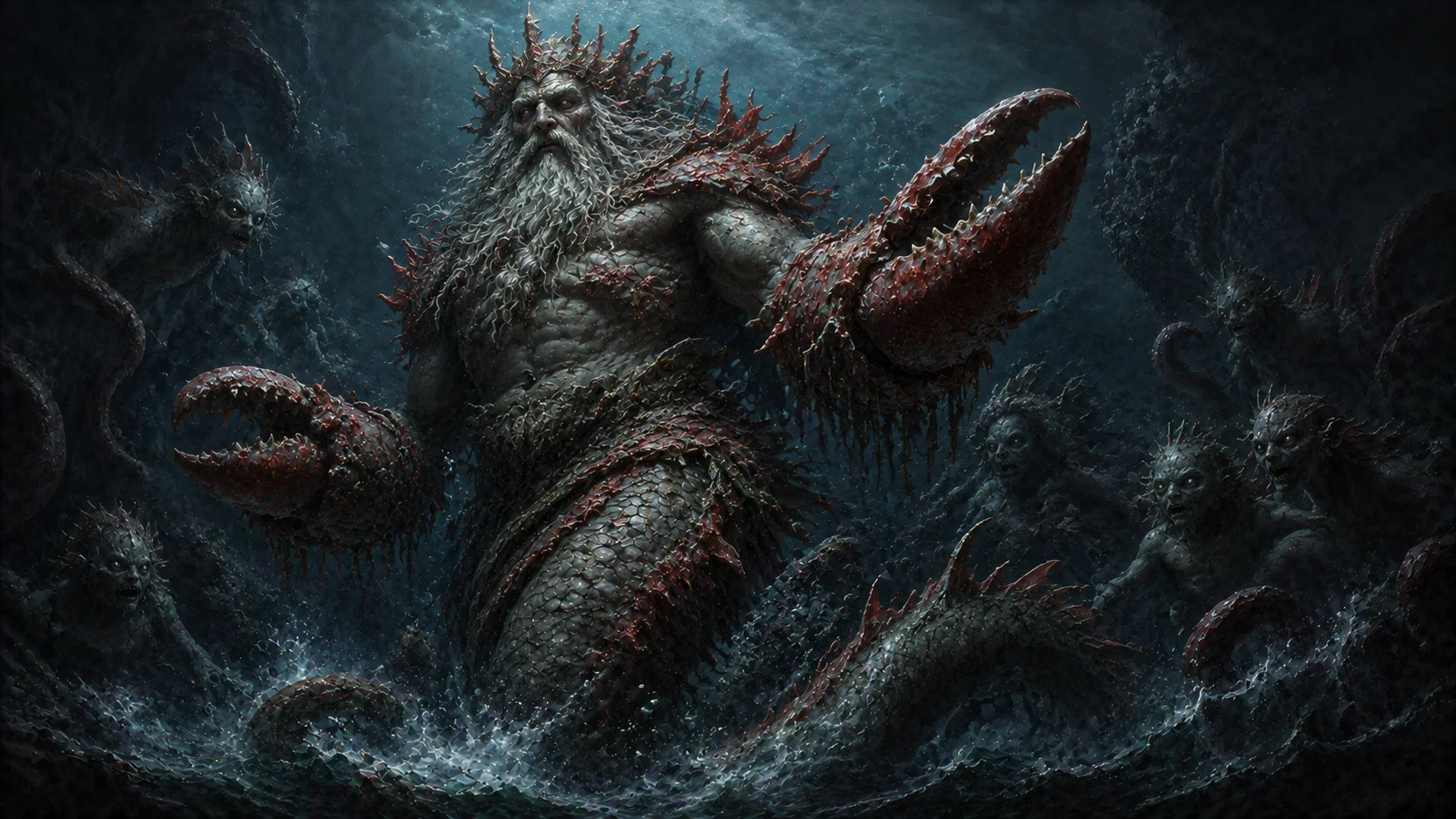
A son of the primordial sea (Pontus) and earth (Gaia), Phorcys was an ancient sea-god of the older generation, predating the Olympians. He personified the dangerous, hidden aspects of the ocean — the hazards of the deep, the rocks and reefs, the monsters of the abyss. He was often pictured as a grey-haired old merman with the tail of a fish, crab-claws, and reddish, spiky skin.
Father of the Phorcydes
With his sister and consort Ceto, Phorcys sired a famously monstrous family — the “Phorcydes.” Their children read like a catalogue of the heroes' greatest foes: the Gorgons (including Medusa), the Graeae, the dragon Ladon, the monster Echidna (mother of yet more monsters), and the sea-monster Scylla in some accounts. Through this brood, Phorcys is grandfather to a vast portion of the monstrous world — the dark wellspring from which so many of myth's terrors flowed.
The Dark Face of the Sea
Phorcys endures as the embodiment of the sea's peril and its capacity to spawn horrors — the ancient deep as a breeder of monsters. Where the Olympian Poseidon ruled the sea with kingly power, the older Phorcys represented its primal, dangerous fertility, the abyss that gives birth to nightmares. He is the father of monsters at the bottom of the world.
Behind half the monsters the heroes ever fought stood one old grey sea-god and the dark deep that bred them.
A Name That Means Grey
The Greeks themselves were not entirely sure what Phorkys meant. A surviving ancient lexicon glosses the adjective phorkos as “white,” “grey,” “wrinkled” — the colour of old men, of sea-foam, and of the flat pewter light that sits on water before weather comes in. Whether the god took his name from the word or the word from the god has never been settled, and the etymology is still open. What is certain is that the association held. Everything in Phorcys’ line comes out grey: his daughters the Graeae are born old, and his most famous daughter turns living flesh the colour of stone.
There is a second Phorcys in Greek epic who has nothing to do with him — a Phrygian commander in the Iliad, son of Phaenops, who leads his men from far Ascania and is cut down by Ajax in the fighting over Patroclus’ body. The name existed as a human name. That is worth noticing: the father of monsters was called something a Trojan might plausibly be called, not something invented to sound terrible.
Two Old Men of the Sea
Hesiod does not merely set Phorcys against Nereus; he divides the sea’s temperament between them in the same breath. The firstborn of Pontus is Nereus, whom Hesiod praises as truthful and unlying, gentle, and mindful of what is right. Phorcys arrives a few lines later in the same list of children, alongside Ceto, Thaumas and Eurybia. Same father. Same water. Opposite harvests.
Nereus fathers the fifty Nereids — sea-daughters who marry heroes, rescue sailors, and in one case give birth to Achilles. Phorcys fathers the Gorgons, the Graeae, the serpent coiled around the golden apples, and the mother of half the monsters in the canon. The Greeks were not being careless when they kept two old men of the sea instead of consolidating them. They were saying something they knew from experience: that the water which feeds a coastal people and the water which swallows them whole is the same water, and no single god can honestly personify both.
Homer applies the same title, halios gerōn — the old man of the sea — to Phorcys, to Nereus, and to Proteus. It is a rank rather than a name, an office held by several ancient powers who predate the Olympian order and were never fully absorbed into it.
The Harbour of Phorcys
The one place that carries his name is not a temple but an anchorage. In the thirteenth book of the Odyssey, the Phaeacians row the sleeping Odysseus home and set him ashore at the harbour of Phorcys in Ithaca — a cove between two jutting headlands that break the swell so completely that ships need no mooring at all, with a cave of the Naiads above it, stone mixing-bowls and stone looms inside, and an olive tree at its head. It is the most peaceful landscape in the poem, and Odysseus wakes in it without recognising his own country.
The detail rewards a second look. The safest anchorage in Ithaca is named for the god of the deep’s hidden dangers. It is tempting to read that as deliberate: you do not name the shelter after the calm, you name it after the thing the shelter is protecting you from, because the name is a kind of acknowledgement paid to the power you have just escaped.
Grandfather of the Cyclops
The Odyssey opens by explaining why Poseidon will not let Odysseus go home, and the explanation runs straight through Phorcys. Polyphemus, the Cyclops whose eye Odysseus put out, was born to Thoosa, a nymph named as the daughter of Phorcys who rules the unharvested sea; Poseidon fathered him in the hollow caves. So the blinding is not merely an insult to a monster. It is an injury to Poseidon’s own son by a daughter of the old sea-god, and the ten years of wandering follow from it.
This is how Phorcys actually functions in Greek story. He is almost never on stage. He is the reason the plot has the shape it has — the ancestor whose blood explains why a particular horror is standing in front of a particular hero.
The Grey Sisters and the Shared Eye
Hesiod names two of the Graeae, Pemphredo and Enyo, and says they were grey from birth, which is why they are called the Grey Ones; later writers add a third, Deino. The tragedy Prometheus Bound gives the darker picture: three ancient maidens in the shape of swans, sharing a single eye and a single tooth between the three of them, upon whom neither the sun ever looks with his beams nor the moon by night. Aeschylus is credited with a lost play called Phorkides — the daughters of Phorcys — so these sisters once held a stage of their own.
In the version that became standard, Perseus finds them and waits. The eye has to travel; there is a moment when it is in neither socket, passing from one sister’s hand to the next, and in that moment he takes it. He does not fight them. He robs three blind old women of the one sense they own between them and refuses to give it back until they tell him the road. It is the least heroic thing in the Perseus cycle, and the Greeks kept it, because the story is honestly about cunning rather than courage.
Latin poetry leaned on the patronymic hard. Ovid calls Medusa Phorcynis, the daughter of Phorcys, and names the grey sisters simply the Phorcides — letting the father’s name carry the whole identification, with no explanation offered to the reader.
Plato’s Strange Promotion
The most surprising thing ever written about Phorcys sits in a philosophical dialogue. In the Timaeus, Plato recites the traditional divine genealogy: from Earth and Heaven came Oceanus and Tethys, and from them Phorkys, Cronus and Rhea, and the rest of that generation.
Read that again. In this version Phorcys is not a minor son of the Sea — he is the brother of Cronus and Rhea, an elder of the very highest rank, standing one generation above Zeus. It is a minority tradition and it never displaced Hesiod. But it preserves a memory that Hesiod’s neater arrangement demotes: that Phorcys could be counted among the greatest of the old powers, before the poets sorted the pantheon into a tidy hierarchy and filed him under monsters.
A God With No Temple
Poseidon had Isthmia and Sounion, festivals, chariot races, black bulls slaughtered on the shore. Phorcys, so far as the surviving evidence goes, had essentially nothing — no significant cult, no attested priesthood, no festival calendar. This is not so much a gap in the record as a description of what kind of god he was.
Phorcys is a genealogical god. His function is to be a father, and the theogonies that name him are doing something more practical than they look: they are a filing system for terror. The Greek mind would not accept a monster that simply existed. Medusa had to come from somewhere. Scylla had to have parents. Echidna had to be somebody’s daughter before she could be everybody’s mother. Put Phorcys and Ceto at the root and the whole monstrous world resolves into a family — one household, with a known address at the bottom of the sea.
Phorcus Among the Romans
Rome kept the name and quietly drained the horror out of it. Virgil names him twice in the fifth book of the Aeneid, both times as company rather than cause: once in a sailor’s prayer, invoked alongside the chorus of Nereids and the sea-maiden Panopea, and once in the retinue of sea-powers moving through the water — Phorci exercitus omnis, the whole host of Phorcus. He is no longer the breeder of nightmares; he is a lord with a following, part of the ornamental machinery of Latin epic seascape. The monsters stayed in the family, but they had migrated into the patronymic, while Phorcus himself was promoted into a dignified old sea-noble with a chorus behind him.
Why the Deep Needed a Father
Every ancient people feared the sea. The Greeks did something specific with that fear: they made the sea fertile. The desert kills you and produces nothing. The sea kills you and keeps handing things up — the drowned, the wreckage, and the catch, which for a Mediterranean fisherman regularly included animals that resembled nothing on land. Deep water was the only frontier the Greek world had that manufactured new shapes.
Phorcys is the theological answer to that observation: a generating power in the dark below, older than the Olympians, married to its own sister, and grey.
Yet notice the consolation folded into the terror. A father implies a finite number of children. Once the monsters are a family they can be counted, and once they can be counted they can be killed one at a time by named men: Perseus takes Medusa, Heracles takes Ladon, Odysseus loses six sailors to Scylla and sails on. The genealogy that makes the horror explicable is the same genealogy that makes it survivable. That is the real work Phorcys does — he gives the abyss a household, and a household has a door you can walk out of.
Sources & traditions
- EncyclopediaWikipedia — Phorcys
- TraditionGreek texts, inscriptions and later retellings (Greece)
Myths change from area to area and from time to time. This chronicle follows the most widely told versions; tellings in other villages, regions and eras may differ.