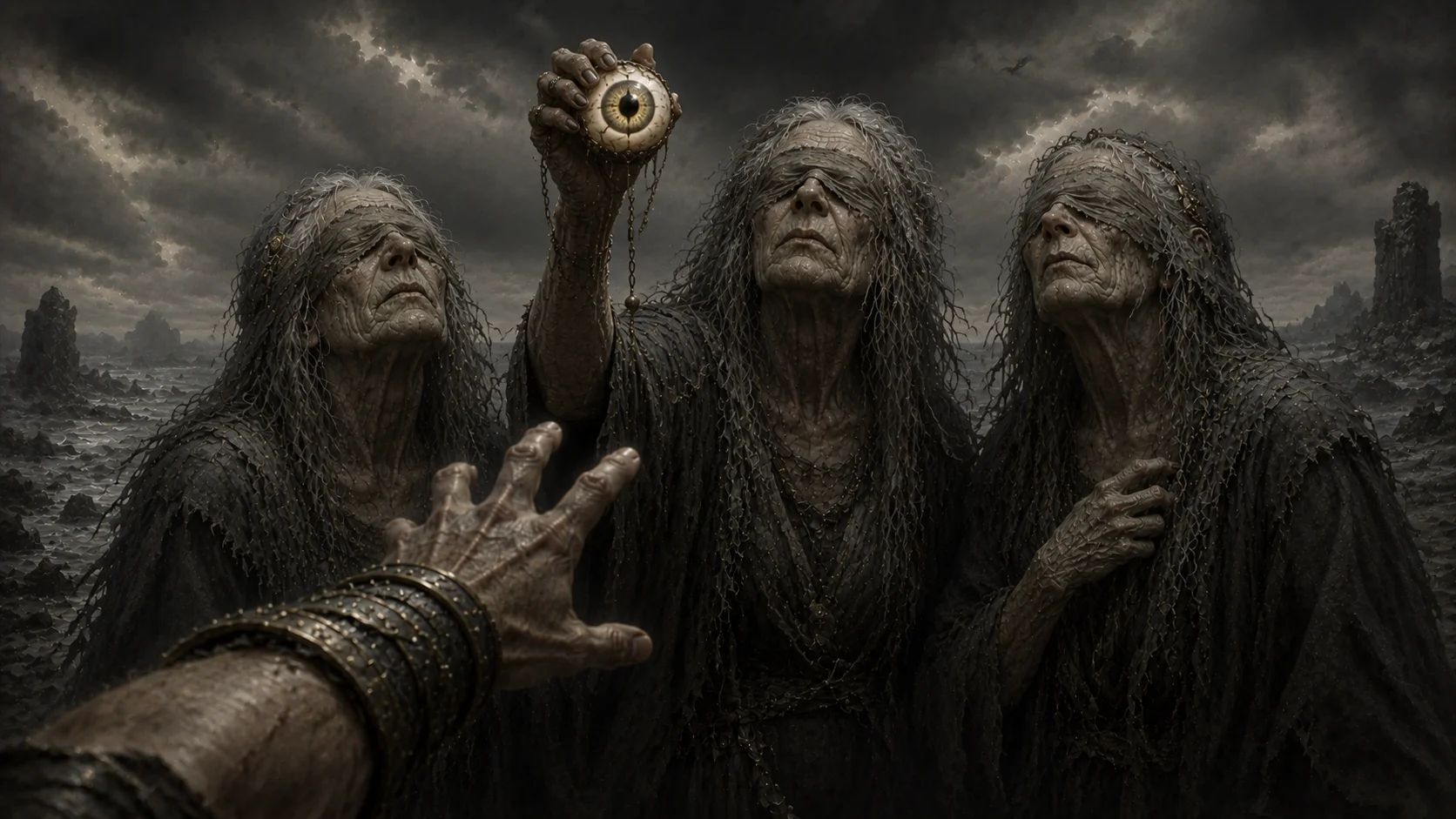
The Graeae — the “Grey Sisters” or “Grey Ones” — were three ancient witches who shared between them a single eye and a single tooth, passing them from hand to hand. Born grey-haired and aged, they are among the strangest beings in Greek myth, and their one shared eye became the key to the slaying of Medusa.
The Grey Ones
The Graeae were sisters of the Gorgons, daughters of the old sea-deities Phorcys and Ceto. There were three of them (commonly named Deino, Enyo, and Pemphredo), and they were unusual among monsters: they were not born young and then aged, but were said to have been grey-haired from birth — old women from the very beginning, personifications of the white foam of the sea or of old age itself.
The Shared Eye and Tooth
Their defining and eerie feature was that, between the three of them, they possessed only a single eye and a single tooth, which they shared by passing from one sister to the next — one would use the eye to see while the others were blind, then hand it on. This meant that at the moment of the exchange, when the eye was passing between hands, all three were briefly blind. That instant of shared blindness was their one vulnerability.
The Theft by Perseus
The hero Perseus, on his quest to slay Medusa, needed information that only the Graeae possessed — the location of certain magical objects (or of the Gorgons themselves, or of the nymphs who guarded the winged sandals and cap of invisibility). So Perseus crept up on the Grey Sisters and waited for the moment when they passed the eye between them — then snatched it from the air. Holding their single eye hostage, blind and helpless, the Graeae were forced to give Perseus the information he sought before he would return their eye. Cleverness, again, defeating ancient power.
The Sisters of Shared Sight
The Graeae endure as one of mythology's most haunting and original images — three beings forced to share a single sense, eternally taking turns to see, eternally vulnerable in the instant of exchange. They embody a strange, dreamlike idea of dependency and shared perception, and their myth is a perfect small lesson in how a hero wins: not by strength, but by finding and seizing the exact moment of weakness.
Three sisters, one eye between them — and a hero who knew that the moment it changed hands, all three were blind.
Two Sisters, Then Three
The oldest surviving mention of the Grey Ones is stranger than their later reputation suggests. Hesiod's Theogony, composed around 700 BCE and one of the foundational texts of Greek divine genealogy, names only two of them — Pemphredo and Enyo — and calls them, almost perversely, fair-cheeked. It goes further: Hesiod dresses them, giving Pemphredo the epithet well-robed and Enyo saffron-robed, the wardrobe of a goddess rather than a hag. These are beings the same poet says were grey from the moment of birth. Fair-cheeked is a stock formula in early epic, handed out to many women, so the contradiction may be an accident of poetic habit rather than design — but it is an accident nobody afterwards bothered to smooth away, and the Graeae kept the doubled quality ever after: loveliness and decrepitude occupying one body at once.
Even the count took time to settle. Aeschylus, writing two centuries later, speaks of three sisters but leaves them unnamed. The third name, Deino, belongs to the mythographer Apollodorus and his Library — which is also where Perseus's ordeal takes its fullest surviving shape.
Two of the three names were never decorative. Enyo is not a name invented for a monster at all: it belongs to an actual war goddess, a grim companion of Ares whom Homer calls a “sacker of cities.” Deino is built on the ordinary Greek adjective for dread, and means something close to “the terrible one.” Even setting the shared eye aside, the sisters carried violence and fear folded into their own syllables, long before Perseus came looking for them.
Daughters of the Old Man of the Sea
Their parentage is the detail most retellings mention once and then drop, though it does a great deal of work. Where the Nereids — the sea's gentle, youthful daughters — descend from Nereus, a sea-elder Hesiod praises as truthful and kindly, the Graeae and the Gorgons come from a rougher branch of the same water: Phorcys, another “old man of the sea,” and his sister Ceto, whose name is simply the Greek word for a sea monster. Aeschylus calls the Grey Sisters the Phorcides, the daughters of Phorcys, and the label carries weight. It places them in the sea's oldest and least governable generation, born of Pontus and Earth long before Poseidon held the waves and wholly untouched by that rule. They are not creatures the sea produced by accident. They are what the sea was before it had a king.
Swan-Shaped, Beneath No Sun
Aeschylus, in Prometheus Bound, gives the Phorcides a form found nowhere else in what survives of the tradition. Mapping out the road Io must travel to the edge of the world, Prometheus describes three long-lived maidens who are swan-shaped, who share one eye and one tooth between them, and on whom neither the sun ever looks with his beams nor the moon by night.
The swan-form repays unpacking. Aeschylus knew the belief that a swan sings its finest song only as it dies — he reaches for exactly that image in the Agamemnon — and to give the Grey Sisters a swan's body is to make the whole creature, and not merely its white hair and its failing eye, an emblem of life at its last. It also strands them in a country lit by neither sun nor moon: the one address in the Greek world where an eye would be of almost no use to anybody.
What the Sisters Actually Gave Up
The bargain Perseus struck is usually reported vaguely, but Apollodorus is specific about the price. What the blinded sisters surrendered was not the road to the Gorgons but the road to the nymphs, and the nymphs held three things no mortal could obtain any other way: a pair of winged sandals, a pouch called the kibisis, and the cap of Hades, which made its wearer invisible. Each one answers a separate problem in the killing. The sandals carry Perseus beyond the reach of Stheno and Euryale, who unlike their sister were immortal and so could not be fought at all. The kibisis takes a severed head that has not stopped petrifying whatever meets it. The cap covers the escape. Read that way, the Graeae are not an obstacle standing on the road to Medusa. They are the gate to the entire arsenal that made killing her survivable.
The Pattern of the Guarded Secret
Set against the rest of Greek myth, the Graeae belong to a recognisable type: the monstrous keeper of knowledge, who cannot simply be fought, because there is nothing in the knowledge to strike. The Sphinx outside Thebes guarded her secret the same way — not with claws first, but with a question no army could answer. What sets the Graeae apart within that type is how physical their guard is. A riddle can only be out-thought. An eye changing hands can be timed. Their myth takes an abstract proposition about hidden knowledge and turns it into something a storyteller can stage in a single held breath.
The Grey Sisters After Antiquity
Three old women passing one eye has proved an unusually durable picture. Ray Harryhausen's effects work gave the scene its most famous modern staging in the 1981 Clash of the Titans, where the sisters — renamed the Stygian Witches — lose the eye to a waiting Perseus in almost exactly Apollodorus's rhythm of snatch, hostage, bargain. Rick Riordan's Percy Jackson novels took the opposite tone entirely, recasting the Grey Sisters as bickering New York taxi drivers who pass the eye around the front seat while the cab keeps moving. The joke only lands because the underlying myth is already so exact and so strange. Very few figures out of Greek myth work equally well played straight and played for laughs; the shared eye is one of the few images that does.
Sources & traditions
- EncyclopediaWikipedia — Graeae
- TraditionGreek texts, inscriptions and later retellings (Greece)
Myths change from area to area and from time to time. This chronicle follows the most widely told versions; tellings in other villages, regions and eras may differ.