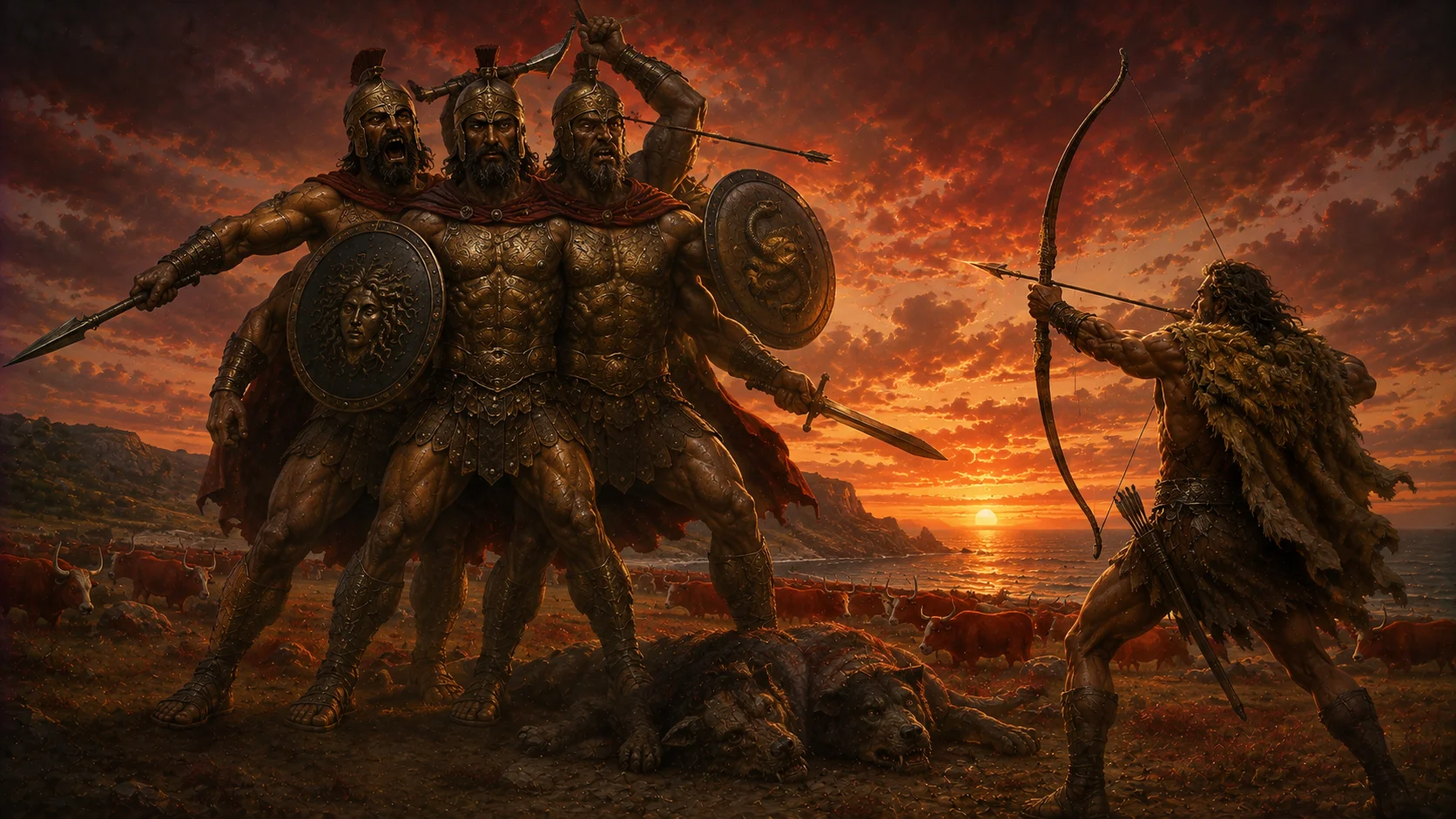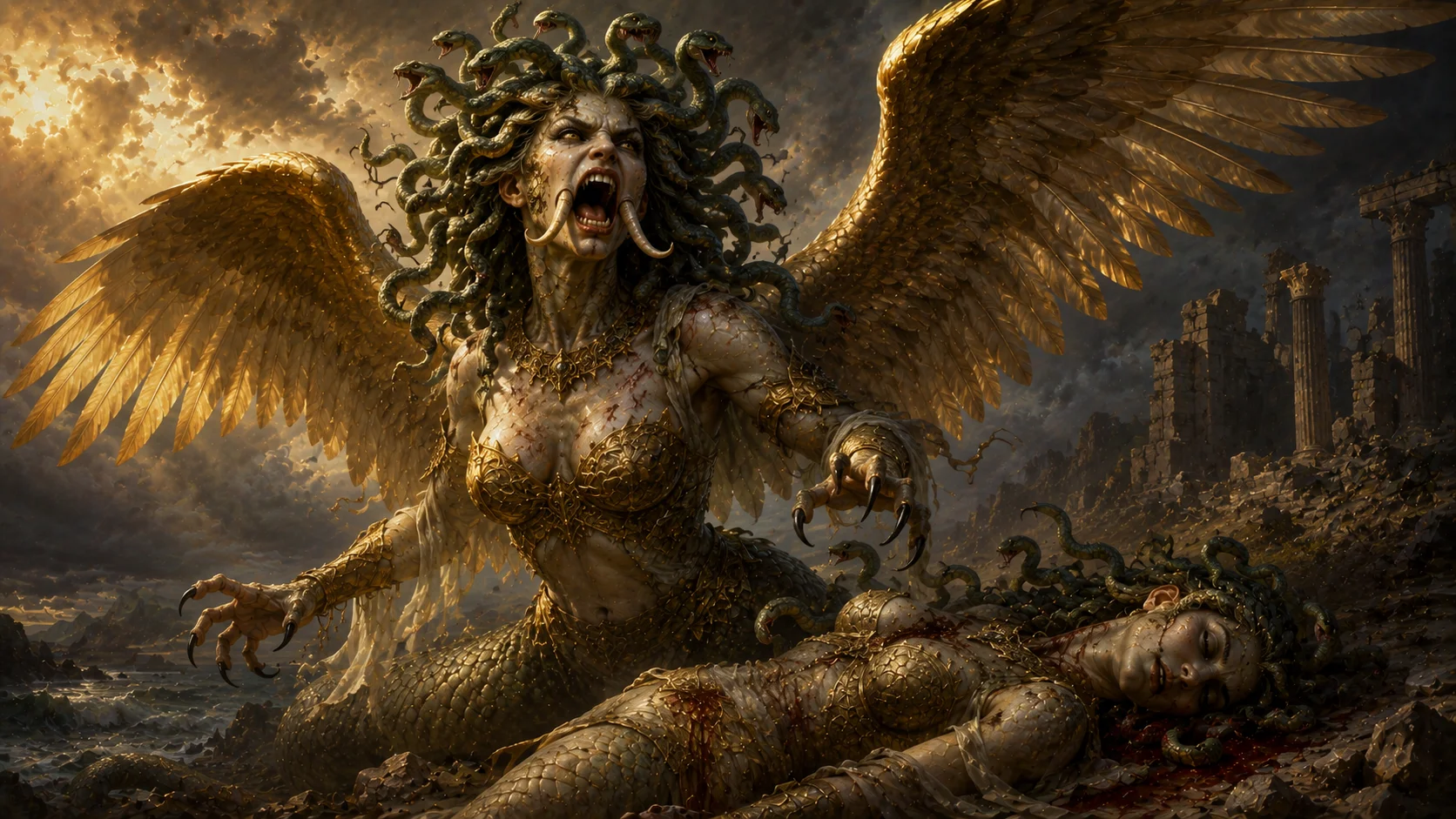
Stheno was the eldest of the three Gorgon sisters — and, the myths say, the deadliest of them all, having killed more men than both her sisters combined. Yet she is forever overshadowed by her younger, mortal sister Medusa, because Stheno had something Medusa lacked: she was immortal, and so no hero ever defeated her.
The Eldest Gorgon
Stheno (whose name means “strength” or “the mighty”) was one of three monstrous sisters, the Gorgons, daughters of the ancient sea-deities Phorcys and Ceto. Like her sisters Euryale and Medusa, she was a winged creature with serpents for hair, fearsome tusks, and a gaze that turned the living to stone. But where Medusa was mortal, Stheno and Euryale were immortal and ageless — eternal monsters who could never be slain.
The Deadliest of the Three
Ancient sources record that Stheno was the most ferocious and independent of the Gorgons, said to have slain more men than her two sisters put together. Fierce, violent, and undying, she dwelt with her sisters at the edge of the world, a terror to any who approached.
The Sister Who Could Not Be Killed
When the hero Perseus came to behead a Gorgon, he could target only one: Medusa, the sole mortal sister. He beheaded her using a mirror-shield to avoid her gaze — but he had to flee immediately, because the immortal Stheno and Euryale woke, saw their sister slain, and pursued him in a fury. Only Perseus's winged sandals and cap of invisibility allowed him to escape the two undying sisters, who could never themselves be killed. Stheno's grief and rage went unavenged, for there was no weapon in the cosmos that could end her.
The Forgotten Terror
Stheno endures as a reminder that Medusa was not alone — that she was the youngest and only vulnerable of three monstrous sisters, and that the most dangerous Gorgon of all was the one no hero could touch. Stheno is the eternal, undefeated monster: the terror that outlived the famous victory, still dwelling, immortal, at the edge of the world.
Medusa was the one who could die — her eldest sister was the one who never could.
The Family Beneath the Waves
Long before Zeus and the Olympians took charge of the cosmos, the sea was already breeding monsters, and Stheno's parents belonged to that older order. Phorcys and Ceto — themselves children of Pontus, the sea, and Gaia, the earth — were an elder pair of marine deities who barely act in any surviving story. Their place in myth is defined almost entirely by what they produced, and nearly everything born to them was something no hero wanted to meet alone.
Hesiod's Theogony gives Stheno, Euryale and Medusa a crowded house of siblings: the Graeae, grey-haired from the moment of their birth; and, as the last child of that union, the serpent set to guard the golden apples in the hidden places of the dark earth — the creature later poets would name Ladon. Echidna, the half-woman, half-serpent mother of Cerberus, the Hydra and the Chimera, is introduced in the same passage, though the Greek leaves her parentage genuinely ambiguous and readers have argued ever since over whether she is Ceto's daughter or Callirhoe's. The family tree has loose branches. The pattern, though, is unmistakable: Stheno was not an isolated freak of nature. She belonged to a lineage, and the lineage was the point — the sea's way of reminding early Greeks that not everything ancient and powerful had been tamed by the newer gods.
The Sisters Who Shared One Eye
Before Perseus could raise a blade against Medusa, he had to find the Gorgons at all — and nobody simply knew the way. According to Apollodorus' Library, the road ran first through Stheno's own sisters. The Graeae were born old: grey from birth, and so reduced between them that the three shared a single eye and a single tooth, passing each from hand to hand as they needed them.
Perseus ambushed them in the moment of exchange and seized both eye and tooth before any of the three could see to stop him. Blind and toothless, they bargained; he gave back what he held only once they had shown him the road to the nymphs who kept the equipment he would actually need — winged sandals, the cap of Hades that made its wearer invisible, and a pouch, the kibisis, sturdy enough to carry a head whose gaze still killed after death. Only with all of that in hand did Perseus dare approach the sleeping Gorgons. Stheno's side of the story, in other words, begins with her own sisters being robbed of their sight so that another sister could be found.
What the Name Stheno Carries
Stheno comes straight from the Greek sthenos — might, force, raw physical power. The same root is still in daily use: negate it and you have asthenia, the medical word for weakness; join it to kallos, beauty, and you have calisthenics. Her sisters' names read like companions chosen on purpose rather than at random. Medusa is a participle of a verb meaning to rule or to guard — “the guardian,” “she who watches over”; Euryale is usually explained as “far-leaping” or “wide-roaming.” Set side by side, the three names describe not three personalities but three faces of a single overwhelming force — strength, dominion, and reach — which may be exactly why the myths so rarely distinguish the sisters by anything except which of them could die.
The Face That Never Changed
Walk through any museum's Greek gallery and you have almost certainly met a Gorgon already, even if no label told you her name. The Gorgoneion — a wide, staring face with a lolling tongue, boar's tusks and snakes for hair — was among the most widely reproduced images in the ancient Mediterranean, precisely because it was not meant to be admired. It was meant to guard. In the Iliad, the Gorgon's head is set on Athena's aegis alongside Rout and Strife, a weapon of pure dread carried into battle; the same face glares out from temple pediments, hoplite shields, roof tiles, doorways and coins across the Greek world, doing the same job everywhere — frightening off whatever frightening things might otherwise come near. The west pediment of the Temple of Artemis at Corfu, carved around 580 BCE, gives the type its grandest surviving form: a colossal Gorgon running and kneeling at once, flanked by great cats, with Pegasus and Chrysaor at her sides.
Here is the detail almost nobody notices: that face was never carved as Stheno's, specifically, or Euryale's. Artists individuated Medusa over the centuries — the grotesque archaic mask softening, by the Hellenistic period, into the calm and almost beautiful face of the so-called “beautiful Gorgon” type — because Medusa was the one who died, the one whose face became an object other people had to carry, mount and depict. Stheno's face never changed because no artist ever had to imagine her final expression. She has no death mask, because she has no death.
A Mask Older Than Greece
The Gorgoneion did not spring from nowhere. Long before Greek workshops were carving staring, tusked faces onto temples and shields, the Near East had its own tradition of grimacing protective masks — demon-faces fixed over doorways and household objects to frighten off harm before it arrived. Art historians have long argued that this older current fed into the Greek Gorgon during the orientalizing centuries, when Greek art was absorbing forms from Egypt, the Levant and Mesopotamia. It remains a proposal rather than a settled fact; but if it holds, Stheno's face is older than the story told to explain it.
The Weight of Never Dying
There is a particular loneliness built into being the monster nobody can defeat. A story needs an ending, and endings, for monsters, mean a death. Medusa's gave her everything that came afterwards: a severed head with a career of its own, a name that outlived the language that coined it, and centuries of sculptors and painters obliged to decide what her face looked like at the end. Stheno's immortality bought her the opposite — not glory, not even infamy, but omission. She is the sister the poets could not finish, and so, for the most part, never started.
That is the quiet horror underneath her, and it has nothing to do with snakes. It is the suggestion that some things are simply not resolvable. They do not lose. They are not defeated. They are only, still, there.
Sources & traditions
- EncyclopediaWikipedia — Stheno and Euryale
- TraditionGreek texts, inscriptions and later retellings (Greece)
Myths change from area to area and from time to time. This chronicle follows the most widely told versions; tellings in other villages, regions and eras may differ.