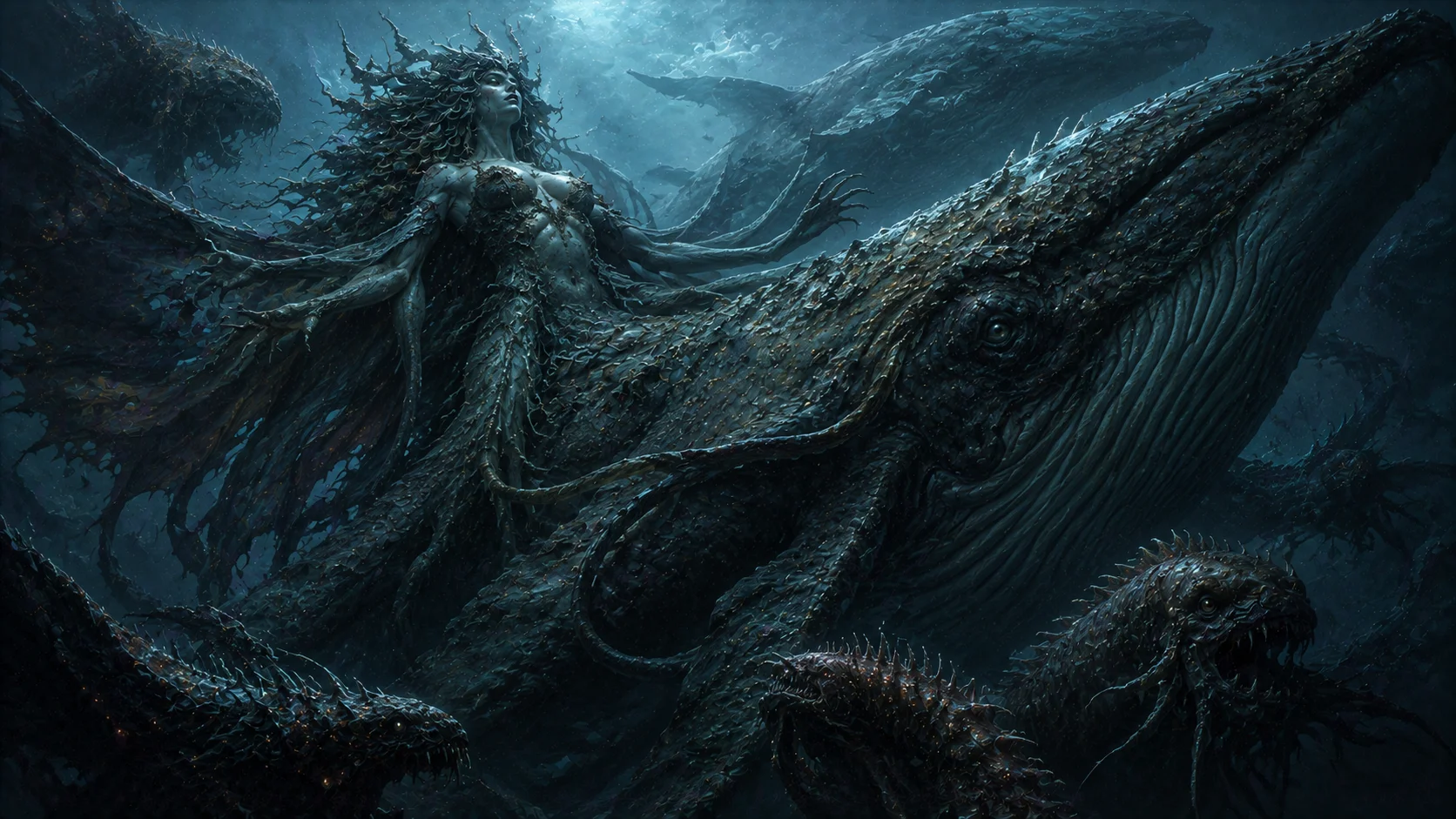
Ceto was the primordial goddess of the sea's monsters and its deepest dangers — the mother, with Phorcys, of the most fearsome creatures in Greek myth, and the personification of the terror of the deep. Her very name became the root of our words for sea-monsters and whales (cetacean), and she is the dark womb from which so many horrors of the ocean emerged.
The Goddess of Sea-Terrors
A daughter of the primordial sea (Pontus) and earth (Gaia), Ceto (whose name means “sea-monster” or “whale”) personified the dangers of the deep ocean — especially its great and terrible creatures, the huge beasts that lurked in the abyss. She was a being of the older, primal order of sea-deities, embodying the ocean not as a kingdom to be ruled but as a dark deep teeming with horrors.
Mother of Monsters
With her brother-consort Phorcys, Ceto gave birth to the great monstrous brood — the Gorgons (Stheno, Euryale, and Medusa), the grey Graeae, the dragon Ladon who guarded the golden apples, and (in many accounts) the monster Echidna, herself the mother of still more monsters. Through Ceto, the line of the sea's terrors extends to nearly every famous monster the Greek heroes ever faced. She is, with Echidna, one of the two great mothers of monsters in Greek myth.
The Sea-Monster Itself
Beyond being the mother of monsters, Ceto was also identified with the great sea-monsters themselves — the ketos, the huge whale-like beasts of the deep, including the very sea-monster that Perseus slew to save Andromeda (often called Cetus, the same root). She is at once the goddess who breeds the horrors of the sea and the horror itself, the living embodiment of everything that makes the deep ocean a place of dread.
The Dark Mother of the Deep
Ceto endures in our very vocabulary — in “cetacean” (whales and dolphins) and the constellation Cetus — and as one of mythology's primal mothers of monsters. She represents the ancient, fertile, terrible deep: the ocean as an abyss that gives birth to nightmares, the dark counterpart to the bountiful, gentle sea.
The deep does not merely hold monsters — in Ceto, the Greeks made the deep their mother.
What the Oldest Text Actually Says
The earliest surviving account of Ceto is not a story. It is a list. In Hesiod’s Theogony, the children of Pontus go past in a handful of lines: Nereus the eldest, called unerring and truthful; then, borne to Pontus by Gaia, Thaumas, whose name means wonder; Phorcys; Ceto; and Eurybia, who carries a heart of adamant in her breast. Five names, no adventures, no cult titles — and then the poem quietly does something extraordinary with two of them.
Nereus’s line yields the Nereids: fifty sea-nymphs whose names are the vocabulary of a good day at sea — calm water, safe harbour, fair current, the glitter of a wave. Ceto’s line yields almost every creature a Greek hero would later be obliged to kill. The two branches grow from the same parents in the same paragraph, and the poet never comments on the contrast. He does not have to. The sea has two faces, and the Theogony simply gives each face a parent and moves on.
The Fair-Cheeked Mother
Anyone who goes to the Greek meets a detail that tends to stop them: Hesiod calls Ceto fair-cheeked. The mother of the Gorgons is handed a beauty formula, the ordinary poetic ornament given to goddesses and to lovely mortal women. He then uses the very same epithet of the Graeae, the grey sisters — who, the poem insists in the same breath, were grey-haired from the instant they were born. Lovely and old at once, from birth, with no youth in between.
This is worth pausing on, because it corrects an assumption almost every modern reader brings to Greek monsters. Monstrousness in this tradition is rarely a matter of being ugly. Medusa in archaic art is a grinning grotesque with tusks and a protruding tongue; by the classical period she has become a beautiful, sorrowing face, and she is no less lethal for it. What makes a thing monstrous in Greek thought is that it crosses a boundary it should not cross — woman and snake, maiden and crone, mother and abyss. Ceto is terrible not because she is hideous but because of what comes out of her.
The Brood, Line by Line
Read as a catalogue rather than a summary, the children of Phorcys and Ceto arrive in a deliberate order, each one worse than the last.
- First the Graeae — Hesiod names only two, Pemphredo and Enyo, and says nothing at all about a shared eye. The single eye and single tooth, passed from hand to hand in the dark, belong to later poetry; a third sister, Deino, is added along the way. The most famous thing about the grey sisters is not in the oldest text about them.
- Then the Gorgons — Stheno, Euryale and Medusa — who dwell, the poem says, beyond glorious Ocean at the frontier towards Night, out where the Hesperides sing. Two of them are deathless and do not age. Medusa alone is mortal. That single line is the hinge on which the entire Perseus myth turns: of all the horrors Ceto produced, exactly one could be killed.
- Last, and youngest, the serpent who keeps the all-golden apples in the secret places of the dark earth, at its great bounds. Later writers call him Ladon, and some of them reassign him to Typhon and Echidna instead — the genealogies of monsters were never fixed, and rival poets shuffled the parentage freely.
There is a telling asymmetry buried in all of this. Ancient authors habitually call the Gorgons and the grey sisters the Phorcides — daughters of Phorcys. The mother who bore them lends her name to none of them. She is the womb in the family tree, and the tree is filed under her brother.
The Echidna Problem
Whether Echidna is Ceto’s daughter is one of the genuinely open questions in early Greek myth, and it comes down to a pronoun. The passage that introduces Echidna — half bright-eyed girl, half enormous speckled snake, eating raw flesh under the hidden places of the holy earth — opens with a “she” whose antecedent the Greek does not settle. It may be Ceto, continuing the catalogue of her children. It may be Callirhoë, who was mentioned a few lines earlier. Editors and commentators have argued the point at length, and the text itself does not decide it.
The consequences are large. If the “she” is Ceto, then Echidna is her daughter, and since Echidna with Typhon produced Cerberus, the Hydra, the Chimaera and their kin, virtually every monster in Greek myth descends from one sea-goddess inside a few dozen lines of verse. If the “she” is Callirhoë, the monstrous population of the world has two independent sources rather than one. An ambiguous pronoun in a poem roughly twenty-seven centuries old decides the shape of an entire mythology.
The Goddess Nobody Worshipped
Search the record for a temple of Ceto and there is nothing. No sanctuary, no festival, no priesthood, no votive dedication, no month named for her, no rite performed by sailors before a voyage. Her brother-consort at least touches the map: the Odyssey names a harbour of Phorcys on Ithaca, the cove where the Phaeacians lay the sleeping Odysseus ashore. Ceto has no harbour, no cave, no headland, no altar and no worshippers.
This is not neglect. It is what she is for. Ceto is a piece of theological engineering — a designated place in the family tree where the horrors of the sea can be attached without implicating anyone who mattered. Poseidon governs the sea as a kingdom; Nereus embodies its kindness; Ceto absorbs everything left over. A Greek sailor prayed to Poseidon for a safe crossing. Nobody prayed to the thing waiting underneath, because the point of Ceto is that she cannot be bargained with. She is the part of the ocean that does not negotiate.
Crataeis, and the Unsettled Mother of Scylla
Ceto is sometimes folded into a second figure, Crataeis, and the trail behind that identification is genuinely tangled. In the Odyssey, Circe tells Odysseus that when he passes the strait he should call on Crataeis, mother of Scylla, who bore that creature as a plague to mortals — and Homer says nothing more about who Crataeis is. Later poets fill the silence in incompatible ways: Apollonius makes Scylla the child of Phorcys by night-wandering Hecate, whom he identifies with Crataeis; other sources give her Phorcys and Ceto; others still supply names that appear nowhere else.
What survives is not a contradiction to be resolved but a pattern to be noticed. “Mother of the monster” behaves in Greek myth like a vacant office rather than a person. Different names step into it in different centuries and different regions, and the traditions borrow one another’s occupants. Ceto is among the names that recur in that slot, and the reason is probably the plainest one available: her name was already the Greek word for the thing being born.
How to Recognise a Ketos
The Greeks drew the sea-monster often enough that it has a consistent, recognisable anatomy. A ketos in vase painting, gem carving and mosaic has a long tooth-lined jaw somewhere between a dog’s and a crocodile’s, frequently a pointed ear or a spiny crest along the skull, a pair of clawed forelimbs or flippers just behind the head, and then a scaled serpentine body that coils away into a broad finned tail. It has no hind legs. It is, in effect, the front half of a predator welded to the back half of an eel — category violation rendered in paint.
It appears in two scenes above all: Perseus at Joppa, and Heracles at Troy. One of the earliest surviving depictions of the Trojan monster, on an archaic Corinthian vase, shows it not as a fleshy beast but as a huge pale head rising out of the rock, rendered with such a bare, bone-like eye socket that it has been proposed the painter had seen a fossil skull weathering out of a cliff. The suggestion cannot be proved, and it should be held lightly — but the Mediterranean coast is rich in exposed fossil beds, and the ancients certainly dug such bones up and drew conclusions from them.
Then something strange happens to the ketos. By the Hellenistic and Roman periods it has been thoroughly domesticated: Nereids ride the creatures side-saddle across mosaic floors, sarcophagus panels and bath-house walls, part of the cheerful marine procession that decorated any room a Roman wanted to feel cool in. The nightmare of the deep ended up as wallpaper.
Andromeda’s Monster Was Shipped to Rome
The best-documented moment in the whole afterlife of the ketos is an exhibition. Pliny the Elder records that Marcus Scaurus, during his term as aedile, brought back from Joppa — the very town where Andromeda was said to have been chained to the rock — the bones of the sea-monster itself, and put them on public display in Rome. Pliny gives measurements: a skeleton some forty feet long, ribs taller than an Indian elephant, a backbone a foot and a half thick. Joppa kept its other relics too, and visitors were shown the rock and the marks of Andromeda’s chains.
The remains were almost certainly those of a stranded whale, which is precisely what makes the episode so revealing. This was not credulity in the abstract. Romans went to look at physical evidence for a myth, and the evidence they were looking at was a real animal from the same dark water the myth was about. The word for the goddess, the word for the monster and the word for the whale had always been the same word.
Three Days in the Belly
The Trojan ketos gives us the other great encounter. Laomedon, king of Troy, cheated the gods who built his walls; the sea sent a monster; his daughter Hesione was chained at the shore as payment, and Heracles killed the creature and was cheated of his fee in turn, which is why he later sacked the city. A darker strand of the tradition — preserved in the ancient scholia to the Iliad and echoed in Lycophron’s Alexandra — adds a detail the summaries usually drop: Heracles did not fight the monster from outside at all. He leapt down its throat, spent three days cutting his way out of its belly, and emerged alive with every hair scalded from his head.
Swallowed, three days in the dark, and out again — it is a shape the eastern Mediterranean returned to more than once, and it is the reason the next section exists.
The Word That Swallowed Jonah
In Greek, ketos never meant one species. It meant any enormous thing in the water: a whale, a shark, a seal of unusual size, the unknown mass that surfaces once and is not seen again. When the Hebrew scriptures were translated into Greek at Alexandria, the great fish that swallowed Jonah was rendered with exactly that word, and the Gospel of Matthew quotes the story in the same terms — three days and three nights in the belly of the ketos. Latin took it over as cetus.
So the whale of the popular imagination, the one in every children’s Bible, arrived wearing the name of a Greek sea-monster goddess, and kept it. Modern zoology never let go either: every whale, dolphin and porpoise on earth is still classified under her name. Ceto lost her temples, her stories and her worshippers, and won the dictionary instead.
The Mother Who Was Never Fought
Set Ceto beside the great sea-mothers of the neighbouring traditions and one absence becomes very loud. In Babylonian myth, Tiamat — the salt-water mother of monsters — is confronted by Marduk, killed, and split in two to make the sky and the earth. In the Ugaritic texts the storm god fights Yam, the Sea. Hebrew scripture keeps the same combat in poetic memory, with Leviathan and Rahab broken in the deep. The pattern is one of the oldest in the region: the young sky god defeats the old water and builds the world out of the corpse.
Nobody ever fights Ceto. No Olympian confronts her, no hero seeks her out, there is no battle and no death scene. Her children are hunted down one at a time — Medusa beheaded, Ladon shot at the world’s edge, the grey sisters robbed of their eye — and their mother simply stops being mentioned. That is how Greek theogony disposes of the older order generally: not by combat but by genealogy. The primordial powers are married off, out-generated and filed into a family tree, until the new gods hold the throne and the old ones have become paragraphs. Ceto is not defeated. She is catalogued, which for a deity is a quieter and more permanent kind of ending.
Cetus Among the Stars
The monster kept one territory the Olympians could not take, and it is enormous. Cetus is one of the classical constellations and among the largest in the sky, and it sits inside the region the old star maps call the Water: Eridanus the celestial river, Aquarius pouring, Pisces, Capricornus, the southern fish. Ancient astronomers put a whole ocean overhead and dropped the sea-monster into it.
Two of its stars matter far beyond mythology. In 1596 the astronomer David Fabricius watched a star in Cetus, omicron Ceti, fade entirely from naked-eye visibility and then return — generally counted the first star recognised as genuinely variable, at a time when the heavens were still widely held to be changeless. It was later named Mira, the wonderful. And Tau Ceti, a sun-like star roughly twelve light years away, was one of the first two stars ever deliberately listened to in a radio search for signals from other civilisations, in 1960. When humanity first turned an ear towards the possibility of another mind in the universe, it aimed at the sea-monster.
Release the Kraken
Modern cinema handed Ceto’s creature the wrong name, and the wrong name won. In the 1981 film of the Perseus myth and again in its 2010 remake, the beast sent against Andromeda is called the Kraken — a monster of Scandinavian sea-lore, from the cold north Atlantic, with no connection whatever to the Greek myth it was drafted into. The line ordering its release became one of the most quoted in modern monster cinema. It is also a mythological misfiling of some two thousand miles and two thousand years: the thing Andromeda was left for is a ketos, Ceto’s namesake and Ceto’s kind.
The substitution is instructive rather than merely annoying. Audiences needed a word that sounded like dread, and by the twentieth century the Greek word had been worn smooth by biology — you cannot frighten anyone with a cetacean. The monster had to borrow a name from a colder sea.
Why the Deep Still Keeps a Mother
Every other Greek monster has a location you could in principle sail to. The Gorgons live past Ocean, Scylla in a named strait, Ladon in a specific garden. Ceto has no address, because the thing she personifies is not a place but a volume — the unlit majority of the planet, the water below the depth light reaches, which is most of the water there is.
That is why she survives every correction. Medieval mapmakers filled unsurveyed ocean with her descendants; whalers came home with stories that would have been perfectly at home in Hesiod; and the giant squid, an animal fully as strange as anything the Greeks imagined, was not photographed alive in the wild until 2004. We have mapped the surface of Mars in more detail than the floor of our own sea. The abyss is still doing what it did when a Boeotian poet gave it a fair-cheeked mother: producing things we have not met, at a rate we cannot inventory.
Every other myth asks what lives in the deep. Ceto answers a harder question — where the deep gets them from.
Sources & traditions
- EncyclopediaWikipedia — Ceto
- TraditionGreek texts, inscriptions and later retellings (Greece)
Myths change from area to area and from time to time. This chronicle follows the most widely told versions; tellings in other villages, regions and eras may differ.