Iravan — Irāvān, also Aravan — is one of the most remarkable and tender figures of the Mahabharata: the son of Arjuna and the serpent-princess Ulupi, a young warrior who offered himself in self-sacrifice for the Pandava victory, and who — on the eve of that death — was wed for a single night to the god Krishna in female form. He is worshipped as a god in his own right across Tamil Nadu, the patron deity of the Aravani transgender community who claim him as their own.
The Serpent-Princess’s Son
Iravan was born during Arjuna’s years of pilgrimage, when the hero journeyed to the realm of the nagas and was wed to the widowed serpent-princess Ulupi. Their son was raised in the underwater serpent-kingdom of his mother’s people and came to his father’s side only when the great war demanded every able warrior. He fought valiantly in the early days of Kurukshetra — until a darker necessity arose.
The Battlefield Sacrifice
To secure victory, the Pandavas were counselled to perform kalappali — the sacrifice of a perfect warrior to the goddess Kali before battle. The only volunteers fit for the offering were Krishna, Arjuna, and Iravan; and of these only Iravan freely offered his own head. He laid down but one condition: he would not die unmarried, for a man who dies a bachelor is denied the proper funeral rites and a wife’s mourning. But who would wed a man doomed to die at dawn? No woman would consent to so brief and bereaved a marriage.
The Marriage of Mohini
So Krishna himself took the form of Mohini, his enchanting female avatar, and married Iravan. For one night Krishna-as-Mohini was his wife; and at dawn, when Iravan’s severed head was offered and his life given for the cause, Mohini wept and mourned for him as a widow, breaking her bangles and lamenting — the god grieving for the boy who gave everything. It is among the most poignant images in all the epic: the supreme deity, in a woman’s form, weeping over the sacrifice of a young hero.
The God of Koovagam
From this tale springs one of South India’s most extraordinary living festivals. At the temple of Koothandavar (Iravan) in the village of Koovagam, the eighteen-day festival re-enacts the marriage and mourning each year: Aravani transgender women and hijras ritually marry the god Aravan, then on the final day mourn his death as widows, breaking their bangles and beating their breasts. Iravan, the boy who would not die unwed, has become across Tamil Nadu a divine patron and a figure of deep identity and belonging — a small character of the Sanskrit epic transfigured by folk devotion into a living god of sacrifice, marriage, and grief.
A Second Death, Written Centuries Earlier
Long before Koovagam’s drummers process past the shrine of Koothandavar, the Mahabharata itself killed Iravan a different way — on the battlefield, in daylight, with none of the tenderness of Mohini’s mourning. In the Sanskrit epic’s account of the eighth day of the war, Iravan rides against the Kaurava host at the head of his own troop and cuts down the brothers of Shakuni, the sons of Subala, one after another, until Duryodhana turns to the one ally capable of stopping him: Alambusha, a rakshasa who fights by illusion.
The duel that follows is a duel of shapes. Iravan, born of a naga mother, takes serpent form and is ringed about by his mother’s kin until he looms as vast as Ananta himself. Alambusha answers by becoming Garuda, the eternal devourer of snakes, and eats the serpents out of the air around him. Stripped of the one inheritance that made him formidable, Iravan is cut down where he stands and his head taken with a sword — the same head that Tamil devotion would later set on a pedestal and worship.
It is a quieter, crueler death than the one Tamil devotion later gave him: no bridal night, no willing sacrifice, only a young half-naga warrior undone by the oldest enemy of his mother’s people. But the epic does not let it pass unanswered. Hearing that his cousin has fallen, Ghatotkacha — Bhima’s son by the rakshasi Hidimbi — roars and drives straight at Duryodhana, wounding the Kaurava king in the open field, until Bhagadatta forces his war-elephant between them to save him. Both of these young men were born outside the boundaries of ordinary marriage, one to a naga princess and one to a rakshasi, and it is the second who avenges the first. The epic offers this almost in passing, though it says a good deal about who the Pandavas’ most formidable soldiers actually were.
The Head That Watches the War
Tamil tradition gives Aravan not one boon but three, and the second is the strangest. Krishna grants him a heroic death, then the sight of the entire eighteen-day war, and only then the wife he asked for. That second boon is what turns a severed head into a witness: the offering is made at dawn, and the head goes on watching the war it bought.
Iravan is not alone in this. Rajasthan keeps a strikingly similar story about Barbarik, who is, as it happens, the son of that same Ghatotkacha and so a grandson of Bhima. Barbarik came to Kurukshetra with three arrows given him by Shiva and a vow that could have ended the war in an afternoon: he would fight for whichever side was losing, which meant victory would swing wherever he wished it the moment he loosed the first of them. Krishna, testing him in the disguise of a brahmin, saw the danger at once and asked for his head as a gift of charity before the fighting began. Barbarik gave it — asking, as Iravan asked, for one condition of his own: that his head be set on a height above the field so that he might watch the whole war. It was granted, and that head is worshipped in Rajasthan today as Khatu Shyamji.
Set side by side, the two stories share a shape: a young warrior only tangentially of the main Pandava line is asked to give his head before the war rather than his life inside it, and is repaid not with a hero’s death but with a second existence — a god who watches, blesses and guards the very war that killed him. Neither figure owes that afterlife to the Sanskrit text. Barbarik does not appear in it at all, and Iravan appears only to die on the eighth day. Both were kept alive by the regions that adopted them.
A God Kept Apart from His Body
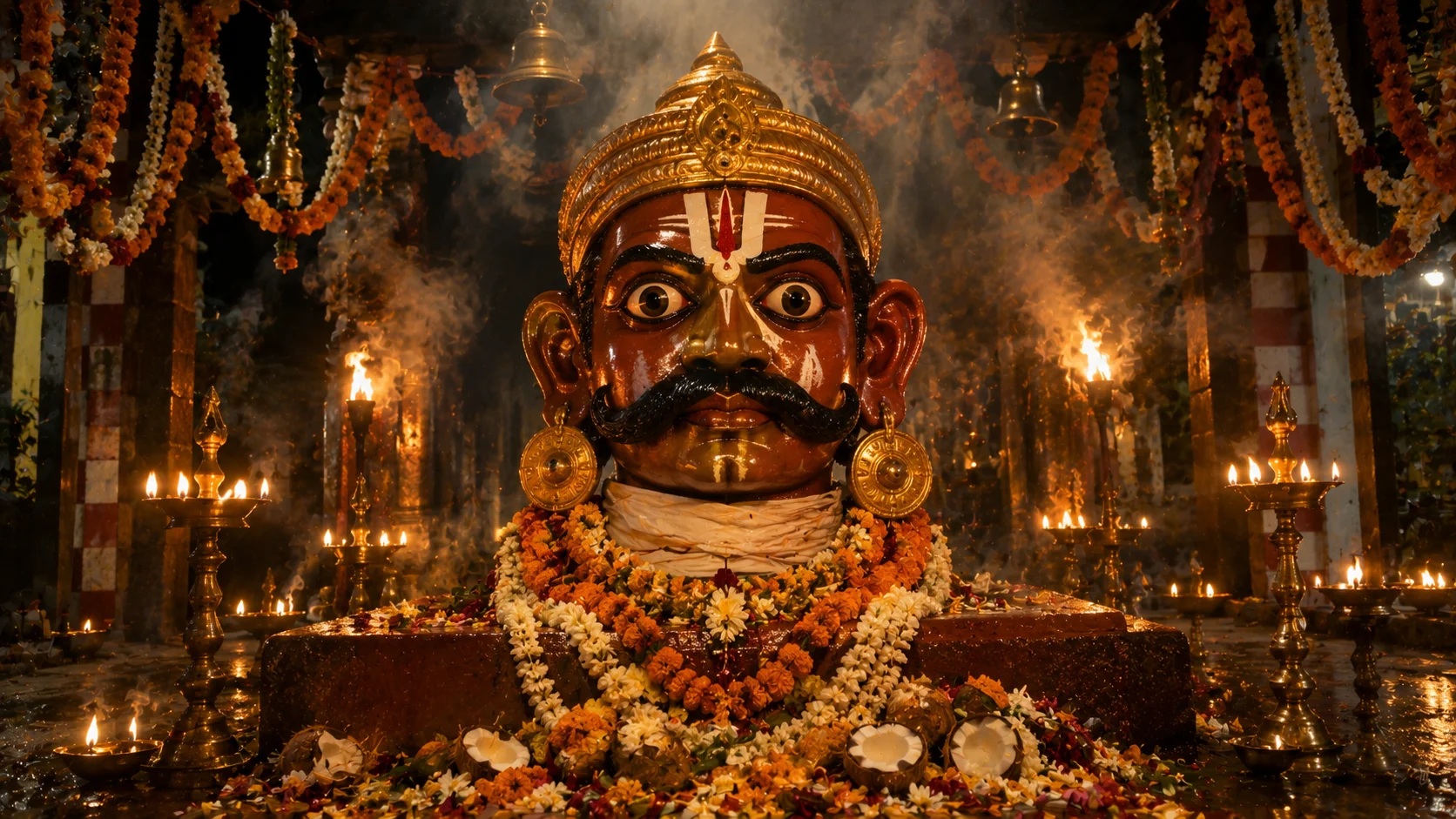
That inheritance shapes how Aravan is actually pictured. Where most Hindu deities are shown whole — body, limbs, attributes, mount — his principal icon in Tamil Nadu is a head and nothing else: oversized, moustached, wide-eyed and large-eared, crowned with a conical kirita and marked on the brow with the Vaishnava tilaka of a devotee of Krishna. The face is very often painted a strong red. Most versions give him the fierce canine teeth of a being who belongs partly to the far side of some boundary, and a cobra rises from the crown or from behind it — his mother Ulupi’s naga blood, asserted in the one place nobody can miss it.
It is a disconcerting image to meet for the first time, until the story behind it is known, and then it becomes exactly the point. This is a god defined by what he gave away, and the icon declines to pretend otherwise.
The venerated head also sits inside a much older Tamil habit. From the Sangam period onward the Tamil country planted nadukal — hero-stones raised for men killed in battle or in the cattle-raids that fill the martial poetry, carved with the dead man’s last act; the Tolkappiyam sets out the stages of erecting one. These were never merely memorials. They were garlanded, dressed with peacock feathers and worshipped as gods, and more than a few became the seed of a village shrine. Aravan’s cult did not invent that instinct. It belongs to the same long Tamil conviction that a man who dies giving himself away does not thereby stop being present — and it attached to that conviction an unusually literary and emotionally exact story.
Three Boons, Two Cults
The three boons are not a decorative flourish. They are the seam along which Aravan’s worship splits in two. The Kuttantavar cult, whose great festival is the one at Koovagam, ritualises the first and the third: the glorious death, and the marriage. The Draupadi cult, spread across its own network of temples, ritualises the second instead. There, Aravan’s head is hoisted on a post above the ground where the war is performed again, so that the god may do each year exactly what Krishna promised him, and watch.
The same story, in other words, yields two entirely different rites depending on which promise a community elects to keep. One tradition takes up the wedding and the widowhood and builds from them a festival of identity and grief. The other takes up the watching, and builds a theatre with a god in the audience. Even the medieval Tamil retelling by Villiputturar carries its own variant, granting Aravan a sight of the battle lasting a few days rather than the whole of it.
What survives every version is the bargain itself. Iravan is that rare figure permitted to name his terms to a god and have them honoured to the letter — and each of the three things he asked for has outlived him as a rite performed by living people. It is an extravagant afterlife for a warrior the Sanskrit epic disposes of in a single afternoon.
Sources & traditions
- EncyclopediaWikipedia — Iravan
- TraditionHindu texts, oral tradition and village tellings (South Asia)
Myths change from area to area and from time to time. This chronicle follows the most widely told versions; tellings in other villages, regions and eras may differ.