Somewhere in the roll-call of Völuspá, deep in the poem's catalogue of dwarves known as the Dvergatal, a name is spoken among dozens of others: Dvalinn. It passes quickly — one entry in a list meant to be recited, not lingered on. And yet no other name in that catalogue turns up so often elsewhere. Dvalinn is spoken again in Hávamál, again in Grímnismál, again in Alvíssmál, again in Fáfnismál, again in Snorri Sturluson's Prose Edda, and again, centuries later, in a saga about a cursed sword. A single name, recurring across the whole span of Old Norse literature, never quite the same figure twice.
A Name Spoken Four Times Over
Dvalinn (rendered in English as Dvalin) is one of the most frequently named dwarves anywhere in the surviving Old Norse corpus. He is not the subject of a saga of his own, and no single poem tells his life from beginning to end. Instead he surfaces again and again, in different poems, in different roles, as though the tradition simply assumed everyone already knew who he was and never bothered to explain him from scratch.
Scattered Across a Literature
That scattering is itself the story. The Poetic Edda — the anonymous verse collection gathered into the Codex Regius manuscript around 1270 CE in Iceland, drawing on oral material centuries older — names him in at least four separate poems. Snorri Sturluson's Prose Edda, written around 1220 CE as a handbook for poets working two to three centuries after Scandinavia's conversion to Christianity, repeats several of those uses. To read Dvalinn is to read a name doing several jobs at once across a literature that was never trying to be a single consistent encyclopedia.
The Dwarf Who Taught the Runes
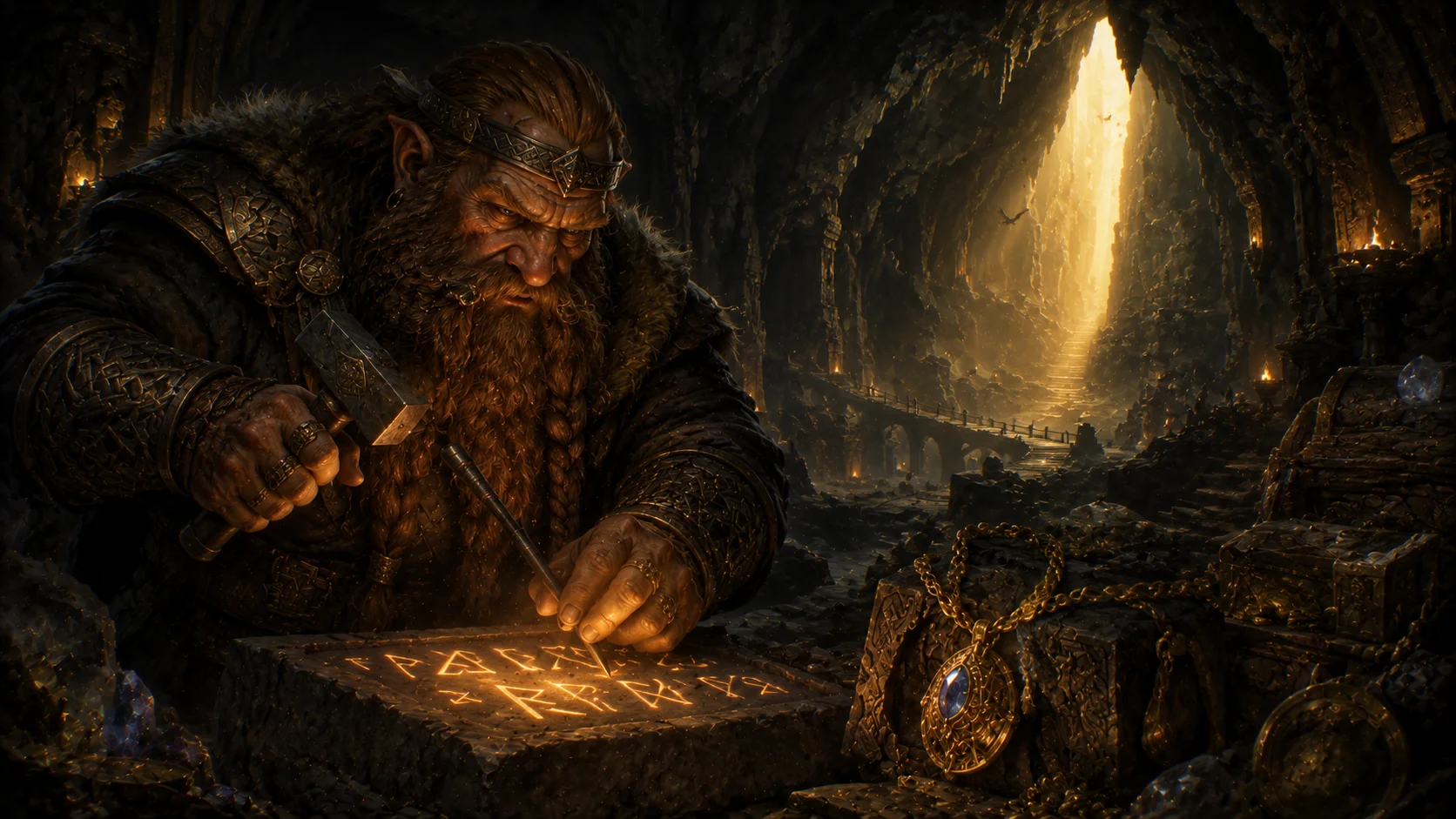
Of all his appearances, the one that carries the most weight is in Hávamál, the Poetic Edda's great collection of wisdom-sayings attributed to Odin. There, in the verses concerning the origin of the runes — the angular letters that carried both writing and magic in the Norse world — the poem states that the knowledge of the runes was carried to each race of beings by one of their own. Odin brought the runes to the Aesir, the gods. Dáinn brought them to the elves. Ásviðr brought them to the giants. And Dvalinn brought them to the dwarves.
An Ancestral Claim to Hidden Knowledge
This is not a small honor folded into a longer story. It places Dvalinn at the head of an entire lineage of dwarvish rune-lore, the ancestral source from which every dwarf who ever carved a rune-stave was, in the poem's own logic, ultimately descended. Where Odin's gift to the gods is the best known of the four transmissions, Dvalinn's parallel role for the dwarves marks him as their equivalent figure — not merely a craftsman among craftsmen, but the keeper of the dwarves' own claim to hidden knowledge.
Freyja's Necklace, Made by Four Hands
Craft, of course, was the dwarves' native element, and Dvalinn's name is bound to one of the most celebrated treasures in the Norse imagination: Brísingamen, the necklace of the goddess Freyja. The short tale Sörla þáttr names Dvalinn as one of four dwarves who forged it together. It was not his alone. The necklace was a collaboration, and the story remembers all four makers, Dvalinn among them, rather than crediting a single smith.
Not Brokkr's, Not Eitri's
It is worth being precise about what this does and does not connect Dvalinn to. Norse tradition preserves other, separate stories of dwarvish treasure-making: the contest between the smiths Brokkr and Eitri, who forged the boar Gullinbursti, the ring Draupnir, and the hammer Mjölnir; and the earlier gifts of the so-called Sons of Ivaldi, a different group of dwarves entirely, who made Sif's golden hair, the ship Skíðblaðnir, and the spear Gungnir. Skáldskaparmál, the section of the Prose Edda that tells these stories, never names its Sons of Ivaldi individually — and Dvalinn is not among the smiths credited with the Brokkr-and-Eitri contest either. His treasure-making, as the sources actually give it, belongs to Brísingamen and nowhere else.
One of Four Names Grazing Yggdrasil
Elsewhere in the Poetic Edda, the name reappears in a wholly different register. Grímnismál, a poem largely concerned with cataloguing the geography of the Norse cosmos, lists four stags that graze among the branches of the world-tree Yggdrasil, cropping its leaves: Dáinn, Dvalinn, Duneyrr, and Duraþrór. The same four names recur in Gylfaginning, the section of Snorri's Prose Edda that lays out the structure of the cosmos.
Scholars treat this stag named Dvalinn as a distinct use of the name from the dwarf — not a second role in one continuous biography, but the same word doing separate work in a different part of the mythological furniture. Norse literature reused names across categories of being with a freedom that can look, to a modern reader, like carelessness. It was not; it was simply how a large oral-derived tradition organized itself, letting names recur wherever they scanned or wherever they fit the shape of a formula. The stag Dvalinn stands beside the dwarf Dvalinn as a second, separate figure sharing his name, one more example of how thoroughly the word had worked its way into the vocabulary of the cosmos — not a further deed to add to the dwarf's own account.
The Sun as Deceiver
The most vivid use of the name, though, is not a role or a title at all but a riddle. In Alvíssmál, a poem built entirely around a contest of kennings — the layered, indirect poetic names the skalds used in place of plain words — the sun itself is given a name drawn from Dvalinn: "Dvalinn's deceiver," or a kenning very close to it.
The logic behind the kenning is one of the oldest and grimmest facts of dwarf-lore. Dwarves belonged to the dark and the underground; sunlight was not merely uncomfortable to them but lethal, capable of turning a dwarf caught in its light to stone. The dwarf Alviss meets exactly this fate elsewhere in the same poem, talked through the night by Thor until dawn breaks and petrifies him. To call the sun "Dvalinn's deceiver" is to compress that entire fear into two words: the sun as trickster, luring the unwary dwarf into the light that will end him. Whether the kenning implies that this fate befell Dvalinn himself, or simply invokes his name as emblematic of the peril every dwarf faced, the sources give us the phrase and no more — but either way, it fixes his name permanently to that terror of the light.
Odin brought the runes to the gods. Dáinn brought them to the elves. Ásviðr brought them to the giants. And Dvalinn brought them to the dwarves.
A Cursed Sword, Centuries Later
The name resurfaces once more, long after the Eddas, in the legendary saga Hervarar saga ok Heiðreks. There, a dwarf named Dvalinn — working alongside another dwarf, Durinn — forges and curses the sword Tyrfing, the weapon whose doom will haunt the saga's heroes for generations.
This is a genuinely different tradition from anything in the Poetic or Prose Edda, and it is worth holding the two apart deliberately. The Hervarar saga belongs to the later legendary-saga genre, composed well after the Eddic poems and Snorri's handbook, and its Dvalinn-and-Tyrfing story has no attested connection to the rune-teaching, the Dvergatal listing, or the Brísingamen-making of the earlier sources. It is not a continuation of those stories or a hidden piece of the same puzzle. It is simply a separate literary tradition that happened to reach for the same well-worn dwarf-name when it needed a smith capable of forging a legendary, cursed blade — much as later fantasy fiction and games have gone on doing with dwarvish names ever since, often blending and inventing relationships that the medieval sources themselves never state.
What the Name Carries, and What It Doesn't
Taken all together, Dvalinn's many appearances outline something unusual: a figure defined almost entirely by function rather than by biography. The sources never tell us where he was born, who his kin were, or how his story ended. What they give instead is a scattered set of credits, recurring across centuries of Icelandic writing:
- Rune-bringer to the dwarves, named alongside Odin, Dáinn, and Ásviðr in Hávamál's account of the four transmissions
- An entry in the Dvergatal, Völuspá's long roll-call of dwarf-names
- One of four dwarves who forged Freyja's necklace Brísingamen, per Sörla þáttr
- The name shared by one of the four stags grazing Yggdrasil in Grímnismál and Gylfaginning
- The dwarf invoked in Alvíssmál's kenning for the sun as "Dvalinn's deceiver," tied to the dwarves' fatal vulnerability to sunlight
- A separate, later dwarf of the same name credited in Hervarar saga ok Heiðreks with forging the cursed sword Tyrfing
No source connects all six of these into a single continuous life, and none should be forced to. What they share is simply the name, carried by a medieval literary culture that valued recurrence and formula over the kind of single-hero biography that later ages have tried to reconstruct for him.
A Dwarf Made of Fragments
It is tempting, faced with so many appearances, to want to stitch Dvalinn into one coherent character — the rune-master who also made the necklace, who also lent his name to a stag, who also forged a cursed sword, who also, perhaps, met the sun's deception at the end of it all. The sources resist that stitching. Each appearance stands where it was written, in its own poem, serving its own purpose, and the honest shape of Dvalinn is the shape of all of them held apart rather than fused together.
That fragmentary quality is, in its own way, the most Norse thing about him. The dwarves of Old Norse literature were rarely given the sustained narrative attention paid to gods or heroes; they were craftsmen, keepers of the underground and its secrets, named in catalogues and invoked in kennings rather than followed through a plot. Dvalinn, more than almost any other dwarf in the corpus, is what that mode of storytelling produces: not a hero with a beginning and an end, but a name that a whole literature kept reaching for, generation after generation, whenever it needed a dwarf to carry knowledge, or craft, or dread.
Sources & traditions
- EncyclopediaWikipedia — Dvalinn
- TraditionNorse texts, inscriptions and later retellings (Scandinavia)
Myths change from area to area and from time to time. This chronicle follows the most widely told versions; tellings in other villages, regions and eras may differ.