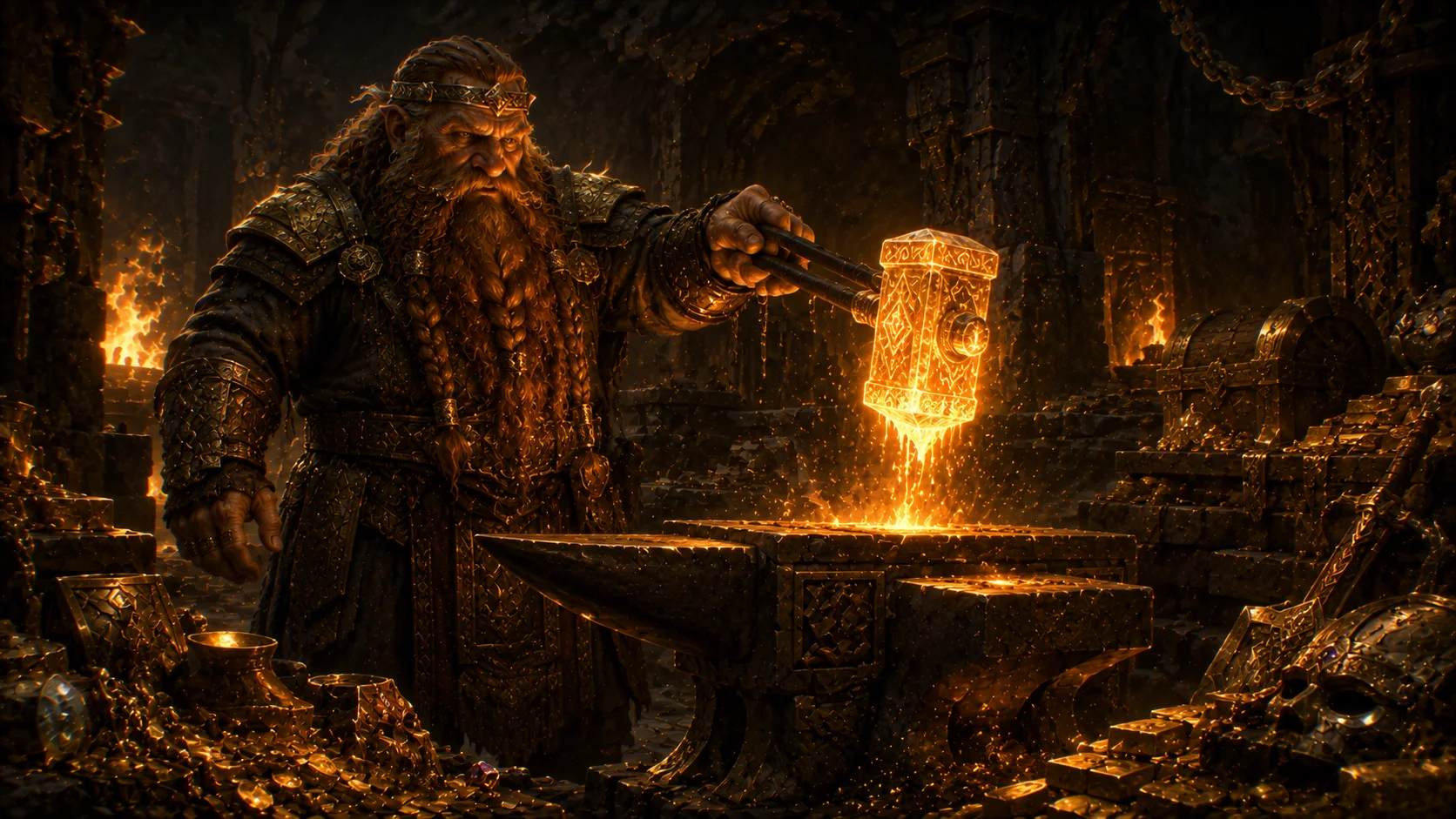
Somewhere beneath the rock, a fly is biting a dwarf's eyelid until it bleeds, and the dwarf will not let go of the bellows. Above him at the anvil, his brother has just laid a strip of iron into the coals and given an order: whatever happens now, do not stop pumping. A god's head is riding on it. What comes out of that fire, minutes later, is the hammer that will guard every world the gods hold.
Two Brothers and a Furnace
Eitri — called Sindri in the same breath by the very source that names him — was a dwarf-smith, brother to Brokkr, and by the account that has survived, the finest craftsman ever to work a forge in the Norse cosmos. Snorri Sturluson set the story down around the year 1220 in the Skaldskaparmal section of his Prose Edda, and it is essentially the only place Eitri appears at all. He is not named in the older poems of the Poetic Edda, not listed among the dwarves of Voluspa's long catalogue, not mentioned in Havamal or Grimnismal the way his kinsman Dvalin is scattered across half a dozen texts. Eitri exists, almost entirely, inside one telling — and it is enough, because that telling gave the gods their sharpest weapon.
Dwarves, in the Norse imagination, were not a footnote race. Voluspa and Gylfaginning describe them as having arisen from the flesh and bones of the primordial giant Ymir himself, and their gift — the thing that set them apart from gods, elves, and men alike — was craft. They worked stone and earth and metal in forges hidden from daylight, and the treasures that came out of those forges were, again and again, the treasures that made the gods who they were. Eitri stood at the very top of that lineage. Brokkr worked the bellows; Eitri worked the fire. It was a partnership built on an absolute division of labor — one man's hands on the metal, one man's arms on the air that fed the flame — and neither role could succeed without the other holding perfectly still under pressure.
A Wager Born of Loki's Vanity
The story that brought Eitri to the anvil did not begin with him at all. It began, as so much trouble in Norse myth does, with Loki. He had cut off the golden hair of Sif, Thor's wife — an act of pure mischief with no forge in sight — and to make amends he went to a different set of dwarves, the sons of Ivaldi, and had them forge new hair for her out of gold, along with two more wonders: the ship Skidbladnir, which could be folded like cloth, and the spear Gungnir, which never missed its mark.
Pleased with himself, Loki made a boast he had no need to make. He wagered his own head that no smith alive could match what the sons of Ivaldi had built. It was the kind of bet a trickster makes when he has forgotten that other people can also work miracles. Brokkr took him up on it. He staked that his brother Eitri could forge three better treasures — and the contest that followed would produce, among other things, the hammer that still guards Asgard in every telling of the myth that follows it.
The Forge That Would Not Stop
Eitri's method was simple and absolute. He laid the raw material into the fire — gold, a pigskin, a bar of iron — and told Brokkr to work the bellows without pause, no matter what he saw or felt, until the piece was drawn from the flame. There is no room in that instruction for hesitation. The craft depended entirely on unbroken heat, and unbroken heat depended entirely on a man who would not let go of his handles no matter what happened to him.
Loki, watching his own head slide toward forfeiture, was not content to lose fairly. He turned himself into a fly and descended on Brokkr at the bellows, stinging him again and again to break his rhythm and ruin the work. For the first two treasures, Brokkr held. For the third — the hammer — the fly bit him on the eyelid itself, hard enough to draw blood, hard enough that for one instant Brokkr's hands came up to his own face instead of the bellows. Eitri had already told him not to stop. He had stopped anyway, for a heartbeat, because a man can only take so much before his own body answers pain before instruction.
That heartbeat is why Mjölnir's handle came out of the fire shorter than Eitri intended. Not a flaw in the smith's skill — a flaw in what a fly and a trickster's malice can do to the hands of the man holding the bellows, even when the man himself would not have chosen to fail.
What Came Out of the Fire
Three things came out of Eitri's forge that day, each of them among the most famous objects in the entire Norse mythological corpus.
- Gullinbursti, the golden boar, whose bristles glowed bright enough to light the dark and who could outrun any horse across land, sea, or open air.
- Draupnir, the arm-ring, from which eight new rings of equal weight dripped every ninth night — a wellspring of gold that never emptied itself.
- Mjölnir, the hammer, forged with a handle too short by the width of one stolen heartbeat, but a weapon that never missed what it was thrown at and always found its way back to the hand that threw it.
Three objects, three different kinds of power — light against darkness, wealth without end, and a weapon that could not be evaded — all drawn from the same fire by the same pair of hands working in perfect, nearly-unbroken coordination.
The Judgment
When the treasures were laid before the gods for judgment, the panel was not a casual one. Odin, Thor, and Freyr sat to decide which set of wonders was greater — the sons of Ivaldi's golden hair, folding ship, and unerring spear, or Eitri and Brokkr's glowing boar, self-multiplying ring, and short-handled hammer.
The gods ruled for Mjölnir. Not because it was flawless — everyone present could see the handle was short — but because of what it could do: stand between Asgard and the frost giants who wanted it destroyed. A hammer that never missed and always returned was worth more to the gods' survival than gold that dripped forever or a boar that outran the wind. Craftsmanship, in this verdict, was measured by what would keep the gods alive, not by what looked most perfect on the table.
The Price of Losing a Bet with a God
Eitri and Brokkr had won. Loki had lost his head, by his own wager, fair and spoken aloud before witnesses. But Loki was never a creature who paid debts cleanly. He argued that while Brokkr had won his head, he had never bargained for Loki's neck — and there was no way to take the one without cutting the other. It was a trick answer to a trick's own bet, and it worked. Loki kept his head. Brokkr, denied the payment he was owed, took the only compensation left to him and sewed Loki's lips shut instead — a silencing rather than a killing, but a mark on the trickster all the same.
Eitri himself does not speak again after the forging. The text gives him no line in this final scene; it is Brokkr, the bellows-worker, who deals with Loki's escape. Eitri's part in the story ends where his part in the craft ends — at the anvil, with the work already finished and already judged.
One Smith or Two Names?
Even within Snorri's own account, Eitri is not named with total consistency — the same passage that calls him Eitri also uses the name Sindri, and neither medieval manuscripts nor modern retellings agree on whether these are one dwarf under two names or two distinct figures folded together by scribal habit. Most popular summaries simply treat Eitri and Sindri as the same smith, and that is the safest reading of a passage that was never trying to settle the question for us. It is a small, honest gap in the record — the kind oral and manuscript traditions leave everywhere, and one more reminder that even a story this famous survives through a single narrow channel of transmission.
His name itself may carry an echo of that channel's strangeness: some etymologists connect Old Norse Eitri to eitr, "poison" or "venom" — an odd shadow to fall across a maker of treasures, though the connection is not certain, and Snorri's text gives no hint that it mattered to the story he told.
A Craft That Did Not Belong to the Gods
What makes Eitri's story matter beyond its own three treasures is what it says about power in the Norse cosmos. The Aesir were mighty, but they were not self-sufficient. Thor's hammer, Odin's rule, Freyr's judgment at the trial — all of it depended, in this one tale, on beings the gods did not command and could not simply order into obedience. Eitri and Brokkr were outsiders to the divine family, bound to no god, answering to no one but the terms of their own wager. And yet the single object most associated with the defense of Asgard against the giants came from their hands, not the gods' own.
That is the pattern across the wider family of dwarf-smiths in these texts — Eitri and Brokkr forging Mjölnir, Draupnir, and Gullinbursti; the sons of Ivaldi forging Sif's hair, Skidbladnir, and Gungnir in the same cycle of stories. Neither group fought in wars or ruled over anything. Their power was entirely the power of the anvil, and the gods, for all their strength, needed what that anvil produced.
From the Forge to the Screen
Eitri and Sindri's afterlife did not end with Snorri's manuscript. In the modern God of War video games, Sindri and Brok are recast as recurring companions with invented rivalries, family drama, and personalities built entirely for the games — none of it drawn from the medieval sources, all of it a new story wearing an old name. It is worth holding the two apart: the dwarf who forged Mjölnir under a fly's sting is a figure of a single, spare medieval passage: a smith, a brother, a fire that could not stop, and three treasures judged before Odin, Thor, and Freyr. Everything since is someone else's telling.
What the Hammer Remembers
Eitri never raises a weapon, never enters a hall, never speaks a line of dialogue that survives to us beyond the instruction to keep the bellows moving. And still, every time Mjölnir returns to a hand that threw it, it is Eitri's hand, in a sense, still at work — the smith who would not let a burning fly-bitten brother's flinch spoil what the fire had already promised to become. Draupnir still drips its eight rings on schedule; Gullinbursti still, in the telling, outruns the wind. But it is the hammer with the too-short handle that the gods themselves judged greatest, and it is the hammer that has outlived every other detail of the story — the one thing from Eitri's forge that the frost giants of Asgard could never get past.
Sources & traditions
- EncyclopediaWikipedia — Eitri
- TraditionNorse texts, inscriptions and later retellings (Scandinavia)
Myths change from area to area and from time to time. This chronicle follows the most widely told versions; tellings in other villages, regions and eras may differ.