A hand closes around the handle of the bellows, and does not let go. Something has bitten it — hard, between the knuckles, the kind of bite that makes a man's grip fail — and still the hand holds. Blood runs down the dwarf's fingers while his brother works the forge-fire behind him, and in the coals a pig's skin is becoming something else. This is the moment the golden boar is made: not in a quiet workshop, but in the middle of a sabotage, on a wager for a god's head.
An Act With No Stated Reason
The tale begins, in Snorri Sturluson's Skáldskaparmál, with an act of vandalism. Loki cut off the hair of Sif, the wife of the god Thor. Snorri's text does not explain why. It states the act and moves straight to the consequence — no jealousy, no grudge, no self-preservation is named as the cause, whatever later tellers have supplied since. What the source gives us is only the deed and the debt it created. That gap is not an accident of a lost page; it is how this whole cycle of stories is told throughout — an action reported flatly, its motive left for the audience to supply or simply do without. The pattern set here at the opening line repeats all the way through to the golden boar's own making.
Gold That Grows Like Hair
To make amends, Loki turned to dwarves called the Sons of Ivaldi, who forged Sif new hair out of gold — hair said to take root and grow upon her head as living hair would. The same commission, in the same visit, produced two further wonders: the ship Skíðblaðnir, built for Freyr, and the spear Gungnir, made for Odin. Three gifts from one visit to one pair of smiths, each one solving the debt in a different register: the hair repairs the original harm directly, while the ship and the spear are, in effect, interest paid on top — proof that the dwarves' skill exceeded what the injury alone required.
A Wager Over His Own Head
Loki, pleased with the work, could not leave it alone. He wagered his own head against the dwarf Brokkr that Brokkr's brother Eitri — also called Sindri — could not match it. It was a reckless bet even by Loki's standards, and it set two separate pairs of dwarf-smiths against each other across the same story: the Sons of Ivaldi on one side, Brokkr and Eitri on the other. The stakes matter for how the rest of the episode reads. What follows is not simple mischief for its own sake — it is a man trying to keep his own head attached to his shoulders, and that pressure is what turns a craft contest into sabotage.
Skin Into the Fire
Eitri began the second forging by throwing a pig's skin into the flames, while Brokkr took up the bellows and pumped without pause. Dwarves in Norse tradition are craftsmen of the underground and the forge-fire above all else, and this pair worked to a rhythm that could not be broken, because Loki had already resolved to break it. The choice of a pig's skin as the raw material is worth sitting with: nothing else in the tale explains why that hide, of all things, went into the coals, and yet it is exactly what determines the shape of everything to come. The fire does not transform the material into something unrelated to its origin — it keeps the boar's shape and simply changes what the boar is made of.
The Gadfly at the Bellows
He came as a gadfly and bit Brokkr on the hand. It was meant to stop the bellows and ruin the work. Brokkr bled and did not stop pumping. The fire held its heat, the skin in the coals kept taking shape, and what came out of the flame was a boar with bristles of pure gold. The near-miss is part of what the tale is doing: the work is not perfect because nothing interfered, but perfect because the interference failed. A story that wanted to celebrate flawless craftsmanship untouched by trouble would have left the gadfly out; this one keeps it in, and lets the golden boar carry a scar of effort even though nothing about its finished body shows one. It is also the only act of sabotage the tale gives Loki in this episode — one bite, one moment, and the whole outcome turns on whether it succeeds.
The Bristles That Burn Like Day
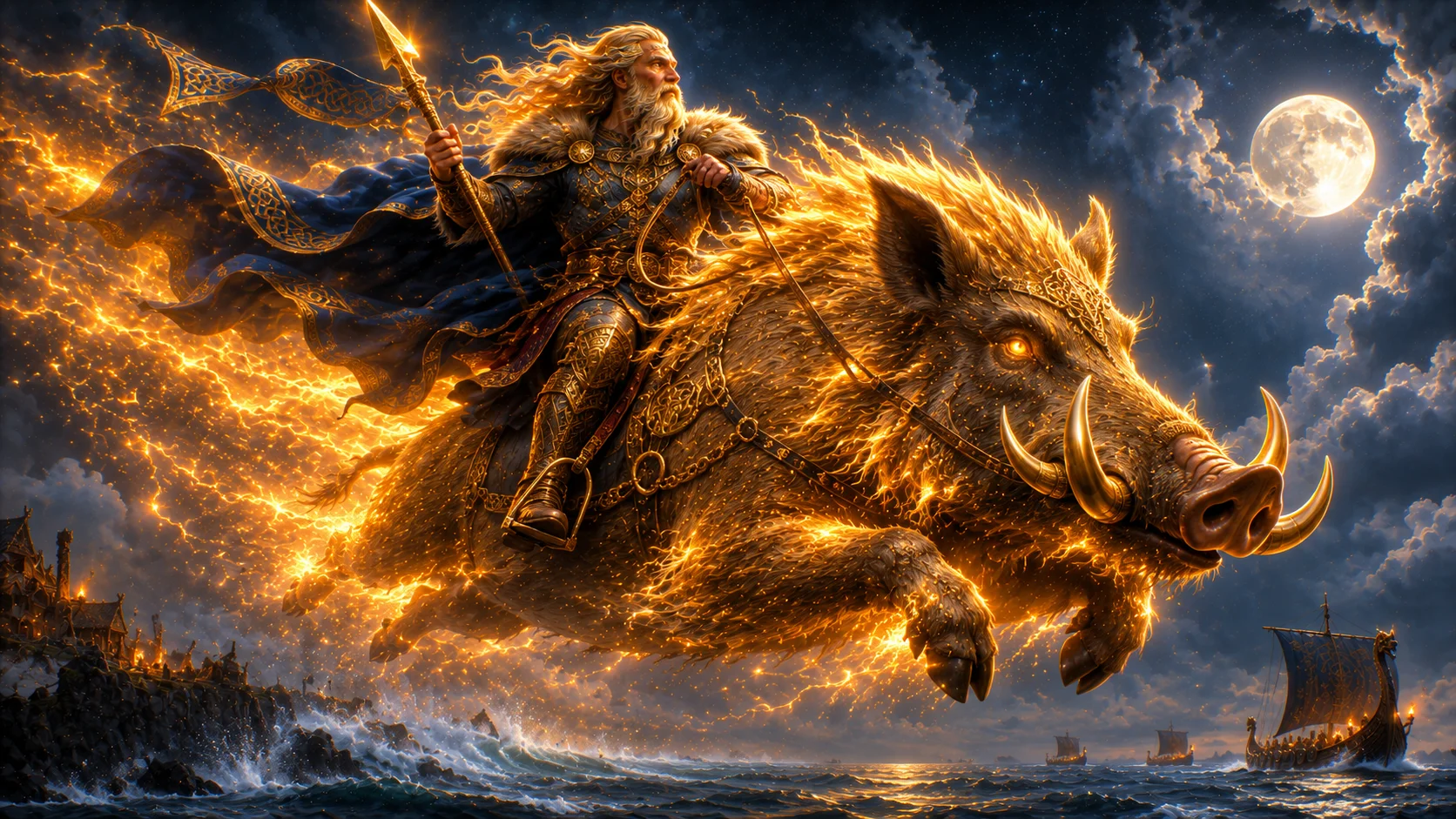
The boar's gold was not ornament. His bristles shone brightly enough to light up dark places as he moved through them — a creature that carried its own daylight into the night, the forge's fire made permanent and portable in his mane. He was given two names: Gullinbursti, "golden-bristled" or "gold mane," and, in some sources, Slíðrugtanni. Two names for one animal is itself a small piece of evidence about how these figures moved through oral and later written tradition — a being important enough, or old enough, to have been called more than one thing by more than one teller, with both names surviving into the record rather than one displacing the other.
Six Treasures, Two Workshops
He was one of three treasures to come from that single forging with Brokkr and Eitri — the others being the ring Draupnir, made for Odin, and the hammer Mjölnir, made for Thor, the very god whose wife's hair had started the whole chain of debts. Two dwarf-pairs, one tale, six treasures between them: Sif's hair, Skíðblaðnir and Gungnir from the Sons of Ivaldi; Gullinbursti, Draupnir and Mjölnir from Brokkr and Eitri. It is worth holding the two groups apart, because the story is often flattened into one workshop and one set of hands, and it was not. The structure is symmetrical in a way that rewards noticing: three gifts answer three gifts, and the contest that decides which set is finer is really a contest over which fire burned truer under pressure, not which smiths were simply more skilled in the abstract.
Bitten to the bone and still pumping the bellows — the forge that made the golden boar was won by a hand that would not open.
Passing to the God of Plenty
Gullinbursti went to Freyr, the Vanir god of fertility, prosperity, sunshine and the harvest — the same god who had just received Skíðblaðnir from the rival dwarves in the same episode. A boar suited him doubly: the animal itself was already bound up with fertility and abundance in the Norse world, and now it arrived dressed in gold, the metal of wealth itself. Two symbols of plenty, animal and metal, fused into a single mount. Nothing in the tale needs to argue for the fit between rider and mount; it is simply presented, and the presentation is the argument — a god already associated with growing things and shining harvests receives an animal already associated with fertility, remade in the one material that stands for wealth without qualification.
Faster Than Any Horse
Freyr rode Gullinbursti, or was carried by him in a chariot, and the boar could run through air and over the sea faster than any horse — outrunning the one animal Norse warriors trusted most for speed. His glowing bristles lit the way as he went, so that wherever Freyr travelled by his back, the road ahead was already bright. Speed and light travel together in this description rather than as two separate claims: the same bristles that mark him as valuable also make him useful, so that his beauty and his function are never described apart from one another.
At Baldr's Funeral
The boar's appearance has been placed at the funeral procession of the god Baldr, Freyr arriving behind a chariot Gullinbursti pulled — the golden light of the boar's mane moving through a scene otherwise given over to mourning. It is one of the few moments where Gullinbursti is not simply described in general terms but placed at a specific event among the other gods, and the contrast is part of what makes it memorable: a source of light built out of triumph and craft, present at the one gathering defined by loss.
What the Boar Meant, and What It Did Not Have To Say
Everything about Gullinbursti argues by association rather than statement. The dwarves' fire made him; the pig's skin that went into the coals was already a boar's substance before the gold took hold; his rider was already the god of harvest and sun before he ever climbed onto a golden-bristled back. The boar carried meaning the way his bristles carried light — radiating outward from what he was made of and who he served, not from anything the myth needed to explain aloud.
Where the Boar Sits in the Wider Cosmology
Read alongside the other treasures of the same episode, Gullinbursti belongs to a broader Norse habit of pairing a god with an object that amplifies what the god already is rather than granting a new power outright. The dwarves who forge these objects occupy a fixed place in that cosmology too: craftsmen beneath the earth whose fire answers the gods' need but is never itself worshipped, a means rather than a power in its own right. These treasures — Gungnir, Draupnir, Mjölnir, Skíðblaðnir, Gullinbursti and Sif's hair alike — are prized among the gods precisely because each one answers to the god who holds it: a spear for the war-leader, a ring for the ring-giver, a hammer for the protector, a ship for the seafarer, a boar for the god of the harvest. Freyr's boar, in the same vein, does not make him a different kind of god — it makes the harvest, the sunlight and the plenty he already governs travel faster and shine further.
A Handbook Written Centuries Later
The wider tale he belongs to survives because Snorri Sturluson wrote it down around 1220 CE, two to three centuries after Scandinavia's conversion to Christianity — a literary handbook for poets, compiled from older material rather than a living pagan scripture composed in the moment of belief. That distance matters for how the story reads: precise about the forge, the bite, the wager and the gold, and silent about the interior motives modern retellings are often tempted to supply. It also means that what has come down to us is deliberately practical in purpose — a reference for skalds composing verse, not a devotional text — which may be part of why the tale reads as an inventory of concrete details rather than an explanation of belief.
- Gullinbursti and Draupnir and Mjölnir — forged together by Brokkr and Eitri
- Sif's hair, Skíðblaðnir and Gungnir — forged together by the Sons of Ivaldi
- Both sets produced in the single episode that began with Loki cutting Sif's hair and ended with his wager over his own head
A Light That Needed No Explanation
Strip away the wager and the gadfly and the bleeding hand, and what remains is simple: a boar of gold that outran horses, crossed water and sky, and lit the dark for the god who rode him. Norse storytelling did not need to spell out why light, gold, harvest and a boar belonged together — the pairing does its own work, the way Freyr's fields did theirs. Gullinbursti is the rare treasure in this cycle whose meaning asks nothing further of the reader than to watch him run.
Sources & traditions
- EncyclopediaWikipedia — Gullinbursti
- TraditionNorse texts, inscriptions and later retellings (Scandinavia)
Myths change from area to area and from time to time. This chronicle follows the most widely told versions; tellings in other villages, regions and eras may differ.