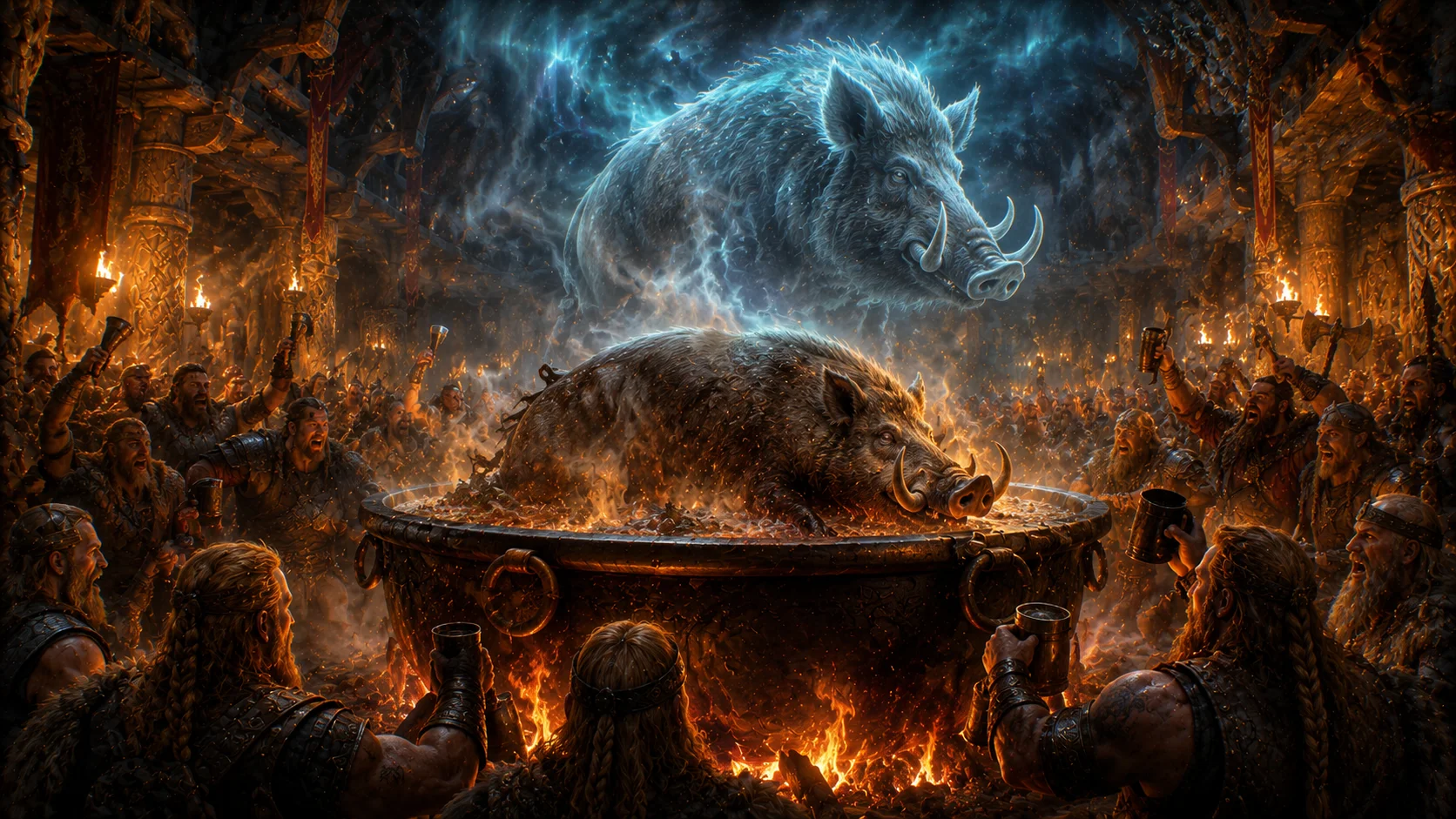
Saehrimnir was the magical beast of Valhalla — the boar (or beast) who is slaughtered and cooked every day to feed the slain warriors at their endless feast, and who is made whole again every night, providing inexhaustible meat for the heroes of Odin's hall. With the mead-goat Heidrun, he makes the feast of the Einherjar a feast that can never fail.
The Beast of the Endless Feast
Saehrimnir (Old Norse Sæhrímnir) was a magical creature — usually described as a great boar — kept in Valhalla, the hall of the slain warriors. Each day, the cook of the gods, a figure named Andhrímnir, slaughtered Saehrimnir and boiled his flesh in the great cauldron Eldhrímnir, and from this meat all the warriors of Valhalla were fed at their feast — and there was always meat enough for every one of the countless slain, however many they were. But the wonder of Saehrimnir was this: each night, after he had been slaughtered and eaten, the boar was made whole again, restored to life, so that he could be slaughtered and eaten anew the next day, and the next, forever.
The Meat That Never Runs Out
Saehrimnir was the source of the endless meat of Valhalla, as the goat Heidrun was the source of its endless mead. Together these two wondrous beasts provided the eternal feast of the Einherjar — the bravest of the battle-slain, gathered by Odin to fight by day and feast by night in his hall until Ragnarök. The image of the self-renewing boar — killed and eaten each day, whole again each night — is one of the most striking in Norse myth: a perfect, inexhaustible food-source, a beast whose very death and resurrection is the daily miracle that feeds heaven.
The Paradise of Plenty
Saehrimnir embodies the Norse vision of Valhalla as a warrior's paradise of endless plenty — a place where the heroes feast every night on the finest meat, with no fear that it will ever run out, because the very beast they eat is reborn to be eaten again. It is a heaven imagined in the most concrete and desirable terms a Norse warrior could conceive: endless battle, endless feasting, endless meat and mead. The self-renewing boar is the Norse answer to the question of how a hall full of the eternal dead could feast forever — with a beast that dies and rises every single day.
The Self-Renewing Boar
Saehrimnir endures as the magical feast-beast of Valhalla — the boar slaughtered and cooked each day and made whole each night, the inexhaustible source of meat for the feasting slain. He embodies the Norse warrior's dream of the afterlife and the wonderful, concrete imagination of Norse myth: a paradise where even the food is a daily miracle, a beast eternally dying and rising so that the heroes of Odin's hall may feast forever, until the day they are called to the final battle.
Slaughtered and eaten every day, whole again every night — the boar of Valhalla is a daily miracle, so that the feasting dead may never run short of meat until the world ends.
A Single Stanza, Copied Twice
Everything anyone has ever known about Saehrimnir comes down, in the end, to a few lines of alliterative Old Norse verse. The boar appears in Grímnismál, one of the mythological poems of the Poetic Edda, preserved in the Codex Regius, an Icelandic manuscript copied out around the twelve-seventies. The poem itself is generally reckoned to be considerably older than the vellum it survives on — a fragment of pre-Christian tradition caught just before it might have been lost entirely. It is spoken by Odin, held captive and tormented between two fires, who repays the boy that brings him a horn to drink from with the secrets of the cosmos: the names of the halls, the wolves, the rivers, the world-tree. The stanza that names Saehrimnir ends on a line that has teased readers ever since — having just explained how the boar is cooked, the poem admits that few in fact know what the Einherjar are fed on.
The Icelandic chieftain and mythographer Snorri Sturluson retold the same image in his Prose Edda, written around 1220 — a good half-century before the Codex Regius was copied out, which means he was working from the poem in some earlier form now lost. He stages it as an answer given by one of three lookalike enthroned figures — Hárr, Jafnhárr and Þriði — who receive the wanderer Gangleri, King Gylfi travelling under a false name, in Gylfaginning: how, Gangleri wants to know, can there possibly be provisions enough in Valhalla for so vast a host of the dead? The answer handed back is Saehrimnir, and Snorri quotes the older stanza almost word for word. That two seemingly separate sources collapse into a single lineage is typical of how little of Norse myth survives at all: not as a living, spoken tradition still passed hand to hand, but as a narrow thread of manuscript, kept by scholars in a newly Christian Iceland who were curious enough about their grandparents' gods to write them down before it was too late.
A Name Built From Soot
Look closely at the cast of this daily miracle and a pattern emerges that translation usually flattens: the cook is Andhrímnir, the cauldron he cooks in is Eldhrímnir, and the boar he cooks is Sæhrímnir. All three names share the same second element, -hrímnir, which a medieval audience would have heard as something close to “sooty” or “grimed” — the blackening that an open fire and a boiling pot leave behind. Eldhrímnir reads transparently as “fire-sooted”, and Andhrímnir as something like “soot-faced”, the cook marked out by the very smoke of his own trade. Sæhrímnir's first element is the disputed one: it may simply apply the same sooty idea to the beast itself, or it may reach for an older word for the sea, and translators still do not agree. What is not in doubt is the effect of the pattern. Cook, cauldron and beast are bound together by sound as much as by story — three sooty things orbiting the same fire — so that the boar's very name carries the smell of the kitchen he dies in every day. It is the kind of detail a poem preserves and a modern retelling almost always loses: not a moral, not a warning, just the texture of a working hearth transposed onto eternity.
The Warriors Share the Boar's Fate
That the Einherjar fight by day and feast by night is quickly said and easily passed over. What the sources actually describe is worth setting beside the boar. Every single day the chosen dead arm themselves and go out into the courtyard of Odin's hall to fight, and it is a battle in earnest — they wound and fell one another, because that is the only kind of practice worth having for men being trained for the end of the world. Then, each evening, however many fell that day, they rise again whole and ride home together to drink and eat at the same table as the men who killed them hours before. Saehrimnir, in other words, is not the one strange exception in an otherwise ordinary paradise — he is the pattern the whole hall runs on. His cycle of slaughter and restoration is the rule the Einherjar themselves live by, and the old poems seem to want their listener to notice the echo: an afterlife built entirely out of death that will not stick, over and over, feast after feast, until the one day it finally does.
Not the Only Boar Worth Knowing
Norse myth is unusually fond of magical boars, and setting Saehrimnir beside his kin sharpens what makes him distinct. Freyr, god of fertility and good harvests, owns Gullinbursti, the “Golden-Bristled”, forged by the dwarf brothers Brokkr and Eitri during the wager in which Loki bet his own head that they could not outdo the treasures made by the sons of Ivaldi — a beast whose bristles shed light enough that no night is dark wherever he goes, and who runs better than any horse, over air and over water. Freyr's sister Freyja has her own: in the poem Hyndluljóð, she disguises her human protégé Óttar as her boar Hildisvíni, the “Battle-swine”, and rides him to the giantess Hyndla so that his own ancestry can be recited back to him. Both of those boars are creatures of status and protection — ridden by a god, or worn as a disguise. Saehrimnir does neither. Nobody rides him, and what he offers is not speed or safety but simply an unlimited supply of himself.
The boar carried real weight across the wider Germanic world as an emblem of protection in battle. Old English poetry describes warriors going to war under boar-crested helmets, and archaeologists have recovered the objects themselves — boar figures mounted on the crests of iron helmets found in early Anglo-Saxon graves. Against that backdrop, casting the inexhaustible feast-beast of the ultimate warrior hall as a boar was not an arbitrary choice of animal. It was the one animal these cultures already trusted with a warrior's survival.
An Echo in Irish Tradition
The idea of an animal that can be killed, eaten, and found alive again the next morning is not unique to the Norse world. Medieval Irish tales tell of the swine of Manannán mac Lir, the sea-associated figure of the Tuatha Dé Danann: pigs that could be slaughtered and cooked one day and would be found whole and living again the next, so that the otherworld feast never had to end. The same tradition pairs them with an otherworld ale-feast that kept age and death away from those who drank it — so the Irish material folds the self-renewing pig into a broader gift of ageless feasting, rather than binding it to one named beast the way Saehrimnir is bound to Valhalla. The wish underneath, though, is one two very different cultures arrived at on their own: if you are going to imagine a perfect afterlife, the question of where the food keeps coming from has to be answered somehow, and the most satisfying answer either people found was not a storehouse or a harvest but an animal that simply refuses to stay eaten. Saehrimnir, for all his strangeness, is solving a problem — how do you feed eternity? — that more than one mythology sat down and worked out for itself.
Sources & traditions
- EncyclopediaWikipedia — Sæhrímnir
- TraditionNorse texts, inscriptions and later retellings (Scandinavia)
Myths change from area to area and from time to time. This chronicle follows the most widely told versions; tellings in other villages, regions and eras may differ.