Brokkr was one of the master dwarf-smiths of Norse myth — who, with his brother Eitri (Sindri), forged three of the gods' greatest treasures, including Thor's hammer Mjölnir, and who won a wager against Loki in a contest of craftsmanship, claiming the trickster's head as the prize. His tale is the story of how the gods came by their mightiest weapon.
The Dwarf-Smith
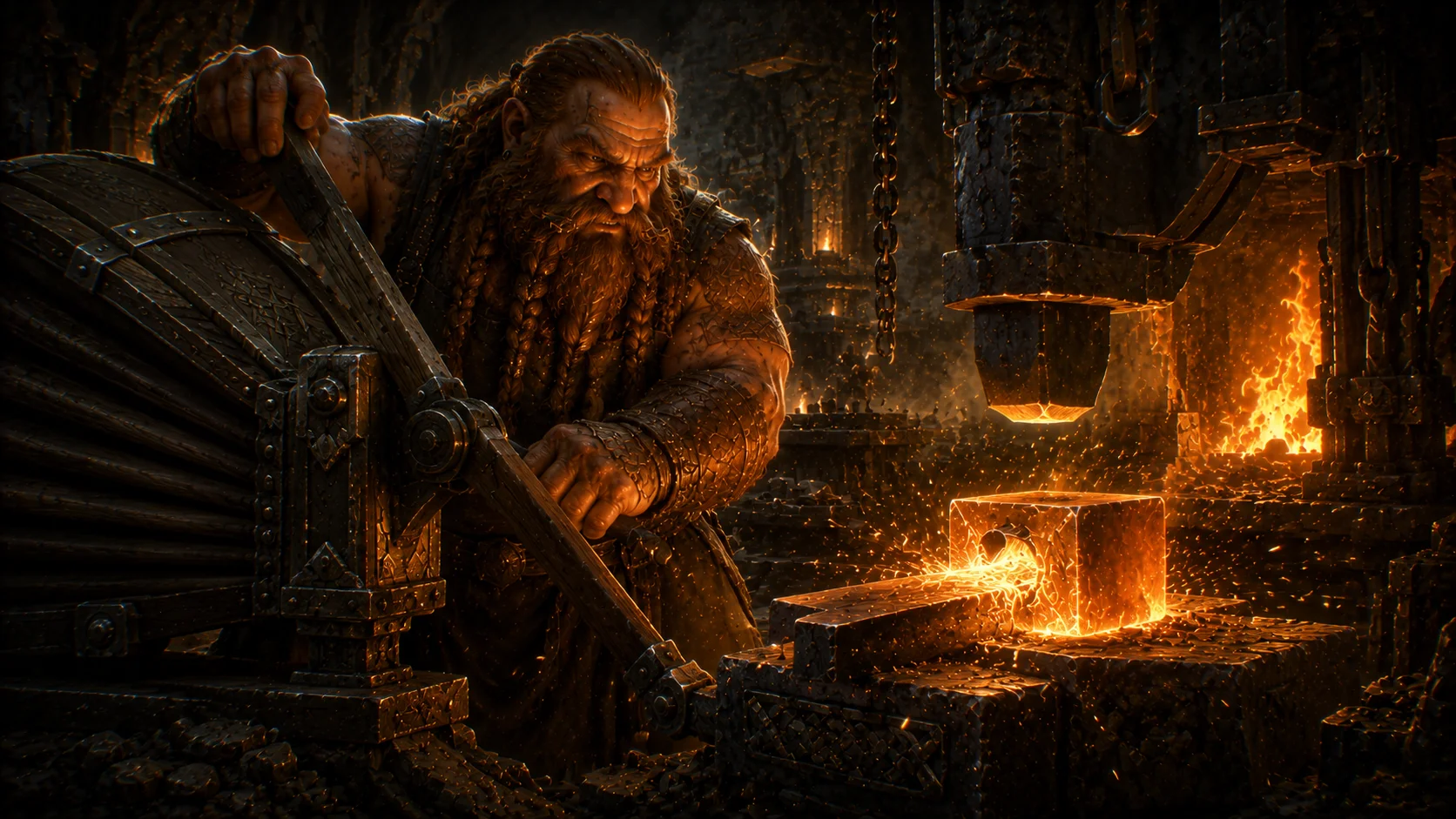
Brokkr (Old Norse Brokkr) was a dwarf, one of the legendary smiths of the underground — for in Norse myth the dwarves were the supreme craftsmen of the cosmos, master metalworkers who forged the most precious and powerful objects of gods and men. Brokkr worked alongside his brother Eitri (also called Sindri), and together the two brothers were among the finest smiths in all the worlds, their forge the source of wonders.
The Wager with Loki
Brokkr's great tale began with a boast by Loki. The trickster had commissioned treasures from the dwarf sons of Ivaldi (golden hair for Sif, the ship Skidbladnir, the spear Gungnir) and then, to stir trouble, wagered his own head that Brokkr and Eitri could not forge three treasures to equal them. The brothers took up the challenge. Eitri worked the forge while Brokkr worked the bellows — and Loki, desperate to win the bet and save his head, transformed himself into a fly and bit Brokkr again and again as he pumped the bellows, trying to spoil the work.
The Forging of the Treasures
Despite Loki's torment, Brokkr never stopped pumping the bellows, and the brothers forged three magnificent treasures. First, the golden boar Gullinbursti, with bristles of gold that shone in the dark, for the god Frey. Second, the golden ring Draupnir, which dripped eight new golden rings every ninth night, for Odin. And third — greatest of all — the hammer Mjölnir for Thor: but here Loki's fly-bites nearly succeeded, for at the crucial moment the fly bit Brokkr's eyelid so hard that blood ran into his eye and he paused the bellows for an instant to wipe it. As a result, the hammer's handle came out a little short — the one small flaw in the gods' mightiest weapon, the price of Loki's sabotage.
The Forfeit of Loki's Head
The gods judged the contest, and they declared Mjölnir — the hammer that would defend them against the giants — the greatest treasure of all, so that Brokkr won the wager and the right to Loki's head. But the cunning Loki argued that he had wagered his head, not his neck, and so Brokkr could not cut it off without harming the neck, which was not his to take. Foiled, Brokkr settled for sewing Loki's lips shut with an awl and a thong — a fitting punishment for the silver-tongued trickster. Brokkr endures as one of the great dwarf-smiths of Norse myth, the maker (with Eitri) of Mjölnir, Draupnir and Gullinbursti, the craftsman who endured Loki's torment to forge the gods' greatest treasures and won the trickster's head — if not, in the end, the right to take it.
He pumped the bellows through every bite of Loki's fly-form to forge the hammer that guards the gods — and won the trickster's head, though Loki's cunning saved his neck.
Born from a Giant's Corpse
Before there was a Brokkr, there had to be dwarves — and the Norse creation myth gives them one of the strangest births of any race in the Eddas. When the gods slew the primordial giant Ymir and built the world from his body — his flesh the earth, his blood the sea, his skull the vault of the sky — the dwarves are said to have quickened inside that dead flesh the way maggots breed in a corpse, until by decision of the gods they were given intelligence and the shape of men, while keeping their home in the earth and in stone. Four of them — Nordri, Sudri, Austri and Vestri, named for the compass points — were set beneath the four corners of Ymir's skull to hold up the sky, so that in Norse cosmology the heavens rest on dwarven shoulders. Brokkr's people, in other words, are not merely miners and metalworkers by trade. They are grown from the same substance the world itself was built out of.
The Dwarves' Other Tales
Brokkr is only the best-remembered of a race with its own catalogue of stories, most of them turning — like his — on cleverness meeting its match. The dwarf Alvíss, whose name means "all-wise", once came to claim Thor's daughter as his bride, insisting she had been promised to him; Thor, unwilling to hand her over, stalled him all night with a barrage of riddling questions — what the sky is called among the gods, the elves, the giants and the dwarves, and what the sea is called, and the moon — until the sun rose and caught Alvíss still answering, and turned him to stone where he stood. Elsewhere, two dwarves named Fjalar and Galar murdered the wise being Kvasir, who had been made from the spittle the gods spat into a vat to seal the truce that ended their war, and brewed his blood with honey into the mead that makes a poet of anyone who drinks it — the same mead Odin later wins back by disguise, seduction and outright theft. And the dwarf Andvari, living as a pike in a waterfall, hoarded a fortune in gold and a ring that bred more gold from itself, until Loki netted him and stripped him of everything; the curse Andvari laid on that gold follows it through the rest of Norse legend, poisoning every hand it passes through. Set beside these, Brokkr's story is unusual for how well it ends for him — bitten bloody and cheated of his prize, he still walks away the acknowledged maker of the gods' greatest weapon.
Wayland, and the Smiths Who Were Not Dwarves
Germanic tradition has more than one master craftsman, and it is worth being precise about which kind Brokkr is. The other towering smith of the north, Völundr — known in English as Wayland the Smith — is called in the Eddic poem Völundarkviða a prince of the elves rather than a dwarf, and his story has nothing to do with treasures made for gods. Captured by a king who wanted that skill kept for himself, and hamstrung so that he could not walk away from the forge, Völundr takes a terrible revenge on the man's household and then, in the poem's last scene, rises laughing into the air and is gone. Set the two smiths side by side and the difference between them is not craftsmanship but consent: Brokkr forges for a wager he entered freely and is judged in open court, while Völundr forges at knifepoint. What both stories assume underneath is the same thing — that a smith is a dangerous person to wrong, because the things he makes outlast the quarrel.
A Name in Two Forms
Read enough retellings of this story and Brokkr's brother will not always answer to the same name. Snorri Sturluson's Prose Edda — the only source that preserves the wager tale in full, in the section called Skáldskaparmál — calls him Eitri. The name Sindri belongs elsewhere in the sources: Völuspá places a hall of gold on Niðavellir, the dark fields, and says it belongs to the kin of Sindri. Somewhere between the medieval text and the modern bookshelf the two were welded together, and today most readers meet the golden-boar-and-hammer smith as Sindri and are surprised to learn Snorri wrote Eitri. It is a small, useful reminder that a myth is not a fixed text but a thing repeatedly retold, and that every retelling — including this one — leaves fingerprints.
The Hammer Made Flesh
Mjölnir's short handle — the flaw Loki's fly-bite bought — is close to a physical description of the amulets Viking-Age Scandinavians actually wore around their necks. Surviving Thor's-hammer pendants, cast in silver, bronze, iron and lead and recovered from graves across Scandinavia and the wider Viking world, are consistently stubby and thick-shafted rather than long-handled, worn as protection and as a public declaration of allegiance to Thor at a time when Christianity was spreading through the same communities. Craftsmen of the period sometimes worked from soapstone moulds cut to cast a hammer pendant and a small cross side by side — evidence of a lived, everyday world in which the two faiths overlapped in the same workshop and, it seems, sometimes in the same customer's mind. Brokkr's flawed hammer, then, is not only the weapon that guards the gods in myth. Its silhouette is the one ordinary people chose to hang against their own chests.
From Edda to the Screen
The dwarf-smiths never really left. J.R.R. Tolkien took the names of his dwarves — Dwalin, Fíli, Kíli, Thórin, Glóin, Dáin and Durin himself among them — almost unchanged from the Dvergatal, the catalogue of dwarf-names embedded in Völuspá; even Thorin's epithet Oakenshield is a name from that list, Eikinskjaldi, promoted to a title. Gandalf came from the same roll-call, where Gandálfr is a dwarf-name meaning roughly "wand-elf", and Tolkien gave it to a wizard instead. Neil Gaiman's 2017 book Norse Mythology retells the wager against Loki much as Snorri told it, putting the story in front of a generation of readers who had never opened the Prose Edda. And when Marvel's Avengers: Infinity War needed a forge equal to Thor's hammer, it reached for a dwarf named Eitri, ruling a forge-world called Nidavellir — the same dark fields where Völuspá had put its golden hall a thousand years earlier — and had him explain that his people had made Mjölnir once already.
Why the Bellows Never Stopped
Strip away the fly and the wager and what is left in Brokkr's story is something plainer and older: the belief that anything worth having was made by someone who suffered to make it. The dwarf does not pour metal into a mould and wait. He stands at the bellows while something bites him, again and again, and he does not stop, because stopping is what failure looks like. That the greatest weapon the gods will ever own comes out of the fire carrying one small permanent flaw is, if anything, what makes the story feel true rather than fantastical — real craftsmanship, the myth insists, keeps the mark of the conditions it was made under. It is the same intuition that makes a handmade object feel more honest than a flawless one, and it is why, of all the wonders forged that day, it is the imperfect hammer — not the ring that bred gold, not the boar with bristles that burned back the dark — that the gods judged best.
Sources & traditions
- EncyclopediaWikipedia — Brokkr
- TraditionNorse texts, inscriptions and later retellings (Scandinavia)
Myths change from area to area and from time to time. This chronicle follows the most widely told versions; tellings in other villages, regions and eras may differ.