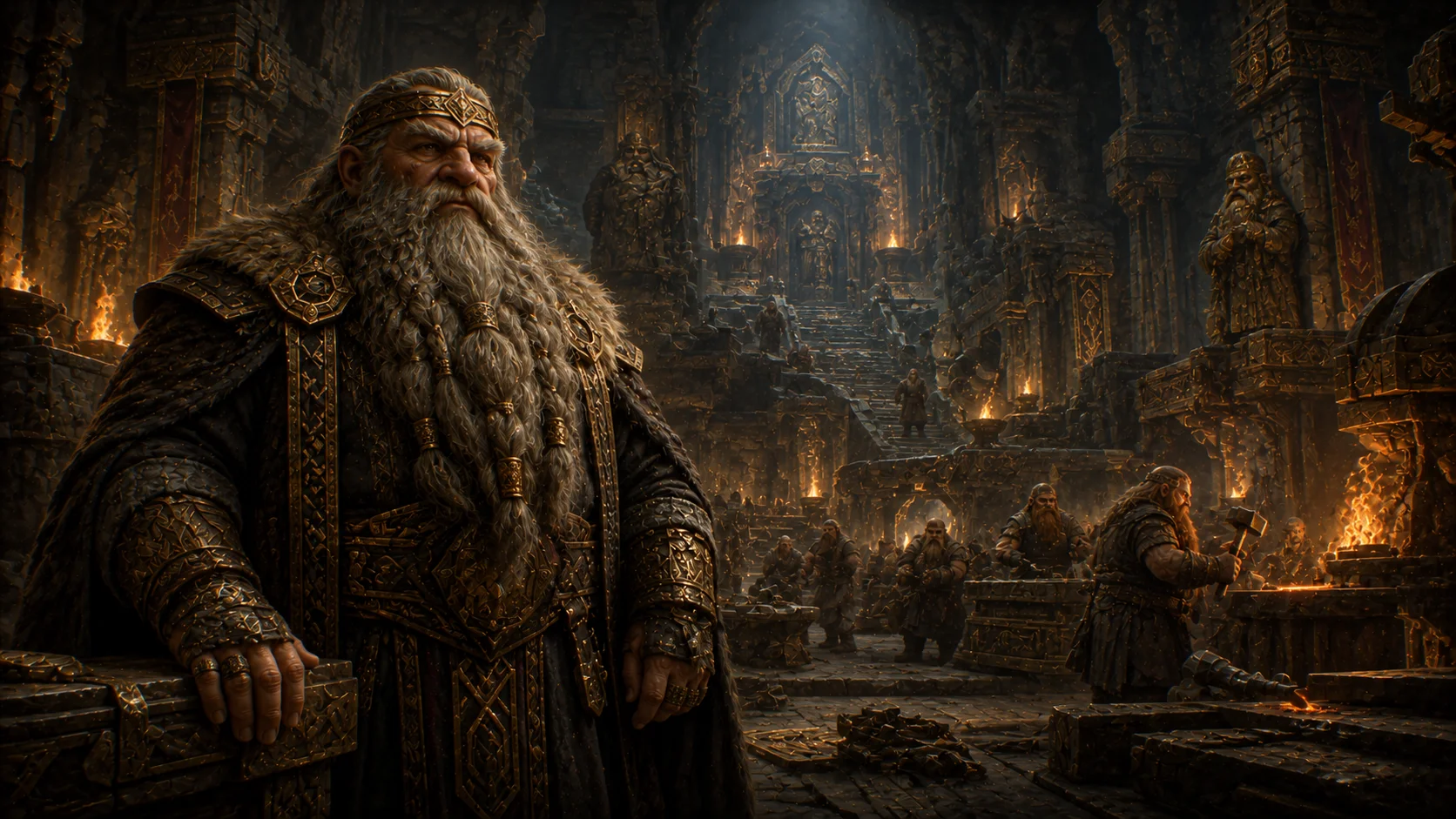
Durin was one of the first and greatest of the dwarves in Norse myth — named in the ancient lore as second only to the foremost dwarf, Mótsognir, and as a maker of many of his kind. A figure from the very dawn of the dwarf-race, his name became legendary, echoing down through later fantasy as the archetype of the ancient dwarf-lord.
The First of the Dwarves
Durin (Old Norse Durinn) appears in the Völuspá, the great Norse poem of creation and prophecy, in the famous catalogue of dwarf-names. There it is told that when the gods created the dwarves, the foremost was Mótsognir, and the second was Durin — and that these two, the greatest of the dwarves, then fashioned many more dwarves in human form from the earth and stone, as the gods had commanded. Durin thus stands at the very origin of the dwarf-race, one of the first two dwarves, a maker of his own kind, a being of the primordial dawn of the world.
The Birth of the Dwarves
The Norse told that the dwarves had originated as maggots in the flesh of the slain primordial giant Ymir, from whose body the world was made, and that the gods gave them reason and human shape and set them to dwell in the earth and the rocks. Durin and Mótsognir were the first and greatest of these beings, and from them and their making came the whole multitude of the dwarves — the master-smiths and craftsmen of the underground, the makers of the gods' treasures, the keepers of the deep places of the world. Durin stands at the head of that lineage, an ancestor of the dwarf-race.
The Catalogue and the Legend
The Völuspá's long list of dwarf-names — the “Dvergatal,” the catalogue of dwarves — preserves Durin among many others, and these ancient names have echoed remarkably down the centuries. The very name Durin, along with many of its companions in the list (and the name Gandalf, “wand-elf,” which appears there too), would be drawn upon in modern times as the archetypal names of dwarves and wizards in fantasy literature, giving Durin a strange afterlife as the model of the ancient, noble dwarf-lord of the deep mountains. But in his original Norse context, he is one of the primordial first dwarves, a maker of his kind at the dawn of the world.
The Ancient Dwarf-Lord
Durin endures as one of the first and greatest of the Norse dwarves — second of his race, a maker of dwarves, a figure from the creation of the world. He embodies the Norse vision of the dwarves as an ancient and venerable people, born at the dawn of the cosmos, dwelling in the stone, masters of craft and the deep places — and through the long echo of his name, he stands as the very archetype of the ancient dwarf-lord, a name from the dawn of the world that has never quite faded.
Second of all the dwarves, born at the dawn of the world and a maker of his own kind — Durin's ancient name has echoed down the ages as the very archetype of the dwarf-lord.
A Name Without a Story
Read the Dvergatal in full and a strange thing becomes clear: most of the names in it, Durin included, never do anything. The Völuspá's catalogue is a genealogical roll call, not a saga — dozens of dwarves named in a rolling metre, many of them never mentioned again anywhere else in the surviving corpus. Durin is unusual only in his rank, second after Mótsognir. He has no wife, no feud, no death recorded, and beyond a single ambiguous cameo we will come to, no forge credited to his hands. For a mythology that gave other dwarves entire episodes — a suitor kept talking until sunrise, a smith who wins a wager against Loki, a dwarf whose stolen gold is cursed to ruin every owner after him — Durin's silence is itself worth noticing. He is less a character than a title: the second-born, the second-greatest, a name that exists to anchor a lineage rather than to star in one.
Repeated by Snorri: Durin in the Prose Edda
The catalogue mattered enough that it did not stay in one poem. When Snorri Sturluson composed the Prose Edda in the thirteenth century — a handbook meant to preserve pagan lore for Christian-era poets who still needed it to read the old skaldic verse — he retold the making of the dwarves in Gylfaginning and quoted the Völuspá catalogue directly, Durin named there as before, second of all the dwarves. That an author writing two centuries after Iceland's conversion still thought the roll call worth copying out says something about how the list functioned: not as narrative but as reference, a piece of inherited cosmological furniture a working poet was expected to know by name, the way a genealogist needs the full family tree even for relatives who left no other trace.
The Dwarves Who Forged a Cursed Sword
One story does put a Durin at the centre of events — though whether he is this Durin, second of the dwarves, or simply another dwarf who shares his name, the saga never says. In Hervarar saga ok Heiðreks, the legendary king Svafrlami, reckoned in the saga a grandson of Odin, rides out hunting and comes upon two dwarves, Dvalin and Durin, beside a great stone at sunset. He sets his drawn sword between them and the rock, cutting off their retreat, and names his price for their freedom: a sword that will never blunt or rust, that will cut through iron and stone as easily as through cloth, and that will carry victory in every battle and duel it is drawn into.
The dwarves make it. Its name is Tyrfing. But a weapon extracted under threat from craftsmen with no love for the man extorting it rarely comes without a catch, and as Durin and Dvalin hand it over they lay a curse on their own work: the sword must kill a man every time it is drawn, it will be the instrument of three great evils, and it will be the death of Svafrlami himself. All three come true — Tyrfing kills its own owner within the saga's opening generation and goes on killing across several more, a blade with a mind bent toward tragedy, forged by hands that never wanted to make it. Apart from the shaping of the dwarf-kind in the Völuspá, where the work is done as Durin directed, it is the only episode in which a dwarf of that name acts at all — and fittingly for a figure otherwise defined by his place in a list, what he does is set a doom in motion and disappear from the page.
Kin in the Catalogue: Runes, Rivals, and Master Smiths
Dvalin, Durin's collaborator under duress in the Tyrfing story, has a fuller life elsewhere in the tradition — the Hávamál credits him with teaching the runes to the dwarves, just as Odin taught them to the gods and Dáinn taught them to the elves, one runemaster assigned to each people of the Norse cosmos. Other dwarves get whole poems of their own: Alvíssmál follows a dwarf named Alvíss who comes to claim Thor's daughter as his promised bride and is instead kept answering questions, deliberately, until sunrise turns him to stone. And the two most celebrated smiths of all, the brothers Brokkr and Eitri, earn their fame in Skáldskaparmál by winning a wager against Loki, forging Thor's hammer Mjölnir, Odin's ring Draupnir and a golden boar for Freyr in a single working, with Loki turned into a fly and biting at Brokkr's eyelid to try to spoil the bellows-work. Set beside performances like these, Durin's near-total absence from independent plot is conspicuous. He founded the line; others got to be interesting within it.
From Eddic List to Middle-earth: Durin's Long Afterlife
The passage of Durin's name into modern fantasy, touched on briefly elsewhere in this article, runs deeper than a single borrowed word. J.R.R. Tolkien was a philologist who read the Völuspá in the original Old Norse, and when he needed names for an entire race of dwarves he took them from the Dvergatal wholesale — Thorin, Bifur, Bofur, Bombur, Dóri, Nóri, Óri, Óin, Glóin, Fili, Kíli, Dvalin. Durin, though, he raised above the rest. In Tolkien's legendarium Durin becomes the eldest of the Seven Fathers of the Dwarves, first of his people to wake at the world's beginning, and ancestor of the Longbeards, the clan the books call Durin's Folk. He is given his own foundation myth: waking alone on Mount Gundabad, wandering until he finds a mountain lake named Kheled-zâram, and founding beneath it the great underground kingdom of Khazad-dûm — better known by its Elvish name, Moria — after seeing seven stars shining above his reflection in the water like a crown and taking it as a sign. The dwarves of his line believed Durin was reborn again and again across the ages, so that a much later king could still bear his name, and when that king's miners dug too deep beneath Khazad-dûm and woke something far older than any dwarf, it killed him and kept his name for its own: Durin's Bane. None of this is Norse myth — it is one modern writer's invention, built with real philological care on two syllables from a thousand-year-old poem — but it is the reason most readers meet the name Durin in a paperback long before they ever meet it in the Edda.
Why a Bare Name Still Echoes
There is something almost experimental about how little the medieval sources give us and how much later ages have been willing to build on it regardless. Durin arrives in the record with no adjectives attached beyond his rank — second of the dwarves — and no incident beyond, at most, a single ambiguous cameo forging a doomed sword. Everything else asked of him since — ancestor, founder, king reborn across ages, name behind a mountain kingdom — has been supplied afterwards: by Snorri's careful antiquarianism, by an anonymous saga-author's taste for cursed weapons, by a twentieth-century professor mining his own scholarship for material. That, in the end, is the peculiar power of a catalogue name. Unlike a god with a fixed biography, a name from a list is an empty seat at an old table, and every century that still finds dwarves compelling gets to decide, a little, who was sitting in it.
Sources & traditions
- EncyclopediaWikipedia — Durinn
- TraditionNorse texts, inscriptions and later retellings (Scandinavia)
Myths change from area to area and from time to time. This chronicle follows the most widely told versions; tellings in other villages, regions and eras may differ.