Night has fallen over Asgard, and a dwarf stands in the hall demanding a bride. He is pale from a life spent under stone, proud of his own name, and entirely certain of his rights. He does not know that the god across from him has no intention of losing this argument — and no intention of winning it by force, either. By the time the sky lightens, the dwarf will still be talking. That, in the end, is what kills him.
A Suitor Who Will Not Be Refused
The Eddic poem Alvíssmál — "The Sayings of Alvíss" — survives in the Poetic Edda and is generally dated by scholars to around the twelfth century, later than many of the other Eddic poems it sits beside. It opens without preamble: Alviss, whose Old Norse name Alvíss means "all-wise" or "all-knowing," arrives in Asgard to collect a bride he claims was promised to him — Thor's own daughter, unnamed in the poem itself. Later retellings sometimes attach the name Thrúd to her, but that identification belongs to secondary tradition, not to the text.
Thor was not present when this promise was supposedly made. He has no wish to hand his daughter to a dwarf, and every reason to say so plainly. He does not. Instead he does something far more interesting: he agrees to the marriage, on one condition. Alviss is famous for his wisdom — so famous his very name is a boast. Very well, says Thor. Prove it. Answer my questions, on every subject I choose, and the bride is yours.
The Trap Baited With Flattery
It is a masterstroke of a trap precisely because it flatters its victim. Alviss is not being challenged; he is being invited to perform the one thing he is proudest of. He agrees eagerly, without suspicion, because refusing would mean admitting a limit to his own knowledge — and admitting a limit is not something an all-wise dwarf is built to do. Thor has found the one lever that will hold a creature of pure intellect in place for as long as he needs: pride.
Nothing about the exchange looks like combat. There is no blow struck, no threat made. Thor's weapon here is a question, asked patiently, again and again, deep into the night.
Naming the World Six Times Over
What follows — roughly stanzas ten through thirty-four of the poem — is one of the strangest and richest passages in the entire Eddic corpus. Thor asks Alviss, in turn, what the great features of the world are called: the earth, the sky, the moon, the sun, the clouds, the wind, the sea, fire, the forest, the night, the seed, and more besides. But he does not ask for one name apiece. He asks for the word as it is spoken by each of the different peoples of the Norse cosmos in turn — by men, by the Æsir, by the Vanir, by the giants, by the elves, and by the dwarves themselves, sometimes reaching even to those in Hel.
It is, in effect, a demand for six vocabularies at once, a cosmological thesaurus recited live under interrogation. And Alviss delivers every single one of them. He does not stumble, does not guess, does not fall back on a name he has already used. Stanza after stanza, he answers fully and correctly, moving through the tongues of gods and giants and men as easily as a man might move through rooms in his own house.
This matters, and it is worth pausing on. Alviss is not a fool being made to look wise before he is exposed as ignorant. He never gives a wrong answer. His knowledge is real, total, and freely demonstrated — which is exactly what makes his fate so unsettling. He loses despite being everything he claimed to be.
What the Lists Were Really Counting
For readers today, and for the philologists who first pored over the poem, this recitation is treasure in its own right. Alvíssmál functions as a structured catalogue of Old Norse poetic synonyms and kennings — a source text mined for centuries by scholars trying to reconstruct how the Norse imagination sorted and named its own world. Every stanza is a small window onto six ways of seeing the same sky, the same fire, the same sea. The poem's narrative purpose and its philological value are, unusually, the exact same passage of text.
But while the reader marvels at the list, something else is happening in the room. Time is passing. And time, here, is the only enemy that matters.
The Contest Thor Was Never Trying to Win on Points
It helps to notice what kind of contest this is not. In another Eddic wisdom poem, Vafþrúðnismál, Odin and the giant Vafþrúðnir trade questions back and forth as genuine equals, each testing the other's knowledge in turn — a true duel of minds where either party might slip. Alvíssmál is built differently. Thor asks every question. Alviss only answers. There is no moment where Thor's own knowledge is on trial, no possibility that he might be caught out. The form itself tells you who holds the power in the room, long before the ending arrives.
That asymmetry is the whole design. Thor was never trying to out-wise Alviss — an effort at which, honestly, a dwarf famed for knowing everything might well have won. Thor was trying to out-last him. And the only opponent that can defeat pure knowledge without ever engaging it directly is the sun.
Dawn as a Weapon
Dwarves in Norse tradition belong to the dark and to the deep earth — beings said, in the tradition preserved in the Vǫluspá and Gylfaginning, to have arisen from the flesh and bones of the primordial giant Ymir, dwelling in stone rather than open sky. Sunlight is not merely unpleasant to such a creature. It is lethal. The same motif — a being of darkness caught by the rising sun and turned to stone — recurs elsewhere in Norse folklore, in tales of trolls undone at daybreak. It is a belief about the order of the world: some things belong to the night, and the night does not extend an exemption to anyone still standing in the open when it ends.
Thor knows this. It is, in fact, the entire content of his plan. Every question he asks is not idle curiosity — it is a fuse, burning down toward sunrise, and Alviss, delighted to be asked, never once thinks to look at the sky.
The Sun Shines in the Hall
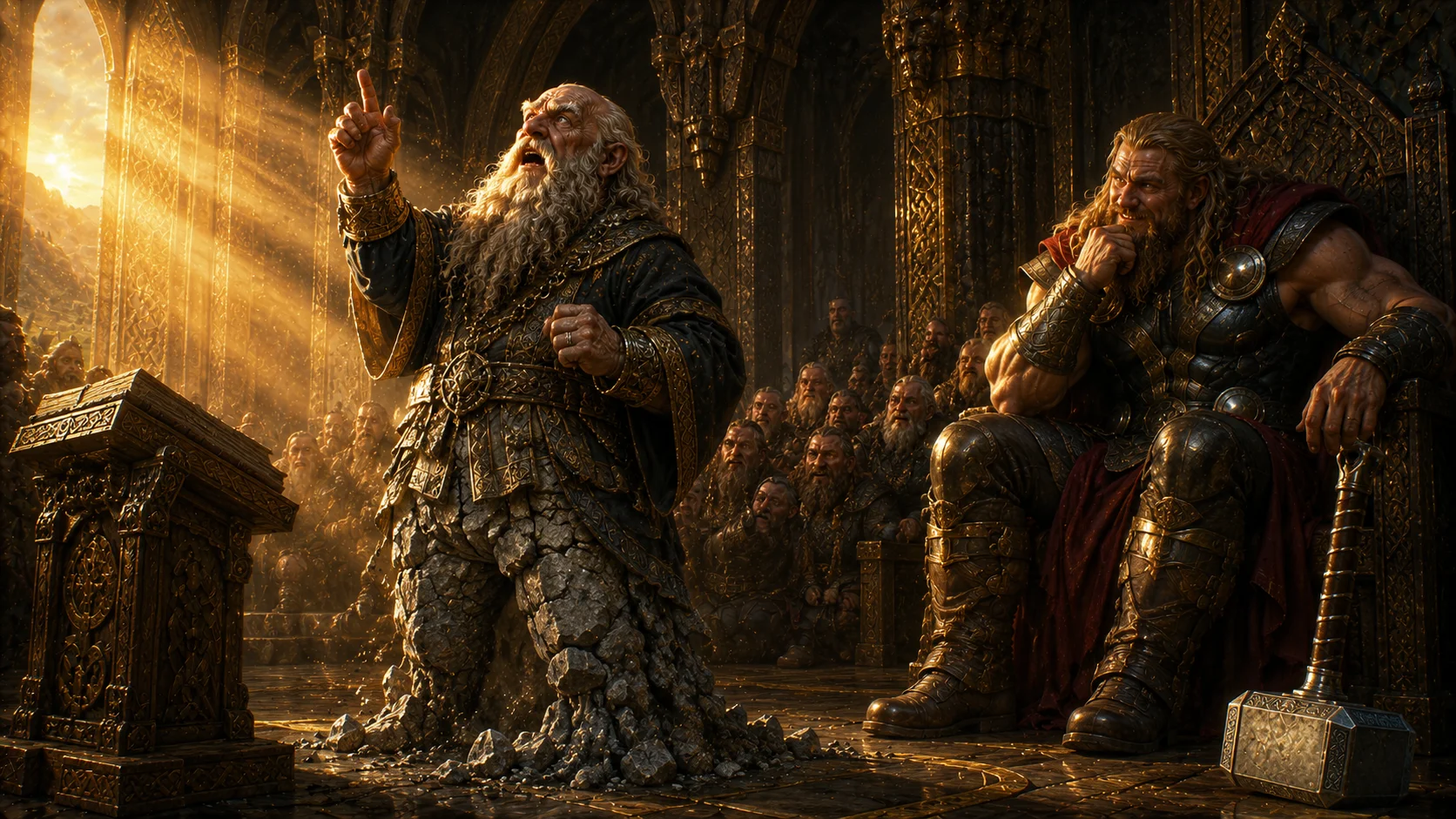
The poem's final stanzas turn without warning. Alviss is still answering — flawlessly, as he has all night — when the light changes. Thor's parting words are not a threat but something closer to a taunt dressed as praise: he tells the dwarf that he has never met anyone so learned, and in the same breath tells him that he has been deceived — that dawn has come, that the sun now shines into the hall. There is no drawn weapon, no struck blow. The first rays simply reach Alviss where he stands, mid-sentence, and turn him to stone. His claim on the bride, and his voice, end in the same instant.
The all-wise dwarf knew the name of everything in every tongue — but not that Thor was only keeping him talking until the sunrise turned him to stone.
A Loss That Was Never About Being Wrong
It bears repeating, because it is the detail most retellings flatten: Alviss does not lose because he fails a test. He passes every part of it. What defeats him is not a gap in his learning but a gap he never thought to measure — the hours of the night, ticking down toward a deadline no one told him he was racing. There is something almost tragic in that, alongside the wit of it. A being defined entirely by knowledge is undone by the one fact that was never his to know: the time.
Thor, for his part, is shown here in a mode he rarely occupies elsewhere in the corpus. This is not the hammer-swinging slayer of giants. This is Thor as tactician, protective of his daughter and willing to win by patience and misdirection rather than force — a single, atypical portrait of cunning worn by a god usually defined by strength.
A Figure Without a Second Story
Unlike many named dwarves in the Norse corpus — Dvalin, for instance, turns up scattered across the Vǫluspá's dwarf-catalogue, in Hávamál, Grímnismál, Fáfnismál, and Gylfaginning, a name reused so often it reads as a stock figure rather than a fixed character — Alviss appears nowhere else. He has no other tale, no other appearance, no scattered mentions in kennings elsewhere in the Prose Edda. Everything known of him begins and ends within his own poem.
That isolation is itself worth sitting with. It suggests Alvíssmál was composed as something closer to a self-contained set piece — part riddle-catalogue, part morality tale about pride and timing — rather than a thread pulled from a larger, shared mythology the way the tales of Andvari's cursed gold or Eitri's forged treasures connect outward into the wider Norse story-web. Alviss was never meant to recur. He was built for one long night, and one ending.
Why the All-Wise Dwarf Still Holds Attention
Centuries on, Alviss endures for reasons that have little to do with plot and everything to do with shape. His tale is a treasury of Norse poetic vocabulary, a rare and vivid demonstration of Thor operating through wit rather than muscle, and a fable whose moral resists easy paraphrase: not that wisdom is worthless, and not that pride is fatal on its own, but that even total, genuine mastery of what things are called cannot substitute for knowing what time it is. Alviss knew every name in every tongue across six worlds. He simply never thought to ask the one question that would have saved him — how long until morning.
Sources & traditions
- EncyclopediaWikipedia — Alvíss
- TraditionNorse texts, inscriptions and later retellings (Scandinavia)
Myths change from area to area and from time to time. This chronicle follows the most widely told versions; tellings in other villages, regions and eras may differ.