There is a place beneath a waterfall where the water never quite goes dark, because something down there is made of gold. A pike moves through the churn — grey, unremarkable, the kind of fish a hungry traveler would not look at twice. It has lived there for longer than anyone travelling past the falls could guess, circling a hoard it never lets out of its sight. It is not a fish. It has never been a fish. It is a dwarf who decided, long ago, that the shape of a fish was the safest shape to hold a fortune in.
The Falls Where No One Fishes
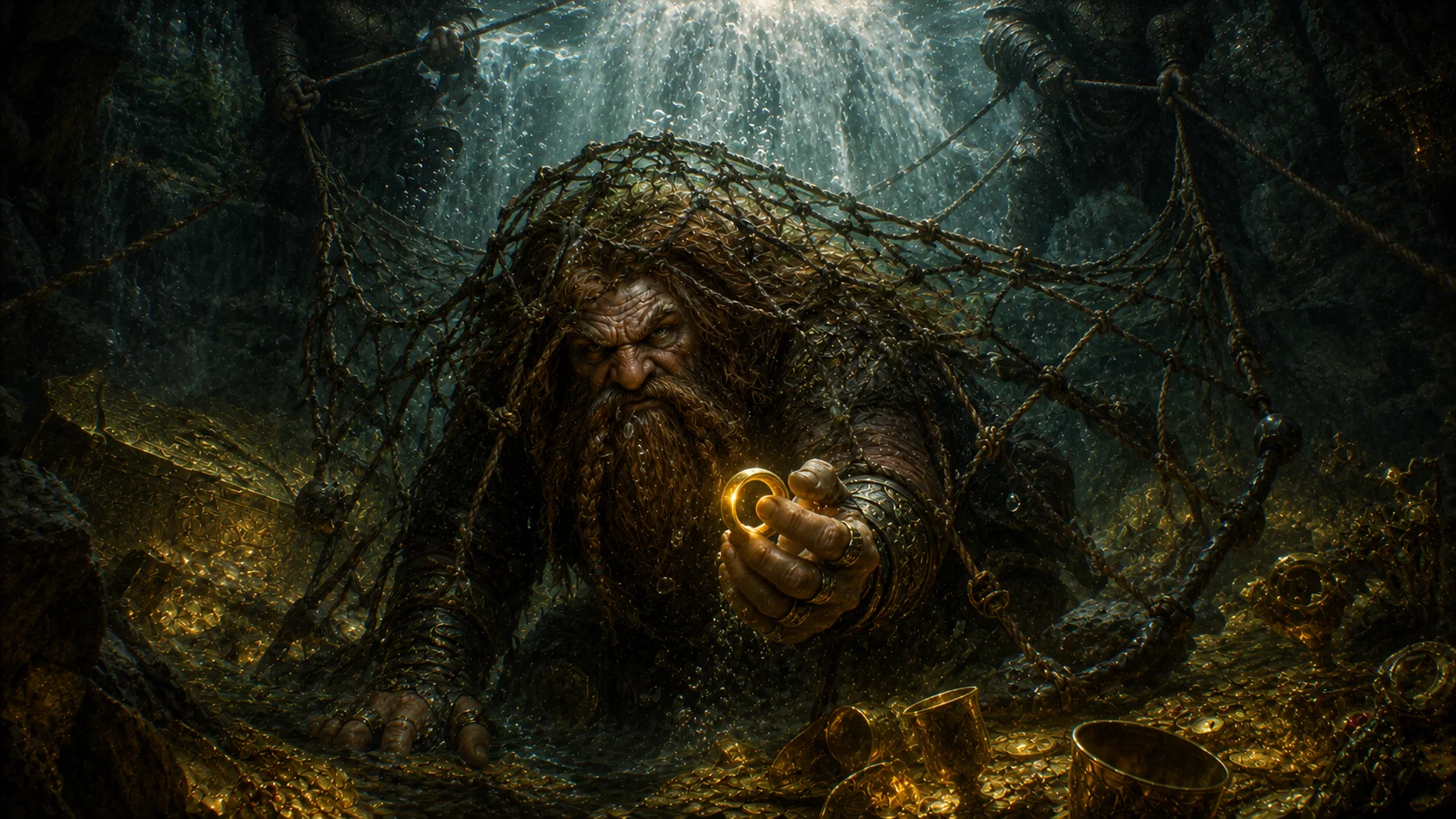
Andvari — the name is Old Norse for something like "the careful one," "the cautious one" — lives beneath a waterfall called Andvarafors, Andvari's Falls, a place named for him because he has been there so long the water itself carries his name. Beneath the falls he keeps a hoard of gold, and he does not guard it the way a warrior guards a hall, with weapons and walls. He guards it by disappearing into it. He takes the shape of a pike and swims among his own treasure, indistinguishable from any other fish that has ever slid through cold water, and in that shape he is untouchable — not because he is strong, but because no one thinks to look for a dwarf in a fish's skin.
Among the gold is one object he prizes above everything else he owns: a ring. It is called Andvaranaut — "Andvari's gift," though there is a bitterness in that name once you know what it will come to mean, because what it is truly the ancestor of is loss. The ring has a property that would make any hoarder love it beyond reason: it breeds gold. Left with its owner, it does not simply sit and shine. It multiplies. Whoever holds Andvaranaut watches their wealth grow on its own, without labor, without limit, for as long as the ring stays on their hand. It is, in other words, the one possession in the entire hoard that could make Andvari richer forever. He does not know yet that it is about to make him poorer than anyone.
An Otter, a Stone, and a Debt That Was Never His
None of what happens to Andvari begins with Andvari. It begins upstream, with three travelers who have nothing to do with him: Odin, Hoenir, and Loki, moving through the world the way gods do in these stories, restless and unaccountable. Along a riverbank Loki kills an otter with a stone, without much thought — the kind of small, careless violence that gods commit against the world and rarely answer for, except that this otter is not an otter. It is Otr, a shapeshifting son of a farmer and sorcerer named Hreidmar, caught in animal form at the wrong moment by the wrong stranger.
Hreidmar does not let it pass. With his surviving sons — among them Fafnir and Regin, names that will matter enormously before this story is finished — he seizes the three gods and names his price for Otr's death: a weregild large enough to fill the otter's skin completely and cover it on the outside as well, so that not one hair of Otr shows through. It is a debt built to be nearly impossible to pay, and it falls on Odin to see it paid. He sends Loki to find the gold — because Loki broke this, and because Loki is very good at finding what other people would rather keep hidden.
The Net in the Water
Loki knows, or learns, where a fortune large enough might be found: beneath the falls, in the keeping of a dwarf who never leaves his own gold unwatched. He goes to the water with a net — the kind associated with the sea-goddess Ran, made for catching what swims — and does what patient hunters do to careful prey. He casts it where the pike moves among the treasure and pulls it tight, and there is nowhere in that net for a fish to hide what it truly is. Andvari is caught. The shape that has kept him safe for so long is, in the end, still a shape that can be netted like any other fish.
Held and exposed, Andvari has no leverage left. Loki demands the hoard, and the dwarf gives it — all of it, gold heaped without argument, because there is no argument to make against a god holding you dripping out of your own river. But Andvari tries one last thing. As the gold goes over, he holds back the ring. Just Andvaranaut, the one piece that could let him begin again, quietly, the way a hoarder starts a second hoard smaller and more careful than the first. It is a single closed hand in the middle of total surrender, and it very nearly works. Loki sees it anyway, and because he sees it, he takes exactly that.
What a Dwarf Says When He Has Nothing Left to Lose
This is the moment the entire story turns on, and it happens to a figure who by every measure of power in this world should not matter at all — a dwarf, alone, stripped of every possession he has, standing in the wreck of a hoard he spent who knows how long building. He has no army, no magic left to work with, nothing to bargain with and nothing left to protect. What he has, in that moment, is a voice, and he uses it the only way someone with nothing left can: he curses what was taken from him.
Robbed of his last ring, Andvari retreats into the stone. What he speaks there is not a plea, and not a threat he has any power to enforce — it is a prophecy he cannot take back and no longer has any reason to withhold: that this gold will be the death of every man who owns it after him.
The poem that preserves the moment gives the curse a specific shape beyond a general doom — gold that becomes the death of two brothers, and a source of ruin for princes beyond them — though the exact wording and numbers shift a little between tellings, as old verse does across centuries of retelling. What does not shift is the shape of what he has done. Andvari has no sword and no army, and it does not matter. He has turned his own loss into the engine of every tragedy that follows.
The Gold That Kills the Man It Was Paid To
Loki carries the hoard back and the debt is paid — gold enough to fill Otr's skin and cover it besides, exactly as demanded. For one moment it looks as though the story might simply end there: a death, a payment, a debt closed. Then the curse begins to work, and it does not spare the very man it was paid to. Hreidmar, who demanded the gold, who was owed it, who did nothing wrong in Andvari's story at all, is murdered for it by his own son.
Fafnir kills his father for the hoard, and then does something no one asked of him and nothing in the weregild required: he transforms himself into a dragon, so that he can lie on the gold forever and let no one — brother, stranger, or hero — take it from him the way it was taken from Andvari. A dwarf's curse has already turned a son into a killer and a killer into a monster, and the gold has not even left the family yet.
The Hero Who Inherited a Curse He Never Saw Cast
The hoard does not stay buried under a dragon forever. Regin, Fafnir's brother, who was cut out of the gold entirely, spends years scheming to get it back by raising a foster-son named Sigurd and steering him, patiently, toward the one act Regin cannot perform himself: killing a dragon. Sigurd does what he is shaped to do. He slays Fafnir, and takes the hoard, and takes the ring — Andvaranaut, still carrying the same promise of endless wealth, still carrying the same curse it left the waterfall with.
Andvari himself is gone from the story by this point. He never appears again after the moment at the falls — no revenge, no return, no final confrontation with the hero who ends up holding what was once his. His part in this legend is contained entirely in that one scene: caught, stripped, and left to speak a doom he will never see land. But the curse he spoke does not need him present to keep working. It follows the ring through Sigurd's hands and, from there, through the tragic close of the Volsung and Gjukung story — the deaths of Sigurd and Brynhild, and the ruin of the family — Gunnar, Hogni, and the rest of the Gjukungs — who possess the gold after him.
A Ring That Outgrew Its Own Story
Andvaranaut is one of the oldest cursed objects in Western storytelling to work exactly the way cursed objects still work in fiction today: desirable enough that everyone who sees it wants it, lethal enough that no one who takes it escapes what it costs them. That shape — a ring of power, hoarded, stolen, fought over, and ruinous to whoever finally wins it — is one of mythology's most influential exports, its fingerprints visible in centuries of later treasure-curse tales that never mention Andvari by name but inherit his logic completely.
The clearest direct descendant is operatic rather than literary: Richard Wagner's Der Ring des Nibelungen draws its central object from Andvaranaut, renaming the dwarf Alberich and the ring simply "the Ring," while reshaping the plot for the stage. Wagner's version is vivid enough that it is often mistaken for the myth itself — but it is an adaptation, built centuries later on Eddic foundations. The dwarf under the waterfall, netted and cursing what he could not save, came first.
A Name Among Many, in the Old Poem's Long List
Andvari does not stand alone in the old texts as a single, isolated figure with one story. The Poetic Edda's Voluspa contains a long catalogue of dwarf names — the Dvergatal — a versified list rather than a narrative, and forms close to Andvari's own name turn up among its entries, alongside other names, such as Dvalin, that recur across the wider body of Norse dwarf-lore. Andvari was not invented whole for the Volsung story alone; he belongs to a broader tradition of named dwarves the poets drew on and reused.
What makes Andvari different from most of that list is that he is the one entry the Dvergatal cannot reduce to a name alone. Where Dvalin and the others are catalogued and move on, Andvari is given an entire scene, a motive, a loss, and a curse that outlives him.
A Craftsman's World That Andvari Never Belonged To
Andvari is a dvergr — one of the dwarves of Norse cosmology, beings tied to earth and stone, said in the old poems to have arisen from the flesh and bones of the primordial giant Ymir. In most of the surviving stories, dwarves are known as craftsmen: dwarven smiths forge Mjolnir for Thor, Draupnir and Gullinbursti, Sif's golden hair, the ship Skidbladnir, the spear Gungnir — treasures made for gods, by makers the gods depend on and rarely fully respect. Andvari stands apart from that pattern. He is not shown forging anything. He is a hoarder, not a maker — his gift to this mythology is not a masterwork handed to a god, but a curse handed to a thief, remembered far longer than most of the smiths' handiwork precisely because of what it went on to destroy.
Like every dwarf in these tales, he is never counted among the Aesir or Vanir — always an outsider to the divine families, encountered by gods only when they need something a dwarf has. Loki does not visit Andvari as an equal or even as a customer. He visits him as a debtor's errand-runner with a net, and that imbalance of power is the whole reason the theft is possible at all.
Why the Curse, Not the Dwarf, Is What Survives
It says something about how this story is built that Andvari — the character who starts everything — is barely present in it. One scene. A capture, a loss, a curse spoken once and never repeated. He does not appear at Fafnir's death, or Sigurd's, or the fall of the Gjukungs, and no character in the later saga ever mentions going back to find him. Yet nothing in the entire cycle happens without him. Every death that follows — Hreidmar's, Fafnir's transformation, Sigurd's doom, Brynhild's, the ruin of a royal line — traces back to one dwarf, dripping and furious, refusing to let a theft go unanswered even though answering it is the only power he has left.
That is the shape Andvari leaves behind in Norse legend: not a monster to be fought, not a god to be worshipped, but proof that a curse spoken with nothing behind it but grief and fury can outlast everyone who ever laughs it off. Loki took the ring and walked away untouched. Everyone who touched it after him did not.
Sources & traditions
- EncyclopediaWikipedia — Andvari
- TraditionNorse texts, inscriptions and later retellings (Scandinavia)
Myths change from area to area and from time to time. This chronicle follows the most widely told versions; tellings in other villages, regions and eras may differ.