Sigurd (Siegfried) was the greatest hero of Norse legend — the dragon-slayer who killed Fafnir, won the cursed treasure of the Nibelungs, learned the language of birds, awakened the valkyrie Brynhild from her ring of fire, and was at last betrayed and murdered, his tragic tale forming the heart of the great Volsung saga. He is the supreme champion of the north, the model of the heroic dragon-slayer.
The Volsung Hero
Sigurd (Old Norse Sigurðr; in the German tradition, Siegfried) was a hero of the Volsung line, a descendant of Odin himself. His father Sigmund was killed before his birth, and the shards of Sigmund's broken sword were kept for the son who would come. Sigurd was fostered by the cunning smith Regin, who reforged the broken sword into the mighty blade Gram — so sharp it could cleave an anvil and cut a tuft of wool drifting on water — and who set the young hero on the path to his destiny.
The Slaying of Fafnir
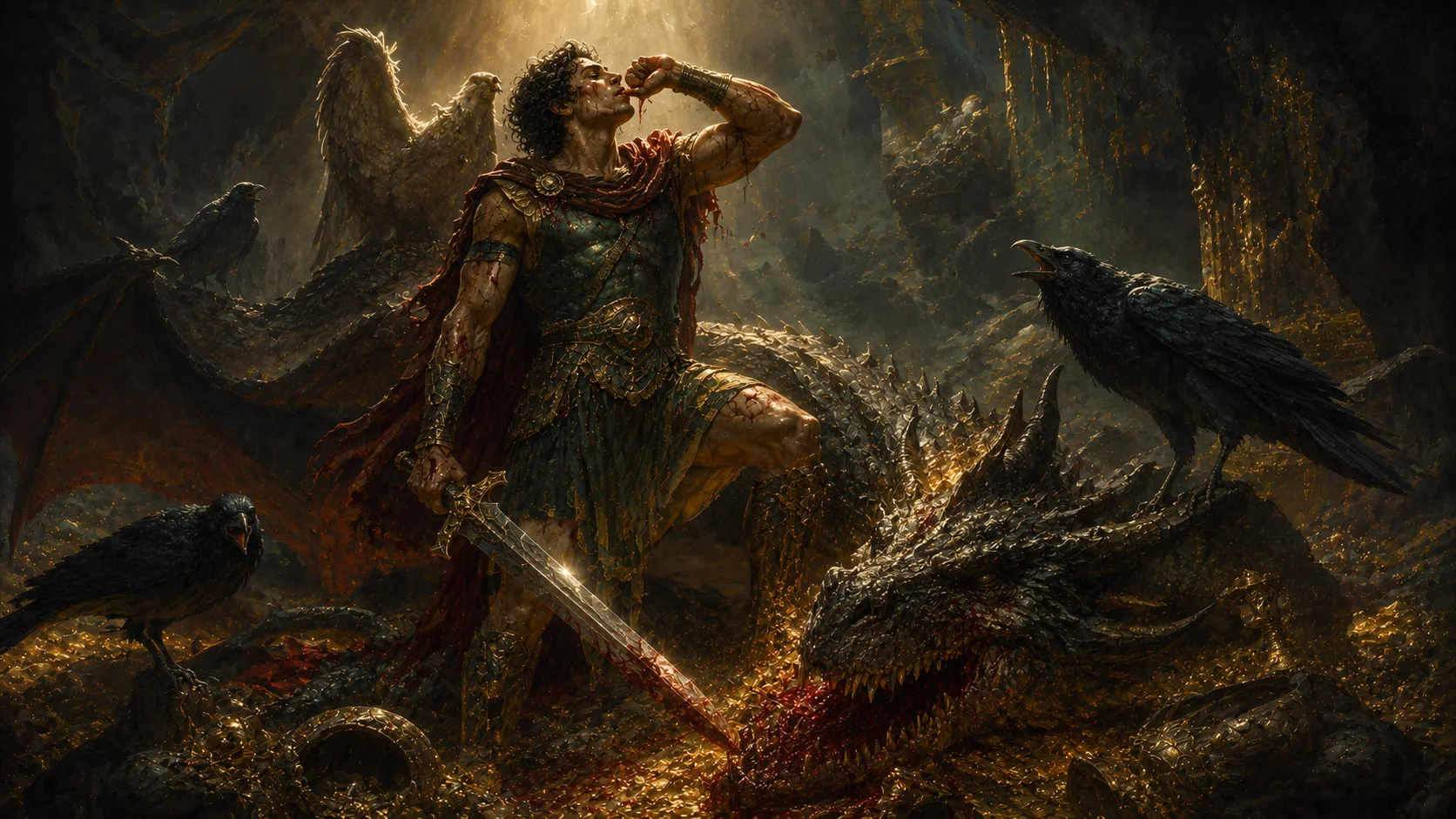
Regin had a secret motive: he wanted Sigurd to slay the dragon Fafnir — Regin's own brother, who had murdered their father for the cursed gold of Andvari and become a venomous dragon to guard the hoard — so that Regin might claim the treasure. Sigurd agreed, and on Regin's counsel (and the advice of a disguised Odin) he dug a pit in the dragon's path and, when Fafnir crawled over it to drink, thrust Gram up into the beast's soft underbelly, slaying the great dragon. Then Sigurd roasted Fafnir's heart; and when he touched his thumb to the hot blood and put it to his mouth, he suddenly understood the language of birds — and heard the birds warn him that Regin meant to betray and kill him for the gold. So Sigurd slew the treacherous Regin and took the cursed hoard, along with the ring Andvaranaut, for himself.
Brynhild and the Ring of Fire
Riding on, Sigurd came upon a hall ringed with flames, within which slept a beautiful warrior-woman — the valkyrie Brynhild, whom Odin had punished with an enchanted sleep behind a wall of fire, to be awakened only by a man who knew no fear. Sigurd rode through the flames on his great horse Grani, woke Brynhild, and the two pledged their love. But the curse of the gold was at work. Through the schemes of the Nibelung queen Grimhild, Sigurd was given a potion of forgetfulness, forgot Brynhild, and married Gudrun instead; worse, disguised by magic as another man (Gunnar), he rode through the flames a second time to win Brynhild as a bride for Gunnar. When the deception was uncovered, the betrayed and humiliated Brynhild's love turned to a terrible desire for vengeance.
The Betrayal and the Legacy
Brynhild, consumed by grief and rage at the betrayal, drove the Nibelungs to murder Sigurd — and the greatest hero of the north was treacherously slain (stabbed in his bed or in the forest, in the differing tellings), the curse of Andvari's gold claiming him as it claimed all who held it. Brynhild, unable to live without him, took her own life and was burned on his pyre. Sigurd endures as the supreme hero of Norse and Germanic legend — the dragon-slayer, the winner of the cursed hoard, the lover of the valkyrie, the tragic champion betrayed and murdered. His saga, retold across the centuries (in the Völsunga saga, the Nibelungenlied, and modern opera and fantasy), is one of the great heroic tragedies of the world, the very model of the dragon-slaying hero and his doom.
He slew the dragon, tasted its blood and understood the birds, rode through fire to wake a valkyrie, and won a cursed hoard — and for that gold, the greatest hero of the north was murdered in his bed.
Where the Curse Begins: The Otter's Ransom
The gold that kills Sigurd was already lethal before he was born, and it was the gods who made it so. Odin, Hœnir and Loki were walking the world when they came to a waterfall where an otter sat on the bank eating a salmon with its eyes shut. Loki killed it with a stone, and the three carried the skin away as a trophy. They had killed a man. Otr was the son of Hreidmar and the brother of Fafnir and Regin, and he liked to take an otter's shape when he fished. That evening the gods asked Hreidmar for lodging, showed him the pelt, and found themselves bound. The price of their lives was set: the skin must be stuffed with gold and then buried under gold, until not a single hair showed.
Loki went back to the falls, borrowed a net, and caught the dwarf Andvari, who was hiding in the water in the shape of a pike. Andvari gave up his whole hoard to buy his freedom but tried to hold back one ring; Loki took that too. So the dwarf did the only thing left to him and laid a curse on the ring — that it would be the death of every man who owned it. The skin was stuffed and heaped over, and one whisker still showed, and Odin surrendered the ring to cover it. Fafnir then murdered his own father for the treasure, carried it away to the heath called Gnitaheiðr, and took serpent shape to lie on it.
This is the stretch of the legend most retellings skip, and it is the stretch that makes the rest cohere. The dragon is not a monster that wandered in from the wilderness. He is a son who wanted his inheritance. And the hoard Sigurd wins is not treasure at all — it is blood-money, compensation paid for a killing the gods committed and then walked away from. Every character in the Volsung story is settling a debt somebody else ran up.
The Dying Dragon's Questions
The eddic poem Fáfnismál does something almost no other dragon story does: it lets the dragon talk, at length, while he dies. Fafnir's first question is not why but who — what man are you, and whose son? Sigurd refuses to answer, and the prose that runs beside the verse is explicit about why: a dying man's curse was held to bite hardest when it could name its target. He calls himself a noble beast, motherless and fatherless, come alone. Only when the dragon is nearly gone does he give his name.
What follows is a conversation between a killer and his victim about power. Fafnir says he wore the ægishjálmr, the helm of terror, over the sons of men, and that while he lay coiled on his treasure he believed himself stronger than anyone alive. Sigurd's reply is the coldest line in Norse heroic verse and the reason the poem still works: a helm of terror shields nobody where men actually have to fight, because whoever comes among many discovers soon enough that no one is bravest of all. Fear had been Fafnir's whole strategy, and it turned out to be a story he told himself. Then the dragon warns him that the ringing red gold will be his death — and Sigurd answers, in effect, that somebody holds the hoard until the appointed day, and that the day comes for every man alive. He knows. He takes it anyway. That is the difference between a hero and a fool, and the poem does not pretend the difference is large.
What the Valkyrie Taught Him
The scene behind the wall of flame is usually remembered as a kiss. In the poem Sigrdrífumál it is a lesson. The woman who wakes gives Sigurd a horn of ale and then teaches him runes, one class at a time:
- Victory-runes, to be cut on the hilt and guard of a sword, with the god Týr's name spoken twice
- Ale-runes, marked on the drinking horn and the back of the hand, with a leek cast in the cup, against a wife who would betray a guest's trust
- Helping-runes, to loose a child from the womb
- Sea-runes, cut on stem and rudder-blade and burnt into the oar
- Limb-runes, carved on the bark of trees, for healing wounds
- Speech-runes, for the assembly, so no man may repay harm with harm
- Mind-runes, for being wiser than all others
Then she gives him plain counsel, most of it about restraint: keep faith with kin, never quarrel with a fool in a crowd, do not trust a man whose father or brother you have killed, and be wary of a woman's sweet words. The greatest hero in the north is handed, in advance and in full, the exact wisdom he will fail to use.
The teacher is named Sigrdrífa, "victory-driver" — and whether that is a personal name or a valkyrie's title is one of the oldest unsettled questions in the material. The Völsunga saga treats her simply as Brynhild; the eddic poems are less tidy, and some readings keep two women behind the fire rather than one. The uncertainty is not the fault of the poets. The one medieval manuscript that carries the heroic poems of the Poetic Edda, the Codex Regius, is missing a gathering of eight leaves — the Great Lacuna — and it falls precisely here, swallowing the end of Sigrdrífumál and the long lay of Sigurd that once stood after it. Of that lay, twenty-two stanzas survive as a fragment; the original may have run past two hundred and fifty. The central love story of Germanic legend reaches us mainly because a saga-writer in Iceland was working from a fuller book than any that has come down to us.
Reading Sigurd in Stone
Before anyone wrote this story down, people carved it. On a flat rock face at Ramsund in Södermanland, Sweden, cut around 1030, the whole tale runs as a strip cartoon in which the dragon's own body forms the band that holds the runic inscription: Sigurd crouched beneath, thrusting up through the serpent; the heart roasting on a spit; the thumb going into the mouth; the birds in the tree; Grani tethered and loaded; and Regin flung down beside his hammer, tongs and anvil, with his head off. It is the earliest coherent telling of the story we possess, and it is a picture, not a text. The inscription itself says nothing about dragons: it records a woman named Sigríðr, Orm's daughter, who had a causeway built for the soul of Holmgeirr, her husband's father. Her husband's own name was Sigrøðr — Sigurd — which may well be why that story and no other was chosen for the rock. A cruder version was copied nearby onto the Gök stone by a carver who plainly did not understand what he was reproducing.
The same scenes appear on the carved portal of the stave church at Hylestad in Setesdal, Norway, on stone crosses raised by Norse settlers on the Isle of Man, and on sculpture in northern England, including the cross shaft at Halton in Lancashire, where a smith works at his forge in one panel and lies beside his own severed head in the next. Some identifications are firmer than others; a man with his thumb in his mouth beside a smith's tools is fairly unambiguous, a lone bird in a tree is not.
What nobody has settled is why a pagan dragon-slayer was carved onto Christian monuments and church doorways by Christian patrons. The usual explanations are that Sigurd was read as a figure of Christ or of St Michael harrowing the serpent; that families who claimed descent from him were advertising it in the most public place available; or, least flatteringly to theology and most plausibly to anyone who has ever commissioned art, that it was simply the best story the carvers knew.
Gold Was Called "Grani's Burden"
The surest measure of how completely this legend saturated the north is not the sagas but the shorthand. Skalds could refer to gold as the otter's ransom, Fafnir's bed, Grani's burden or the Rhine's fire and expect a hall full of listeners to follow instantly — four compressed references to four different moments of the same story, used as a routine word for money. Snorri Sturluson lists them among the standard kennings for gold in Skáldskaparmál. You do not build a metaphor system on a story people half-know.
The horse in that phrase deserves his own note. Grani was chosen from a king's herd on the advice of a grey old stranger with one eye, who told Sigurd to drive the whole herd into a river and watch. Every horse but one swam back to the bank; the one that held the water was a young grey no man had yet ridden, and the stranger said he came of the stock of Odin's own Sleipnir before vanishing. Odin gives Sigurd the horse. Odin, disguised again, tells him how to dig the pit that kills the dragon. Odin is the ancestor of his line, and Odin is the one who condemned Brynhild to sleep in the first place. The god is threaded through every hinge of Sigurd's life, which raises a question the sagas never quite answer out loud: whether Sigurd's triumphs were ever entirely his own, or whether he was being moved from the start toward the death that would deliver him to Odin's hall.
The Southern Siegfried
Around 1200 an anonymous poet in Austria or Bavaria wrote the Nibelungenlied, and the hero who walks into it is recognisably the same man with a different biography. This Siegfried is a prince of Xanten on the lower Rhine, not a fatherless boy in a smithy. He bathed in the blood of a dragon he had killed, and his skin became hard as horn — except for one spot between the shoulder blades where a linden leaf fell as he bathed. He owns a Tarnkappe, a cloak that confers invisibility and the strength of twelve men, taken from the dwarf Alberich. There is no valkyrie on a mountain, no potion of forgetting, and no birds.
What survives intact is the shape of the catastrophe. Siegfried helps Gunther win Brünhild by trickery; years later the two queens quarrel in public over which of them may enter the cathedral at Worms first, and Kriemhild flings the truth at her rival on the church steps. Hagen extracts from Kriemhild the location of the vulnerable spot, on the pretext of protecting her husband, and asks her to mark it with a cross stitched on his tunic. He spears Siegfried through it at a woodland spring while the hero is bent over the water drinking. The hoard is sunk in the Rhine. Kriemhild marries Etzel and spends the second half of the poem destroying everyone involved.
The difference between the two traditions is the engine, not the plot. In the north, Brynhild destroys Sigurd because she was cheated of him; in the south, Kriemhild destroys an entire royal house because her husband was murdered. The Norse version is a tragedy of a woman betrayed in love. The German version is a tragedy of a widow's revenge. Other retellings scatter further still: the Norwegian Þiðreks saga sets the newborn adrift on a river in a glass vessel, has him suckled by a hind and then taken in by a smith, and a later German popular ballad, Das Lied vom Hürnen Seyfrid, turns him into a horn-skinned strongman who rescues Kriemhild from a dragon on a mountain with a dwarf's help.
The History Underneath
Three real catastrophes are buried in this legend, and they can be dated. Gunnar, or Gunther, carries the name of Gundahar, a historical king of the Burgundians on the Rhine, defeated by the Roman general Aetius in 436 and destroyed the following year when Hunnic troops fell on his kingdom and burned Worms. Atli, or Etzel, is Attila, who died in 453 in his own bed on the night he married a young woman recorded as Ildico — a death that contemporaries already found suspicious, and which the Norse tradition converts into Gudrun's deliberate revenge. Jörmunrekkr is Ermanaric, king of the Goths, dead around 375; Jordanes preserves the story of a woman torn apart by horses on his orders and two brothers who came to maim him for it.
A massacre, a warlord's convenient death, a king's atrocity: three separate disasters, generations and hundreds of miles apart, fused across centuries into the misfortunes of one family. And at the centre of all that history stands Sigurd, the one figure nobody has been able to anchor. The best guess scholarship offers is that his name preserves the sigi- element common among Merovingian kings, which is a resemblance and not a man. The invented one outlived every real one around him. That may be the point — history supplied the wounds, and legend supplied someone worth losing.
After the Murder
The saga does not stop when the hero dies; it gets worse, methodically, for two more generations. Guðrún sits by the body unable to weep while the women of the court recite their own griefs to unlock hers, until one of them pulls the sheet from Sigurd's face and lays his head on his wife's knee, and the tears come. She is later married to Atli, who kills her brothers for the gold: Högni's heart is cut out, and Gunnar is thrown bound into a snake-pit, where he plays a harp with his toes until one adder reaches him. Gudrun's answer is the most terrible act in Norse literature — she kills the two sons she bore Atli, serves them to him, tells him what he has eaten, and burns the hall.
Sigurd's daughter Svanhild is trampled to death by horses at Jörmunrekkr's command, and Gudrun sends her last sons, Hamðir and Sörli, to avenge her. They hack off the king's hands and feet before his men, having been warded against iron, are told to stone them instead. The Volsung line is extinguished by rock because steel could not do it.
One thread escapes. Áslaug, daughter of Sigurd and Brynhild, is smuggled out of the wreckage as a child — hidden inside a harp, in the telling that survives — and grows up to marry Ragnar Loðbrók, which grafts the blood of the dragon-slayer onto the most famous viking dynasty in the sagas and offered later Scandinavian houses a genealogy running back through Sigurd to Odin himself. Legends of this size are rarely preserved for pleasure alone. Somebody's claim to a throne usually depends on them.
The Ballad That Is Still Danced
In the Faroe Islands the Sigurd story is not primarily something read. It is sung and danced. The Sjúrðarkvæði — a cycle whose parts include Regin smiður, Brynhildar táttur and Høgna táttur — belongs to the Faroese chain dance, in which a lead singer, the skipari, carries the verse from memory while a ring of dancers holding hands answers the refrain and steps the rhythm through hundreds of stanzas. The dance is a living social form, still performed at weddings, gatherings and Shrovetide. It means that in one corner of the North Atlantic the reforging of the sword and the killing of Fafnir have never stopped being spoken aloud by ordinary people in a room, in their own language, with everyone joining in.
Rediscovery — and Misuse
Nineteenth-century Europe fell on this material hard. William Morris and Eiríkr Magnússon published an English Völsunga saga in 1870, and Morris followed it with his own long poem Sigurd the Volsung in 1876, which he rated above everything else he wrote. Wagner had finished the score of Der Ring des Nibelungen two years earlier, and in that same summer of 1876 the four operas were staged as a cycle for the first time, at Bayreuth; he had drawn far more on the Norse sources than on the German poem, and he gave the world the image most people still carry — the fearless boy, the reforged sword, the fire, the doomed love. Fritz Lang filmed Die Nibelungen in 1924. J. R. R. Tolkien wrote his own eddic-metre retelling in the 1920s and 1930s, published long after his death as The Legend of Sigurd and Gudrún; when a translator suggested his own ring owed something to this one, he replied that both rings were round and there the resemblance ceased.
The darker afterlife has to be stated too. After 1918 the German nationalist right built the Dolchstoßlegende, the stab-in-the-back myth, around the image of Siegfried speared between the shoulders by a treacherous ally — the undefeated hero brought down from behind. Hindenburg himself reached for the comparison in as many words. Defensive lines built in 1917 and again from 1936 carried the hero's name. A medieval poem cannot be held responsible for what a later politics does with it, but the episode is a permanent reminder that the most useful thing about a hero who cannot be beaten in a fair fight is the excuse he provides for losing.
Why the Story Will Not Let Go
Strip away the dragon and Sigurd is a story about a specific and very modern kind of ruin. He is the man who cannot be killed except in one place, and someone he trusts learns where it is. He is given, explicitly and in advance, all the wisdom he needs to survive, and he is undone not by any failure of courage but by a drink, a disguise and a lie told to a woman. He understands the speech of birds and misreads every human being around him.
And the treasure at the heart of it was never wealth. It was a debt, cursed at the moment it was taken, passed hand to hand through a father, a brother, a hero, a queen and a river, killing each holder in turn. That is why the tale went into stone in Sweden, into a church door in Norway, into a poem in Austria, into an opera house in Bayreuth, and into a ring of dancers in the Faroes, and has not stopped moving. The oldest fear it carries is not the serpent on the heath. It is the suspicion that what we most want to inherit is precisely what will destroy us.
Sources & traditions
- EncyclopediaWikipedia — Sigurd
- TraditionNorse texts, inscriptions and later retellings (Scandinavia)
Myths change from area to area and from time to time. This chronicle follows the most widely told versions; tellings in other villages, regions and eras may differ.