Bellerophon was the hero who tamed the winged horse Pegasus and slew the fire-breathing Chimera — and then flew too high, in every sense, and fell. His story is one of myth's clearest parables of hubris: the warning that the same daring that lifts a hero to glory can carry him straight into the wrath of the gods.
A Name Earned in Blood
He was not born Bellerophon. Ancient sources give his birth-name as Hipponous, grandson of the cunning Sisyphus and son of Glaucus, king of Corinth — though tradition also whispered a second, grander paternity: that his true father was Poseidon, and that Glaucus was only the husband who raised him. The Greeks were comfortable leaving that ambiguity unresolved; a hero could belong to two fathers at once, one mortal and one divine, without the story needing to choose between them.
The name Bellerophon, by which he is remembered, is explained by some ancient sources as meaning "slayer of Belleros" — a killing, not a birthright. Accounts differ on exactly whom he killed to earn it: some name a man called Belleros, others say it was his own brother, Deliades. What the sources agree on is the consequence. Blood had been spilled, deliberately or not, and a prince of Corinth could not simply stay in Corinth after it. He went into exile carrying a new name that named his crime.
A Guest Purified, A Queen's Lie
Exile took him to Tiryns, to the court of King Proetus, who did what a king was bound to do for a suppliant guest: he purified Bellerophon of the bloodguilt and took him in under the sacred protection owed to any guest-friend. It should have been the end of his troubles. Instead it produced worse ones.
Proetus's wife — called Anteia in some tellings, Stheneboea in others — made advances on the young exile. Bellerophon refused her. Spurned, she went to her husband with the accusation reversed: that it was Bellerophon who had tried to force himself on her. It is the same shape as the story told of Potiphar's wife in a very different tradition, and it put Proetus in an impossible bind. Guest-right forbade him from killing a man he had sheltered under his own roof with his own hands. So he found another way.
A Letter Meant to Kill Its Bearer
Proetus sent Bellerophon to Lycia, to his father-in-law King Iobates, carrying a sealed letter he was never shown the contents of. The letter asked Iobates to put the bearer to death. Bellerophon delivered his own death warrant with his own hands and did not know it.
Iobates, like Proetus before him, would not simply murder a guest who had been welcomed at his table — hospitality carried a weight in this world that overrode even a king's private wishes. So he chose the same solution his son-in-law had: send the young man somewhere a monster, not a host, could do the killing instead. The task he set was the Chimera.
The Bridle Given in a Dream
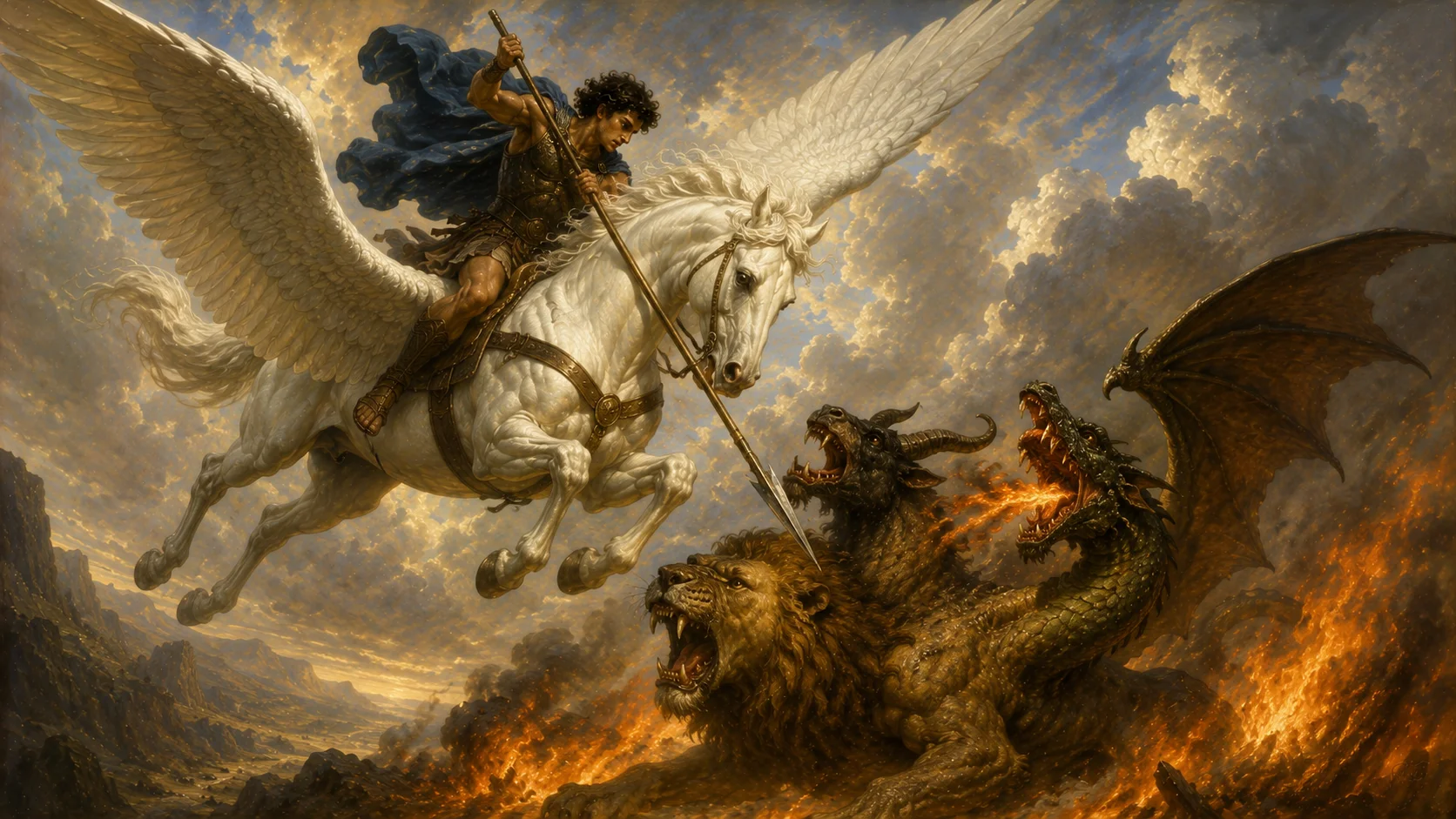
The Chimera could not be fought on foot — a fire-breathing hybrid of lion, goat, and serpent, it burned anything that came within reach. Bellerophon needed a way to fight from above, and that meant catching the one creature wild enough to carry him there: Pegasus, the winged horse that had sprung fully formed from the blood of the slain Gorgon Medusa.
Athena came to his aid directly, giving him a golden bridle with which to master the immortal horse. With it he tamed Pegasus at a spring, and the two became inseparable partners — a hero who could not otherwise have stood a chance, and a horse that no other hand could hold.
Fire Answered With Lead
Mounted on Pegasus, Bellerophon attacked the Chimera from the air, beyond the reach of its jaws and its flame, raining arrows down where the ground-bound could never have survived to throw them. It was not enough to wound the creature from a distance; it had to be finished.
He fixed a lump of lead to the tip of his spear and drove it into the Chimera's burning throat. The monster's own fire did what no blade could: it melted the lead in the wound, and the molten metal poured down and killed it from within. The Chimera had been unbeatable only to those who tried to beat it on its own terms. Bellerophon simply refused to.
This episode is the best-attested of all Bellerophon's deeds, recounted already in Homer's Iliad, where his grandson Glaucus of Lycia tells the story to the Greek warrior Diomedes on the battlefield — proof of how early and how firmly the tale had already taken root by the time Homer was composing.
Trials That Would Not Kill Him
The Chimera's death did not end Iobates's design. If one monster could not remove the young man, Iobates tried harder targets still: he sent Bellerophon to fight the fierce Solymi people, and after them the Amazons, and when even that failed to finish him, he arranged an ambush meant to do what open battle could not.
Bellerophon survived every one of them. A king who had begun by trying to have a man killed by proxy was left, trial after trial, staring at a survivor he could no longer explain away as lucky.
The King Who Changed His Mind
Faced with a man who could not be killed by monster, army, or ambush, Iobates read the pattern for what it was: divine favor, plainly and repeatedly shown. He abandoned the plot his own son-in-law had set in motion and did the opposite of what the sealed letter had asked. He gave Bellerophon half his kingdom and his daughter in marriage.
It is the turn the whole story pivots on — the falsely accused exile, sent to die twice over by two different kings, ending instead as an heir to a throne. For a while, at least, the tale reads as vindication rather than tragedy.
A Rider Who Forgot He Was a Man
Vindication did not sit well on him. Bellerophon came to believe his run of impossible victories had earned him a place among the gods themselves, and he turned Pegasus's wings toward Olympus, meaning to fly up and join them there. It was the one flight the horse could not be allowed to finish.
Zeus, in most versions of the story, did not need thunder or a bolt to end it. He sent a single gadfly to sting Pegasus mid-flight. The horse reared in pain, and Bellerophon was thrown. This episode, too, is old enough to be referenced in Homer and was developed further by the poet Pindar in his Seventh Isthmian Ode — a fall notable enough to be sung about for centuries after.
The Long Way Down
He fell the whole distance back to earth. It did not kill him, which in the logic of this myth was closer to a punishment than a mercy. He lived, but crippled, and he spent the rest of his years shunning the company of other men, wandering alone rather than face what he had been and what he had tried to become. The horse that had made him a hero left him exactly where his own ambition had aimed him — not among the gods, and no longer quite among mortals either.
The Horse That Reached Olympus Without Him
Pegasus did not fall. He continued on alone and completed the flight Bellerophon never finished, arriving at Olympus and taking up a place there in his own right. According to Hesiod's Theogony, Pegasus became the bearer of Zeus's own thunderbolts — the one member of that failed ascent who was actually welcome at the top.
It is a detail worth sitting with: the horse earned by taming succeeded exactly where the man who tamed him did not. Divinity, in this story, was never Bellerophon's to claim by force of will, no matter how many monsters he had already proven himself against.
A Warning Carved Into Later Memory
Bellerophon's arc became one of Greek myth's clearest cautionary shapes: obscurity, then earned glory, then a ruin that came not from an enemy but from his own reach exceeding what a mortal was owed. The Pegasus-and-Chimera imagery spread widely through Greek art long after, and the image of Bellerophon's fall recurred in later classical literature as a standing moral exemplum — alongside myth's other stories of mortals who tried to fly too close to the gods and were brought back down.
He could tame a horse no one else could ride — but he could not rein in his own pride, and it cost him the sky.
Sources & traditions
- EncyclopediaWikipedia — Bellerophon
- TraditionGreek texts, inscriptions and later retellings (Greece)
Myths change from area to area and from time to time. This chronicle follows the most widely told versions; tellings in other villages, regions and eras may differ.