Amun was the great hidden god of ancient Egypt — the “Hidden One,” a creator-god of the air and the unseen who rose to become the supreme deity of the Egyptian empire as Amun-Ra, the King of the Gods. Beginning as a local god of Thebes, he became the most powerful god in Egypt, the invisible and universal divine power behind all creation, worshipped at the vast temple of Karnak.
The Name That Cannot Be Seen
Amun (Egyptian Imen) carried a name that was itself a theological statement: “the hidden one” or “the invisible one.” He was not a god of a single visible phenomenon — not the sun disc blazing overhead, not the flooding river, not a particular animal or star — but the unseen power of air and hiddenness itself. Long before he was a national god, he was a local deity of Thebes, one voice among many in Egypt’s crowded pantheon, worshipped by a provincial population with no reason to suspect he would ever eclipse the old gods of Heliopolis or Memphis.
A Provincial God Finds an Empire
Amun’s ascent tracks the ascent of the city that worshipped him. As Thebes grew from a regional town into the political center of Egypt, his standing rose in step, and by the Middle Kingdom he had climbed from local cult figure to a deity of national prominence. It was in this period that the decisive theological move occurred: Amun was merged with Ra, the ancient sun god of Heliopolis, to form the composite deity Amun-Ra. The union was not a replacement of one god by another but a fusion of attributes — the hidden, all-pervading power of Amun joined to the visible, radiant power of Ra. From the New Kingdom onward, Amun-Ra held the title “King of the Gods,” the closest thing Egyptian religion produced to a supreme, imperial deity.
Consort and Son at the Heart of Thebes
Amun did not reign alone. At Thebes he was worshipped as the head of a divine family known as the Theban Triad: Amun himself, his consort Mut, and their son Khonsu. This triad anchored Theban religious life and gave the city’s temple architecture its structuring logic — sanctuaries and processional routes built around the relationships of a divine household, echoing the human family in monumental stone.
Karnak, the Primary Seat of the God
Amun’s primary cult center was Karnak, known to the Egyptians as Ipet-Isut. Karnak grew over centuries into a temple complex of staggering scale, expanded by successive pharaohs eager to associate themselves with the King of the Gods. Luxor Temple, some distance to the south, was equally central to Amun’s worship, and the two sites were bound together by a great processional avenue lined with sphinxes, along which the god’s cult statue was carried during festival rites that moved between his two Theban homes.
The Crown of Two Plumes
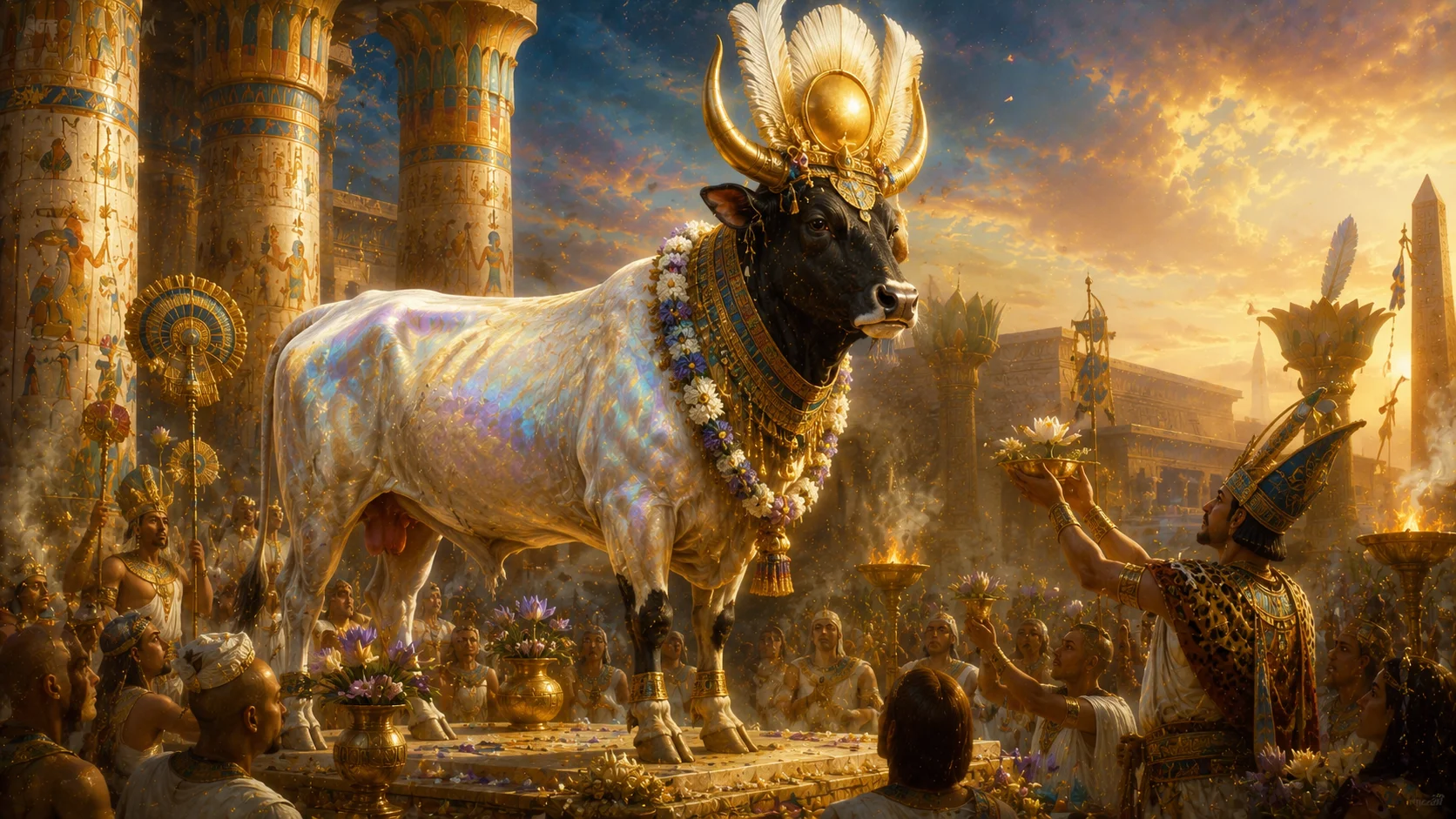
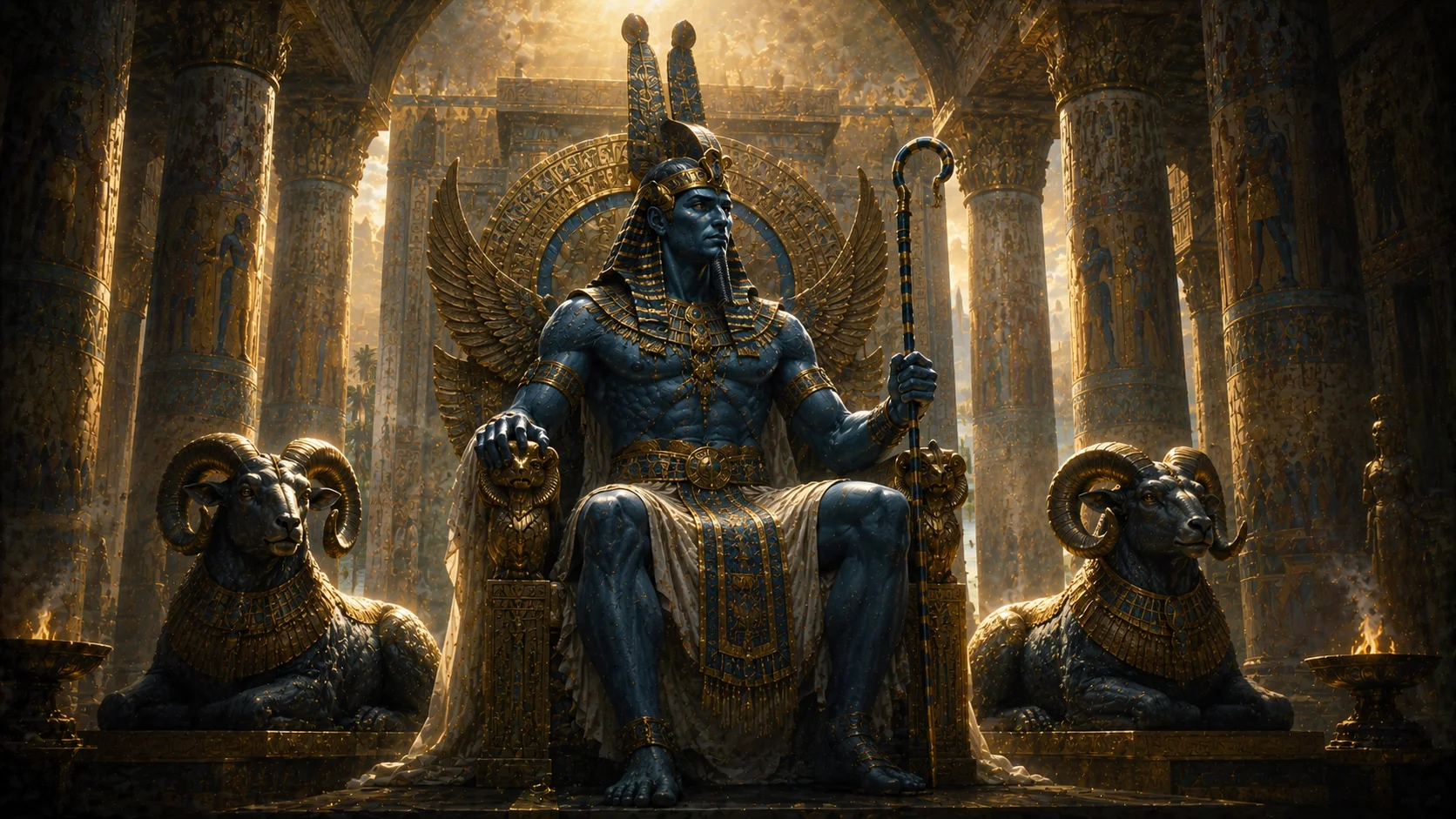
Amun was typically shown as a man wearing a tall crown of two upright plumes, a headdress unmistakable among Egyptian iconography and reserved for him. He was also associated with ram’s horns, and the ram itself was sacred to him, alongside the goose — both animals carrying his cult identity into temple reliefs, votive offerings, and the ceremonial life of his sanctuaries. These were not decorative flourishes but markers of divine presence, ways for worshippers to recognize the hidden god made momentarily visible in image and ritual.
A Priesthood That Grew Beyond the Temple Walls
The wealth that flowed into Amun’s cult during the New Kingdom was extraordinary, and it did not stay confined to religious matters. The priesthood of Amun at Thebes accumulated land, labor, and treasure on a scale that made it a genuine rival to pharaonic authority. By the Third Intermediate Period this rivalry had become fact rather than tension: the High Priests of Amun effectively ruled Upper Egypt in their own right, a theocratic power base built on centuries of royal donations to the god who was supposed to legitimize the throne.
The King Who Tried to Erase Him
That very power made Amun a target. The pharaoh Akhenaten, born Amenhotep IV, moved to suppress Amun’s cult in favor of the sun-disc Aten, closing temples dedicated to Amun and ordering his name struck from monuments across Egypt. The campaign did not outlast its author. Under Tutankhamun and Horemheb, Amun’s cult was restored to its former standing, the closed temples reopened, and the erased name recut into stone, a reversal that speaks to how deeply Amun’s worship was woven into Egyptian religious identity.
Absorbing the Sun God’s Story
As Amun merged with Ra, he inherited more than a name. The solar cosmogonies long associated with Ra, along with mythic material such as the Contendings of Horus and Set, were absorbed into Amun-Ra theology as he took on the attributes of a solar creator god. Amun-Ra became not merely a king among gods but a cosmic force credited with the ongoing work of creation itself, folding the old Heliopolitan sun theology into his own hidden, universal nature.
Titles Fit for a King of Gods
The epithets attached to Amun reflect the scale of his eventual standing: “King of the Gods,” “Lord of the Thrones of the Two Lands,” and, always, the “Hidden One.” These titles were not poetic excess but formal religious language, used in temple inscriptions and royal texts to declare Amun’s supremacy over the rest of the Egyptian pantheon and his direct relationship to the throne of a unified Egypt.
An Oracle in the Desert, Consulted by a Conqueror
Far from Thebes, in the desert isolation of the Siwa Oasis, stood the Oracle of Amun — a shrine whose reputation reached well beyond Egypt’s borders. Its most famous visitor was Alexander the Great, who made the journey to Siwa and was declared son of Amun there, an episode that fused Egyptian religious tradition with the ambitions of a Macedonian conqueror and cemented the oracle’s place in history far outside Egypt’s usual religious geography.
Zeus Ammon: A God Renamed Abroad
Egyptian religion did not stay sealed within Egypt’s borders, and Amun is one of its clearest cases of cultural crossover. The Greeks identified Amun with their own supreme god Zeus, worshipping him under the composite name Zeus Ammon — a striking instance of interpretatio graeca, the Greek habit of mapping foreign deities onto their own pantheon. That Amun, rather than any other Egyptian god, was chosen for this equation with the king of the Greek gods says something about how thoroughly his own countrymen had already cast him as supreme.
Hymns to a God Who Cannot Be Named in Full
Amun’s theology found its fullest written expression in hymns composed at the height of his cult’s power. The Great Hymn to Amun, preserved on Papyrus Leiden I 350 alongside related New Kingdom compositions, praises him as a hidden, all-encompassing creator god — a deity who exceeds every image and every name applied to him, present in all things while remaining fundamentally unseen. These hymns are among the most sophisticated surviving statements of Egyptian theology, wrestling directly with the paradox at the center of Amun’s identity: a god defined by concealment, praised in some of the most elaborate religious poetry Egypt ever produced.
The Hidden Power Behind an Empire
Amun endures as one of the most theologically rich gods of ancient Egypt — a deity who began as a local god of air and mystery in Thebes and rose, through union with Ra, oracle and empire, temple wealth and royal patronage, to become Amun-Ra, King of the Gods. His story is also the story of Egypt’s New Kingdom itself: a provincial cult swelling into an imperial theology, a priesthood powerful enough to rival kings, a name erased by one pharaoh and restored by his successors, and a hidden god ultimately recognized, under another name, by conquerors and Greeks alike.
The Hidden One, the invisible breath behind all things, who rose from a local god to become Amun-Ra, King of the Gods — at once beyond the world and present in every living thing.
Sources & traditions
- EncyclopediaWikipedia — Amun
- TraditionEgyptian texts, inscriptions and later retellings
Myths change from area to area and from time to time. This chronicle follows the most widely told versions; tellings in other villages, regions and eras may differ.