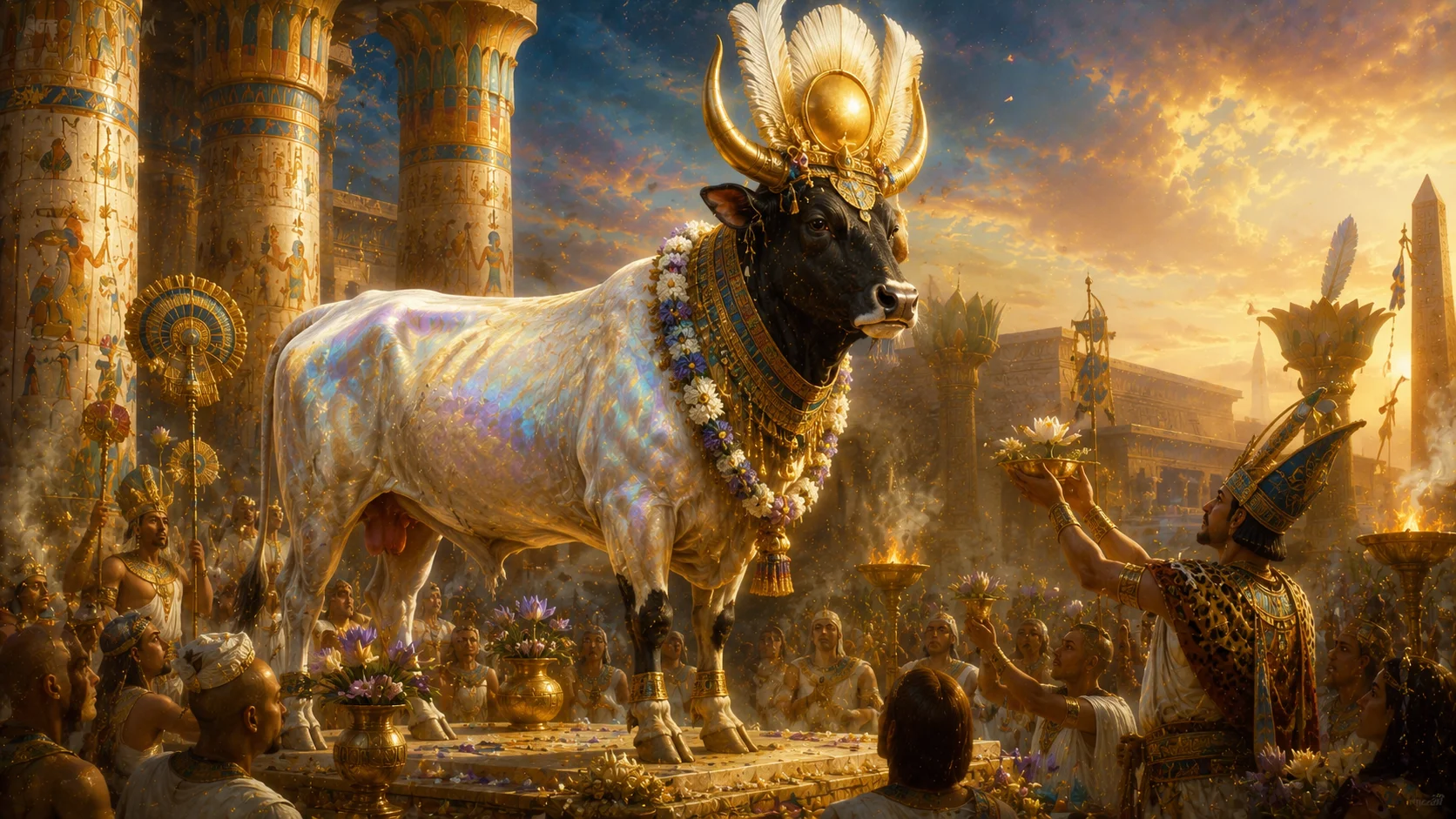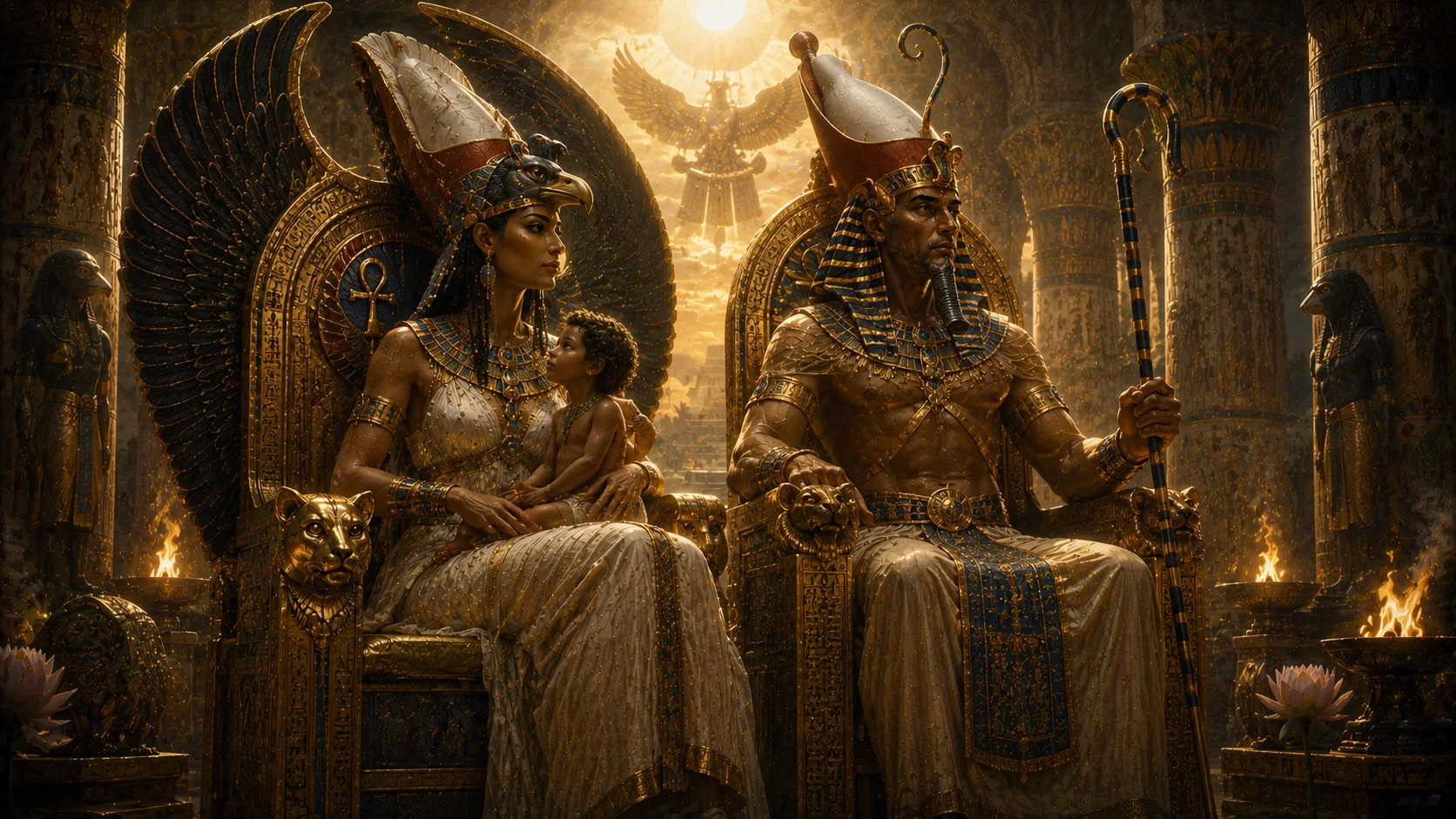
Mut — whose name is simply the Egyptian word for “mother” — was the great mother-goddess of Thebes, consort of Amun and, with him, mother of the moon-god Khonsu. Together the three formed the Theban triad, the divine family at the heart of Egyptian state religion during the New Kingdom. Mut's own precinct rose at South Karnak, ringed by a horseshoe-shaped sacred lake, and her worship carried both a tender maternal register and a fierce, leonine one that placed her alongside Egypt's most dangerous protective goddesses.
A Name That Is Also a Title
Mut's name does not describe her function so much as declare it outright: in Egyptian, mut means “mother.” Few deities in the Nile Valley pantheon carried a name this unadorned, this stripped of narrative incident. Where other goddesses accumulated epithets describing what they did or where they ruled, Mut's identity sat directly in the word itself. She was written with the hieroglyph of a vulture, and that same vulture recurs in the vulture headdress she is shown wearing — an image of watchful, sheltering motherhood spread protectively overhead, wings extended as if in the act of covering and guarding.
This directness is part of what makes Mut unusual among Egyptian deities. She is not primarily known through a chain of myths recounting her deeds, rivalries, or adventures. She is known instead through her place in a family, her place in a landscape of temple and lake, and her place in the ritual calendar of Thebes. Her significance was cultic and topographical before it was ever narrative — a goddess defined by where she stood and whom she stood beside, rather than by a story told about her.
Mistress of Isheru
At South Karnak, adjoining but distinct from the vast precinct of Amun, Mut's own sanctuary was bounded by an extraordinary architectural feature: the Isheru, a horseshoe-shaped sacred lake that curved around the temple grounds. This lake gave Mut one of her defining titles, Mistress of Isheru, and it set her cult apart from nearly every other major Egyptian temple complex, few of which incorporated a body of water so directly into the shape of the sanctuary itself.
The Isheru was not merely decorative. Theban temple ritual calendars record processions that moved across or around the lake as part of the festival life associated with Mut's precinct, an annual observance woven into the wider rhythm of Theban worship. The details of exactly how these processions unfolded come down to us through temple and administrative texts rather than through any single connected narrative — fragments of liturgy and record-keeping rather than story — but the picture that survives is one of a goddess whose worship was inseparable from a specific, distinctive place: the curved water at Karnak that bore her name as its mistress.
The Third of the Theban Triad
Mut's prominence cannot be separated from the political fortunes of Thebes itself. As Thebes rose from a regional city to the seat of Egyptian imperial power during the Middle and New Kingdoms, its patron god Amun rose with it, eventually merging with the sun-god Ra to become Amun-Re, the dominant state god of the empire. Mut's own ascent tracked this rise precisely. As Amun's consort, she was carried upward by the same current that made her husband the King of the Gods, and their union produced the third member of the triad: Khonsu, the moon-god.
Amun, Mut, and Khonsu together formed the great divine family of Thebes, worshipped as a unit at the height of Egyptian state religion. This was not a private domestic arrangement projected onto the gods for its own sake, but a theological structure that mirrored and reinforced royal ideology — a father, a mother, and a son standing at the center of the pantheon in much the way the pharaoh's own house stood at the center of the state. Mut's temple, close to but architecturally separate from Amun's own vast precinct, gave her a distinct cultic identity even within this closely bound triad — she was honored in her own right, at her own lake, under her own titles, even as she was never worshipped apart from her place beside Amun.
Crowned as Queen of the Two Lands
Mut is frequently shown as a woman wearing the double crown of Egypt — the pschent, combining the White Crown of Upper Egypt and the Red Crown of Lower Egypt into a single unified headdress. This was, above all, the crown of kingship, worn by the pharaoh as the visible sign of the two lands joined under one rule. Placing it on Mut linked her directly to notions of queenship and to the unified kingdom itself, casting her not simply as a mother in the abstract but as a royal mother — queen of the gods in a sense that paralleled the pharaoh's own royal authority on earth.
In her other principal guise she wears the vulture headdress instead, the bird whose hieroglyph spelled her name, wings often shown outstretched in a gesture of protection. Between these two images — the crown of unified kingship and the vulture of sheltering motherhood — the two poles of Mut's character come into view: a goddess of political legitimacy and royal continuity on one side, and a goddess of maternal shelter and care on the other, each reinforcing rather than contradicting the other.
The Lioness Beneath the Mother
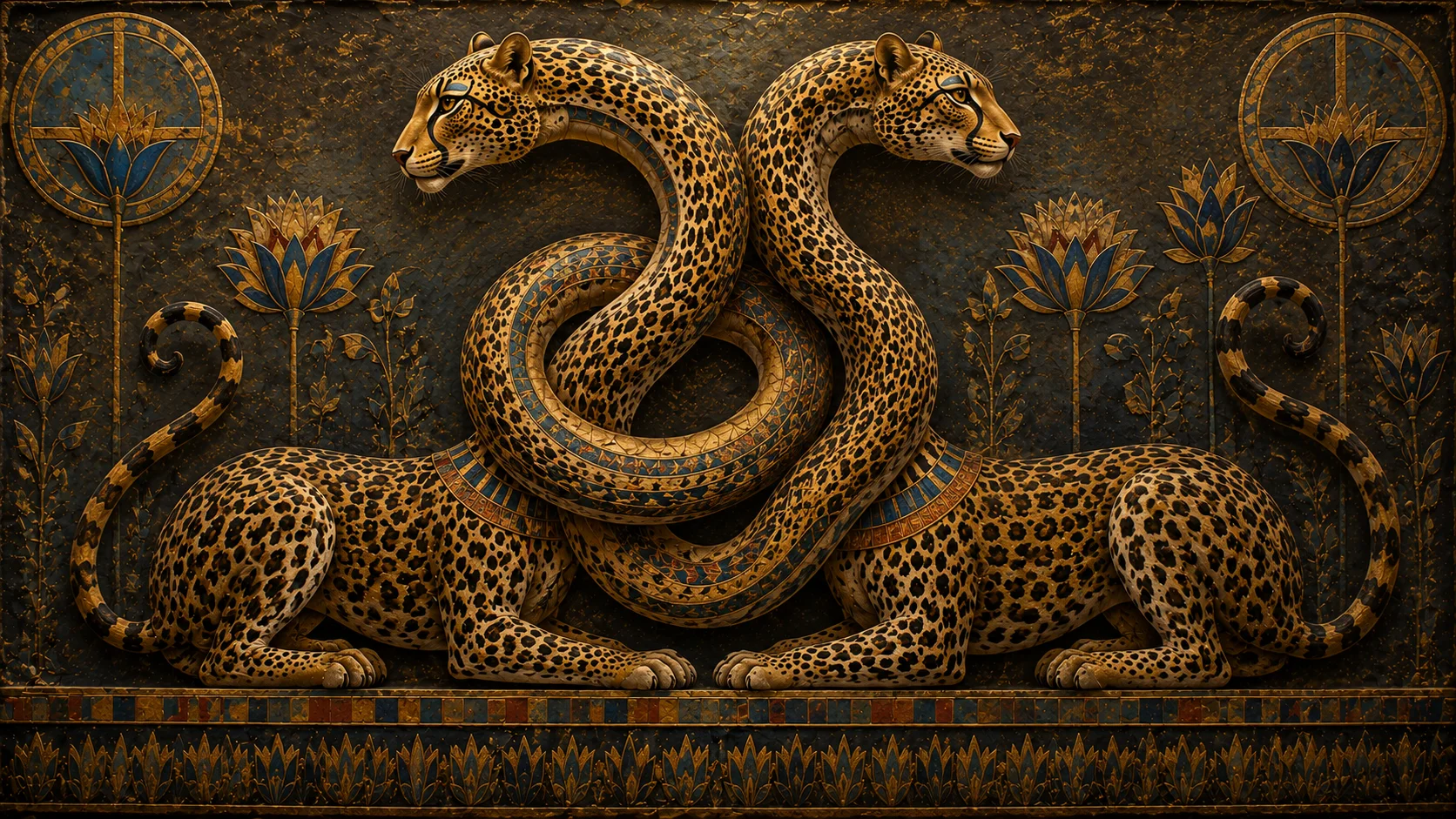
Egyptian goddesses associated with motherhood were rarely gentle only. Mut, like several of her counterparts, carried a second, fiercer identity that could surface alongside her nurturing one: a leonine, aggressive form connecting her to lioness goddesses such as Sekhmet. This was not experienced as a contradiction within Egyptian religious thought. The mother who shelters is also, by necessity, the mother who defends, and the lioness — swift, powerful, and dangerous to any threat — was the natural image for that defensive ferocity.
The connection between Mut and the lioness goddesses was not merely conceptual; it was built directly into her own temple grounds. Numerous statues of Sekhmet, most of them originally commissioned under Amenhotep III, were placed within the Mut Precinct at Karnak, so that a worshipper walking through Mut's own sanctuary would have encountered, again and again, the seated or striding figure of the lioness goddess. This physical proximity — dozens of Sekhmet images standing within the mother-goddess's own precinct — reflects a close cultic association between the two figures that went well beyond shared iconography, embedding the fierce, protective aspect of the goddess directly into the architecture of Mut's own cult center.
An Absorbing, Expanding Goddess
As Mut's cult grew in importance through the New Kingdom, she did not remain a static, singular figure. She absorbed and was syncretized with aspects of other goddesses, including Hathor and Bastet, drawing their qualities and associations into her own expanding identity. This kind of syncretism was a familiar pattern in Egyptian religion, in which a rising cult center could gather the attributes of established goddesses to itself, layering new meaning onto an existing name rather than inventing a wholly new figure from nothing.
For Mut, this absorption reinforced rather than diluted her central character. Hathor's associations and Bastet's added further dimensions of protection and fertile abundance onto a goddess already defined by motherhood, queenship, and fierce guardianship, so that by the height of the New Kingdom, Mut stood as a composite of maternal power drawing multiple divine feminine traditions into a single figure enthroned at the heart of the Theban state cult.
The Eye That Watches Over Ra
Among Mut's epithets is one she shared with several other major goddesses: Eye of Ra. This title, also carried by Hathor and by Sekhmet among others, identified the goddess bearing it with a particular mythic role — the fierce, protective daughter of the sun-god, an extension of Ra's own power sent out into the world to act with a violence and immediacy the sun-god himself did not directly wield.
That Mut could be addressed by this shared title again underscores how her identity operated by accumulation and association rather than by a single fixed narrative. She did not need an exclusive myth explaining how she became the Eye of Ra; the title itself, applied to her alongside Hathor and Sekhmet, was enough to align her with the broader current of solar-daughter goddesses whose fierce protectiveness balanced the more tender, sheltering motherhood evoked by her name and her vulture headdress.
A Cult Without a Storybook
It is worth pausing on what makes Mut genuinely unusual within the wider landscape of Egyptian deities: the near absence of independent narrative myths attributed to her. Many major Egyptian gods and goddesses come down to history wrapped in developed stories — accounts of conflict, trial, death, and restoration. Mut, by contrast, is known chiefly through cult topography, temple ritual, and her fixed position within the Theban triad, rather than through any comparable mythic storyline of her own.
This is not evidence of a minor or marginal goddess — quite the opposite. Mut's precinct at Karnak, her sacred lake, her processions, and her place beside Amun and Khonsu all attest to a cult of major and sustained importance throughout the New Kingdom and beyond. It simply means that her significance was expressed through a different vocabulary than narrative myth: through architecture, through the calendar of festivals, through the statuary crowding her sanctuary, and through her fixed, unshakeable position as the mother at the center of the Theban divine family.
What the Ground at Karnak Still Holds
Today, Mut is known primarily through this same material and cultic record rather than through literary myth — and that record continues to grow. The Mut Precinct at Karnak remains an active site of Egyptological excavation, notably including work carried out by the Johns Hopkins University expedition, which continues to uncover and study the physical remains of her sanctuary, her lake, and the statuary that once filled her temple grounds.
This ongoing excavation means that Mut's story, in a real sense, is still being recovered from the ground itself rather than read from a completed text. Each season of work at South Karnak adds detail to what is known of her precinct's layout, her statuary, and the rituals once performed around the Isheru — a goddess whose significance was always rooted in a specific place, and whose modern rediscovery is happening, appropriately, in that same place.
Mother, Queen, and Guardian at the Heart of Thebes
Mut endures as the mother-goddess of the Theban triad — consort of Amun, mother of Khonsu, mistress of the horseshoe lake that curved around her Karnak sanctuary. She wore the crown of a unified kingdom and the wings of a sheltering vulture; she stood beside statues of the lioness in her own temple courts and carried, alongside Hathor and Sekhmet, the title of the Eye of Ra. Her rise mirrored the rise of Thebes itself, and her cult, layered over generations with aspects of other great goddesses, became one of the central pillars of state religion at the height of Egyptian imperial power — a goddess whose name required no elaboration, because it already said everything: mother.
Sources & traditions
- EncyclopediaWikipedia — Mut
- TraditionEgyptian texts, inscriptions and later retellings
Myths change from area to area and from time to time. This chronicle follows the most widely told versions; tellings in other villages, regions and eras may differ.