Aten was the visible disc of the sun itself, elevated by the pharaoh Akhenaten into the sole god of Egypt during the 14th century BCE — history's most famous experiment in exclusive worship of a single deity, a god without myths, without a human form, and without any face but light itself. For a single royal generation the Aten was proclaimed creator and sustainer of everything that lived, and then, as swiftly as it had risen, it was struck from memory.
A Minor Light Before Its Hour
Long before Akhenaten's reign, the Aten already had a place in Egyptian religion — a modest one. It named the physical disc of the sun as distinct from the sun-god Ra who sailed it across the sky, one solar aspect among several recognized by priests and worshippers. Nothing in that older tradition suggested the Aten would ever eclipse Ra, Amun, or any of the established gods; it was a facet of solar theology, not a rival cult. The transformation that followed was not the discovery of a new god but the deliberate promotion of an old and minor one to a place no Egyptian deity had held before.
The King Who Renamed Himself for the Disc
That promotion began with a pharaoh born Amenhotep IV, who changed his own name to Akhenaten, “effective for the Aten,” and with it announced where his reign would be aimed. Under Akhenaten the Aten was raised to sole, or very nearly sole, status as the god of the Egyptian state. Scholars debate exactly how to characterize what resulted — some describe it as monolatry or henotheism, the worship of one god without fully denying the existence of others, rather than monotheism in the strict sense — but by any description it was a rupture with millennia of Egyptian religious practice, which had always accommodated a crowded pantheon.
A City Built for a Single God
Akhenaten did not attempt this reform within the old religious centers. He abandoned them and built an entirely new capital on a stretch of desert plain, Akhetaten — the modern site of Amarna — raised specifically as the Aten's cult center. Temples, palaces, and administrative quarters rose there in a matter of years, populated by a court uprooted from Thebes and reassembled around the new god. The city's very existence was theological argument made in stone: a declaration that the Aten required, and deserved, a home untouched by any other deity's claim on the land.
Silencing the Old Gods
Elevating the Aten was not achieved by addition alone. Akhenaten's reform actively suppressed the older cults, above all that of Amun, whose priesthood had accumulated vast wealth and influence. Temples to Amun were closed, his name was chiselled out of monuments across Egypt wherever royal agents could reach it, and the machinery of state devotion that had sustained the old gods for centuries was redirected toward the Aten. This was not passive neglect of the old religion but active erasure — a campaign against memory as much as against practice.
A God With No Human Face
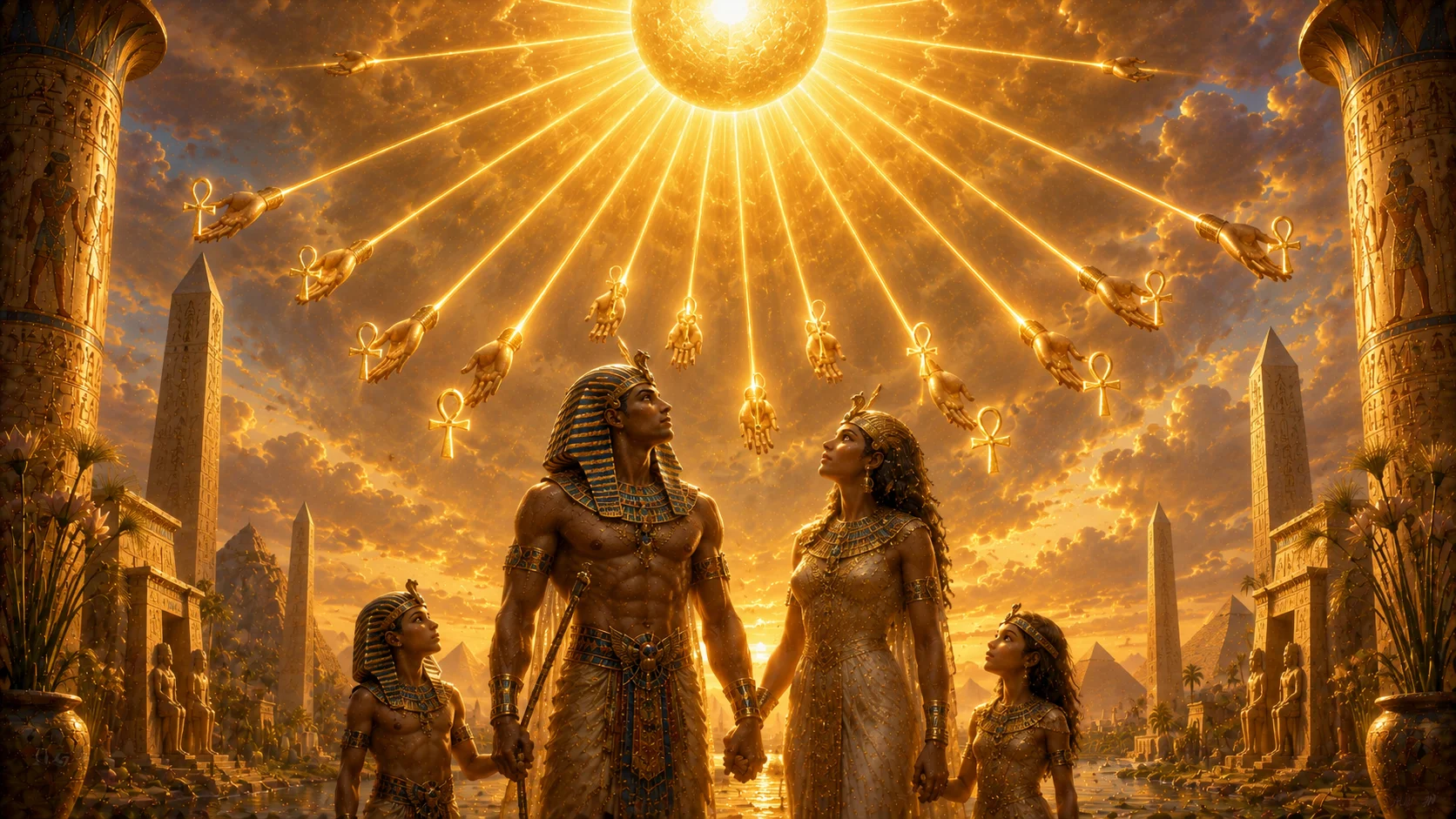
Where other Egyptian deities were shown as human figures, animal-headed figures, or composites of both, the Aten broke entirely from that visual language. It was depicted only as the sun-disc itself, its rays extending downward and terminating in small human hands. This was a striking iconographic departure — a deity with no body, no face, and no animal form, represented instead by pure radiating light reaching toward the world below. No other major Egyptian god was rendered this way, and the choice underscored what the Aten was understood to be: not a personality with a story, but a principle of light and life made visible.
Hands That Offered Life
Those small hands at the end of the Aten's rays were rarely idle in Amarna art. They are shown extending the ankh, the sign of life, toward the nostrils of Akhenaten, Nefertiti, and their daughters, and reaching more generally over scenes of the royal family at rest, at worship, or simply together. The imagery is intimate in a way earlier Egyptian royal art rarely was — the king and queen shown embracing their children beneath the descending rays, the disc itself an active, tender presence in the domestic scene rather than a distant cosmic force.
The Sole Doorway to the Divine
This intimacy carried a theological consequence with real political weight. Ordinary Egyptians could not approach the Aten directly. Akhenaten and his queen Nefertiti positioned themselves as the unique intermediaries between the god and humanity, the sole channel through which worship and blessing could pass. Where earlier religion had offered many gods and many points of access, Atenism offered one god and one royal household standing between that god and everyone else — a structure that bound loyalty to the Aten inseparably to loyalty to the throne.
The Hymn That Praised a Universal Creator
The fullest surviving expression of Aten theology is the Great Hymn to the Aten, inscribed in the tomb of the courtier Ay. It describes the Aten as the sole creator and sustainer of all life, the source of light that wakes the world each morning and the maker of every land and every people, each suited to its place by the god's design. Scholars have long noted parallels, debated in how far they extend, between the hymn's language and Psalm 104 in the Hebrew Bible — a resemblance that has made the hymn a recurring point of reference in discussions of the ancient world's theological imagination, whatever its precise relationship to later scripture.
A God Without a Story
Unlike nearly every other figure in Egyptian religion, the Aten has no developed mythological narrative. There is no birth story, no genealogy of divine parents, no conflict with rival gods, no cycle of adventures or trials of the kind that fills the traditions of Osiris, Isis, or Horus. The Aten is a theological and solar principle rather than a character who acts within a plot. That absence is itself notable within Egyptian religion, where myth-narrative was the ordinary mode through which gods were understood; the Aten was, from the start, something else — an idea given a visible form rather than a personality given a history.
The Reform That Died With Its King
None of it outlasted Akhenaten. After his death the religious order he had built collapsed with remarkable speed. His successors — Tutankhamun, Ay, and Horemheb — restored the traditional polytheistic worship the reform had suppressed, reopened the old temples, and dismantled the monuments of Akhetaten. The city built for a single god was abandoned within a generation of its founding, its purpose undone as deliberately as it had been created.
Struck From the Record
The condemnation that followed went beyond dismantling buildings. The epithet and iconography of the Aten were largely purged from public monuments, and later king lists — among them the Abydos King List — omit Akhenaten and his immediate successors entirely, skipping from the preceding reign to the one that followed as though the episode had not occurred. This was not mere neglect but a considered act of erasure, the same tool Akhenaten himself had turned against Amun now turned against his own memory.
A Question Later Ages Keep Returning To
Modern scholarship has repeatedly returned to Atenism in debates over the origins of monotheistic religious thought, drawn by the striking image of a single, universal, creator god centuries before better-known monotheisms took shape. Any direct historical influence on later Abrahamic monotheism remains speculative and is not a matter of scholarly consensus — the Amarna episode was too short-lived, and too thoroughly suppressed by the generation that followed, to trace a clear line forward. What survives instead is the record of the attempt itself: a sun-disc reaching down with small hands to offer life, worshipped as the maker of every land and every people, for the length of one reign.
Sources & traditions
- EncyclopediaWikipedia — Aten
- TraditionEgyptian texts, inscriptions and later retellings
Myths change from area to area and from time to time. This chronicle follows the most widely told versions; tellings in other villages, regions and eras may differ.