Khonsu was the Egyptian god of the moon, time and healing — the youthful moon-god who measured out the months and the passage of time, the divine son of Amun and Mut in the great Theban triad, and a powerful healer and protector who drove away evil spirits and disease. The traveler of the night sky, he is the moon whose changing course marks the months and whose light guards against the terrors of the dark.
The Moon-God
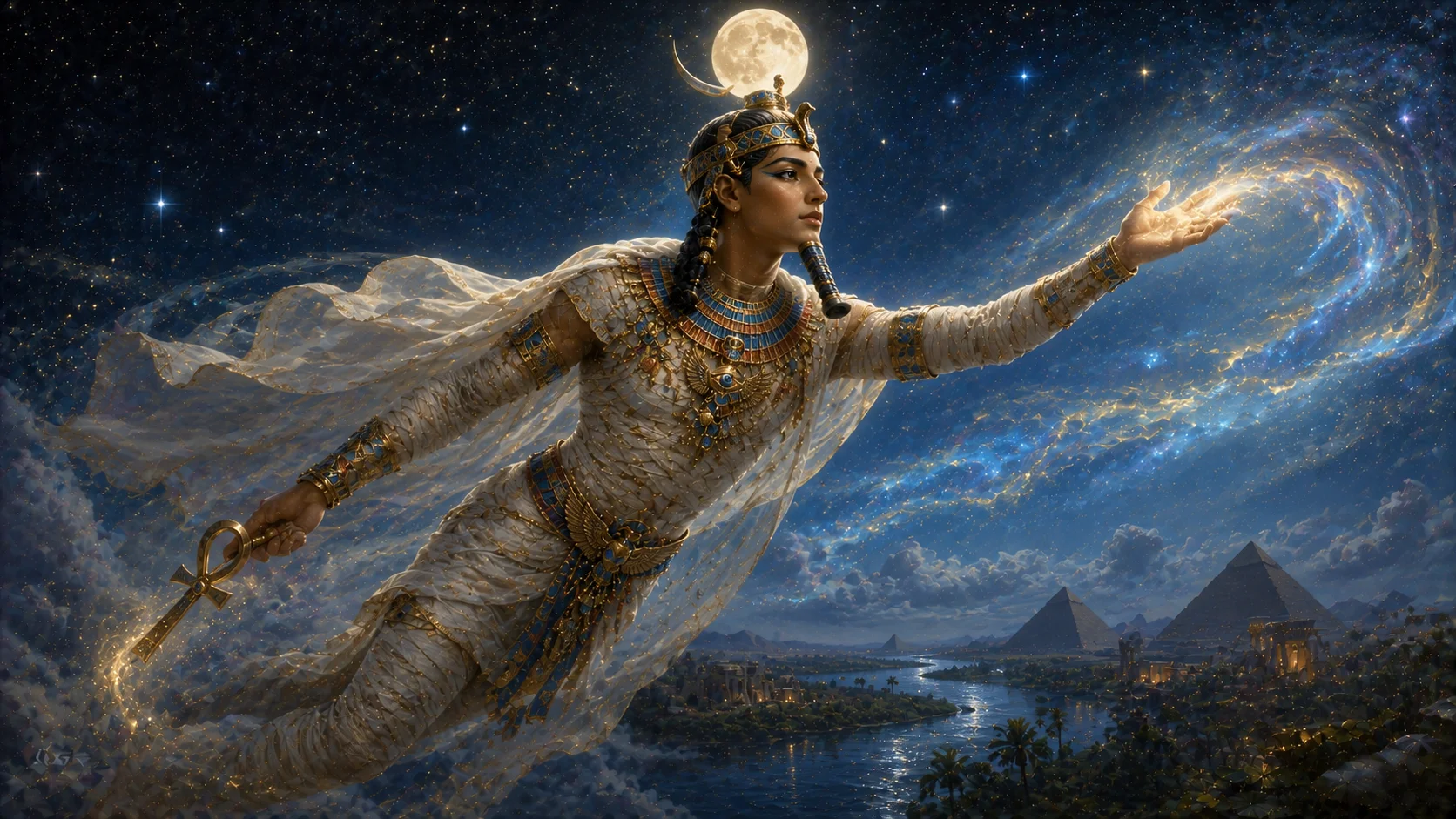
Khonsu (Egyptian Khonsu, “the traveler” or “the wanderer”) was the god of the moon, his very name reflecting the moon's journey across the night sky. He was usually depicted as a youth, often as a young man wrapped like a mummy with a side-lock of hair (the symbol of youth and childhood), wearing a headdress combining the full lunar disc and the crescent moon. As the moon-god, he traveled across the heavens by night as Ra traveled by day, the great light of the darkness, the wanderer of the night sky whose changing phases the Egyptians watched with care.
The Measurer of Time
As the moon, Khonsu was the great measurer of time. The Egyptian calendar and the reckoning of months were based on the cycles of the moon, and so Khonsu, who governed the moon's phases and journey, was the god who measured out the months, the seasons and the passage of time. He determined the length of life, watched over the divisions of time, and was associated with the calendar and the marking of the year. The waxing and waning of the moon was his doing, and through it the very flow of time was reckoned. He was, in this aspect, kin to Thoth, who was also a moon-god and a measurer of time.
The Healer and Protector
Khonsu was a powerful god of healing, protection and the driving-out of evil. He was believed to drive away evil spirits, to protect against disease, madness and the dangers of the night, and to heal the sick. In a famous text (the “Bentresh Stela”), a statue of Khonsu was sent to a foreign land to heal a princess possessed by an evil spirit, which the god successfully exorcised. His light, like the moon piercing the darkness, drove away the demons and terrors that lurked in the night, and he was invoked for protection and healing throughout Egypt. As a protective god, he watched over people in the dangerous hours of darkness.
The Wanderer of the Night Sky
Khonsu endures as the Egyptian god of the moon, time and healing — the youthful wanderer of the night sky, the measurer of months and the passage of time, the divine son of the Theban triad, and the powerful healer who drove away evil and disease. He embodies the Egyptian reverence for the moon as the light of the darkness and the measure of time, and the protective power of that light against the terrors of the night; and he completes, with Amun and Mut, the great divine family of Thebes — the youthful moon-god son of the King and Queen of the Gods.
The youthful moon-god who wanders the night sky, measures out the months, and drives away the demons of the dark — the healing light in the darkness, son of the King and Queen of the Gods.
The God Who Strangled Gods
Before he was gentle, Khonsu was a killer. His earliest appearance is in the Pyramid Texts carved inside the pyramid of King Unas at Saqqara around 2350 BCE — the oldest substantial body of religious writing to survive from Egypt — and in the passage Egyptologists call the Cannibal Hymn (Utterances 273–274) he is not a healer at all. He is the weapon of a dead king who has decided to eat the gods. Khonsu slays the lords of heaven and strangles them for the king; another god, Shezmu, carves them up and cooks them on the evening hearth-stones, so that the king may swallow their magic and rise into the sky with their power sitting in his belly. It is among the most violent texts Egypt ever produced, and the moon-god is its executioner.
The name suits that older role better than the later one. Khonsu comes from a verb meaning to cross, to traverse, to range over — and the ranging it describes is not a stroll. It is the movement of something covering ground with intent, the word that fits a predator quartering the desert as naturally as it fits a light quartering the sky. The moon that crosses the heavens each night and the killer who crosses a battlefield are, in Egyptian, doing the same thing. Over the following thousand years Thebes domesticated him almost entirely: the strangler became a mummiform boy with a side-lock, the god you called to sit beside a fever. The old teeth never quite vanished, though, and there is a logic in that. A god employed to drive out demons has to be more frightening than they are.
One God, Several Selves
Egyptian theology never treated a deity as one indivisible person, and Khonsu is among the clearest demonstrations of it. At Thebes he existed as a set of named forms, each with its own statue, its own cult and its own priests. Khonsu-em-Waset-Neferhotep, “Khonsu-in-Thebes, Perfect of Peace”, was the senior form, the great god resident in Karnak. Khonsu-pa-ir-sekher — literally something like “Khonsu who carries out the plan”, usually rendered “Khonsu the Provider” — was the working form, the one sent out to do things. Khonsu-pa-khered, “Khonsu the Child”, was the god in infancy, worshipped in his own right and in his own chapel.
That division is not a footnote. It is the entire mechanism of the healing story the Egyptians told about him. In the Bentresh Stela the great Khonsu of Karnak does not travel to the foreign land of Bakhtan himself; he transfers his protective power into the travelling form, and it is that Khonsu who sails abroad and confronts the spirit. The statue is then kept by the princess’s father for years — until the ruler dreams of a golden falcon flying back towards Egypt, wakes frightened, and sends the god home loaded with gifts. It is worth knowing what kind of document this is. The stela presents itself as a record from the reign of Ramesses II, but its language and spelling place its composition many centuries later, in the Late or Ptolemaic period. It is a temple advertisement wearing the costume of history: evidence not that a Bronze Age princess was cured, but that Theban priests long afterwards wanted every pilgrim to know their god had an international reputation, and that his services could be requested from abroad.
Two Calendars and One Moon
Egypt ran two calendars at once, and only one of them belonged to Khonsu. The civil calendar — the one used for taxation, administration and dating the reigns of kings — was a tidy artificial thing of twelve thirty-day months plus five extra days, 365 in total, with no leap day at all. It therefore slipped against the real solar year by about a day every four years and wandered slowly through every season before returning to its starting point. Underneath it ran the older lunar calendar, and that one was the god’s. It governed when many of the great festivals actually fell. As Egyptologists reconstruct it, its month began not with the sliver of new crescent in the evening but with the morning on which the waning crescent could no longer be seen before sunrise — the moon’s disappearance, not its reappearance — and it carried its own feasts, most importantly on the first day, the sixth, and the fifteenth, when the disc stood full.
Because twelve lunar months fall about eleven days short of a solar year, the priests had to slot in a thirteenth month periodically to keep the temple year from drifting out of its season. Someone had to watch the sky, count, and decide. This is the concrete, unglamorous work behind the title “measurer of time”: a god whose service required observation and arithmetic every single month.
The lunar cycle also explains why the god of the moon is the god of healing, which otherwise looks like an accident of association. Egyptians understood the waxing moon as an injured eye being made whole again — the divine eye damaged in conflict and progressively restored, filling out over fifteen nights until it is perfect and complete. The sky, in other words, performs a healing in public, on schedule, every month, and never once fails to finish it. A god who owns that process is the obvious one to ask when a body needs the same thing done. A hymn in his Karnak temple credits his shining forth with making cattle fertile and women conceive, and with filling every throat and every nostril with air — the reappearing light is also the return of life.
The Small Temple That Became the Textbook
Khonsu’s own temple still stands in the south-western corner of the great Karnak enclosure. Ramesses III built the bulk of it, on ground that had held earlier structures, and generations of later kings and Theban high priests added, decorated and repaired. Because it is compact and nearly complete, it has become the building most often used to teach the classic Egyptian temple plan: pylon, open court ringed by a colonnade, hypostyle hall, a barque shrine standing free in its own room with a corridor of chapels around it, and beyond that the dark chambers only priests ever entered. Walk inward and the floor rises while the ceiling drops and the light thins, so the architecture squeezes you step by step from the public glare into a small black room. It is the theology of concealment built in stone.
The temple also happens to preserve one of the sharpest documents of Egypt’s political collapse. In its forecourt the High Priest of Amun Herihor, at the end of the New Kingdom, had himself depicted with the full trappings of kingship — a priest quietly annexing royal iconography in the house of the moon-god, while the pharaoh’s authority drained away northwards. In front of the whole building Ptolemy III Euergetes raised a monumental gateway, still standing, and from that gate an avenue of sphinxes runs south towards the precinct of Mut and on towards Luxor. That avenue is not decoration. It is a road built for a god to be carried along.
The Barque, the Crowd, and a God Who Answered
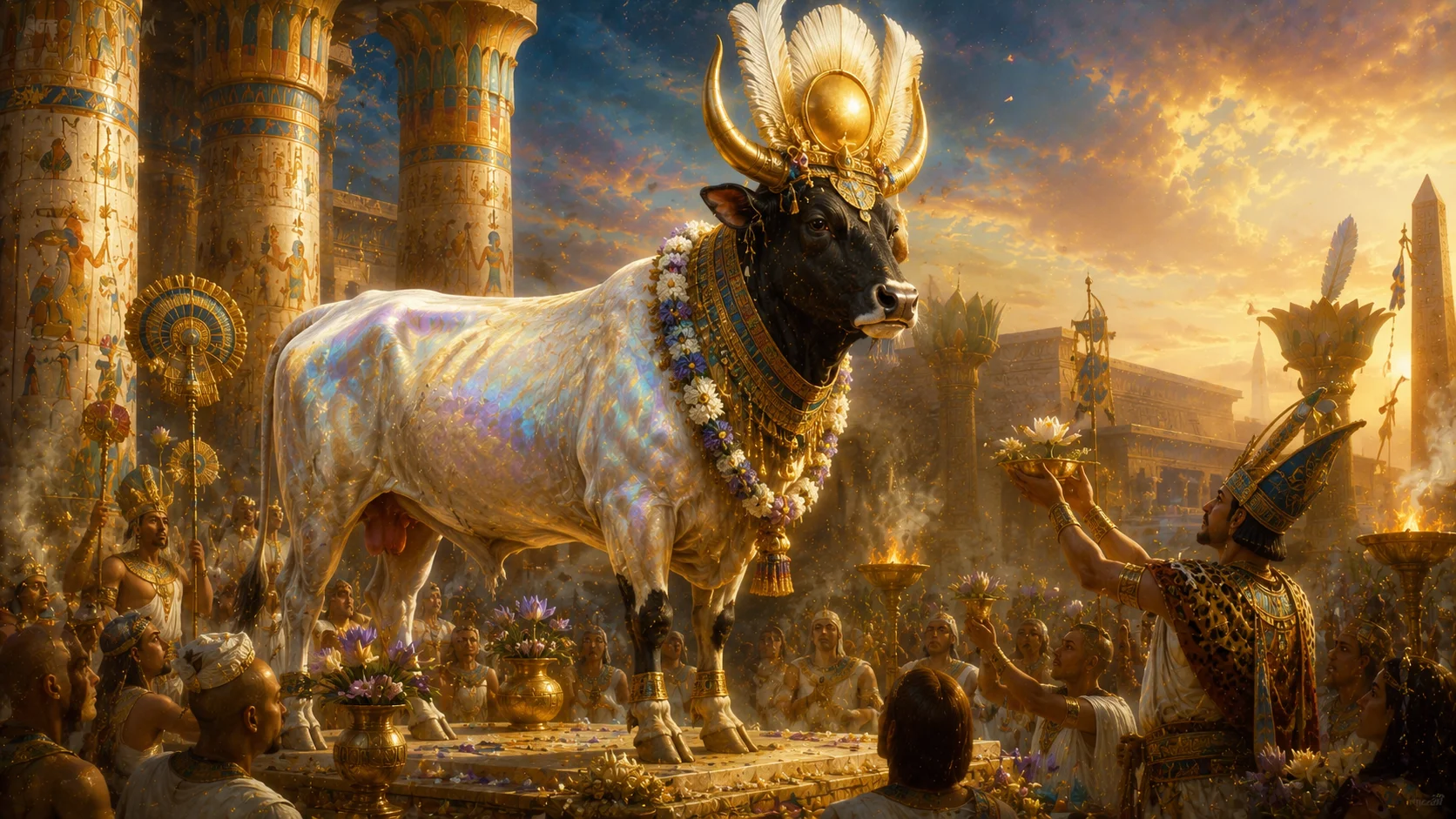
Ordinary Egyptians could not enter the sanctuary, and almost none ever saw the statue. They met their gods on the road, during festivals, when the images left the temple in portable barques carried on the shoulders of priests — Khonsu’s own barque marked out by the lunar disc and crescent riding at prow and stern.
Twice a year Thebes turned out for him. At the Opet festival, Amun, Mut and Khonsu travelled together from Karnak to Luxor and back, a journey of days with feasting, music, dancing and distributed bread and beer along the route: the divine family renewing the king’s vital force in front of everyone. At the Beautiful Festival of the Valley, the same three crossed to the west bank to visit the mortuary temples and the cemeteries, and Theban families went with them — sitting the night through in the tomb-chapels of their own dead with lamps, flowers and food, eating a meal in company with parents and grandparents. The moon-god presided over an evening on which the boundary between the living and the dead was treated as thin and crossable.
These processions were also where the gods were interrogated. A question could be put to the barque as it was carried, and the answer came in the movement of the bearers — a surge forward for yes, a drawing back for no — or by the god pressing towards one of two written options laid before him. Property disputes, thefts, appointments and personal decisions were settled this way. The Bentresh Stela describes exactly this gesture, the great god nodding his assent, and it would have read to an Egyptian audience not as a marvel but as the completely familiar sight of an oracle saying yes.
The Serpent and the Egg
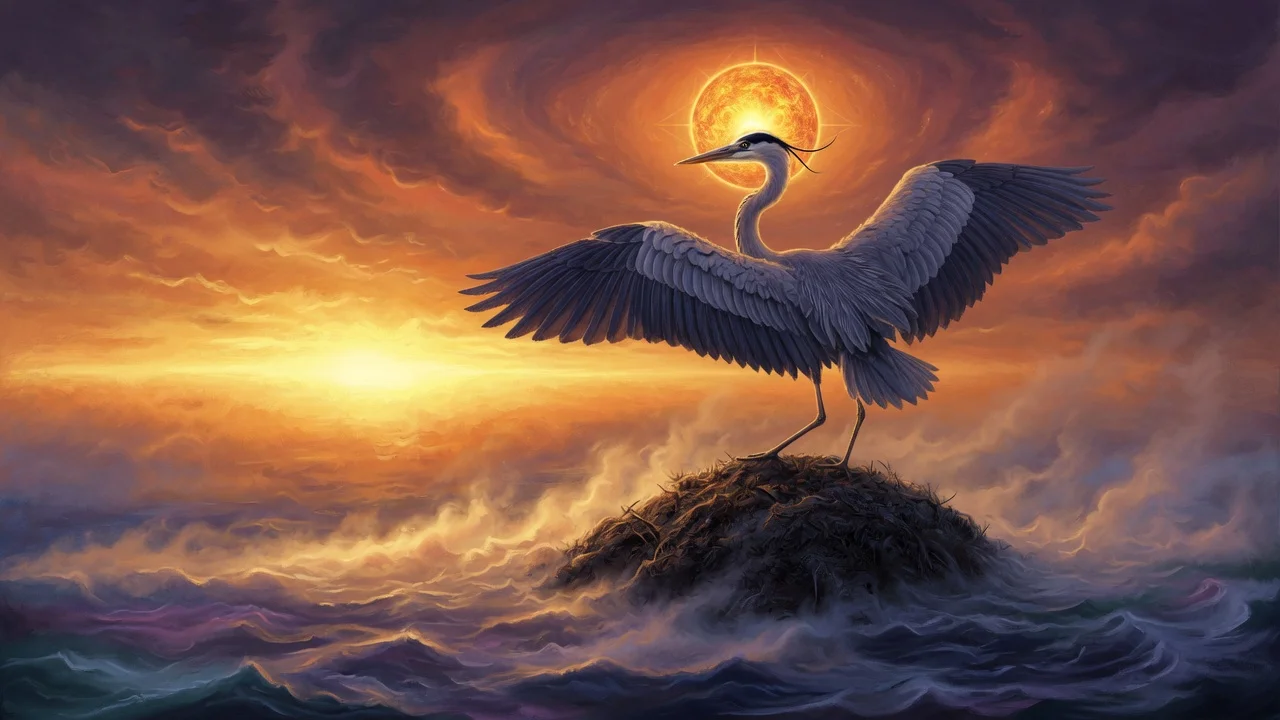
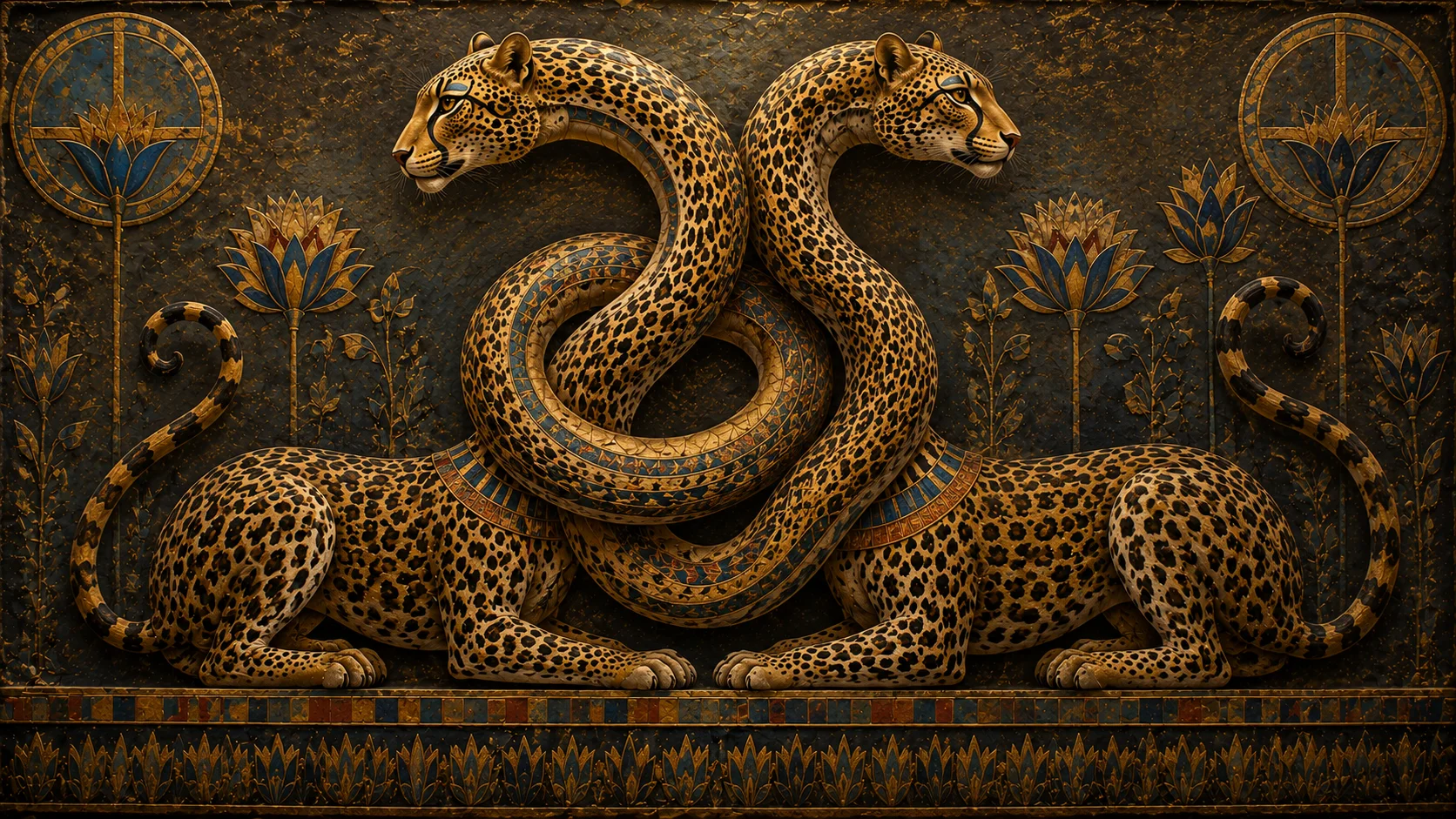
By the Ptolemaic period the theologians of Karnak had promoted Khonsu much further than moonlight. A body of inscriptions in his temple — known to Egyptologists as the Khonsu cosmogony — makes him a creator at the beginning of things, working in the form of the primeval serpent of Theban tradition and fertilising the great egg from which the ordered world hatched. In these texts he is fused with Shu, the god of the air and light that separates sky from earth, and stands close to Amun himself in the primordial darkness.
This is how Egyptian religion habitually worked. A local god who acquired a powerful priesthood and a wealthy temple did not merely gain worshippers; his priests rewrote the beginning of the universe to place him inside it. Khonsu started as a killer in a royal funerary text, became the child of the Theban triad, and ended as one of the powers that made the world — not through reform or revelation, but through the slow accumulation of institutional weight over two thousand years.
Khonsu Beyond Thebes
He was not only a Theban god. At Kom Ombo in the far south, the temple is famously double, and the southern half belongs to a triad of the crocodile god Sobek, Hathor, and Khonsu as their son — the same divine-child role, plugged into an entirely different family. This portability is characteristic: Egyptian triads needed a child, and a well-known young god could be adopted into a local pair without difficulty.
Egypt also felt no need to restrict itself to one lunar deity. Iah was the moon as a body in the sky, the plain word for it personified. Thoth was the moon as intellect — writing, calculation, the recording of judgements. Khonsu was the moon as motion, as time being measured out, and as protective force. They overlapped rather than competing, and Khonsu could be fused outright with another god where a priesthood wanted two registers at once, as the Karnak cosmogony fuses him with Shu. To an Egyptian these were not contradictions but aspects, the way a person can be a parent, a judge and a neighbour in a single afternoon.
Reading Him in Stone
Khonsu is one of the easier Egyptian gods to identify once you know the checklist. Beyond the mummiform youth and the lunar crown, look for the details: arms free at the chest, holding the crook and the flail together with a staff that combines the was-sceptre, the djed pillar and the ankh; a close skullcap; a broad collar; and at the back of the neck the heavy counterpoise of a menat necklace. The thick plaited side-lock of youth hangs at the side of the head, the Egyptian sign for a child. Above the cap sits the full lunar disc resting in a crescent.
Two confusions are worth guarding against. Mummiform, skullcapped and holding that same composite staff also describes Ptah — but Ptah has a straight false beard, no side-lock and no lunar crown. And Khonsu sometimes appears falcon-headed, which makes him look at a glance like Ra-Horakhty; the deciding detail is what sits on the head. A disc with a rearing cobra is the sun. A disc cupped inside a crescent is the moon, and the moon is Khonsu.
The Bird-Skulled God of Moon Knight
The most widely seen Khonsu today is not Egyptian at all. Marvel Comics gave its vigilante Moon Knight, created in 1975, an Egyptian patron named Khonshu, and the 2022 television adaptation put him in front of an enormous audience: an implacable towering figure with a bird’s skull for a face, who keeps a mortal avatar on a leash and is manipulative, vengeful and not remotely safe to serve.
It is a striking invention, and it is an invention. The Egyptian Khonsu is a youth, not a skull; his relationship with worshippers runs through temple offerings and oracles, not through a possessed vigilante. Yet the fictional version has quietly picked up something real from the oldest layer of the tradition. A god who once strangled the lords of heaven so a dead king could eat them is genuinely not safe. Marvel reached past the mild Theban child and got hold, by accident or otherwise, of the god of the Cannibal Hymn.
Why the Moon Needed a Keeper
The sun is reliable to the point of being uninteresting: it rises, it crosses, it sets, and it looks the same each time. The moon does none of that. It changes shape nightly, rises at a different hour, vanishes entirely for days, and comes back. It is the one thing in the sky that visibly dies and visibly recovers, on a schedule short enough for a human being to hold in memory and long enough to matter.
That is why the moon accumulates gods, and why this particular god ended up carrying such an odd bundle of duties. Time is measured by the moon because the moon is the only celestial body that counts where the sun merely shines. Healing belongs to the moon because the moon demonstrates recovery every month without fail. Protection belongs to the moon because in a world without artificial light, the difference between a moonlit night and a dark one is the difference between seeing the thing coming and not. And a night traveller needs a companion who is also travelling.
Khonsu is what an agricultural people build when they need the darkness to be governed rather than merely endured. Not a god who abolishes the night — Egypt was too clear-eyed for that — but a young god who walks through it on a fixed route, keeps count of the months for you, drives off what is in the dark, and always, always comes back.
Sources & traditions
- EncyclopediaWikipedia — Khonsu
- TraditionEgyptian texts, inscriptions and later retellings
Myths change from area to area and from time to time. This chronicle follows the most widely told versions; tellings in other villages, regions and eras may differ.