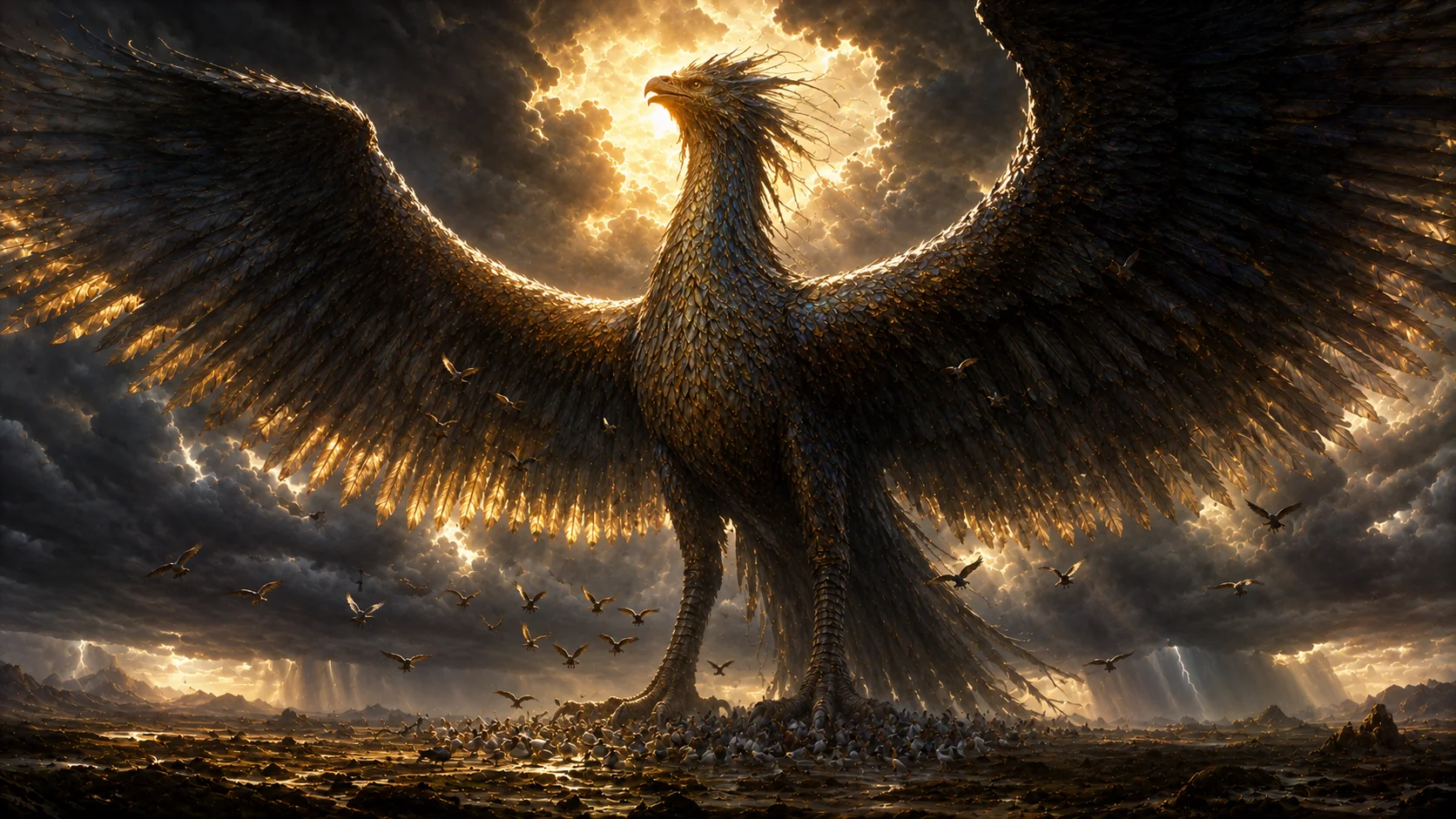
The Ziz is the great primordial bird of Hebrew tradition — a monstrous sky-creature so vast that its outstretched wings darken the sun, the sovereign of the birds as Leviathan is sovereign of the sea and Behemoth of the land. Together these three are the monarch-monsters of the three realms of creation: water, earth, and air.
The King of Birds
The Ziz is described in rabbinic legend as a bird of colossal size, its head reaching toward the heavens while its feet rest upon the earth, its wings so immense that when spread they eclipse the disk of the sun. Some traditions identify it with the mysterious “ziz sadai” of the Psalms — “the wild beast of the field is mine,” read by the sages as a reference to this gigantic fowl. It is the ruler and protector of all the birds of the world, the avian counterpart to the great beasts of land and sea.
Guardian of the Smaller Birds
For all its terrifying scale, the Ziz is remembered as a benevolent guardian. A beloved legend tells how its vast wings shelter the earth and the smaller birds from the fierce storm-winds that blow from the south; without the Ziz spreading its pinions to shield them, the world’s birds would be swept away and humankind left desolate. So the monster of the sky becomes a protector, its very bulk a canopy against destruction. Another tale relates how a Ziz egg once fell and broke, flooding sixty cities and crushing three hundred cedars — a measure of the creature’s staggering size.
The Feast of the Righteous
Like Leviathan and Behemoth, the Ziz is bound up with the destiny of the end of days. In the messianic banquet, when the sea-monster and the land-monster are slain and served to the righteous, the flesh of the Ziz too will be set upon the table — the bird of the air completing the great threefold feast of redemption, one monarch-monster from each realm of creation. In the Ziz, Hebrew tradition crowned the sky with its own primordial sovereign: a bird vast as the heavens, terrible in scale yet gentle in office, sheltering the world beneath its wings until the end of time.
A Second, Stranger Verse
The word ziz is not a common one in Biblical Hebrew, and that scarcity is precisely what let the sages build a monster out of it. Beyond the psalm in which God declares that the ziz of the field is his, it surfaces only once more, half-hidden, in Psalm 80 — and there it keeps very different company. That psalm laments a vineyard God carried out of Egypt and planted, whose hedges have since been broken down, so that “the boar out of the wood doth waste it” and the ziz of the field devours it. Read in context, this second ziz is no sky-spanning sovereign but a marauding thing of the fields, one destroyer among others, stripping a ruined vineyard bare. Two appearances of one rare word, two utterly different creatures: this is the seam along which later tradition worked, hearing majesty in the first verse and quietly declining to hear anything at all in the second. A word too obscure for certainty is a word free to become whatever the imagination needs — and what Hebrew legend needed was a third monarch to finish its trio of the deep, the land, and the air.
Two Birds Become One: Ziz and Bar Yokhani
The egg whose fall flooded sixty cities and snapped three hundred cedars did not begin its life as the Ziz’s egg at all. In the Babylonian Talmud’s tractate Bekhorot the story belongs to a different bird entirely — one called bar Yokhani, sometimes rendered bar Yokneh — and nowhere in that telling is the creature named Ziz. The two figures, the sovereign of the air enthroned beside Leviathan and Behemoth, and the egg-layer of Bekhorot, began as separate strands of aggadah, preserved in different tractates and told to different ends: one to complete a cosmic triad, the other simply to illustrate how large large can be. Centuries of retelling fused them, so thoroughly that by the time the legend reached popular Jewish storytelling, asking which bird actually laid the egg had become a meaningless question. It is a small case study in how folklore really grows — not as one author’s invention handed down intact, but as a slow braiding of independent tales that resemble one another closely enough to be mistaken for one, and then simply remembered as one.
The Sailor’s Tall Tale
Long before novelists sent their heroes to sea to meet monsters, the rabbis had already done it. Tractate Bava Batra preserves a cycle of traveller’s reports attributed to the sage Rabbah bar bar Hana, each pitched at the outer edge of believability: waves that rise like mountains; a fish so immense that sand had drifted across its back and grass had rooted in it, so that the crew took it for an island, went ashore to cook, and felt the ground beneath them turn only when its back grew hot. Among these wonders is a bird met in mid-ocean, standing with the water barely to its ankles while its head vanished into the clouds. Taking that for a shallows, the sailors made to climb down and cool themselves — and a voice out of the air stopped them: do not go down here, for an axe dropped into this water long ago has still not reached the bottom. The shallow-looking sea is a depth beyond sounding, and a creature whose ankles it barely covers belongs to some other order of size altogether. Later tradition did not let this bird go unclaimed. It was folded in beside the Ziz already crowned in the older sources — one more sighting of the same impossible sovereign, reported this time not by a sage reading scripture but by a traveller swearing he had seen it with his own eyes.
Sovereigns of the Sky Across the Ancient World
The Ziz did not perch alone in the ancient imagination. Mesopotamia told of Anzu, a lion-headed storm-bird who stole the Tablets of Destiny from the gods themselves — a theft that had to be avenged by a divine champion in single combat. Persian tradition raised the Simurgh, a bird old enough to have watched the world destroyed three times over, nesting in the tree that holds the seed of every plant. Later, Arabic seafaring legend carried the roc, whose spread wings blotted out daylight for sailors far below, most famously in the voyages of Sindbad. Set beside these, the Ziz stands out for what it does not do. Anzu is a usurper who must be struck down; the roc is a hazard sailors dread and flee. The Ziz alone is asked to do nothing but stand there as shelter — a colossus that never fights a god, never menaces a ship, and is granted its terrible size for the sole purpose of putting itself between the world and the wind. Where its neighbours used monstrous scale to threaten, Hebrew tradition used the very same scale to reassure.
Picturing the Unpicturable
The three monarch-beasts were painted as well as told. A thirteenth-century illuminated Hebrew Bible made in southern Germany, now held in Milan, gives the banquet of the righteous a full page: Leviathan coiled into a closed ring with its tail at its mouth, Behemoth as a great horned beast, and the bird of the air beside them. What such an image cannot do is the one thing the legend is actually about. Leviathan survives the translation well, because a circle is a shape and a shape can be drawn at any size. But a creature defined entirely by scale — head in the heavens, wings across the sun — loses the whole of its meaning the moment it is fitted inside a frame, where it must share a page with a fish and an ox and be measured against them. Draw the Ziz and you get a bird. The immensity lives only in the sentence.
Why the Sky Needed a King
Every culture that looks upward eventually has to explain the storm. The sea can be given a monster, because a monster is at least a shape; the land already has its predators. But the sky offers no silhouette to blame, only weather that arrives from nowhere and flattens crops, ships and roofs without warning. Hebrew tradition answered that formlessness with a figure rather than an explanation — not a storm-god to be placated, but something already standing guard, wings out, taking on itself what the wind would otherwise do to smaller and more fragile lives. That is the quiet reason the Ziz has outlasted its stranger cousins, the egg-layer and the sailor’s sighting and the storm-birds of Persia and Mesopotamia it stands beside. It is one of the very few monsters in any tradition invented not to be feared or fought, but to be thanked.
Sources & traditions
- EncyclopediaWikipedia — Ziz
- TraditionHebrew texts, grimoires and later commentary
Myths change from area to area and from time to time. This chronicle follows the most widely told versions; tellings in other villages, regions and eras may differ.