The Cherubim are among the most awesome and least sentimental of the angels of Hebrew tradition: mighty, many-faced guardian beings who bear up the throne of God, ward the holiest places, and stand with flaming sword at the gate of Eden. Far from the chubby winged infants of later art, the biblical cherub is a creature of overwhelming, almost terrifying majesty.
Guardians of Eden and the Ark
The cherubim first appear at the expulsion from paradise: when the man and woman are driven from the Garden, God stations cherubim east of Eden, “and a flaming sword that turned every way, to guard the way to the tree of life.” They are the keepers of the threshold of the sacred. Later, two golden cherubim with outstretched wings are set upon the Ark of the Covenant, facing one another over the mercy seat, and it is from between them that the divine voice is said to speak — the cherubim form the very throne of the unseen God.
The Living Chariot
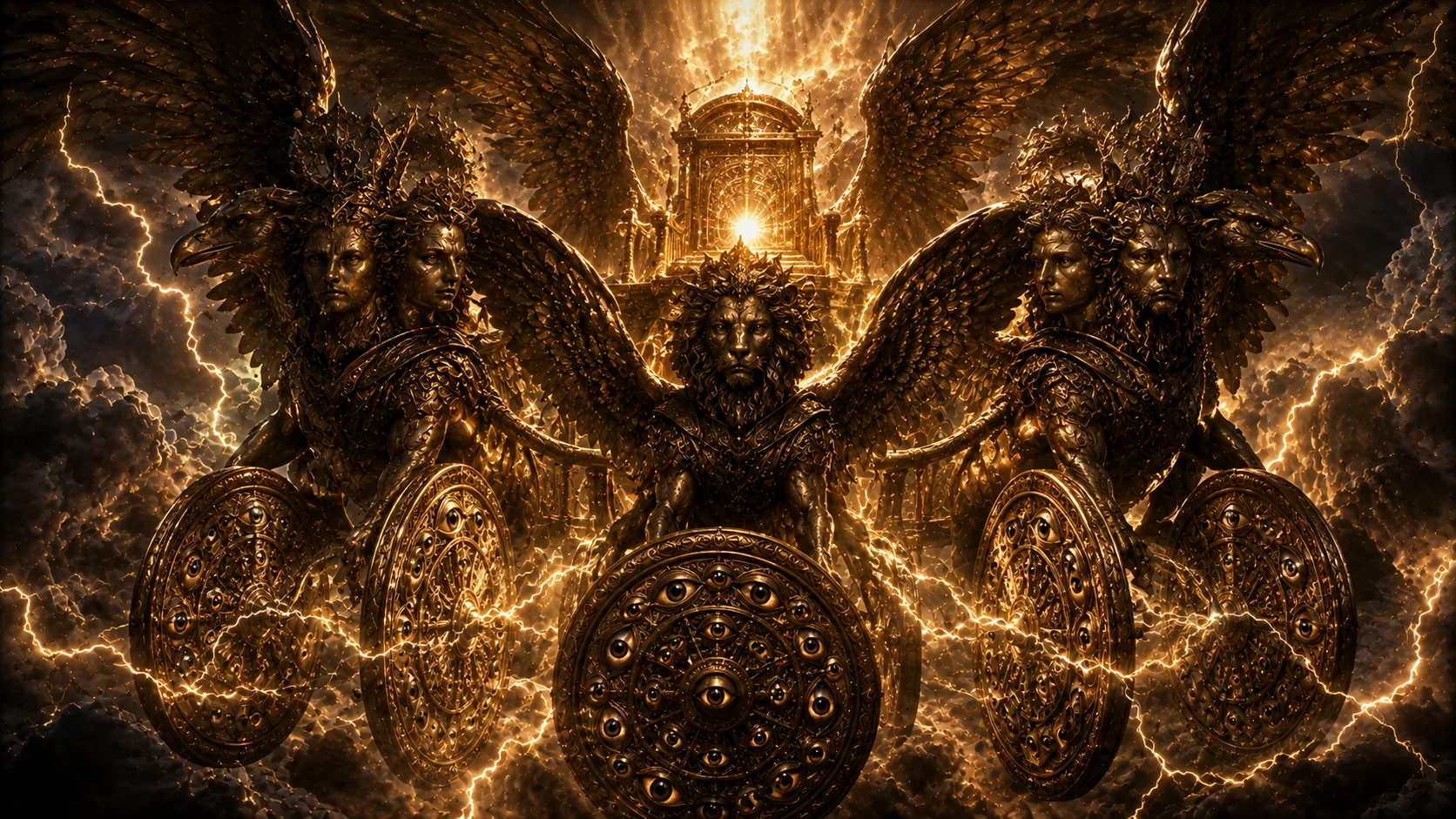
The prophet Ezekiel beheld the cherubim in their full, staggering form: four living creatures, each with four faces — of a man, a lion, an ox, and an eagle — and four wings, gleaming like burnished bronze, moving with the flashing of lightning, accompanied by great wheels full of eyes. These are the bearers of the divine Chariot, the Merkabah, upon which the glory of God rides. The cherubim are thus the throne-bearers of heaven, the mobile foundation of the divine presence itself.
Knowledge and Majesty
In the angelic hierarchy the cherubim rank second only to the seraphim, and tradition associates them with the fullness of divine knowledge and wisdom — they are the angels who behold and bear the glory most directly. Their composite forms, drawn from the greatest of beasts, express a power that transcends any single created thing. Whether guarding Eden, crowning the Ark, or carrying the storm-chariot of Ezekiel’s vision, the cherubim are heaven’s guardians of the holy — vast, vigilant, and ablaze with the presence they protect.
The Name and Its Older Cousins
Hebrew is unusually quiet about what a kerub actually is. The word arrives in the text already fully formed, with no explanation, as though everyone reading knew — which is itself the clue. The likeliest ancestry runs back to the Akkadian verb karābu, “to bless, to greet, to pray”, and to the related kāribu, a figure caught in the posture of intercession. On that reading a cherub is not primarily a warrior but an attendant: the being that stands in the presence, blesses, and passes the petition inward. Guarding and attending turn out to be the same job seen from two sides — whoever is permitted to stand closest is also whoever decides who else may approach.
That Mesopotamian family resemblance runs deeper than a verb. Assyrian palaces at Nimrud, Khorsabad and Nineveh were entered between colossal lamassu — winged bulls and lions with human faces, hooves planted at the gateway, carved so that they read as standing from the front and striding from the side. Their job description is the cherub’s exactly: composite body, human intelligence, animal strength, avian mobility, posted at a threshold that the unauthorised must not cross. Israel did not borrow a monster from Assyria. Both were drawing on a shared Near Eastern grammar in which the guardian of a sacred door is assembled from the strongest parts of the created world.
The Throne Was Furniture Before It Was Theology
One of the oldest titles of the God of Israel is yoshev ha-keruvim — “the one enthroned upon the cherubim”. Readers usually take that as a cosmic metaphor. It is not. It is a description of a piece of furniture, and archaeology has recovered the type.
On the sarcophagus of Ahiram of Byblos, carved around the turn of the first millennium BCE, a king sits on a throne whose sides are winged sphinxes: human head, lion body, wings folded back to form the armrests. Ivory plaques from Megiddo show the same seat, the same creature, the same posture of rule. The cherub-throne was a standard royal fitting of the Levantine world. What Israel did with it was strange and radical: it built the throne and left the seat empty.
This is the hinge on which the whole idea turns. A cult that forbade any image of its God nevertheless commanded images of the beings that carry him — hammered gold on the mercy seat, woven into the tabernacle curtains, carved into the walls, doors and bronze stands of the Temple. The one thing a worshipper could look at was the throne; the occupant was a gap in the air between two wingtips. When Numbers has Moses hear the voice, it comes from exactly that gap — from nothing visible at all.
Ten Cubits of Olive Wood
The small golden pair on the Ark are the famous ones. The pair Solomon put in the inner sanctuary were something else entirely. Each was ten cubits tall — roughly the height of a house — carved from olive wood and sheathed in gold, with wings five cubits each, so that the four wings together spanned twenty cubits from wall to wall: one outer wingtip touching one wall, the other touching the opposite wall, and the two inner wings meeting exactly in the middle of the room.
Picture standing in that windowless chamber. The cherubim fill it. Their wings are the ceiling of the space in which the Ark sits. Nothing about this arrangement is decorative; it is architecture designed to make a human being feel correctly sized. The chubby infant that the word summons today would have been unintelligible to anyone who had been in that room.
The Day the Cherubim Left
Ezekiel’s chariot vision is justly famous. His second cherub vision is the one that should keep people awake.
In a sequence of chapters set among the exiles by the river Chebar, the prophet is shown the Temple in Jerusalem from the inside and watches the glory of God leave it — rising from the cherubim, moving to the threshold, then to the east gate, then out of the city altogether to stand on the mountain to the east. The guardians do not fight for the building. They lift, and they carry the presence away, and what is left behind is an address rather than a dwelling. For a people about to lose that Temple to Babylon, this was the theological shock absorber: the holy had not been captured, because it had already gone, on wings, under its own power.
A textual detail in that passage has puzzled readers for two and a half thousand years. When Ezekiel lists the four faces the second time, the ox has been replaced — the first face is now “the face of the cherub”, then man, then lion, then eagle. Whatever a cherub’s own face is, the prophet expects his audience to know it on sight, and declines to describe it. Elsewhere in his temple vision the carved cherubim have only two faces, human and young lion. The being refuses to hold still even inside a single book.
The Anointed Cherub That Covereth
Buried in an oracle against the king of Tyre is a strange, gorgeous fragment of a myth that appears nowhere else intact. The king is addressed as a cherub: the anointed guardian cherub, set on the holy mountain of God, walking among stones of fire, perfect in beauty and in his ways from the day he was created — until iniquity was found in him, and he was cast down.
Read in context it is a poem about the arrogance of a trading city. Read by later Christian interpreters alongside the fallen “day star” of Isaiah, it became the standard biography of Satan, and it is the reason that in much of Western tradition the Devil is not a demon at all but a fallen member of the second choir — a guardian who turned on what he was posted to guard. Aquinas took the identification seriously enough to argue the point directly, reasoning that the fallen one could be called a cherub because knowledge survives in a corrupted will in a way that burning love does not. The betrayal of a doorkeeper is the oldest security failure there is.
The Chariot That May Not Be Explained
The rabbinic tradition treated Ezekiel’s first chapter as radioactive. The Mishnah rules that the Work of the Chariot — Ma’aseh Merkavah — may not be expounded even to a single student, unless he is already a sage who understands it of his own knowledge. Not a ban on reading it; a ban on teaching it, which is a far more interesting restriction. The danger was not information. It was what happens to a mind that goes looking.
People went looking anyway. The Hekhalot literature — the “palaces” texts — describes practitioners who called themselves yordei merkavah, “those who descend to the Chariot”, undertaking a perilous ascent through successive heavenly halls, each guarded, each demanding the right seal and the right name before its gatekeepers would let the traveller pass. The throne the cherubim carry is the terminus of that journey. Every threshold-guardian on the way up is a smaller echo of the pair at the top.
Face to Face in the Holy of Holies
The Talmud preserves an image of the Temple cherubim that startles almost everyone who meets it. When the pilgrims came up for the festivals, the curtain of the sanctuary would be rolled back so that they could see the two cherubim — and the two were intertwined, embracing like a couple. The interpretation offered is not embarrassed in the least: see how beloved you are before God.
Elsewhere the same tradition supplies the reading that would eventually help sink the cherub’s reputation. A rabbinic gloss derives kerub from the Aramaic ravya, a child, and so takes the cherub’s face to be the face of a young child. It is a folk etymology rather than a linguistic one, but it planted a seed: somewhere in the tradition, long before any Italian painter, the cherub had a child’s face.
Four Faces, Four Gospels
If you want to spot a cherub in Western art, do not look for wings first — look for the tetramorph: man, lion, ox and eagle arranged around a central figure, usually one to each corner. Early Christian writers matched Ezekiel’s four faces to the four Gospels, and although the earliest assignments disagreed with one another, the pairing that hardened into convention gives the man to Matthew, the lion to Mark, the ox to Luke and the eagle to John.
That is why the corners of a Romanesque tympanum, a Book of Kells evangelist-symbols page, or a mosaic apse so often carry the same quartet of winged beasts around an enthroned Christ. It is Ezekiel’s chariot, restaged — and, strictly, a hybrid. The four living creatures of Revelation, which the same artists were drawing on, are four separate beasts wearing one face each and carrying six wings apiece, not four beasts with four faces and four wings. The tetramorph that Western art settled on quietly welds the two visions together, and almost nobody notices the seam.
Bearers of the Throne in Islam
The same figure lives on in Islamic angelology, and it kept the job description. The Qur’an speaks of those who bear the Throne and those around it, glorifying their Lord with praise and asking forgiveness for the believers, and of a day on which eight will bear the Throne of the Lord above them. These ḥamalat al-‘Arsh, the Throne-bearers, occupy exactly the structural position the cherubim hold in Hebrew tradition. Muslim writers use the cognate term al-karrūbiyyūn for the angels brought nearest to God, who are absorbed in ceaseless praise and are not, unlike the messenger angels, sent out on errands to human beings. A root first attested in Akkadian words for blessing and petition is, three thousand years later, still naming the beings who stand closest to the throne.
How a Terror Became a Baby
The collapse is one of the most complete in the history of religious imagery. Renaissance artists inherited two separate winged child-figures: the classical amorini or putti, naked infant attendants of Venus recycled from Roman sarcophagi, and the Christian cherub. They painted them into the same skies. Within a couple of generations the words had fused, and the two bored little boys leaning on the parapet at the foot of Raphael’s Sistine Madonna — endlessly reproduced on cards, tins and fridge magnets — became, in popular usage, the definitive cherubs.
Not everyone went along with it. Milton’s Paradise Lost ends with cherubim descending on Eden in a gliding column, dreadful of face and armed, the sword of God blazing before them as the gate closes — the biblical creature at full and undiluted strength. But the tins won. Today “cherubic” describes a toddler’s cheeks, and a being whose original function was to make a king’s knees buckle at a doorway is used to sell confectionery.
Why the Guardian Endures
Strip away the theology and the cherub is an answer to a question every culture asks: what stands at the door? Not the door of a house — the door of the place you are not permitted to go. Eden with its tree, the inner room with its empty throne, the palace gate at Nineveh, the last hall of the heavenly ascent. Humans build thresholds and then need something to make them real, because a boundary nobody guards is only a suggestion.
What makes the cherub particular is that it is not there to punish. It is there to hold the line, and it does so with a face that is partly ours. The composite body says that whatever guards the holy is made of everything — the wisdom of the man, the strength of the ox, the courage of the lion, the sight of the eagle — and that all of it together is still only the furniture on which something greater sits. That is a genuinely uncomfortable thought, and it explains, better than art history does, why we were so eager to turn it into a baby.
Sources & traditions
- EncyclopediaWikipedia — Cherub
- TraditionHebrew texts, grimoires and later commentary
Myths change from area to area and from time to time. This chronicle follows the most widely told versions; tellings in other villages, regions and eras may differ.