Goliath of Gath is the most famous giant in all of Hebrew tradition — the towering Philistine champion whose defeat by the shepherd-boy David became the archetypal story of faith and courage triumphing over brute strength. His name is a byword across the world for any seemingly invincible foe brought low by an unlikely victor.
The Champion of the Philistines
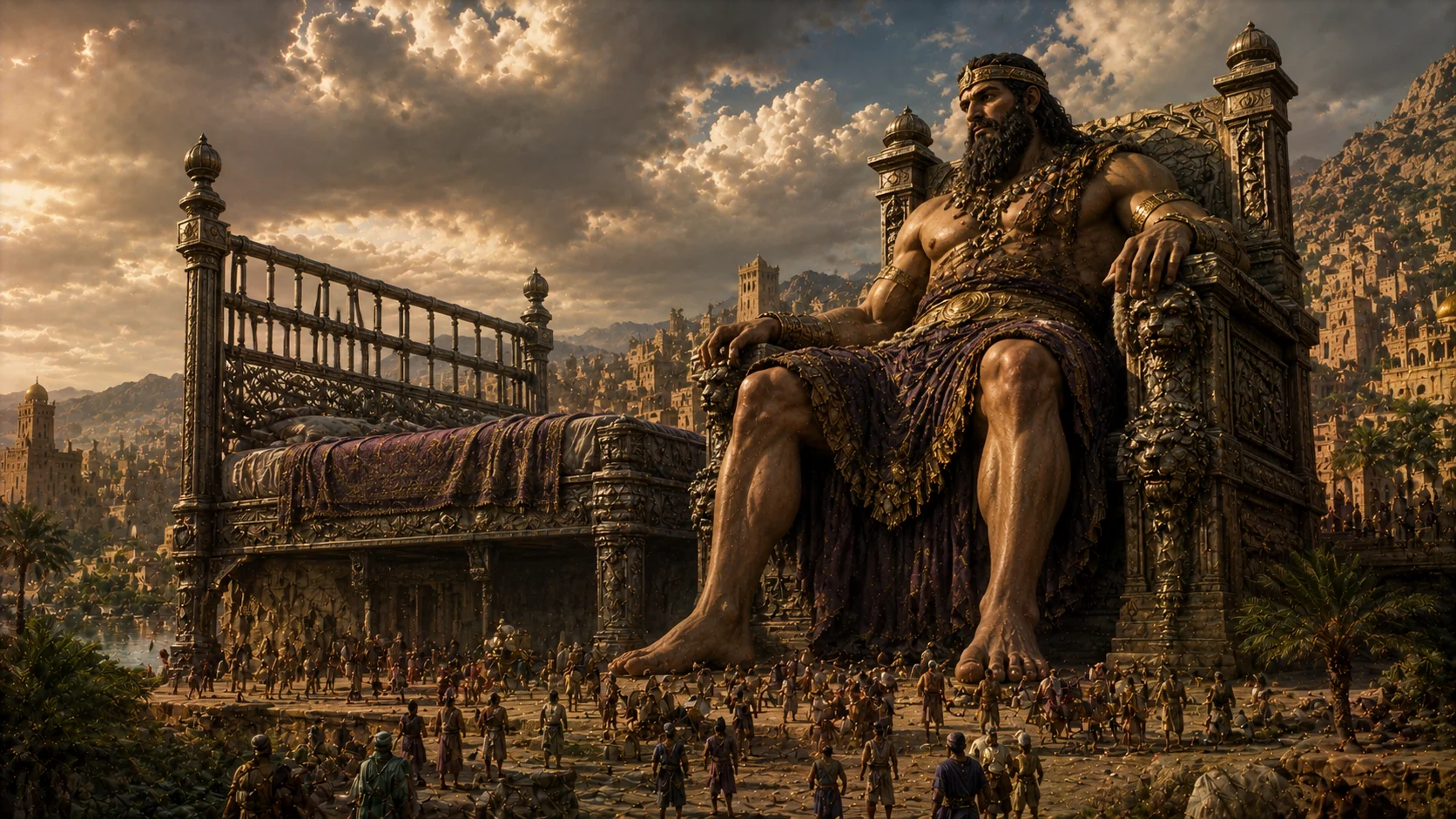
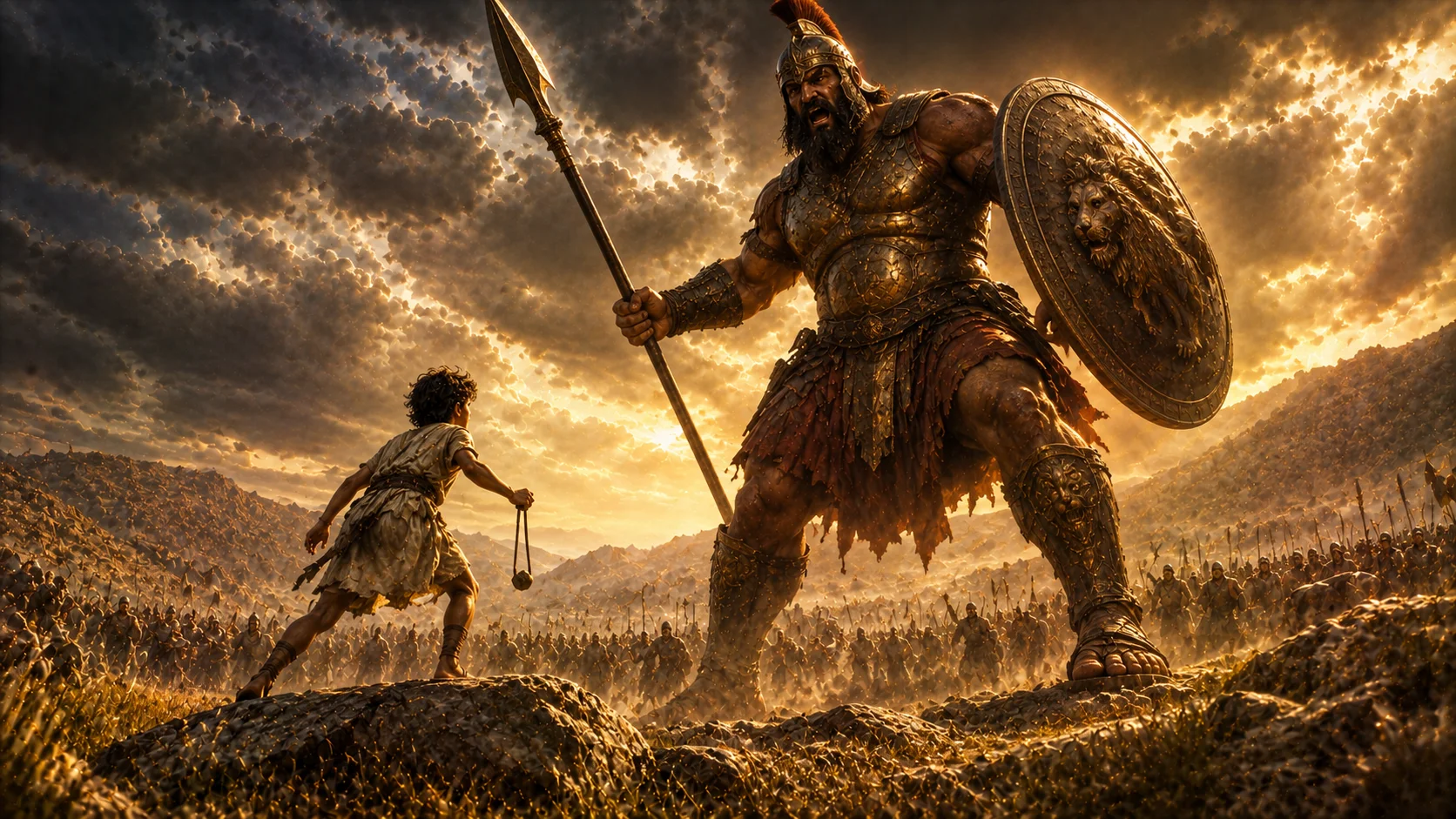
In the valley of Elah, the armies of Israel and the Philistines faced one another, and from the Philistine ranks came forth a champion of staggering size — “Goliath of Gath, whose height was six cubits and a span,” some nine feet tall. He was armored in a coat of bronze mail weighing five thousand shekels, with a bronze helmet and greaves, a javelin slung between his shoulders, and a spear whose shaft was “like a weaver’s beam.” For forty days he strode out morning and evening to taunt the armies of Israel, challenging any man to single combat, and no one dared to face him. Tradition counts him among the remnant of the giant Anakim who lingered in the Philistine cities.
The Shepherd and the Stone
It was the young shepherd David, come to the camp to bring food to his brothers, who answered the giant’s challenge. Refusing armor, he took only his staff, his sling, and five smooth stones from the brook. To Goliath’s scorn he replied: “You come to me with a sword and with a spear and with a javelin, but I come to you in the name of the Lord of hosts.” Then he loosed a single stone from his sling; it struck the giant in the forehead, and Goliath fell face-down upon the earth. David took the giant’s own sword and cut off his head, and the Philistine host fled in terror.
The Fall of the Mighty
Goliath’s defeat became one of the most enduring parables of the ancient world: that true strength lies not in size or armor but in faith and courage, and that the proud and overwhelming can be undone by the small and the brave. Whether remembered as the last of the Canaanite giants or as the eternal symbol of the overmatched bully, Goliath endures wherever an underdog faces an impossible foe. In him, Hebrew tradition gave the world its definitive giant — vast, armored, and invincible in seeming, felled by a boy with a stone and a trust greater than any sword.
How Tall Was the Giant? A Question the Text Itself Disputes
Turn to the oldest surviving Hebrew witness to the story and the giant shrinks by three feet. The Masoretic Text, the Hebrew tradition behind most printed Bibles, gives Goliath’s height as “six cubits and a span” — close to nine feet nine inches, taller than any verified human being in recorded history. But the Samuel scroll recovered from Qumran, together with the ancient Greek Septuagint and the first-century historian Josephus, all give a different figure: four cubits and a span, roughly six feet nine inches. Still a giant by the standards of the Bronze and early Iron Age Levant, but no longer an impossibility on two legs. Scholars have long argued over which number came first — whether an originally more modest champion was inflated by later scribes eager to magnify David’s triumph, or whether a copyist’s eye slipped from one line to a nearly identical one further down the column and quietly gained two cubits along the way. Most English Bibles still carry the taller figure in the body of the text and relegate the shorter one to a footnote — proof that once a legend fixes itself in the popular imagination, it tends to outrun its own manuscripts.
A Name Out of Gath
Excavations at Tell es-Safi, the site identified with biblical Gath, recovered a broken piece of pottery inscribed with two names in an early alphabetic script, from levels dated between the tenth and the mid-ninth centuries BCE. Neither name is Semitic in root; both echo the non-Semitic, Aegean-flavoured speech that the Philistines — among the seafaring “Sea Peoples” who settled the Canaanite coast around the twelfth century BCE — are thought to have brought with them from the direction of the Aegean and western Anatolia. The sherd is not Goliath’s calling card, and no serious excavator has claimed it is. What it does establish is narrower and more interesting: names of that shape were genuinely in use at Gath, in roughly the era the story is set. “Goliath” has never been convincingly explained from Hebrew roots either — to those who study the Philistines’ scattered inscriptions it reads like a foreign name transliterated, not a Hebrew word coined for a villain. The setting was chosen with equal care: the book of Joshua notes that after the conquest of Canaan the Anakim were destroyed everywhere except in three Philistine cities — Gaza, Ashdod, and Gath. A giant turning up at Gath is not an accident of geography. It is the text keeping its own accounts.
The Giant’s Kin: Other Sons of the Rapha
Goliath was not, in the biblical account, an only child of terror. The second book of Samuel preserves a short, almost administrative list of further Philistine giants cut down in the wars that followed, each identified as descended from “the Rapha” — a giant ancestor, or a clan-name, tied to Gath. There was Ishbi-benob, whose bronze spear weighed some three hundred shekels, and who came close to killing an exhausted King David in battle before Abishai intervened. There was Saph, cut down by Sibbecai the Hushathite. There was a giant left nameless and distinguished only by six fingers on each hand and six toes on each foot — twenty-four digits in all — killed by David’s own nephew Jonathan. And there was a fourth, felled by a man named Elhanan, whose identity is the single most argued-over detail in the passage. Read together, the four suggest a dynasty of Gittite giants rather than a lone freak of nature: a family the armies of Israel kept meeting, and kept having to kill, for a generation after the stone struck home.
The Elhanan Problem
That fourth entry contains one of the most quietly debated verses in the Hebrew Bible. Second Samuel states, without qualification, that “Elhanan the son of Jaare-oregim the Bethlehemite killed Goliath the Gittite, the shaft of whose spear was like a weaver’s beam” — the very giant, described in the very words, that David is elsewhere said to have killed. The parallel list in Chronicles resolves the contradiction by naming Elhanan’s victim not Goliath but Lahmi, the brother of Goliath, and by dropping the Bethlehem detail from his lineage. Which version is the repair and which the original has divided readers ever since. Some hold that a copyist garbled the wording in Samuel and that Chronicles preserves what was always meant; others suspect Chronicles is smoothing over an older strand of tradition in which Elhanan, not the shepherd-boy, was Israel’s giant-slayer, the exploit reassigned in time to its more famous king. Whatever lies beneath it, the discrepancy is a rare surviving seam in the text — a place where two versions of the same national memory were stitched together rather than perfectly merged.
Orpah’s Line
Rabbinic tradition could not resist tying the giant’s ancestry to David’s own. The book of Ruth tells of two Moabite widows, Ruth and Orpah, both urged by their mother-in-law Naomi to return to their own people after their husbands’ deaths. Ruth refuses and stays, and becomes in time the great-grandmother of David. Orpah kisses Naomi and turns back. The Talmud takes that fork in the road and follows it to its end, reading the Hebrew word rendered “the Rapha” not as the giant but as a woman’s name — Harafah, near enough to Orpah to be identified with her. In that telling Orpah is the mother of the giants, and her four sons are granted her as recompense for the four tears she shed at parting. One widow’s loyalty produced the shepherd who would save Israel; the other’s four tears produced the men he and his warriors would have to kill. The rabbis were rarely willing to leave a loose thread unexplained, and here the symmetry — two women from the same short story, one bloodline ending in a king, the other ending beneath his sling — was too pointed to pass by.
The Sword Behind the Ephod
Goliath’s story does not end with his head carried off to Jerusalem. His sword survived him, and resurfaces many chapters later in one of the quieter, stranger scenes of the David narrative. Fleeing alone from Saul, hungry and unarmed, David comes to the sanctuary at Nob and asks the priest Ahimelech for a weapon. There is only one to be had: “The sword of Goliath the Philistine, whom you killed in the valley of Elah, is here, wrapped in a cloth behind the ephod.” It had been kept, in other words, as a sacred trophy at Israel’s own shrine — the giant’s blade repurposed as a relic of deliverance. David’s answer is famously blunt: “There is none like it; give it to me.” The boy who had refused Saul’s armour as too cumbersome, and who took down a giant with nothing but a sling, arms himself at last with the giant’s own weapon — drawn not from a battlefield but from behind the curtain of a shrine.
Jalut, in the Qur’an
Islamic tradition preserves its own telling of the duel, under different names. In the second surah of the Qur’an, the army of Talut — Saul — is first tested at a river, where only those who refuse to drink their fill prove fit to fight. The much-reduced company that crosses comes in sight of Jalut and his troops, and some despair of the odds; it is those certain of meeting God who answer that many a small company has overcome a large one by God’s permission. Dawud, serving among Talut’s soldiers, kills Jalut in the battle that follows and is given kingship and wisdom after him. The names shift, and the river-test has no equivalent in the Hebrew account, but the shape of the story — the vast army, the impossible champion, the small remnant permitted to prevail regardless — travelled with the tradition wherever it went.
Carved and Painted
Few duels in scripture have been rendered in bronze, marble and oil as often as this one, and each artist found a different moment worth freezing. Donatello cast his David standing in quiet triumph with one foot resting on Goliath’s severed head, the giant reduced to a plinth for the victor to stand on. Michelangelo went the opposite way, carving a David some seventeen feet tall in his own right — sling over one shoulder, eyes fixed on an opponent the viewer cannot see — capturing not the killing blow but the coiled instant before it. Bernini, a century after Michelangelo, twisted his marble David into full motion, torso wound like a spring, caught mid-release of the stone. And in Caravaggio’s David with the Head of Goliath, the painter is widely thought to have given the giant’s sagging, severed face his own features — a self-portrait read by many art historians as a plea for pardon near the end of a violent life. Four artists, four entirely different giants, united only in being felled by the same boy.
Why the Giant Still Falls
No loser in scripture has lent his name to more headlines. A start-up is a David against an industry Goliath; a lower-league side beating a champion is a giant-killing; the word has drifted so far from Gath that most people who reach for it have never read the chapter it comes from. What made it portable was the narrator’s arithmetic. The height in cubits, the bronze weighed out by the hundredweight, the spear like a weaver’s beam, the forty unanswered days — every one of those details exists to make one side of the equation as large as language can make it. Strip the theology away and what remains is a piece of measuring equipment: Goliath is less a character than a unit, the largest quantity the ancient imagination could name. That is why the name outlived the story. Whatever can topple that can be trusted, in the arithmetic the tale set up, to topple anything.
Sources & traditions
- EncyclopediaWikipedia — Goliath
- TraditionHebrew texts, grimoires and later commentary
Myths change from area to area and from time to time. This chronicle follows the most widely told versions; tellings in other villages, regions and eras may differ.