The Re’em is the mighty wild ox of Hebrew tradition — a colossal, untamable horned beast whose strength became proverbial in scripture and whose size, in rabbinic legend, swelled to mountainous proportions. Half real animal and half legend, the Re’em stands for raw, God-given power beyond any human ability to harness.
The Untamable Strength
The Re’em appears throughout the Hebrew scriptures as an emblem of unconquerable might. “God brought him out of Egypt; he has strength like a wild ox,” says the Book of Numbers; and Job asks, “Will the wild ox consent to serve you? Will he spend the night at your manger? Can you bind him in the furrow with ropes?” — the answer being a resounding no. The Re’em cannot be domesticated, cannot be yoked, cannot be bent to the plow; it is the very symbol of a power that belongs to the wild and to God alone. The Psalms exalt the horns of the righteous as “the horns of the Re’em.”
The Beast of Mountainous Size
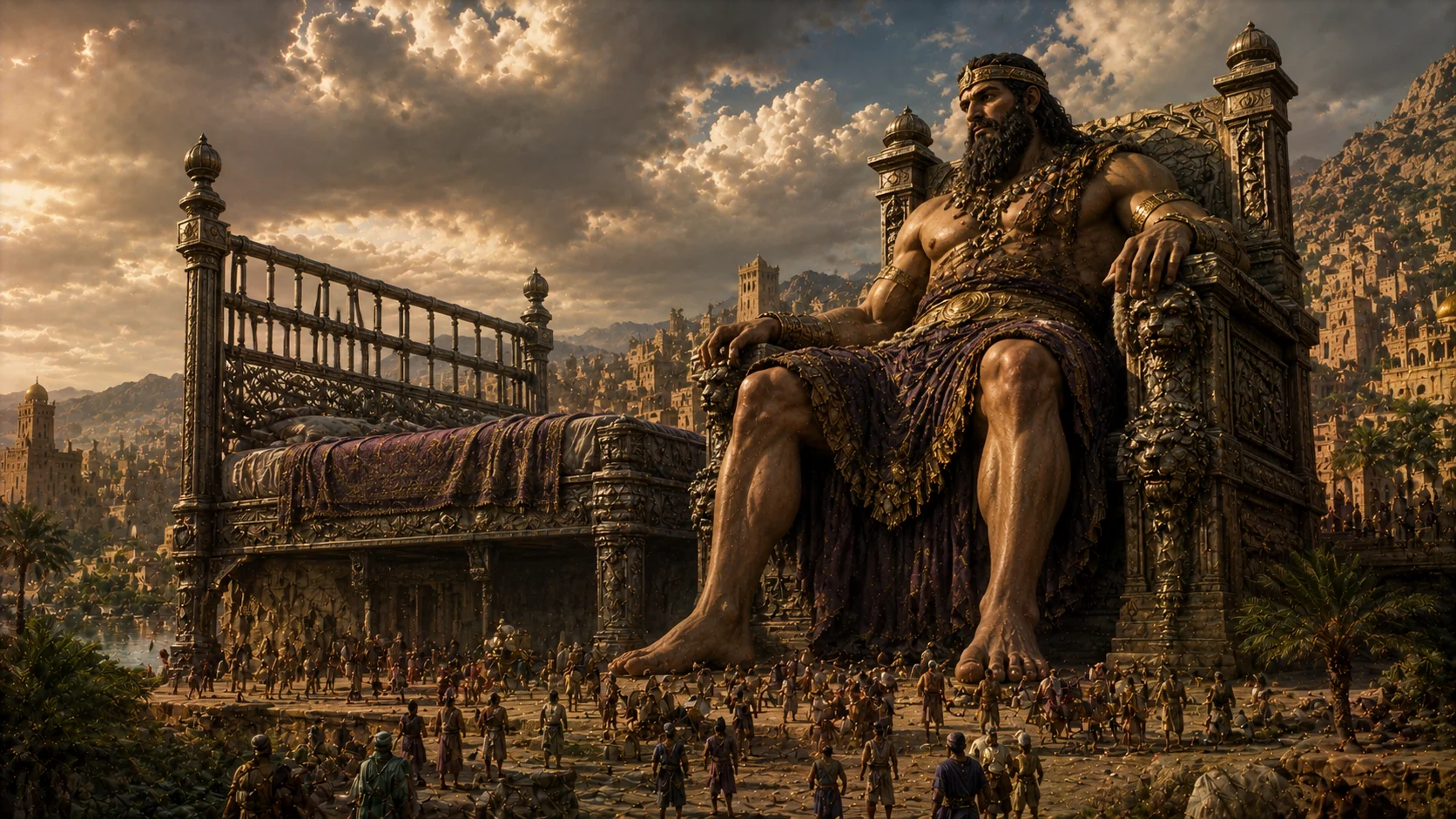
In the legends of the sages, the Re’em grew to staggering dimensions. It was said to be so enormous that it could not fit into Noah’s Ark; instead, the Re’em was tethered to the outside of the Ark and swam alongside through the Flood, or only its nostrils were taken aboard, or its young. One tale tells of a Re’em so vast that a day’s journey was needed to cross between its horns, and of King David, in his youth, mistaking a sleeping Re’em for a mountain and climbing upon it, only for the beast to rise and bear him to the heavens.
Wonder of Creation
The Re’em belongs to that company of marvelous creatures — alongside Leviathan, Behemoth, and Ziz — through which Hebrew tradition contemplated the grandeur and otherness of God’s creation. Whether understood as the great aurochs, the wild ox now extinct, or as a purely legendary giant, the Re’em embodies a single enduring idea: that there are powers in the world made by God that no human hand will ever tame. In its horns and its untamed strength, Hebrew thought found an image of the wild majesty woven into creation itself.
A Word Older Than Hebrew
Centuries before the word settled into Hebrew scripture, its cousins were already old across the ancient Near East. The Akkadian rīmu and the Ugaritic rum, the latter attested in tablets from the late second millennium BCE, name the same creature: a wild bull of terrifying strength, hunted by kings as proof of their fitness to rule. The Assyrian king Tiglath-Pileser I, ruling around 1100 BCE, had it recorded that he killed wild bulls near the city of Araziqu on the approach to the land of Hatti, and at the foot of Lebanon, and that he carried off their calves alive. It is the same posture of conquest that palace reliefs show Assyrian kings taking against lions: the beast that cannot be ruled is killed, and the killing is cut into the wall as an argument. The Hebrew Re’em did not spring from nowhere. It inherited a whole regional vocabulary in which the wild bull already stood for a strength no king could own — only, briefly, match.
The Blessing of Joseph
Beyond the verses in Numbers, Job, and the Psalms, the Torah reaches for the Re’em once more, at one of its most charged moments: Moses’s dying blessing over the tribes of Israel. Of Joseph he says, “His firstling bullock, majesty is his; and his horns are the horns of the wild-ox: with them he shall gore the peoples all of them, even the ends of the earth” (Deuteronomy 33:17) — and the verse names those horns outright as Ephraim and Manasseh. Here the beast is not admired from a distance, as it is in Job, but worn. The horns become the tribe’s own, and a strength that elsewhere marks the outer limit of human reach is handed across as an inheritance.
Isaiah’s Day of Reckoning
The prophet Isaiah puts the Re’em to a darker use. In his oracle against Edom — a vision of total judgement upon a hostile nation — he writes: “And the wild-oxen shall come down with them, and the bullocks with the bulls; and their land shall be drunken with blood” (Isaiah 34:7). The Re’em falls here in the same breath as the bullocks and the bulls, the untameable listed beside the yoked and granted no separate fate. Everywhere else in scripture its strength is the whole point of mentioning it; in Isaiah’s slaughter it buys the animal nothing.
From Wild Ox to Unicorn
The strangest afterlife of the Re’em has nothing to do with oxen. When the Hebrew scriptures were rendered into Greek for the Septuagint, the translators reached for monokerōs — “one-horned.” Jerome’s Latin Vulgate followed with unicornis in some verses and rhinoceros in others, and English Bibles down to the King James Version carried the first of those forward as “unicorn.” A creature that Deuteronomy had explicitly furnished with two horns had, through translation alone, become single-horned in the Christian West.
That reading did real cultural work. The Physiologus and the medieval bestiaries descended from it folded the biblical unicorn into an elaborate allegory: a beast too fierce for hunters to take, which would lay its head in the lap of a virgin and be captured there — read as a figure for the Incarnation, divine power made approachable. Later translators, working more closely from the Hebrew, undid the choice, and modern versions print “wild ox” again. But for well over a thousand years a translator’s decision had quietly converted a Hebrew image of untamable bulk into Europe’s most famous one-horned beast.
The Animal Behind the Legend
The identification usually offered for the Re’em — the aurochs, Bos primigenius — repays more than a passing label. The aurochs was the wild ancestor of domestic cattle and a far heavier animal than its descendants: skeletal remains put bulls at roughly 160 to 180 centimetres at the shoulder, carrying long forward-curving horns, and the species ranged across Europe, Asia, and North Africa well into the historical period. Julius Caesar, describing the Hercynian Forest of Germany, records the uri as beasts the local tribes trapped in pits and prized for their horns, which they mounted in silver and drank from at feasts. He adds that they could not be habituated to people or tamed even when taken very young — the same conclusion Job draws about the Re’em, reached from an entirely separate tradition with no scripture behind it.
The species thinned through the medieval centuries until one protected herd remained in the Jaktorów Forest, some fifty kilometres from Warsaw, where the last known aurochs, a cow, died in 1627. What the Hebrew writers were describing, then, was not a fantasy but an exaggeration — and when the animal itself was finally gone, only the exaggeration was left holding the name.
Sources & traditions
- EncyclopediaWikipedia — Re'em
- TraditionHebrew texts, grimoires and later commentary
Myths change from area to area and from time to time. This chronicle follows the most widely told versions; tellings in other villages, regions and eras may differ.