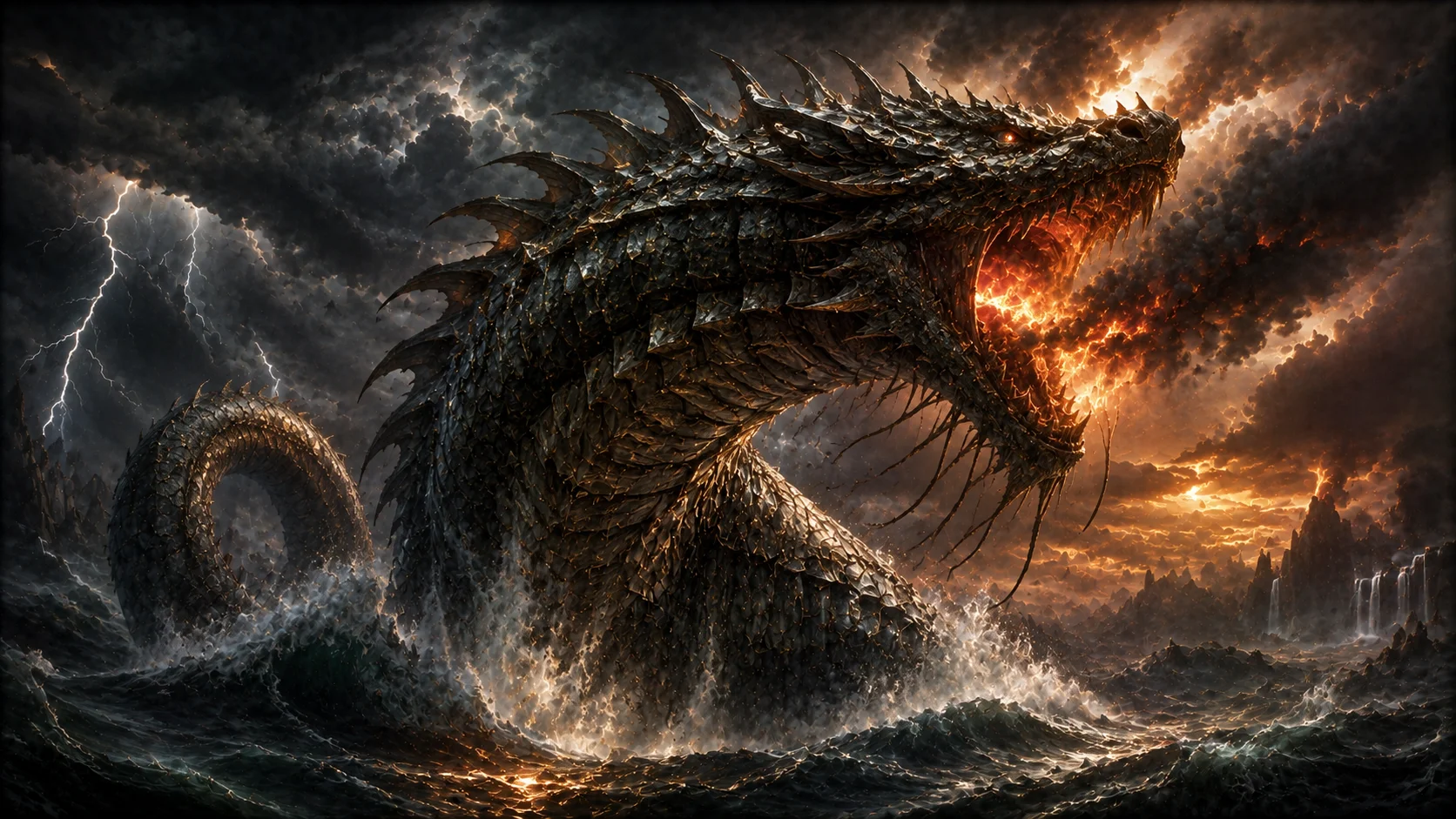
Leviathan is the great primordial sea-monster of Hebrew tradition — a colossal serpent-dragon of the deep, untamable and terrible, whom God alone can master. The mightiest of the chaos-beasts, Leviathan embodies the raw, churning power of the primeval ocean and the limits of human strength before the works of the Creator.
The Terror of the Deep
Scripture describes Leviathan in awestruck, fearful language. In the Book of Job, God himself challenges the proud: “Can you draw out Leviathan with a fishhook?” The creature’s scales are his pride, “shut up together as with a close seal”; from his mouth go burning torches, and sparks of fire leap out; smoke pours from his nostrils, and his breath kindles coals. “Upon earth there is not his like, a creature without fear. He beholds everything that is high; he is king over all the children of pride.” No weapon can pierce him, no man can subdue him — only his Maker.
The Chaos-Serpent
Leviathan’s roots reach back to the ancient Near Eastern myths of the chaos-dragon of the sea, the primeval enemy of order — kin to Rahab, the other great sea-monster of Hebrew lore, and to the dragons that the Creator subdues at the world’s beginning. The Psalms recall how God “broke the heads of Leviathan in pieces” and crushed the sea-monsters in the act of creation, taming the wild waters and establishing the order of the world. Leviathan thus stands for the chaos that the divine power conquers and holds in check.
The Feast at the End of Days
Jewish tradition gave Leviathan a startling destiny. In the rabbinic imagination, God created Leviathan and a mate, but slew the female lest the pair multiply and destroy the world, preserving her flesh. At the end of days, in the messianic age, Leviathan will be slain — doing battle with the land-monster Behemoth until both fall — and its flesh will be served as the great feast of the righteous, while its hide is stretched to make their canopy. So the monster of chaos becomes, at the last, the banquet of the redeemed. In Leviathan, Hebrew tradition gave its grandest form to the untamable deep — the dragon that only God can bind, and that the end of time will turn from terror into triumph.
A Name Older Than the Bible
The word itself is a fossil. Leviathan renders the Hebrew livyātān, formed from a root meaning “to twist” or “to coil” — not a word for sea-monster at all, but a description: the twisted one. That single word is the clearest thread connecting the Hebrew scriptures to a much older Canaanite religion. Centuries before Job or the Psalms were copied onto scroll, scribes at the city of Ugarit, on the Syrian coast, pressed cuneiform tablets describing the storm-god Baal’s defeat of a sea serpent called Lotan — a creature those tablets call, almost word for word, “the fleeing serpent” and “the twisting serpent,” and credit with seven heads. Israel did not invent its sea-monster from nothing. It received one already old, and rewrote its ending.
Isaiah’s Twisting Serpent
That inheritance surfaces most plainly in Isaiah. Looking to a future day of judgement, the prophet declares: “In that day the LORD with his sore and great and strong sword shall punish leviathan the piercing serpent, even leviathan that crooked serpent; and he shall slay the dragon that is in the sea.” The two epithets — the piercing (or fleeing) serpent, and the crooked (or twisting) serpent — are not incidental poetry. They are the very titles given, centuries earlier, to Lotan in the Ugaritic texts. A formula composed for a Canaanite storm-god’s battle with the sea has been carried, almost unchanged, into a vision of Israel’s own God settling accounts with chaos at the end of history.
A Gentler Portrait: Leviathan at Play
Not every verse fears the monster. Psalm 104, a hymn surveying the whole of creation with wonder rather than dread, pauses on the sea: “There go the ships: there is that leviathan, whom thou hast made to play therein.” Here Leviathan is not a rival power straining against God’s dominion but a creature of delight — something vast that God shaped for the pleasure of watching it gambol among the waves, sea-going wildlife rather than sea-going nightmare. Set beside Job’s fire-breathing terror, the psalm shows that the biblical writers did not treat Leviathan as one fixed symbol. They reached for whichever Leviathan — the untamable or the playful — suited what they wanted to say about God’s relationship to the world he had made.
Leviathan Among the World’s Sea-Dragons
The pattern Leviathan belongs to runs much wider than Canaan. In the Babylonian creation epic, Marduk cuts down the salt-water goddess Tiamat and splits her body to build sky and earth. In Greek myth, Zeus beats the storm-serpent Typhon down with thunderbolts, and a later tradition buries him beneath Mount Etna, whose eruptions are his struggling. In Norse tradition, Thor’s appointed enemy is Jörmungandr, a serpent so vast it circles the whole world with its tail in its mouth, and the two are fated to kill one another at the world’s end. None of these figures is a copy of Leviathan, and the Hebrew scriptures do not borrow them wholesale — but the shared shape is unmistakable: a storm or sky god secures order only by subduing a monstrous serpent of the primeval waters. Leviathan is Israel’s entry in a region-wide argument about what stood in the world before the world was made safe.
The Mouth of Hell
Medieval Christian art took Leviathan somewhere the biblical text never quite goes. Commentators had long identified the sea-dragon with Satan, reading Isaiah’s “dragon that is in the sea” as a veiled prophecy of the devil’s defeat. Out of that identification grew one of the most striking images of the Romanesque and Gothic periods: the Hellmouth, a gaping, fanged maw — its jaws owing much to the Book of Job’s account of Leviathan’s terrible teeth — through which the damned are shown being devoured on Doomsday. The twelfth-century English Winchester Psalter gives the image a full page of its own: a toothed, monstrous head crammed with sinners, its jaws locked shut with a great key by an angel. The creature Job described as beyond any man’s mastery had become, by the Middle Ages, the architecture of damnation itself.
The Sovereign Monster
Leviathan’s afterlife eventually outgrew religion altogether. In 1651 the English philosopher Thomas Hobbes gave his treatise on political authority the title Leviathan, and set a line from the Latin Vulgate’s Book of Job at the head of it: Non est potestas super terram quae comparetur ei — “there is no power on earth to be compared to him.” The engraving beneath shows a crowned giant towering over the land, its body composed of hundreds of tiny citizens: the state, Hobbes argued, had to be an “artificial man” as overwhelming as the biblical monster, or the alternative was anarchy. It is a curious inheritance for a creature born to represent chaos — borrowed, thousands of years after Ugarit, to argue for the opposite: absolute, unbreakable order.
Why the Deep Still Frightens Us
Long after anyone believed a literal sea-dragon patrolled the coastline, the shape of the fear survived. Israel was never much of a seafaring people, and the water it looked out on was the one part of creation that never fully submitted — unfarmable, unfixed, swallowing ships and sailors without a trace. Leviathan gave that formless anxiety a face: scaled, fire-breathing, at home where nothing human could follow. To say that God alone could subdue Leviathan was to say something true about the ocean itself, long before anyone had a word for the abyssal dark beneath a hull. The monster is gone from the water. The unease it stood for — the sense that something enormous and unknowable moves beneath what looks like a calm surface — has never fully left us.
Sources & traditions
- EncyclopediaWikipedia — Leviathan
- TraditionHebrew texts, grimoires and later commentary
Myths change from area to area and from time to time. This chronicle follows the most widely told versions; tellings in other villages, regions and eras may differ.