The Dybbuk is among the most feared and most enduring figures of Jewish folk belief — the disembodied soul of a dead person, unable to find its rest, that clings to and enters the body of a living human being, speaking through the mouth it has claimed. Where much of Jewish demonology and folklore reaches back into the Talmudic and Midrashic worlds of late antiquity, the Dybbuk is younger: it takes shape in the mystical circles of sixteenth- and seventeenth-century Safed, in the Kabbalistic thought associated with Isaac Luria and recorded by his disciple Hayyim Vital, before spreading through the tale-literature and lived religious practice of Ashkenazi Eastern Europe. It remains, even now, a living concern rather than a closed chapter of folklore — a belief some communities still hold, and occasionally still act upon.
A Clinging That Will Not Let Go
The word itself carries the whole doctrine inside it. Dybbuk comes from the Hebrew dibbuk, drawn from the fuller phrase dibbuk me-ru'ach ra'ah — roughly, "a clinging of an evil spirit" — and both rest on the root d-b-k, "to cling" or "to adhere." This is not a metaphor added later by storytellers; it is the technical description of the mechanism itself. A dybbuk does not simply appear or haunt a place. It cleaves — to a body, to a living person — the way one surface adheres to another, and having cleaved, it does not easily come free. Everything that follows in the tradition, the diagnosis of possession, the long and careful rites of removal, exists because the verb is "cling" and not "visit."
The Soul With Nowhere Else to Go
In the framework worked out by the Safed kabbalists and their successors, a dybbuk is understood as the soul of someone who has died — but died in a state that leaves it unable to proceed to its proper place in the afterlife. The tradition points to several such states: a person who died carrying unresolved sin, one who left behind unfulfilled religious obligations, one whose death was sudden, violent, or otherwise untimely. Such a soul is left in a kind of suspension, cut off from repose, and in its wandering and distress it seeks refuge. It finds that refuge, according to the belief, by attaching itself to a living body rather than remaining exposed and alone in its unrest. The living person becomes, involuntarily, a shelter for a soul that has nowhere sanctioned to be.
Older Cousins in the Kabbalistic Imagination
The dybbuk did not arrive in Jewish thought as a fully separate idea. It sits beside — and was in some ways distinguished out of — an earlier and gentler concept called an ibbur, a term already current in Lurianic circles before "dybbuk" itself became the common word for the harmful version. An ibbur, too, is a soul that attaches temporarily to a living person, but its purpose and effect are benevolent: it comes to help, to strengthen, or to elevate the person it joins, and it departs without harm. The dybbuk is its dark mirror. Where an ibbur aids, a dybbuk afflicts; where an ibbur is welcomed or at least tolerated, a dybbuk must be identified, confronted, and expelled. Scholars who have traced this history — Gershom Scholem's critical account among them — note that the exact line between the two terms, and precisely when "dybbuk" hardened into its own distinct technical sense, is not perfectly settled; traditional and Hasidic tellings sometimes draw the boundary differently than academic reconstruction does. What is not in dispute is the underlying logic: the same mechanism of soul-attachment could be read as either a blessing or an affliction, and it was the affliction that came to dominate the folk imagination.
A Doctrine Related to Gilgul, and Distinct From It
The dybbuk is closely bound up with gilgul, the doctrine of the transmigration or reincarnation of souls that the Lurianic Kabbalah developed at length — set out extensively, for instance, in the Sefer ha-Gilgulim associated with Hayyim Vital's circle. The two ideas share a conviction that a soul's story does not end simply at death, and some kabbalistic sources go further, treating dybbuk possession as itself a corrective or even punitive mechanism connected to a failed or incomplete gilgul cycle — a soul denied its proper rebirth or its rest because of grave transgression, among the examples given being apostasy, sexual sin, or unpaid debts owed to the community, and so forced instead to take refuge in a body already living. But gilgul and dybbuk possession are not the same event. Gilgul describes a soul entering a new body at conception, woven into that person's life from its beginning. A dybbuk instead forces its way into a body that is already living, already grown, already inhabited by a soul of its own — an invasion rather than a birth, and it is this forcible, uninvited quality that marks it as the more frightening of the two doctrines.
Signs by Which the Afflicted Are Known
Traditional accounts describe a fairly consistent set of signs by which possession was recognized. The possessed person's voice changes — often dramatically, so that a woman speaks in a man's voice, or a man in a woman's, the dybbuk's own vocal register asserting itself through borrowed vocal cords. The voice may speak Hebrew or Aramaic, or reveal knowledge the possessed person could not plausibly have had in life — learning, memories, or facts belonging to the dead soul rather than the living body. Convulsions were reported, along with behavior read as self-destructive or transgressive, conduct utterly out of keeping with the person's ordinary character. Taken together, these signs were understood not as illness in the body's own right but as evidence of a second will lodged inside it — a foreign presence making itself heard and felt through symptoms the community had learned, over generations of such cases, to recognize.
The Rite of Gerush: Calling the Spirit to Account
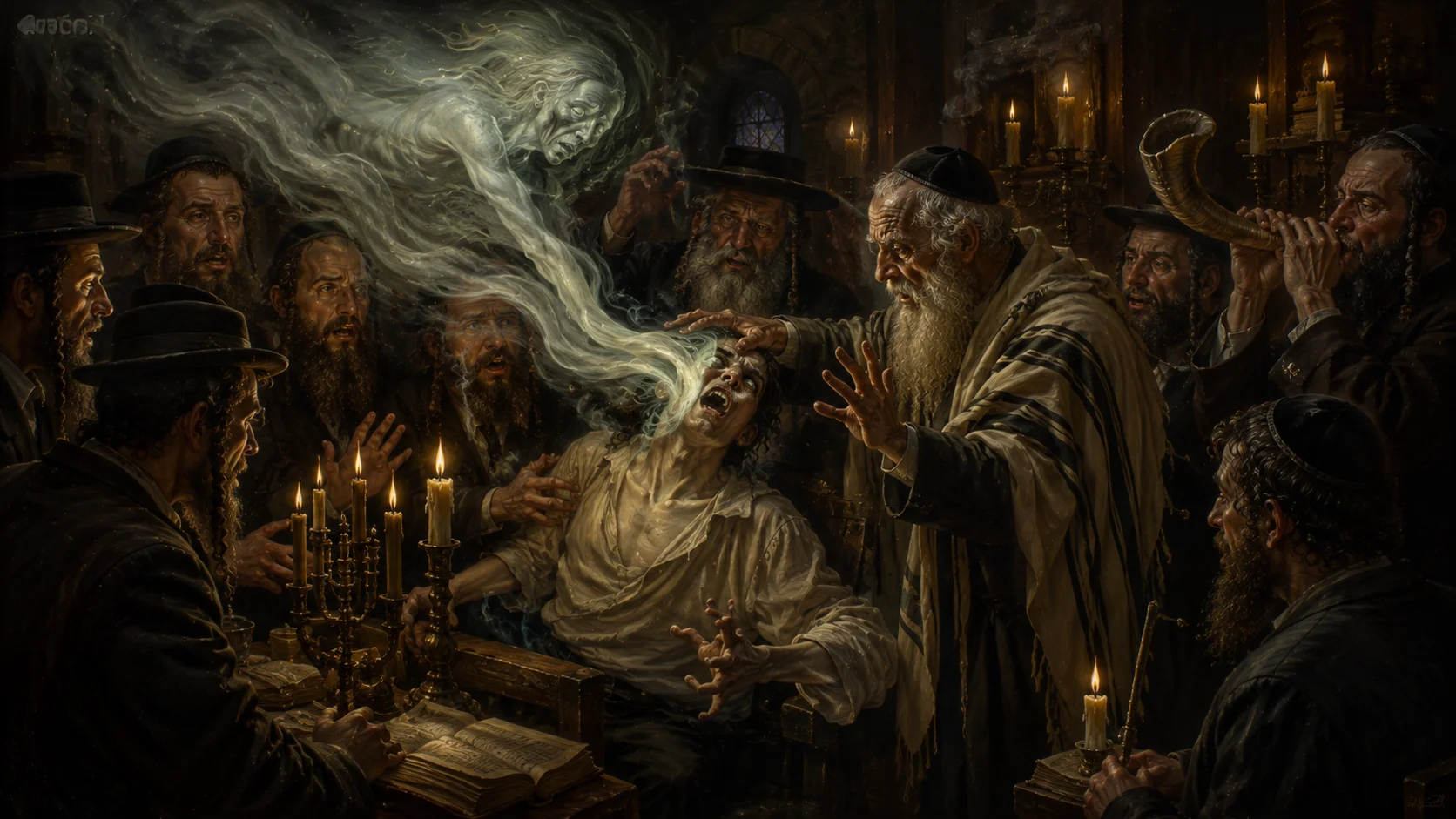
Where possession was diagnosed, the prescribed response was a formal rite of exorcism known as gerush or gerushin — "expulsion." This was not undertaken lightly or informally; it called for a learned rabbi or a ba'al shem, a master of practical, applied Kabbalah versed in the use of divine names, and it was typically performed before a minyan, a quorum of ten. The rite proceeded first by adjuration: the officiant would conjure the spirit using the divine names at his command, compelling it to identify itself and to explain the sin or unrest that had left it wandering. This was not merely procedural. The story the spirit told — who it had been, what it had failed to do or done wrong — was itself part of what the exorcism sought to address, since a soul's unrest was understood to have a specific, namable cause.
Psalms, Shofar, and Scroll
Around the act of adjuration, the exorcism drew on the full instrumentarium of communal and sacred practice. Psalms were recited over the possessed. The shofar, the ram's horn ordinarily sounded at the turning of the year, was blown as part of the rite, its call understood to have force against the clinging spirit. A Torah scroll and candles were brought into formal use, the presence of the scroll itself part of what pressed upon the dybbuk to relent. None of this was theatrical excess; each element belonged to a coherent understanding of what could compel a soul that words and reasoning alone could not move — the accumulated weight of scripture, sound, and sanctified object brought to bear together.
A Departure by the Smallest Door
When the rite succeeded, the spirit was commanded to leave the body it had claimed — and, tellingly, by a specific route. Tradition holds that the dybbuk was directed to depart through a particular bodily extremity, most commonly the small toe, chosen precisely because it was the point through which the possessed person could be freed with the least harm done to the body that had housed the spirit. The image is a striking one: even in expulsion, in a rite meant to drive out an unwelcome and afflicting presence, the concern for the living host's welfare shaped how the departure itself was to be accomplished.
Freeing the Soul, Not Only the Body
Exorcism as force was not the whole of the tradition's response. Some accounts describe the use of pidyon nefesh, a redemptive practice, or other ritual acts meant to help the wandering soul complete its tikkun — its spiritual repair — so that it might depart not merely expelled but genuinely released, able at last to proceed toward its proper place in the afterlife rather than being cast out only to wander further. This softer strand of the tradition matters: it frames the dybbuk not purely as an enemy to be defeated but as a soul in true distress, one whose suffering the living community had some capacity, and perhaps some obligation, to help resolve. The rite, in this reading, aimed at peace for two parties at once — the living person restored to their own body, and the dead soul finally allowed to rest.
An-sky's Play and the Image the World Came to Know
The dybbuk that most people outside traditional Jewish learning have encountered comes not from the kabbalistic case literature but from a work of deliberate fiction: S. An-sky's Yiddish play The Dybbuk, or Between Two Worlds, written in the years around 1913 to 1916 and first staged by the Vilna Troupe in 1920. An-sky drew on real ethnographic material — he had led expeditions through the Pale of Settlement between 1912 and 1914, collecting Jewish folklore directly from the communities that still held these beliefs — but the play's central plot is his own dramatic invention. In it, the soul of a young man, denied the hand of the woman he loved, possesses her in the body of his own grief and longing. That image, a dead lover's soul entering his beloved, is the version of the dybbuk that fixed itself in twentieth-century theatre and popular culture, carrying the figure to audiences who had no connection to the religious tradition it came from.
Where the Story and the Sources Part Ways
It is worth holding the play and the older tradition apart, because they are not telling the same kind of story. The recorded cases in the kabbalistic and folk-legend literature — the earliest detailed accounts appearing in the writings associated with Hayyim Vital and in the later ma'asiyot, the tales that circulated through Eastern European Jewish communities — center overwhelmingly on sin, punishment, and transgression against religious or communal obligation, not on romantic love thwarted by circumstance. An-sky's lovers are a work of art responding to a folk belief, giving it a shape suited to the stage; they are not themselves an attested traditional case. Recognizing this distinction does not diminish either the play or the tradition — it simply keeps the historical record and the literary imagination in their proper places, which the sources themselves ask us to do.
A Belief That Has Not Finished Its Work
The dybbuk has not receded into pure history. Some Haredi and Hasidic communities today still report cases understood as possession and still seek rabbinic consultation toward an exorcism in something like the traditional form — a fact attested in contemporary journalistic and ethnographic reporting rather than in classical religious texts, but no less real for that. This continuity matters: it marks the dybbuk not as a folkloric curiosity preserved only in plays and scholarship but as part of a living religious world, one where the questions the tradition first asked in Safed four centuries ago — what happens to a soul that cannot rest, and what the living owe to it — are still, for some, questions asked in earnest.
Sources & traditions
- EncyclopediaWikipedia — Dybbuk
- TraditionJewish texts, grimoires and later commentary
Myths change from area to area and from time to time. This chronicle follows the most widely told versions; tellings in other villages, regions and eras may differ.