Og, king of Bashan, stands in the Hebrew scriptures as the last named survivor of the Rephaim, an ancient race of giants whose very memory the Torah treats as passing out of the world in his generation. He ruled sixty cities in the rich highland region east of the Jordan, commanded fortified capitals at Ashtaroth and Edrei, and fell in battle against Israel on the eve of their entry into the Promised Land. His iron bedstead, preserved as a public curiosity in Ammonite Rabbah, became scripture's own proof of his stature, while later rabbinic tradition swelled his legend into something nearly cosmic — an antediluvian survivor of Noah's flood, brought down at last only by a leap of Moses himself.
King of the Sixty Cities
Bashan, the territory Og ruled, lay east of the Jordan in the fertile uplands later remembered for their pasture and their oaks. Scripture credits Og with dominion over sixty walled cities there, a kingdom of real substance rather than a single stronghold, anchored by two capitals named directly in the text: Ashtaroth and Edrei. Deuteronomy 1:4 and Joshua 12:4-5 both preserve this geography with care, listing "all the kingdom of Og in Bashan" alongside the region of Argob as territory that Israel would eventually inherit. This was not a marginal border kingdom but one substantial enough that its conquest, alongside that of Sihon king of the Amorites, is treated throughout the Torah as a milestone accomplishment — the last major obstacle cleared before Israel crossed into Canaan proper.
The Remnant of a Vanished People
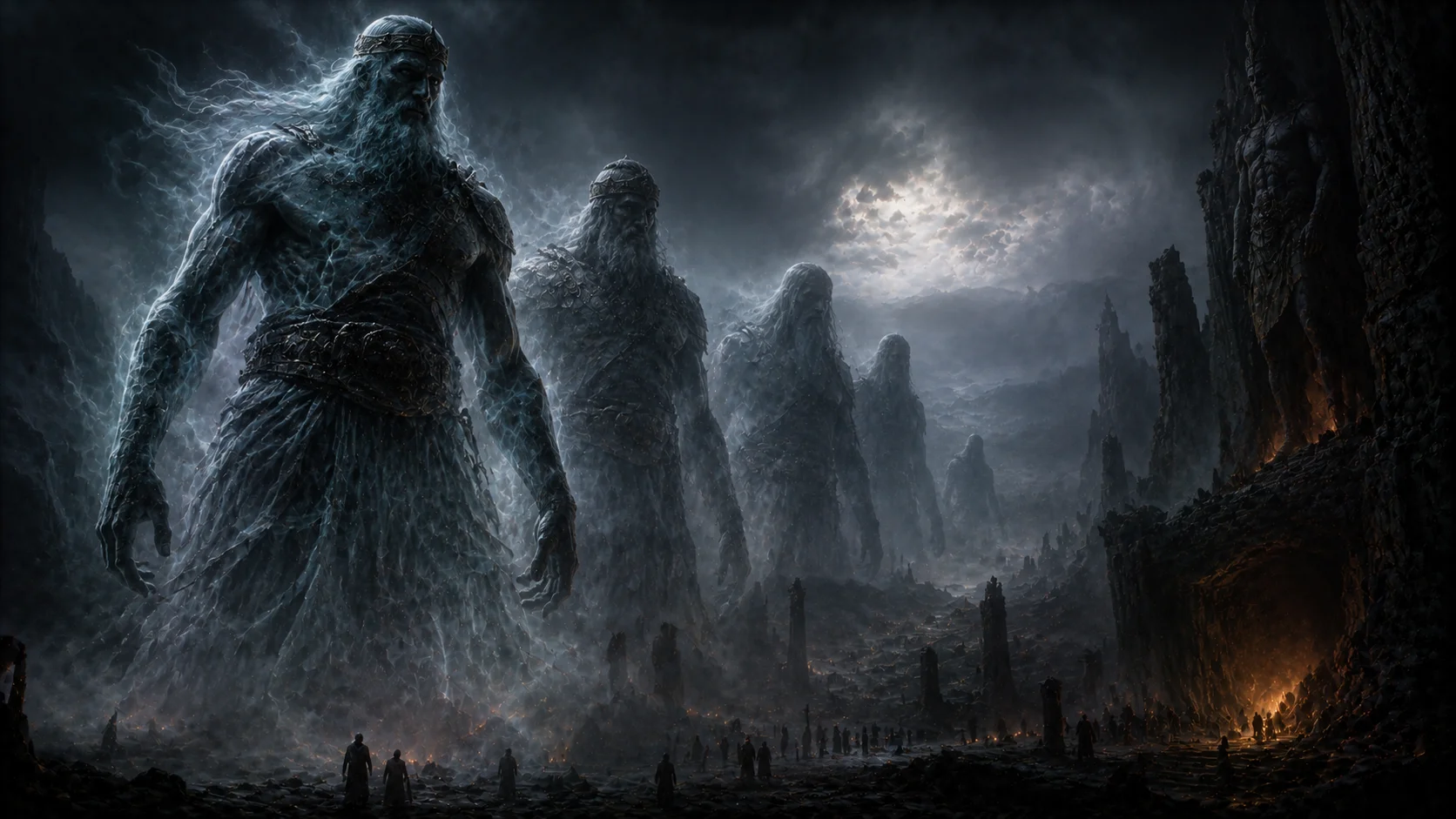
What sets Og apart from every other ruler Israel encountered in the wilderness narrative is a single genealogical note carried in Deuteronomy 3:11: "Og king of Bashan remained of the remnant of the Rephaim." The Rephaim appear elsewhere in the Hebrew Bible as a shadowy people of great stature, associated with the deep past of the land east of the Jordan, and by the time of Israel's approach they had, by this verse's own testimony, essentially disappeared. Og is described as what was left of them — not simply a large man, but the final survivor of an entire vanished lineage. This makes him one of the very few individual giants named and identified by lineage anywhere in the Torah, a distinction scripture does not extend casually.
The Iron Bed of Rabbah
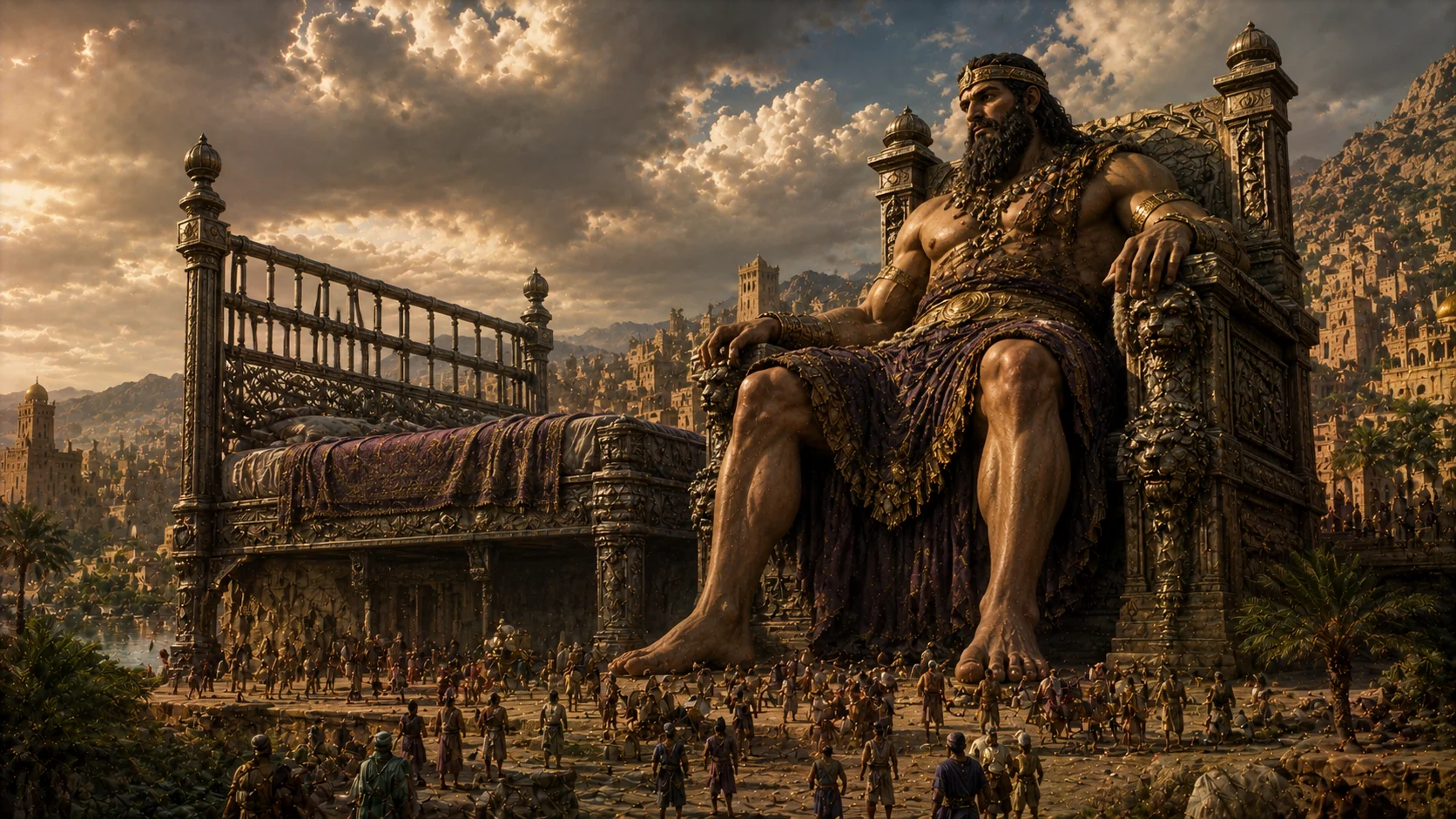
Deuteronomy 3:11 does something unusual for the Torah: it offers a physical, checkable proof of an extraordinary claim. Having stated that Og was of the Rephaim, the text continues, "Behold, his bedstead was a bedstead of iron; is it not in Rabbath of the children of Ammon? nine cubits was the length thereof, and four cubits the breadth of it, after the cubit of a man." By common reckoning this describes an object roughly thirteen feet long and six feet wide — the Hebrew word used, eres, can denote either a bed or a stone sarcophagus-like resting place, and scholars have long weighed both readings. Whichever it was, the verse points its audience to a specific, nameable place, the Ammonite city of Rabbah, modern-day Amman, where the object could apparently still be seen. It functions in the text as an invitation to verify rather than simply to believe — testimony offered in the form of an artifact rather than an assertion alone.
Edrei and the Battle That Was Not to Be Feared
Israel's encounter with Og came to a head at Edrei, one of his two capital cities. Numbers 21:33-35 and Deuteronomy 3:1-3 both recount the moment: Og and all his people marched out to meet Israel in open battle. Before the fighting began, God spoke directly to Moses with words of reassurance — Og was not to be feared, for he and his land and his people had already been given into Israel's hand, just as Sihon king of the Amorites had been before him. The battle that followed ended in total defeat for Bashan: Og was killed, his sons were killed, and his people were struck down until, in the text's own stark phrase, none remained alive. It is a decisive and complete victory, recorded without ambiguity, and it stands as the second of the two great Transjordanian conquests that opened the way to the Jordan crossing.
A Fear That Traveled Ahead of Israel
The defeat of Og did not stay a private memory within Israel's camp. In Joshua 2:10, Rahab of Jericho tells the Israelite spies that the news had already reached her city and unsettled it: the people of Jericho had heard how the LORD dried up the waters of the Red Sea before Israel, and what Israel had done "unto the two kings of the Amorites, that were on the other side Jordan, Sihon and Og," whom they had utterly destroyed. Joshua 9:10 shows the same memory surfacing again, this time among the Gibeonites, who invoke the fates of Sihon and Og as they negotiate for their lives. Og's downfall, in other words, functioned within the world of the text as reported history — a deterrent that preceded Israel's armies into Canaan and shaped how its inhabitants responded before a single battle was fought there.
Inheritance for the Half-Tribe of Manasseh
Conquest, in the Torah's telling, was never an end in itself but a prelude to settlement, and Og's land became someone's inheritance almost immediately. Numbers 32:33 and Deuteronomy 3:13 record that Moses gave the territory of Bashan — Og's former kingdom — to the half-tribe of Manasseh, joining Sihon's land, which went to Reuben and Gad, in Israel's first allotments east of the Jordan. Joshua 13:12 and 13:29-31 return to this allocation once the conquest of Canaan proper was underway, confirming and detailing the boundaries. The defeat of a single giant-king thus reached directly into the practical shape of Israel's tribal geography: real families, real herds, and real cities in Bashan were, from that point on, remembered as having once belonged to Og.
A Name Set Into Israel's Songs
Beyond the historical narrative, Og's defeat became something closer to liturgy. Psalm 135:10-12 and Psalm 136:17-20 both fold Og into hymns celebrating the power and steadfast love of God, naming him in the same breath as Sihon: "to him that smote great kings... Sihon king of the Amorites... and Og the king of Bashan... for his mercy endureth for ever," in the cadence of Psalm 136's refrain. Nehemiah 9:22 recalls the same pair of kingdoms while retelling Israel's history in a prayer of national confession, and Deuteronomy 29:7 has Moses himself refer back to the encounter as living memory within his own farewell address. Across these very different genres — victory narrative, temple hymn, penitential prayer, covenant renewal speech — Og's fall recurs as a fixed reference point, the paradigmatic case of divine strength overcoming an enemy too great for Israel to have defeated alone.
Paired with Sihon, Never Apart
Nowhere in scripture does Og appear entirely on his own. Every reference to his defeat sits beside a reference to Sihon, king of the Amorites, the ruler Israel had defeated just before reaching Bashan. The pairing is deliberate and consistent enough to function almost as a formula: two kings, two kingdoms, two total victories, remembered together as the double proof that opened Transjordan to Israel's settlement. Where Sihon represented the more conventional Amorite kingship Israel had already learned to overcome, Og represented something categorically rarer — the last of a giant people — and the two together, ordinary king and giant king both falling before the same advance, gave Israel's later memory a complete picture of the scale of what had been overcome on the way into the land.
The Sages Enlarge the Giant
Centuries after the Torah's own account, rabbinic tradition took up Og and expanded him past the edges of the biblical text into full legend. Sources such as the Talmud's tractate Berakhot 54b describe a figure of such staggering size that ordinary history could not contain him: he is said to have survived the deluge of Noah's flood entirely, some tellings placing him clinging to the outside of the ark or riding upon its very roof, fed through a hole cut for him as the waters rose. Other tellings push the scale of the final confrontation itself to mythic extremes, with Moses — himself described in these same traditions as a man of unusual height — striking at Og's heel or ankle with a weapon of matching length to bring him down. None of this belongs to the Torah's own text; it is explicitly later aggadic elaboration, the kind of expansive storytelling by which a tradition continues to turn a scriptural figure over in wonder long after the original account has closed. The distinction matters, and the tradition itself has generally kept it: the bedstead in Rabbah is scripture; the flood and the ankle are legend built upon it.
A Lifespan Reaching Back to Abraham
One further thread of rabbinic interpretation goes even further, proposing that Og was not simply ancient in origin but personally present at the very beginning of Israel's story. Certain midrashic sources identify Og with Eliezer, the trusted servant of Abraham, and further connect him to the unnamed man in Genesis 14:13 who escapes to bring Abram news that his kinsman Lot has been taken captive — a figure some traditions render as "Og who escaped," reading an etymological play into the episode. Taken together, this would place a single figure spanning from Abraham's own lifetime all the way to his death at the hands of Moses generations later, an interpretive leap openly acknowledged within Jewish tradition itself as a matter of genuine and unresolved dispute rather than settled teaching. It is best understood, like the flood legend beside it, as testimony to how vividly later generations continued to wonder about a figure the Torah introduces so briefly yet so memorably.
What the Text Leaves Standing
Strip away the later embellishment and what remains is still remarkable on its own terms: a named king, ruling a real and substantial territory, explicitly identified as the last of an entire people the text treats as otherwise vanished, defeated in a decisive battle that the following books of the Bible keep returning to as proof of what had been overcome. His iron bed, displayed for anyone to go and see in Rabbah, was scripture's own chosen evidence — a plain, physical thing left behind by someone the text insists was extraordinary in a way that could be measured. Bashan itself, once his, became home to the families of Manasseh. And in the recurring liturgical pairing of his name with Sihon's, across psalms and prayers composed long after the battle at Edrei, Og's fall was carried forward not as a single closed event but as a name Israel kept singing.
Sources & traditions
- EncyclopediaWikipedia — Og
- TraditionHebrew texts, grimoires and later commentary
Myths change from area to area and from time to time. This chronicle follows the most widely told versions; tellings in other villages, regions and eras may differ.