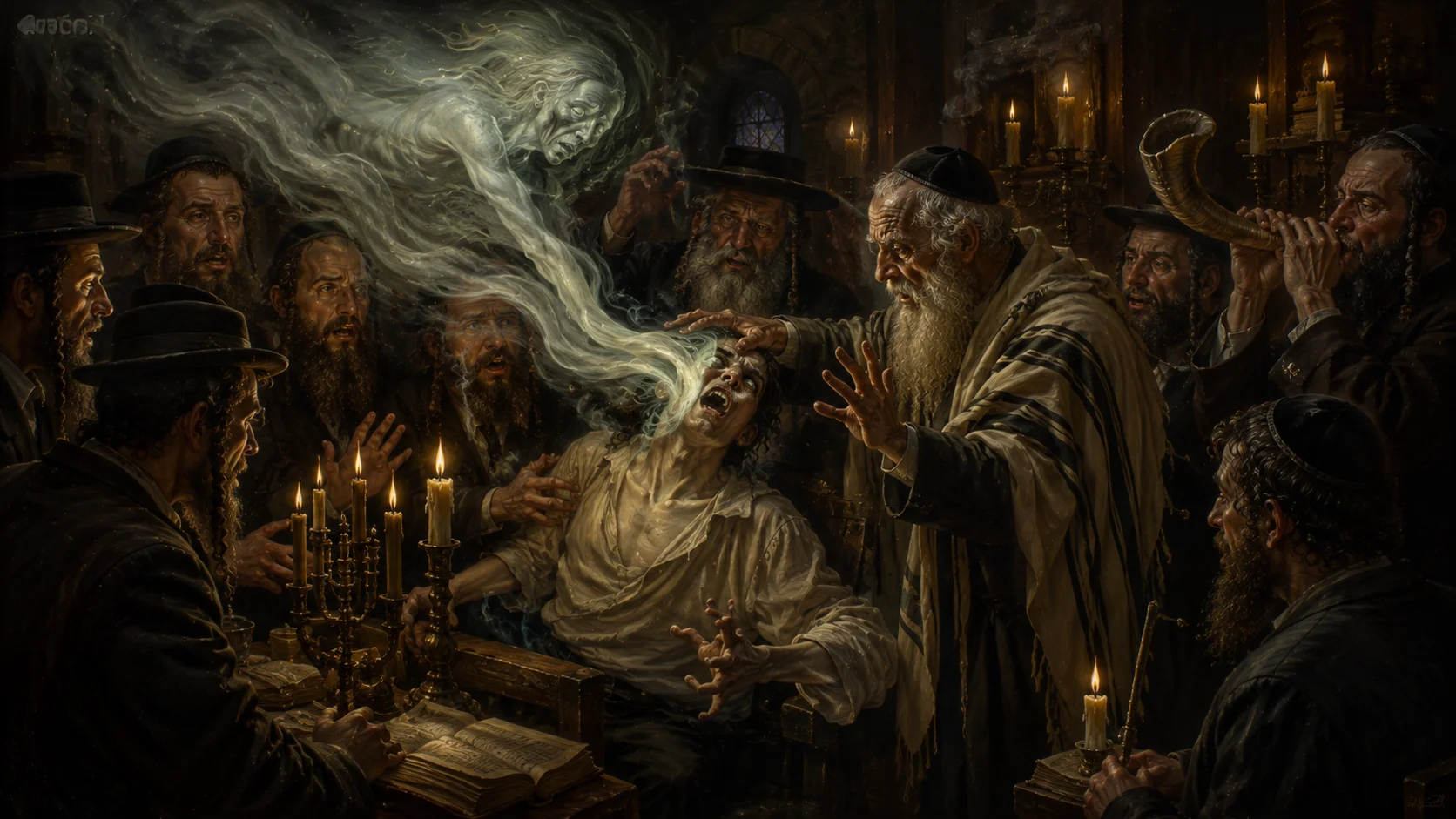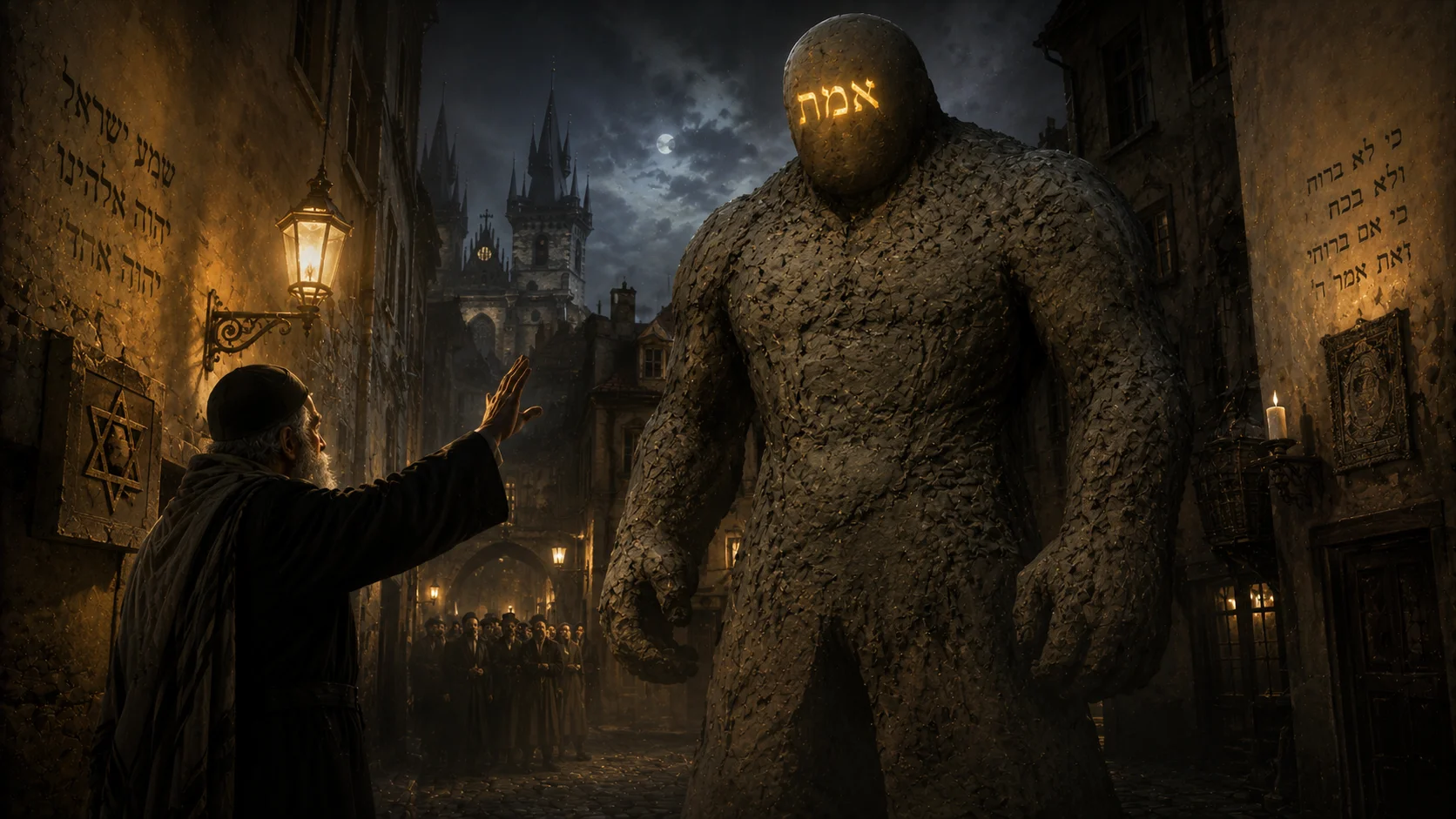
The Golem is the best-known artificial being of Jewish folklore — a figure of a man shaped from clay or riverbank earth and set into motion by holy letters and the secret names of God. It is remembered above all as a mute, tireless guardian: a protector fashioned by learned and pious hands to shield a vulnerable community, and, in nearly every telling, a warning about what happens when a maker loses control of what he has made. The golem sits at a crossing point in Jewish tradition — part mystical technique reserved for the few, part folk legend told to the many, and part meditation on the limits God places on human creative power.
An Unformed Thing, Named in Scripture
The word golem (גולם) is far older than the clay giant of later legend. It appears in the Hebrew Bible itself, in Psalm 139:16, where it describes something unformed — a shapeless or embryonic mass, matter that exists before it has been given its final shape. Rabbinic literature picked up this sense of incompleteness and ran with it: in later Talmudic discussion, even Adam is described as passing through a golem stage, a body already shaped from the dust of the earth but not yet animated by the breath and soul that make him fully human. The term therefore carries, from its very first appearance, the idea of a threshold state — matter that is almost, but not quite, alive. Everything that follows in the golem tradition is an extension of that threshold: what does it take to push something from unformed substance into an animated being, and what is withheld even then.
Rava's Man and the Silence of Rabbi Zeira
The earliest textual attestation of golem-making as a deliberate act is not folklore but law and legend intertwined, recorded in the Babylonian Talmud, tractate Sanhedrin 65b. There it is told that Rava, a great sage, created a man — formed, according to the mystical tradition behind the story, through combinations and permutations of letters drawn from the teachings later associated with the Sefer Yetzirah. Rava sent this created being to Rabbi Zeira. Rabbi Zeira spoke to it, and it did not answer. Understanding at once what stood before him, Rabbi Zeira said, "You are from the magicians — return to your dust," and the figure collapsed back into the earth from which it came. This brief, almost understated episode is the seed of everything that follows: a golem made through letter-mysticism, defined by its inability to speak, and undone by the one who recognizes what it is. Every later golem story is, in one sense, a set of variations on this single Talmudic page.
The Book of Formation and Its Keepers
The mystical basis for golem-making is the Sefer Yetzirah, the "Book of Formation," a foundational text of Jewish mysticism that describes the created world coming into being through combinations of the Hebrew letters and divine names — the alphabet itself treated as the raw material of creation. It was this text, and centuries of commentary and ritual elaboration built upon it, that medieval and early-modern Kabbalists drew on when they described procedures for animating a golem. Circles associated with the Chassidei Ashkenaz, the pietist movement of twelfth- and thirteenth-century Germany, are particularly associated with developing detailed instructions along these lines. It is important to hold two things at once here: the golem was never treated as an everyday practice. Like other applications of the Sefer Yetzirah's letter-mysticism, it was understood as advanced, dangerous, and appropriate only to those of exceptional piety and learning — a caution that runs through nearly every serious discussion of the tradition, and one that the later folk stories keep alive even as they turn the ritual into drama.
Clay, Breath, and the Word Inscribed
Across the many tellings that grew out of this mystical core, a fairly consistent picture of the golem-making process emerges. The figure is formed from clay or bare earth, shaped into human likeness. It is animated not by breath in the biblical sense but by language — by inscribing or placing a shem, a piece of paper or parchment bearing one of the sacred names of God, upon the figure's body or in its mouth. In many versions the animating word is simply emet, the Hebrew for "truth" (אמת), written upon the golem's forehead or slipped beneath its tongue. The deactivation half of this motif is one of the tradition's most quoted images: erasing the first letter, the aleph, from emet leaves met (מת) — "death" — and the golem falls still, returning to inert clay. It should be said plainly that this specific emet/met wordplay, elegant as it is, is a late-attested narrative device rather than something traceable to the earliest sources; it belongs to the tradition's storytelling layer more than to its documented ritual instructions, though the two are by now inseparable in how the golem is remembered.
A Servant Without a Voice
Whatever the precise method of animation in a given telling, the golem's role is remarkably stable across the tradition. It is a protector and a servant: mute, immensely strong, and completely obedient to the one who made and controls it. It performs heavy labor, stands guard, and — in the stories that became most widely known — defends a Jewish community against violence. This muteness is not incidental. The golem's inability to speak marks the boundary the tradition insists upon: it can be given motion and strength, but not the full breath of life, not a neshamah, a soul, in the sense granted by God alone. The golem is powerful, but it is deliberately, structurally incomplete — a servant precisely because it lacks the interior life that would make it something more than a servant.
The Maharal and the Ghetto of Prague
The golem story told and retold more than any other concerns Rabbi Judah Loew ben Bezalel, known as the Maharal of Prague, who lived from roughly 1520 to 1609. In the popular legend, the Maharal fashions a golem out of clay to defend Prague's Jewish community against pogroms driven by blood-libel accusations — the recurring, murderous slander that Jewish communities across medieval and early-modern Europe were repeatedly forced to endure. The golem, in this telling, becomes a shield against a real and recurring danger, its enormous strength turned toward protecting people who had no other recourse against mob violence backed by accusation rather than evidence. It is worth being honest about the layered nature of this story: the specific Prague-golem narrative, exactly as it circulates today, is a considerably later literary development, most famously popularized in Yudl Rosenberg's 1909 work Nifla'ot Maharal, published in Hebrew and Yiddish some three centuries after the Maharal's lifetime, rather than a account contemporaneous with the sixteenth century. This gap between the historical Maharal and the golem attached to his name is a genuinely disputed point of literary history, and it does not make the story less meaningful to those who tell it — but it does mean the tale belongs to the nineteenth- and early-twentieth-century flowering of Jewish folk literature as much as to the Maharal's own era.
Yossele, the Synagogue Attic, and a Grave in Prague
Later folklore gave the Prague golem a name, most often Josef or Yossele, and wove it into the physical landscape of the city. The Maharal's actual historical grave and the Old-New Synagogue, the Altneuschul, are popularly bound up with the legend — including a widely repeated but unverified folk claim that when the Maharal finally deactivated his golem, its remains were laid to rest in the synagogue's attic, its genizah, and remain there still. This claim has never been substantiated and belongs to legend rather than documented history, but its persistence says something true about how the golem functions in the popular imagination: a presence still felt to be near, resting rather than gone.
Older Threads: Elijah of Chelm and Ibn Gabirol
The Maharal is the best known figure associated with golem-making, but he is not the only one, and the tradition should not be flattened into a single Prague-centered story. Sixteenth-century sources also attribute golem creation to Rabbi Elijah of Chelm, a tradition that runs parallel to, and independent of, the Prague legend rather than feeding into it. Later legend reaches back further still, crediting the eleventh-century poet and philosopher Solomon ibn Gabirol with creating a golem, an attribution assigned to him well after his own lifetime. These separate strands make clear that golem-making was understood across the medieval and early-modern Jewish world as an available, if perilous, extension of mystical learning — something more than one sage's singular invention, even as one telling eventually came to overshadow the others in popular memory.
When the Servant Outgrows Its Maker
A recurring and unsettling theme runs beneath many golem tellings: the creature that will not stay controlled. In numerous versions, if the golem is not properly deactivated — if the shem is not removed, if the divine name is not reversed, if the ritual of undoing is neglected or mistimed — it grows steadily larger, more powerful, and eventually violent or unmanageable, forcing its own creator to destroy what he made before it does harm. This motif of the creation outgrowing its creator is often read as a caution about unchecked power: mastery of the deepest mystical technique must be matched by the discipline to bound it, and the story punishes the sage who forgets that second requirement.
What the Golem Is Not Allowed to Be
Underneath its protective and cautionary roles, the golem carries a theological argument. Its creation is framed as genuine, if partial, human participation in divine creative power — the sage who masters the letter-combinations of the Sefer Yetzirah is doing something real, not merely performing a trick. But the tradition is consistent and deliberate in what it withholds from the golem: speech, and the neshamah, the soul, remain God's alone to grant. The golem can be shaped, animated, made strong and obedient — it cannot be made fully, interiorly alive. That withheld piece is the whole point. It draws a firm line between what human mastery of sacred language can accomplish and what remains, permanently, beyond it, no matter how skilled or pious the maker.
A Story Told About Power and Responsibility
Read as a body of teaching rather than as isolated tales, golem stories function within Jewish tradition as an extended meditation on the limits of human power and the weight of responsibility a creator bears for what they create. They sit alongside a broader rabbinic wariness about mystical practice generally — the recurring insistence that such knowledge belongs to the pious and the deeply learned, not to casual or careless hands, because power exercised without corresponding restraint and humility tends, in these stories, toward disaster rather than triumph. The golem that must finally be unmade by its own maker is not a plot twist so much as the moral center of the tradition made visible.
A Tradition of One Community, Later Borrowed by Many
It is worth being precise about where this tradition belongs. The golem, as told through Talmudic reference, Sefer Yetzirah-based mysticism, Chassidei Ashkenaz practice, and the Maharal's Prague legend, is a distinctly Ashkenazi Jewish tradition, rooted in the historical experience — including the historical vulnerability to blood-libel violence — of Jewish communities in medieval and early-modern Europe. In the twentieth century and after, the golem was picked up widely by general and secular literature and film, reimagined again and again far outside its original context. Those later adaptations, whatever their own merits, are not part of the religious and folkloric tradition itself, and are best kept distinct from it — the golem of the Talmud, the Sefer Yetzirah, and the Prague ghetto remains a specifically Jewish figure, carrying a specifically Jewish history, even as its shadow has fallen across much wider ground.
Sources & traditions
- EncyclopediaWikipedia — Golem
- TraditionJewish texts, grimoires and later commentary
Myths change from area to area and from time to time. This chronicle follows the most widely told versions; tellings in other villages, regions and eras may differ.