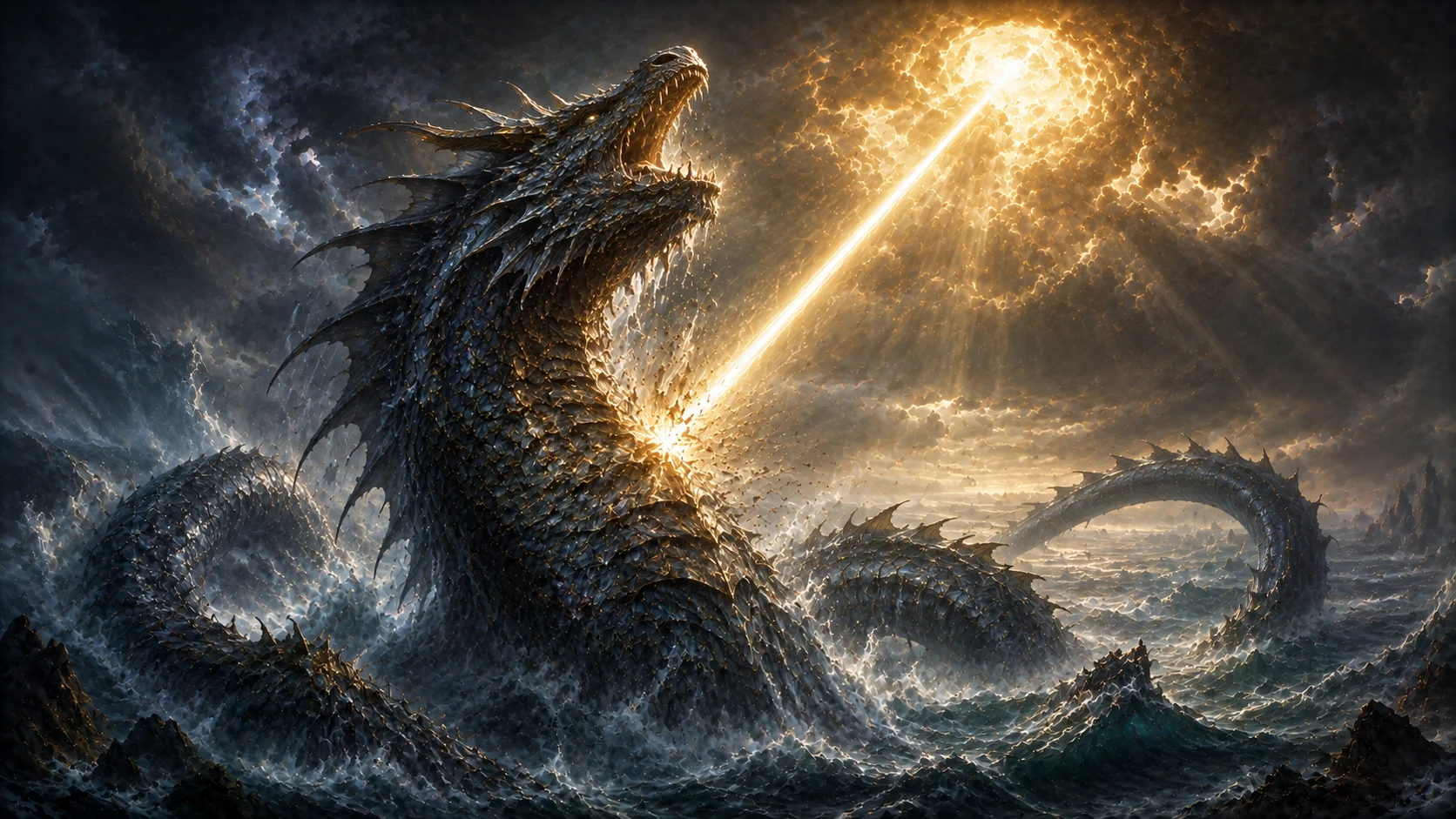
Rahab is the primordial sea-dragon of Hebrew tradition — a monster of the deep and a personification of the raging chaos-waters, whom God subdued at the dawn of creation. Closely allied in nature with Leviathan, Rahab stands for the proud, turbulent sea and the rebellious chaos that the divine power crushed to bring forth an ordered world. (This Rahab, the chaos-monster, is wholly distinct from the human woman of Jericho who bears the same name.)
The Crushed Monster of the Sea
The Hebrew scriptures recall, in their oldest poetic strata, a primeval combat in which God conquered the chaos-dragon at creation. “You rule the raging of the sea; when its waves rise, you still them. You crushed Rahab like a carcass; you scattered your enemies with your mighty arm.” And again in Job: “By his power he stilled the sea; by his understanding he shattered Rahab.” Rahab is the embodiment of the hostile deep, the watery chaos that resisted the order of creation and was broken by the Creator’s strength.
Pride and Tumult
The name Rahab carries the sense of “arrogance,” “storming,” or “tumult” — the very nature of the proud, surging sea. The monster thus personifies not only the physical ocean but the principle of insolent rebellion against the divine order. In this Rahab belongs to the great Near Eastern tradition of the chaos-battle, the conflict between the creator-god and the dragon of the primeval waters, a struggle echoed in the stilling of the sea and the binding of Leviathan.
The Name of Egypt
Rahab took on a further, symbolic life in Hebrew prophecy. Because Egypt lay across the sea and was the great oppressor crushed at the Exodus, the prophets gave Egypt the poetic name Rahab — the proud sea-monster humbled by God. “Was it not you who cut Rahab in pieces, who pierced the dragon?” asks Isaiah, fusing the primeval chaos-combat with the deliverance at the Red Sea. So Rahab became at once the mythic dragon of creation and a figure of every proud power that sets itself against heaven and is brought low. In Rahab, Hebrew tradition preserved the deep memory of the chaos-monster — the storming sea given a name, a pride, and a fall.
The Storm-God and the Sea: Rahab Among Its Near Eastern Kin
Long before Israel had a temple, the peoples around it were already telling a version of this story. At Ugarit, on the Syrian coast, scribes preserved a cycle of myths in which the storm-god Baal fights Yam — whose double title, “Prince Sea, Judge River,” names him as the sea and the flooding river both. Yam sends messengers into the divine assembly to demand that Baal be bound and handed over as tribute; Baal instead has the craftsman-god Kothar-wa-Hasis forge him two clubs. The first glances off. The second strikes Yam between the eyes and brings him down to the ground. Further east, in Babylon, the epic Enuma Elish tells how Marduk faces Tiamat, the salt-water deep from which the gods themselves first emerged, kills her, and splits her carcass like a shellfish, setting half of her up as the sky.
The pattern has a scholarly name — Chaoskampf, the “combat with chaos” — and what is most telling about Rahab is how much of that pattern the Hebrew poets left out. There is no messenger scene, no council of gods deciding whether to fight, no rival deity with a name and a will of his own. Rahab is never granted the dignity of an opponent. It is simply crushed, in the same breath as the clearing of the heavens and the piercing of the fleeing serpent, one more act of ordinary divine housekeeping. The absence is the point: where Baal must fight for his kingship, and Marduk must be proclaimed king by the assembly of the gods before he dares face Tiamat, Yahweh does not negotiate with the sea. He steps on it.
The Helpers of Rahab
One verse hints that Rahab did not fall alone. Answering Bildad, Job says that God “will not turn back his anger,” and that beneath him “bowed the helpers of Rahab” — a fleeting, unexplained reference to a retinue, a cohort of lesser chaos-beings brought low alongside their master. The text never names them or tells their story; they exist only as a shadow cast by a grander one. But the detail matches a pattern found across the region’s mythology, where the sea does not fight alone. Tiamat goes into her final battle with eleven monstrous allies bred for the purpose — a scorpion-man, horned serpents, a rabid dog, a bull-man, a fish-man — and Yam, in the Ugaritic texts, is served by messengers of his own. Rahab’s “helpers” are the faint Israelite trace of the same idea: chaos as a court rather than a lone monster, with underlings who share their sovereign’s fate.
Sar shel Yam: The Prince of the Sea in Rabbinic Legend
The rabbis were not content to leave Rahab in the poets’ hands. In tractate Bava Batra of the Babylonian Talmud, Rav Yehuda relates in the name of Rav that when God set out to create the world he ordered the minister of the sea (sar shel yam) to open his mouth and swallow all the waters of the world, so that there would be room for dry land. The minister refused — it was enough, he said, that he should remain within his own waters — and God struck him dead on the spot. The proof-text offered is the line from Job about God stilling the sea by his power and shattering Rahab by his understanding, and Rabbi Yitzhak then draws the conclusion the whole story was built to reach: the name of the minister of the sea is Rahab. He adds a detail no poet had thought to supply — that were the waters of the sea not covering the corpse, no creature could endure its stench.
It is a striking transformation. The half-glimpsed chaos-dragon of the Psalms and Job becomes, in rabbinic hands, something closer to a disobedient courtier, folded into the vast angelology of later Judaism, where wind and star and sea each have a governing prince who exists to carry out the will of the one God. The myth does not vanish under monotheism; it is re-staffed. Rahab keeps its name, its death, and its association with the sea, but it is no longer chaos itself — it is chaos with a job description, killed not for being monstrous but for insubordination.
Rahab Among the Nations
Not every biblical use of the name is a crushing. One line in the Psalter reads almost like an act of amnesty: God is pictured writing down the nations who will one day be reckoned as born in Zion, and Rahab is named in that roll call alongside Babylon, Philistia, Tyre, and Cush. Rahab here is Egypt, as in the prophets — but the old oppressor is entered on the register as a citizen rather than a casualty, listed among the peoples who know God rather than among the powers he has broken. It is a small line, easy to miss, and it shows how supple the symbol had become by the time the Psalms were gathered. One name could carry the chaos-dragon of creation, the empire humbled at the sea, and a future citizen of the holy city, all without contradiction — because in every case the point was the same: whatever stands against God’s order will, one way or another, end up inside it.
Why Israel Feared the Sea
None of this makes sense without remembering what the sea actually meant to the people telling these stories. Israel was never a maritime nation. Its heartland was hill country and highland farmland; its neighbours built the ships and ran the harbours. To an inland, agrarian people the Mediterranean was not a road but a wall — unmapped, unfarmable, the direction from which nothing good arrived. In the older layers of Hebrew cosmology the deep, tehom, is not scenery but the formless water that was there before the world had any shape at all; and it is the fountains of that same deep that burst open in the flood story to unmake creation a second time. To say that God had already beaten this thing at the very start — had already stood on the neck of everything unformed, hostile, and drowning — was not idle poetry. It was reassurance in the plainest sense: whatever chaos still presses in, natural or political, flood or empire, it presses against a wall that has already been broken once. That is the real work Rahab does in Hebrew tradition. It is not kept around to frighten anyone. It is kept around so that its defeat can be remembered every time the world feels as though it might come undone again.
Sources & traditions
- EncyclopediaWikipedia — Rahab
- TraditionHebrew texts, grimoires and later commentary
Myths change from area to area and from time to time. This chronicle follows the most widely told versions; tellings in other villages, regions and eras may differ.