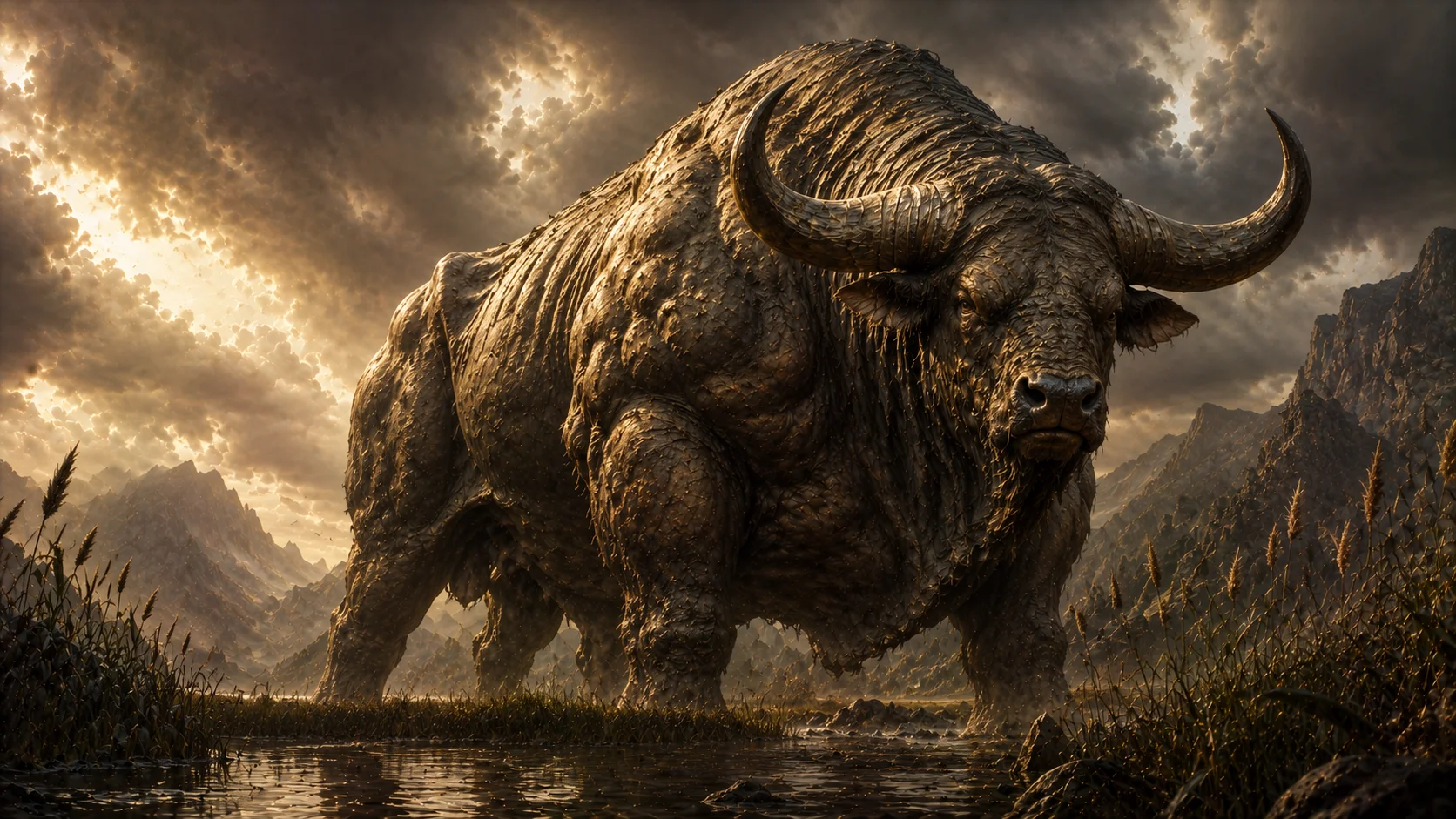
Behemoth is the great primordial land-beast of Hebrew tradition, the colossal counterpart of the sea-dragon Leviathan, an unstoppable monster of the dry earth whose strength is in his loins and whose power is beyond any creature's mastery save God's. He embodies the untamable might of the land as Leviathan embodies that of the sea. Named explicitly in scripture only once, in the twinned climax of God's answer to Job, Behemoth has nonetheless grown across centuries of Jewish reflection into one of the most enduring images of creation's scale and of the humility owed by any creature, human included, before its Maker.
Out of the Whirlwind
Behemoth's sole biblical appearance comes in Job 40:15-24, within God's second speech to Job spoken out of the whirlwind. Job has spent the book demanding an accounting from God, insisting that his suffering be explained in the terms of human justice. God's answer does not take that form. Instead, across two long speeches, God walks Job through the wild grandeur of creation — the stars, the sea, the wild ass, the ostrich, the war-horse — and then, as if reserving the greatest wonders for last, turns to two creatures no human hand can touch: Behemoth of the land, and, in the chapter immediately following, Leviathan of the sea. The two are paired at the very center of the divine speech, a deliberate escalation: after Behemoth's fearsome bulk, only Leviathan is fiercer still.
Behold Now Behemoth
God's introduction is direct and commanding: "Behold now Behemoth, which I made with thee." The Hebrew phrase, traditionally read as "as I made you," casts Behemoth not as an alien monster but as a fellow creature of the same sixth day of creation that produced humankind — a kinship of origin, even as the two could not be less alike in strength. The name itself, בְּהֵמוֹת (behemot), is the plural form of behemah, "beast" or "cattle," an intensive plural suggesting not many beasts but one beast so vast it exhausts the ordinary word for animal. Job 40:15 continues with an almost domestic detail amid all this grandeur: Behemoth "eats grass like an ox," a creature of tremendous power whose diet is nonetheless the humblest of any beast's.
Sinew, Bronze, and Cedar
The description that follows is built entirely from images of unbreakable strength. His power is in his loins, his force in the muscles of his belly (40:16). His tail moves "like a cedar" (40:17), a phrase that has puzzled and fascinated interpreters for centuries, since no ordinary animal's tail resembles a cedar tree — one of the details most often cited by those who read Behemoth as more than a literal creature. His sinews are like tightly wound cords, his bones like tubes of bronze, his limbs like bars of iron (40:17-18). Every image reaches for metal and timber rather than flesh, as though ordinary animal anatomy cannot hold the comparison: this is a creature built, in the poetry's own logic, out of the same materials as fortifications and temple pillars.
First of the Ways of God
At the center of the passage sits a phrase that later readers would treat with enormous weight: Job 40:19 calls Behemoth "the chief of the ways of God" — reshit darkei El, the first or foremost of God's works. In the architecture of the divine speeches this functions as a superlative, marking Behemoth as the pinnacle example among land creatures of what divine power can bring into being. But in later Jewish exegesis the phrase took on a more literal cast, read as placing Behemoth first in the very order of primeval creation, before every other living thing — a beast that stood at the beginning of the world's population by living things, before the world had learned to hold anything smaller.
A Sword No Hand Can Wield
The same verse continues with a statement of absolute limit: "only its Maker can approach it with the sword." Most interpreters have read this as meaning precisely what it says — that Behemoth cannot be subdued, hunted, or slain by any created being, only by God who made him. This is the exact note struck again, more elaborately, of Leviathan in the following chapter: two creatures held up to Job as living proof that human strength has a ceiling, and that the ceiling is set by the same hand that set the boundaries of the sea and the paths of the stars. Job had asked for justice measured on a human scale; God answers by showing him creatures that no human scale can measure at all.
Unafraid Though the Jordan Rage
The passage closes with a scene of total repose amid what would unsettle any lesser creature. Behemoth lies beneath the lotus plants, hidden among the reeds and marsh (40:21), sheltered by the very shade of the riverbank rather than menaced by it. Though the Jordan itself should rush against his mouth in flood, he is not alarmed (40:23) — he could, the text implies, swallow a river and remain unmoved. It is an image of perfect, unbothered mastery over an element — flowing water — that terrifies and destroys human settlements, rendered here as no more than Behemoth's shaded resting place.
Land and Sea Held Apart
Behemoth's role in Job is to stand at the head of a pair, and later Jewish literature took up that pairing and gave it its own narrative. The Book of Parables within 1 Enoch (60:7-9), a distinct and later section of that composite work, names Behemoth explicitly as male, dwelling in an invisible desert called Dendayn east of Eden, while the female Leviathan dwells in the depths of the sea's abyss. The two are kept apart, this tradition explains, because the sea itself could not hold them both — an image of restraint built into creation from the start, the world arranged from its earliest days to keep these two immensities from ever meeting on equal ground.
Reserved from the Beginning of the World
Two further Jewish apocryphal works from roughly the same era develop this separation into something closer to a promise. Fourth Ezra (also called 2 Esdras), a Jewish work of the first century CE, states in 6:49-52 that God created Behemoth and Leviathan on the fifth day of creation and kept them apart from the very start — one confined to dry land, one to the sea — because the world could not sustain the two together. Crucially, this same passage adds that both creatures are reserved, set aside from creation's earliest hours, to become food at the great banquet of the righteous in the age to come. Second Baruch, the Syriac Apocalypse of Baruch, echoes the same claim in 29:4: Behemoth and Leviathan, kept apart since the world's beginning, await the messianic age as sustenance for those found righteous enough to see it.
The Feast of the World to Come
It is the rabbinic tradition of the Babylonian Talmud that gives this promise its most developed telling. In tractate Bava Batra 74b-75a, the sages describe a climactic combat or slaughter at the end of days — Behemoth and Leviathan brought together at last, by God's hand or against one another — that yields the great feast prepared for the righteous in the World to Come. This same Talmudic passage is the primary root of the widely told image of Leviathan's skin fashioned afterward into a canopy or sukkah sheltering the redeemed, an image that has passed well beyond the Talmud itself into the wider imagination of later Jewish storytelling and art.
Grazing a Thousand Mountains
Midrashic tradition magnified Behemoth's scale still further, describing him as feeding daily upon a thousand mountains, their combined yield barely sufficient for a single day's meal — an image that echoes, though does not directly quote, the psalmist's declaration in Psalm 50:10 of cattle upon a thousand hills, that verse itself never naming Behemoth outright. In some strands of this aggadic tradition, Behemoth is set alongside Leviathan the sea-monarch and Ziz the great bird of the sky as a triad of primordial sovereigns, one ruling each realm of creation — land, sea, and air. This threefold grouping, however, is a later systematization built up across midrashic literature rather than a claim made in any single source, and it should be understood as a later layer of interpretation rather than part of the original biblical or apocryphal material.
Sung Still on Shavuot
The motif's vitality did not end with the Talmud. The medieval Aramaic liturgical poem Akdamut, recited in Ashkenazi communities on the festival of Shavuot, invokes the future battle and feast of Leviathan and Behemoth — sometimes named alongside the wild ox, the Reem — as part of its vision of the world's redemption. Composed around the eleventh century, Akdamut stands as a later, post-Talmudic elaboration of the same enduring hope: that the untamable beasts God alone could approach at the world's beginning will, at the world's end, become the sign and substance of its restoration.
A Question Left Open
Behind all of this stands a genuine and long-unresolved question of interpretation: is Behemoth drawn from a real animal observed and then magnified by poetry, or is he a wholly mythic, cosmic figure? Modern scholarship has most often proposed the hippopotamus as the likely referent behind the poem's images, with the elephant and the water-buffalo offered as alternatives, while other readers — ancient and modern alike — have argued that a creature whose tail moves like a cedar and whose bones are tubes of bronze was never meant as a portrait of any living species at all. Some scholars additionally trace the combative language surrounding untamable primeval beasts back to older poetic traditions of God subduing chaos monsters, as in Psalm 74:13-14's shattering of the taninim's heads, or Isaiah 27:1's vision of Leviathan the fleeing, twisting serpent — though these remain distinct textual occurrences, not direct citations of Behemoth himself, and the question of how closely they relate to Job's beast remains open rather than settled.
The Land's Monster-King
Across scripture, apocryphal vision, and rabbinic elaboration, Behemoth remains constant in one respect: he is the measure by which creation itself declares its own vastness. He was made, tradition says, first among the works of God, of iron and bronze and unbending sinew, unafraid before the flooding Jordan, approachable by no sword but his Maker's own. Set apart from Leviathan since the world's first days so that no single realm might hold them both, he waits still, in the hope handed down through the centuries, for the feast that will mark the world's final redemption — the land's own monster-king, mightiest of the beasts of the earth, and a standing reminder that some things in creation answer to God alone.
Sources & traditions
- EncyclopediaWikipedia — Behemoth
- TraditionHebrew texts, grimoires and later commentary
Myths change from area to area and from time to time. This chronicle follows the most widely told versions; tellings in other villages, regions and eras may differ.