Abaddon — whose name means “Destruction” or “Place of Ruin” — is one of the most ominous figures in Hebrew tradition: at once a name for the abyss of the dead and the personified angel of destruction who rules it. He embodies the devouring, bottomless quality of perdition itself, the deep that swallows all things.
The Place of Destruction
In the Hebrew scriptures, Abaddon appears first not as a being but as a place — a poetic name for the realm of the dead, the deepest pit of Sheol, the bottomless ruin from which there is no return. “Sheol and Abaddon are never satisfied,” says the book of Proverbs, pairing it with the grave as an insatiable devourer. It is the abyss of oblivion, the lowest deep, the destruction that lies beneath the world of the living.
The Angel of the Abyss
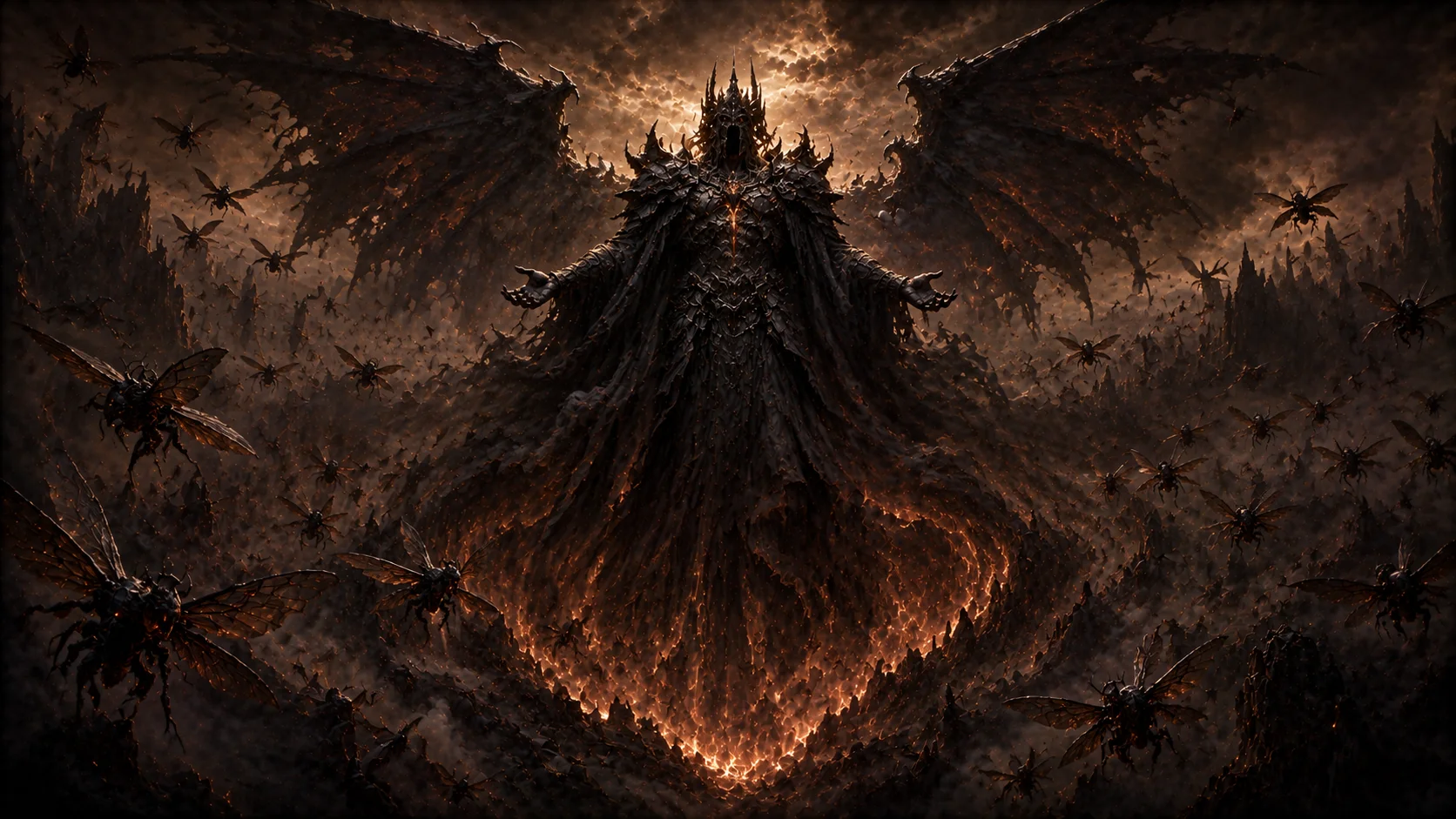
In the apocalyptic imagination this place of ruin takes on a personal form. In the Book of Revelation, Abaddon is named as the king of the bottomless pit and the angel of the abyss — “they had as king over them the angel of the bottomless pit, whose name in Hebrew is Abaddon, and in Greek, Apollyon” (the Destroyer). He commands the monstrous locust-host loosed from the abyss in the last days, a captain of torment unleashed at the sounding of the fifth trumpet. Here Abaddon is no mere location but a dread sovereign of destruction.
Destroyer or Avenging Angel
Tradition has read Abaddon in two ways. To some he is a demon, a prince of the underworld and an agent of the powers of darkness, akin to the fallen Watchers like Semyaza. To others he is a fearsome but obedient angel of God — the divine destroyer who executes the wrath of heaven upon the wicked, the personification of the destroying judgment that God himself commands. In either reading, Abaddon is the face of annihilation: the angel-king of the abyss, ruler of the place where all things are unmade, and herald of the ruin reserved for the last days.
The Voice from the Pit: Abaddon in Job
Before Revelation gave the abyss a king, the poets of the Hebrew Bible had already given it something stranger: a mind. In the Book of Job, Abaddon is not merely a synonym for the grave but a listening presence, paired again and again with Sheol and with Death itself as beings who know. “Sheol is naked before God, and Abaddon has no covering,” Job’s poet writes — the abyss stripped bare under a gaze it cannot escape. Elsewhere in the same book, wisdom is said to be hidden from every living thing, so hidden that even Abaddon and Death can only say, “We have heard a rumour of it with our ears.” It is a startling image: the place of ultimate ruin straining to overhear a secret it will never possess. Centuries before Revelation dressed Abaddon in armour and gave him an army, Job had already made him a character — a listener at the edge of a knowledge that forever eludes him.
An Ear Trained on Greek: Why Apollyon?
Revelation gives the name twice over, first in Hebrew and then in Greek, which reads as a simple act of translation — but the Greek word chosen was not a neutral one. Apollyon is a participle meaning “destroying,” and so “the Destroyer”: a fair rendering of the Hebrew sense, yet it stands a single letter from Apollon, the Greek name of Apollo. Readers ancient and modern have found the resemblance hard to take as accident. Apollo was a god of plague as well as of light — the deity who opens the Iliad by loosing arrows of pestilence on the Greek camp — and at Athens he was honoured under the epithet Parnopios, “of the locusts,” a title the traveller Pausanias explains by a tradition that the god had once driven a locust plague out of the land. He was also the deity Augustus had taken as his personal patron, and imperial art and temple-building had said so loudly. A text written under Roman rule, describing a monstrous swarm loosed from the abyss under a king whose Greek name echoes that god, reads less like coincidence than like a barb carefully aimed: the true destroyer is not the emperor’s patron but the abyss-king who answers to no empire at all.
The Locusts With Human Faces
Scripture does not leave Abaddon’s army to the imagination. When the fifth angel sounds his trumpet, a star already fallen from heaven receives the key to the shaft of the abyss, and smoke pours up “as the smoke of a great furnace,” darkening the sun. Out of that smoke come the locusts, described with the obsessive, nightmarish precision of a fever dream: bodies like horses armoured for battle, something like crowns of gold, faces like human faces, hair like the hair of women, teeth like the teeth of lions, breastplates like iron, wings that roar like chariots racing into war, and tails that end in a scorpion’s sting. They are forbidden to touch the grass or any green thing — the ordinary business of locusts — and forbidden to kill; their commission for five months is to torment, not to end, so that in those days “people will seek death and will not find it.” What the abyss releases, in other words, is not a plague of starvation. It is a plague of suffering with no exit.
The Devouring Throat: A Canaanite Undertow
The Hebrew Bible’s habit of speaking about death as an appetite did not appear from nowhere. Older Canaanite tradition, preserved in the tablets recovered at Ugarit, knew a god of death named Mot, whose gullet is described as reaching from the earth to the heavens and on to the stars, and who swallows the storm-god Baal himself — a maw that devours whatever life sends into it. Biblical poetry keeps faint traces of the same picture: Isaiah says that Sheol has widened its throat and opened its mouth without limit, an image of the grave less as a place one enters than as a hunger one is consumed by. Abaddon inherits that appetite. When Proverbs pairs Sheol and Abaddon as things never satisfied, the phrase is not describing an empty room waiting to be filled but a mouth that cannot be — the same devouring underworld that haunted Israel’s neighbours, stripped of its old god’s name and keeping only his hunger.
A Room in the House of the Dead
Later Jewish tradition did not leave Abaddon as a single, undifferentiated abyss. A well-known passage of the Babylonian Talmud, in tractate Eruvin, gathers seven scriptural names for the realm of punishment — Sheol and Abaddon among them — each anchored in a different verse. Later midrashic writing took that list of names and turned it into a floor plan, imagining the underworld as a stack of chambers or descending depths, one beneath the other, with a different severity of punishment in each. In that reading Abaddon becomes something closer to a district of the afterlife than a title for the whole of it: a named ward inside a larger structure rather than the structure itself. It is a quieter, more architectural vision than Revelation’s armoured king — less a ruler to be feared than an address one hopes never to be assigned.
Apollyon on the Road: The Afterlife of a Name
Abaddon’s Greek face proved to have more staying power in the popular imagination than his Hebrew one. In John Bunyan’s The Pilgrim’s Progress, first published in 1678, the pilgrim Christian is waylaid in the Valley of Humiliation by a monster named Apollyon — scaled like a fish, winged like a dragon, breathing fire and smoke, and furious that Christian has abandoned his service for another king. Bunyan writes that the combat lasted “above half a day,” fought hand to hand until Christian’s sword finds its mark, and generations of illustrated editions have made the scene one of the book’s most familiar images. It fixed Abaddon’s Greek name, rather than his abyss-king title, as a byword for the enemy who meets the faithful in person instead of sending an army. The name has kept travelling since: in modern fiction, comics and games it recurs as shorthand for an apocalyptic, unstoppable destroyer — almost always stripped of Job’s quieter, listening abyss and kept only as pure, weaponised ruin.
Why Destruction Needed a Name
It would have been enough for Hebrew tradition to say that the wicked perish, that graves swallow the dead, that ruin comes to what deserves it. Instead, across centuries of writing, that ruin kept acquiring a face: first a place that listens, then an abyss with a lock and a key, then a king with an army and a title in two languages. The pattern says something less about theology than about how people cope with catastrophe — it is easier to fear, to resist, or one day to defeat a destroyer than to fear destruction itself, which has no throat to strike at and no name to curse. Abaddon exists because “everything ends” is a sentence almost no one can sit with unadorned. Give ruin a king, and there is, at least in principle, someone on the throne.
Sources & traditions
- EncyclopediaWikipedia — Abaddon
- TraditionHebrew texts, grimoires and later commentary
Myths change from area to area and from time to time. This chronicle follows the most widely told versions; tellings in other villages, regions and eras may differ.