Open the letter to the Ephesians at its sixth chapter and you meet a phrase that unsettles more than it explains: the struggle is not against flesh and blood, Paul writes, but "against principalities, against powers, against the rulers of the darkness of this world, against spiritual wickedness in high places." He never stops to define the terms. He does not say how many ranks there are, or where one ends and the next begins. He simply names them, in passing, as if his readers already knew — and then moves on. Centuries later, other hands would take that list and try to build a ladder out of it. One rung of that ladder is called, in Greek, the exousiai. In Latin, the potestates. In English, simply: the Powers.
A Word That Names a Fight
The word itself survives only because Paul used it, more than once, in company with other words of rank. Ephesians 1:21 places "power" alongside "principality," "virtue," and "dominion" among the things Christ is exalted above. Colossians 1:16 lists "thrones, or dominations, or principalities, or powers" among what was created through him. Ephesians 6:12 turns the same vocabulary toward conflict — "spiritual wickedness in high places" — and it is this verse, more than the others, that gives the Powers their later reputation as a rank at war.
What Paul did not do is build a system. He gives clusters of terms, not a numbered hierarchy, and nowhere does he say there are exactly nine ranks of angel or that "powers" occupies a fixed seat among them. The famous ninefold order — the one that puts Powers sixth, between Virtues and Principalities — is a later synthesis, assembled by theologians trying to make Paul's scattered words cohere into an architecture. The Powers, in other words, begin as a phrase before they become an office.
Exousiai and Potestates: A Name Borrowed Twice
The Greek term is exousiai, meaning authority or jurisdiction — the right to act, not merely the strength to. The Latin translators of the Vulgate rendered it potestates, and it is that Latin word which gives the choir its most common English name, "Powers." A second Greek word moves in the same orbit: dynameis, "forces" or "mighty works," which the Vulgate renders virtutes — the Virtues, a separate and neighbouring choir. The two names sound almost interchangeable in translation, and that resemblance has caused a great deal of quiet confusion ever since: writers summarising the angelic ranks sometimes swap "Powers" and "Virtues" as though they were the same office wearing two coats. They are not. They are adjacent choirs with distinct functions, bound together mostly by how easily their Latin names get tangled on the page.
A further name sometimes attached to this choir is "Authorities," which is really no more than the plain English translation of exousiai restated. "Potentates" also turns up in some modern summaries as a synonym, but the word does not appear as a technical term in the Greek text or the Vulgate's Latin for this rank — a popularisation, not a patristic title.
The Middle Rank of a Nine-Fold Order
The systematic version of the hierarchy — the one most often cited today — comes from a work called the Celestial Hierarchy, written in Greek sometime in the fifth or sixth century by an author known to history as Pseudo-Dionysius the Areopagite. In that text the nine ranks of angel are arranged in three groups of three. The first triad — Seraphim, Cherubim, Thrones — stands closest to the divine light. The third triad — Principalities, Archangels, Angels — stands closest to humanity. Between them sits the second, middle triad: Dominions, Virtues, and Powers, ranked fourth, fifth, and sixth. This middle group receives illumination passed down from the first triad and, in turn, transmits divine order downward to the third. The Powers, sixth overall, are the lowest-ranking member of that middle triad, standing directly above the Principalities.
Later theologians tried to give this middle triad a job description. The medieval scholar Bonaventure summarised the nine choirs in three functional pairs, and assigned the middle triad — Dominions, Virtues, and Powers together — the offices of regulating, enforcing, and commanding. It is a useful shorthand: the top triad contemplates, the bottom triad acts directly on the world, and the middle triad administers. The Powers are, on this reading, not contemplatives and not foot soldiers — they are the rank that makes sure the divine order is carried out.
An Authority That Never Turns Tyrant
Dionysius himself is more careful — and more strange — than any summary of him. He does not describe the Powers as an army so much as a kind of discipline. Their name, he writes, signifies an order that governs itself without ever collapsing into force for force's own sake.
"...an orderly and unconfined order in the divine receptions, and the regulation of intellectual and supermundane power which never debases its authority by tyrannical force, but is irresistibly urged onward in due order to the Divine."
Read slowly, it is a definition built almost entirely out of negatives and qualifications: authority, yes, but unconfined; power, yes, but never tyrannical; motion, yes, but always in due order, toward the Divine and never away from it. It is a picture of strength fully submitted to a purpose beyond itself — which is, for Dionysius, the whole point of every rank in the hierarchy. The Powers do not hold their office because they are the strongest angels. They hold it because their strength has been made obedient.
A Different List: Gregory the Great's Disagreement
It would be easy to assume Dionysius's order was simply "the" Christian angelic hierarchy, agreed upon and unquestioned. It was not. Pope Gregory the Great, writing his own account of the nine choirs in Homily 34 on the Gospels, gives a materially different order: Angels, Archangels, Virtues, Powers, Principalities, Dominations, Thrones, Cherubim, Seraphim. In Gregory's arrangement the Powers sit fourth from the bottom, not sixth from the top — a genuinely different position in the ladder, not just a different way of counting the same rungs.
- Dionysius's order (ascending toward the divine): Angels, Archangels, Principalities, Powers, Virtues, Dominions, Thrones, Cherubim, Seraphim
- Gregory the Great's order: Angels, Archangels, Virtues, Powers, Principalities, Dominations, Thrones, Cherubim, Seraphim
There was no single church-wide consensus on where the Powers belonged. What both authorities agree on is that the Powers exist as a distinct rank with a distinct role in restraining evil — they simply disagree about how many other ranks stand above them.
The Angels Who Hold Back the Opposing Powers
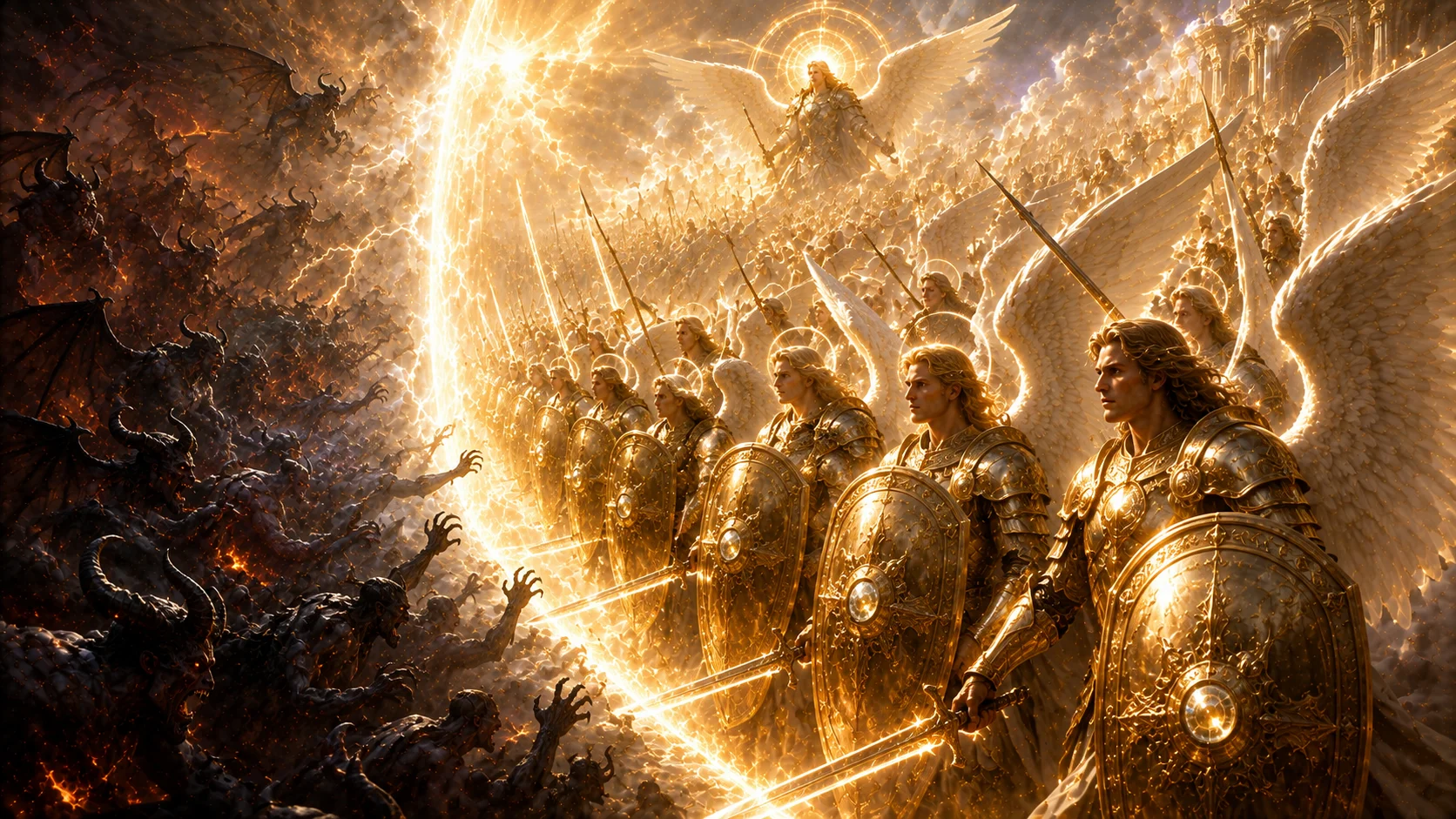
Gregory's homily is also where the Powers get their clearest description as warriors rather than administrators. He writes that the Powers, more readily than the other ranks, have grasped the nature of potency itself — and because of that, the opposing powers, the hostile spiritual forces ranged against them, are made subject to their strength. In Gregory's telling, it is specifically the Powers who hold those opposing forces back from working their will on the human heart: a standing defence against temptation at the boundary between the soul and whatever seeks to unmake it.
This is the martial reading of the choir most durable in popular memory — angels not primarily as messengers or contemplatives but as a check on chaos, a rank whose entire office is to keep something dangerous from getting through. It sits comfortably beside the Ephesians verse about "spiritual wickedness in high places": if that is the enemy Paul names, the Powers are the answer Gregory gives to who opposes it.
Neighbors in Rank: Virtues Above, Principalities Below
Understanding the Powers means understanding where they are not. Immediately above them, in Dionysius's order, sit the Virtues — a gentler office than the Powers' restraint of hostile forces. Immediately below sit the Principalities, whose office is traditionally to govern nations rather than fight the demonic directly. The three choirs are close in rank and easy to blur together in casual retelling, but their offices are distinct: Virtues grant, Powers restrain, Principalities rule. The confusion is not helped by how similar their Latin and Greek names sound to modern ears — virtutes and potestates occupying, in translation, almost the same breath.
Soldiers Without Names
One fact about the Powers is almost more telling than anything said about their function: no individual angel is consistently named as belonging to this rank, in the way Michael, Gabriel, and Raphael are named as Archangels. The Archangels have personalities and biographies attached to their office. The Powers, across the primary sources, do not. They are described only as a class, a rank, an office held collectively — soldiers and administrators without faces. Mainstream Christian angelology — built on Dionysius, Gregory, and successors such as Thomas Aquinas, who largely adopted and carried forward Dionysius's ninefold reasoning in his own systematic treatment of the angelic orders — simply never names a single Power the way it names Michael or Gabriel.
No Feast Day of Their Own
The Archangels have a fixed place on the Catholic calendar — the twenty-ninth of September, shared by Michael, Gabriel, and Raphael. The Powers have nothing comparable. No feast day specific to this choir appears anywhere in the sources that describe it. It is a small absence, but it fits the larger pattern: the Powers were conceived from the start as an office within a structure, not as personalities to be venerated individually. Where the Archangels accumulated stories and a calendar date, the Powers remained what Paul's letters first made them — a category, named in passing, never elaborated into a cult of its own.
What Popular Angelology Adds — and What It Doesn't Prove
Search for the Powers today and the descriptions multiply well beyond Dionysius and Gregory. Modern compilations describe them as the angels who supervise the movement of the heavenly bodies to keep the cosmos in order, who oppose evil spirits that misuse matter, who oversee the power granted to human rulers such as kings, who escort and protect souls on their journey, and who safeguard the records of history. These are vivid images, not necessarily wrong, but not traceable to the primary patristic texts. They belong to later, popular compilations of angelology rather than to the fifth-or-sixth-century Celestial Hierarchy or to Gregory's homily — elaboration built on top of the older, sparer sources rather than settled doctrine.
The honest picture, held next to the popular one: Dionysius gives the Powers a place in a structure and a description of authority that governs itself without tyranny; Gregory gives them a specific job, holding back the opposing powers from the human heart. Everything about heavenly bodies, kings, escorted souls, and guarded records is a later layer, unverified against the texts that founded the choir.
Why the Powers Still Matter
Strip away the disagreements between Dionysius and Gregory and the later embellishments, and what is left is remarkably consistent: a rank of angel defined by restraint rather than by radiance. The Seraphim burn; the Powers hold a line. Paul names them in a list of things to struggle against and things Christ stands above. Dionysius describes an authority so disciplined it never curdles into tyranny. Gregory describes a garrison standing between the human heart and whatever hostile power would unmake it. Across every version of the story, the Powers are never the choir worshipped for its beauty or invoked for its favours. They are the choir trusted to keep watch — an office built, from its first appearance in a half-finished Pauline list, out of the plain, unglamorous work of holding something back.
Sources & traditions
- TraditionHebrew texts, grimoires and later commentary
Myths change from area to area and from time to time. This chronicle follows the most widely told versions; tellings in other villages, regions and eras may differ.