Ask a medieval theologian to name the angel who turns the stars in their courses, the angel through whom a miracle actually reaches the world, and he would not hesitate — the Virtues, fifth of the nine choirs. Ask him for a story about one — a battle, a visitation, a name — and he would fall silent. There isn't one. No wings caught mid-flight, no visit to a frightened prophet, no single face anyone can point to and call by name. They are not characters. They are a function of the universe, given a rank.
The Name That Argued With Itself
The word itself carries a quiet dispute inside it. In Latin the choir is the virtutes — a word that, by the time it reached English Bibles and English theology, had drifted toward "virtues" in the moral sense: patience, courage, temperance, the qualities of a good life. That is not, several modern commentators argue, what the word originally meant here. It translates the Greek dynameis — power, force, potency. The choir was never named for moral excellence. It was named for raw, world-moving might.
The founding text makes this explicit in its own words. Pseudo-Dionysius the Areopagite, describing the order in Greek, glossed its name as signifying:
a certain powerful and unshakable virility welling forth into all their Godlike energies... mounting upwards in fullness of power to an assimilation with God
That is not a description of a saint practicing patience. It is a description of unbreakable force directed at its source. The later Latin translation, rendering that force as virtus, planted a false cognate at the root of the order's entire identity.
A Text From the Late Fifth Century
The order does not come from the Hebrew Bible, and it does not come from any single scriptural list. It comes chiefly from one text: De Coelesti Hierarchia, "On the Celestial Hierarchy," written in Greek by an author now known as Pseudo-Dionysius the Areopagite, in roughly the late fifth century CE. That text became the standard framework for the Christian angelic hierarchy for more than fifteen hundred years — the source that fixed nine ranks of angels into a settled architecture, the one later medieval art, theology, and popular imagination inherited almost wholesale.
It is worth being plain about what this means for a figure carrying the label "Hebrew angel": the Virtues, as a named choir with this specific rank and this specific office, is a Christian development — Greek patristic, then Latin Scholastic. The Hebrew Bible itself contains no nine-choir hierarchy of angels and no order called the Virtues. Whatever earlier Jewish angelology contributed to the broader idea of ranked heavenly beings, this particular structure, with this particular name, was built centuries later, by Christian writers working in Greek and then Latin.
Thin Threads in Scripture
The biblical grounding usually cited for the choir is thinner than the confidence of later systematic theology would suggest. Three New Testament passages, all from the Pauline epistles, are the standard proof-texts: Ephesians 1:21, Colossians 1:16, and 1 Peter 3:22. In Greek these use the word dynameis, which some English translations render as "powers" and others as "virtues." The elaborate architecture of miracle-working, star-governing, grace-bestowing angels credited to the Virtues came from the centuries of theological development that followed these few scattered proof-texts, not from any detailed description within the verses themselves.
The Second Triad
Dionysius organized the nine choirs into three groups of three, and the logic of the grouping matters more than any individual rank. The first triad — Seraphim, Cherubim, Thrones — stands closest to God, contemplating the divine directly. The third triad — Principalities, Archangels, Angels — stands closest to the created world, the ranks that deal most directly with human affairs. Between them sits the second triad: Dominions, Virtues, Powers. This is the middle tier, the administrators, the choir that receives what flows down from above and sends it onward, transformed into governance and action.
- First triad — Seraphim, Cherubim, Thrones: contemplation, nearest to God
- Second triad — Dominions, Virtues, Powers: administration of the cosmos
- Third triad — Principalities, Archangels, Angels: nearest to human affairs
Within that middle triad, later systematized by Thomas Aquinas, the Virtues sit fifth overall — beneath the Dominions, who govern; above the Powers, who defend. They occupy the hinge point: the rank where command becomes force.
A Pope Who Disagreed
The tidy sequence above was never quite as settled as it looks in retrospect. Pope Gregory the Great also taught a nine-order hierarchy, but arranged it differently — his sequence ran Angels, Archangels, Virtues, Powers, Principalities, Dominations, Thrones, Cherubim, Seraphim, swapping the positions of the Virtues and the Principalities relative to Dionysius's scheme. Gregory based this divergence on his own reading of scripture, not on any claim that Dionysius had erred through carelessness. The disagreement is a useful reminder that "the angelic hierarchy" was never a single fixed document handed down intact — it was a live theological argument that different authorities, working from the same scattered scriptural hints, resolved in different orders. What both men agreed on, despite disagreeing on rank, was the Virtues' function.
The Workers of Miracles
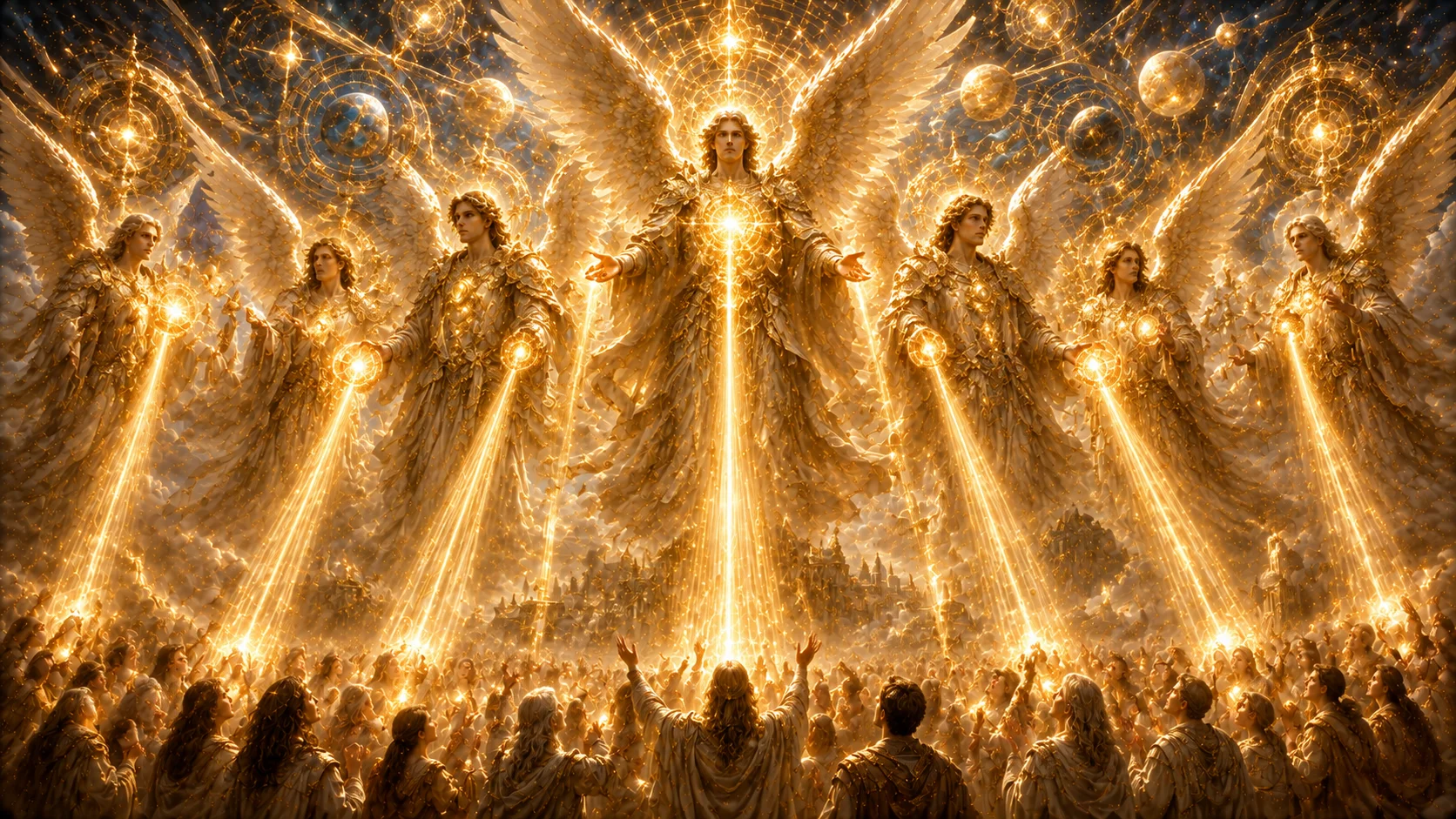
On that function, Gregory the Great is direct: the Virtues are, in his words, the spirits through whom signs and wonders are most frequently accomplished. This is the office that gives the choir its whole character. Reference traditions describe the Virtues as the angels who receive commands from the Dominions above them and, in effect, run the universe — the working class of the celestial hierarchy, the ones who take a governing decree and turn it into an event in the world. Miracles, signs worked through the elements, wonders that exceed the ordinary run of nature — these are credited to the Virtues' activity. They are not the ones who decide what should happen. They are the ones through whom it happens.
To this office tradition also assigns the governance of the heavenly bodies — the regulation of the movement of the stars and the planets, the vast and orderly machinery by which the cosmos keeps its courses. The Virtues are, in this sense, both miracle-workers on the small scale of a single sign given to mortals, and custodians of the largest visible order there is: the turning of the sky itself.
Strength Poured Into Trial
The Virtues' second office turns from cosmos to conscience. Beyond governing stars and working signs, they are described as the source of fortitude and courage poured into the human heart — the angels whose gift is not vision or wisdom but sheer strength of will and spirit. Tradition holds that the saints and heroes of faith who accomplished what should have been beyond them — who endured what should have broken them — were sustained in that endurance by the Virtues. Where the Dominions issue the command and the Powers stand guard against what would corrupt it, the Virtues are the ones who reach directly into a frightened or exhausted person and leave them able to go on. Grace given as raw capacity: the strength to work good beyond what the person carrying it would have been able to manage alone.
Names That Argue Among Themselves
Several modern reference sources call the Virtues by an additional name — the Strongholds. Fewer, and less consistently, use "the Mights." That second label is worth handling carefully: other sources apply "Mights" not to the Virtues but to the Powers, the choir immediately below them, and the two alternate names are not attributed to the same order consistently across the literature. What can be said with more confidence is "Strongholds" — a name that fits the choir's character as well as its official one does, since a stronghold, like the Virtues themselves, is a fixed point from which force is exercised rather than a person exercising it.
Where the Order Sits
Rank in this hierarchy is not decorative — it describes a working relationship. Above the Virtues sit the Dominions, who set direction; below them sit the Powers, whose task, in Gregory's account, is to check the power of darkness — to fight the influences that would corrupt or divert what the Virtues are working to accomplish. The three ranks of the middle triad function as a chain: the Dominions decide, the Virtues enact, the Powers defend the enactment. Strip any one link out and the picture stops making sense, which is part of why medieval theology treated the sequence, disputed rank-order notwithstanding, as a coherent system rather than nine unrelated titles.
The Latin West Makes It Official
Dionysius wrote in Greek, for a Greek-speaking Christian world. The scheme reached its fullest, most durable form in Latin theology through Thomas Aquinas, who incorporated and systematized the nine-choir hierarchy — Virtues included — in the Summa Theologica. It was this Scholastic synthesis, more than the original Greek text, that fixed the order in the imagination of the medieval and early modern Latin West: the nine choirs as painted in altarpieces, carved into cathedral vaults, and taught from pulpits, with the Virtues holding their place at the hinge of the second triad for century after century.
A Loose Echo in a Different System
A separate and later current of Jewish mysticism, Kabbalah, developed its own list of angelic orders tied to the sephirot of the Tree of Life — a wholly different roster from the Dionysian nine, running Chaioth ha-Qadesh, Auphanim, Aralim, Chashmalim, Seraphim, Malakim, Elohim, Beni Elohim, Kerubim, and Ashim. Some syncretic modern sources loosely associate an order they call "Virtues" or "Strongholds" with the sephirah Geburah, the sphere of justice and severity. The correspondence, where it is drawn at all, is not a clean one-to-one match between two equivalent systems — it is a later, contested overlay linking two angelologies that were built independently, for different purposes, in different eras. Treat it as a curiosity at the edge of the subject, not as a second confirmed source for the Virtues themselves.
An Order Without a Face
What the record consistently withholds is a story. Named archangels such as Michael, Gabriel, or Raphael carry individual identities and stories of their own; the Virtues have none of that. They have neither individual members nor named angels nor a single narrative episode anywhere in the sources — they are a class, a function, a rank filled anonymously, generation after generation, by beings who are never singled out. That absence is not a gap in the research; it appears to be the nature of the thing itself. The Virtues were conceived as an office, not as a cast of characters, and the theology that built them seems to have felt no need to correct that.
Might Aimed at the Good
What survives across every version of the argument — Dionysius against Gregory, Latin against Greek, official name against contested alternate — is the core idea the choir was built to hold: that there exists, somewhere in the order of heaven, a rank whose entire office is power in service of the good. Not might for its own sake, not force as spectacle, but strength deliberately positioned between a divine command and its effect in the world — turning the stars, working the sign, and steadying the person who did not think they could go on. Theologians across many centuries disagreed about exactly where to rank that idea. None of them disagreed about needing it.
Sources & traditions
- TraditionHebrew texts, grimoires and later commentary
Myths change from area to area and from time to time. This chronicle follows the most widely told versions; tellings in other villages, regions and eras may differ.