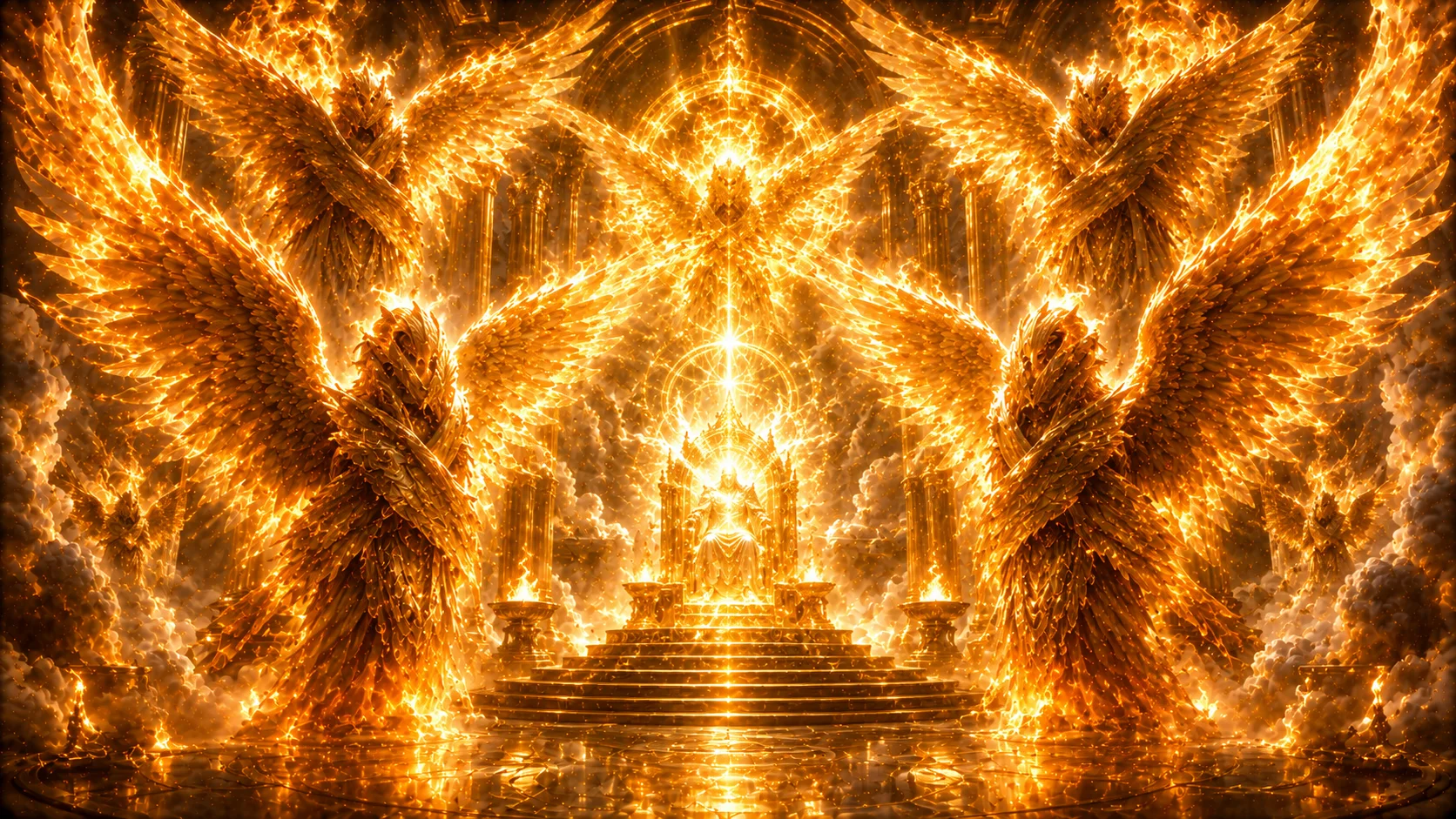
The Seraphim — the “burning ones” — are the highest order of angels in Jewish and later Christian tradition: fiery six-winged beings who stand in the immediate presence of God, ceaselessly singing his holiness. Their name comes from the Hebrew saraph, “to burn,” and they are made of, and wreathed in, divine fire.
The Vision of Isaiah
The seraphim enter scripture in the great throne-vision of the prophet Isaiah. “I saw the Lord seated on a throne, high and lifted up,” he writes, “and above him stood the seraphim. Each had six wings: with two he covered his face, with two he covered his feet, and with two he flew.” And they called one to another the words that became the heart of all sacred liturgy: “Holy, holy, holy is the Lord of hosts; the whole earth is full of his glory.” At their voices the foundations of the threshold shook, and the temple filled with smoke.
The Burning Coal
It is a seraph who performs one of scripture’s most striking acts of grace. When Isaiah cries out that he is a man of unclean lips, a seraph flies to him bearing a live coal taken with tongs from the altar, and touches it to the prophet’s mouth, saying that his guilt is taken away and his sin atoned. Thus the burning ones are not only singers of holiness but agents of purification, carrying the cleansing fire of the divine presence to mortal flesh.
The Highest Choir
In the angelic hierarchies systematized in later tradition, the seraphim are ranked first of the nine choirs, closest of all to God, surpassing even the cherubim and the thrones. They are the angels of pure love and pure fire, so consumed by the divine radiance that they perpetually burn without being consumed. Some traditions link them to the fiery serpents of the wilderness, others see them as flames given form and voice. Above every other order they encircle the Throne, an unceasing chorus of fire forever proclaiming the holiness of the One they cannot stop adoring.
The Serpents in the Wilderness
Long before Isaiah saw them ringing the throne, the word saraph already meant something that bit. In the account of Israel’s wandering, when the people complain against God and Moses in the desert, the LORD sends nechashim seraphim — fiery serpents — among them, and their bite kills. Moses is told to mount a serpent of bronze on a pole; whoever looks at it after being bitten survives. That bronze serpent, remembered as Nehushtan, was kept for generations afterward — until King Hezekiah had it broken up, because the people had begun burning incense to it as though it were a god in its own right. Deuteronomy calls the same wilderness the place of “fiery serpents and scorpions,” using the identical root word.
This is not folk etymology tacked on after the fact. Isaiah of Jerusalem, preaching in the eighth century BC, was drawing on a word that already carried the memory of a burning, venomous, half-divine creature roaming the desert margins of Israelite memory — and quite possibly on an older visual vocabulary too. Winged serpent imagery, close kin to the Egyptian uraeus, turns up on seals and amulets across the Iron Age Levant, including finds from Judah itself: a rearing cobra, wings spread, guarding whatever it faces. Whether Isaiah had such an image in mind when he set fiery, winged beings around God’s throne cannot be proven, and scholars disagree about it. But the line from biting desert serpent to six-winged throne-guardian is one they take seriously — not as coincidence, but as a single idea, something too dangerous to approach unprotected, wearing two different masks.
Nine Choirs, One Flame
The tidy pyramid most people carry in their heads — seraphim at the summit, then cherubim, then a long descending ladder down to ordinary guardian angels — is nowhere in the Bible itself. It comes from a single, extraordinarily influential Greek text written centuries after Isaiah: The Celestial Hierarchy, composed by an anonymous Christian author who signed himself “Dionysius the Areopagite,” borrowing the name of a minor convert of St Paul mentioned in the Acts of the Apostles. “Pseudo-Dionysius,” as scholars now call him, gathered every angelic order named across scripture into three triads of three, with seraphim, cherubim and thrones forming the innermost circle around God — closer, in his scheme, than any rank beneath them could conceive of standing.
Dionysius read the very name seraphim as a verb frozen into a noun: those who kindle, who set ablaze, who carry heat like a fire that never needs feeding. Where he made the cherubim the order of knowledge — their name, he says, signifies the outpouring of wisdom — the seraphim are the order of love: not affection but total, undivided, ceaseless desire for God, burning without fuel because what it burns for cannot run out. Thomas Aquinas took up the same pairing three-quarters of a millennium later in the Summa Theologiae, where the seraphim are named for the ardour of charity and the cherubim for fullness of knowledge, and where he argues that although the intellect ranks above the will in the general case, the love of God reaches further than the knowledge of him. It is a scholastic argument that quietly concludes fire outranks light.
The Kedushah
Isaiah’s seraphim never left Jewish worship; they simply moved into it. The words the prophet heard them call to one another — “Kadosh, kadosh, kadosh” — are recited by entire congregations in the Kedushah, said whenever the Amidah is repeated aloud with a quorum, and joined there to a second line lifted from Ezekiel: “Blessed be the glory of the LORD from his place.” Two prophets’ visions, generations apart, are stitched into a single responsive chorus. Custom has worshippers rise onto their toes at each repetition of kadosh, lifting themselves, as the explanation goes, toward the beings whose words they are borrowing.
In the visionary literature of Jewish mysticism — the Hekhalot and Merkabah texts, which describe mystics ascending through a sequence of heavenly palaces toward the divine chariot-throne first glimpsed by Ezekiel — seraphim recur as part of the throne’s permanent retinue, alongside the ophannim, the wheels-within-wheels of Ezekiel’s vision, and the cherubim on whom the throne is said to rest. These texts care less about ranking the orders than about the sheer sensory overload of approaching them: fire that will not stay still, voices that shake the pillars of heaven, a throne room too bright to describe except by what it does to the person seeing it.
Faces of Fire
Painters and mosaicists inherited a genuine problem: how do you draw a being that is, by definition, not a body? The commonest answer, visible in the domes and pendentives of Byzantine churches and in later Western art alike, is to strip the seraph down to almost nothing — a single face ringed by six wings meeting wingtip to wingtip, with no arms, no legs, no torso at all. It is one of the rare instances in religious art where less figure reads as more power: a being so consumed by what it beholds that it has no use for hands.
Medieval convention tends to render seraphim in red or flame-orange, distinguishing them from the blue favoured for cherubim within the same schemes — though popular memory blurs the two constantly, and has done for centuries. The small winged heads drifting through the clouds of countless Renaissance and Baroque altarpieces descend from both types at once, and most viewers, then and now, could not have told you which order they were looking at. The wings folded over face and feet are usually the tell when an artist bothers to keep them: even the burning ones, nearest of all creatures to the source of the fire, are shown covered in its presence.
The Seraph on the Mountain
The clearest living link between this vision and later devotion belongs to Francis of Assisi. In September 1224, two years before his death, Francis withdrew to fast and pray on the remote peak of La Verna in the Tuscan Apennines. His earliest biographers — among them Thomas of Celano, a friar who had known him — record that he saw descending toward him a six-winged seraph bearing the figure of a crucified man, and that when the vision passed he found on his own body the wounds of the crucifixion. It is the first case of the stigmata recorded in Christian tradition. The Franciscans have been known as the Seraphic Order ever since, Francis is venerated with the title Seraphic Father, and Bonaventure — the order’s minister general and its greatest theologian — is honoured as Doctor Seraphicus. It is a chain of titles that traces back to one man’s encounter, on a mountainside, with a being made of wings and fire.
Nearest the Light
Dante, composing the Paradiso roughly a century after Francis, keeps the Dionysian order intact and puts it to poetic use. Climbing at last past the fixed stars into the Primum Mobile, the outermost moving sphere of his cosmos, the pilgrim sees nine concentric rings of light wheeling around a single blinding point — God reduced, at this altitude, to pure brightness rather than a figure — and the ring that spins fastest and burns nearest that point belongs to the seraphim. Dante’s logic is the one Dionysius and Aquinas had already laid down: speed and heat answer to love, and love is what stands closest.
Why the Burning Ones Cover Their Faces
What makes the seraphim strange, even among angels, is the detail Isaiah spends least time on. Of six wings, only one pair is for flying. The other four are for hiding — two across the face, two across the feet — and they belong not to the prophet, who might reasonably need shielding, but to the creatures already standing in the fire. The order ranked nearest to God is also the order shown unable to look at him.
That asymmetry is probably why the image outlasted every theology built on top of it. Rank the choirs however you like; the seraphim are not a prize at the top of a ladder but a warning about what the top of the ladder is like. They are threshold beings, stationed at the point where holiness stops being an idea and becomes a temperature — and the tradition insists that even they stand there veiled. The seraph is what the imagination reaches for when it needs to say that nearness to the sacred is not a comfort, and that whatever survives the approach does not come back unchanged.
Sources & traditions
- EncyclopediaWikipedia — Seraph
- TraditionHebrew texts, grimoires and later commentary
Myths change from area to area and from time to time. This chronicle follows the most widely told versions; tellings in other villages, regions and eras may differ.