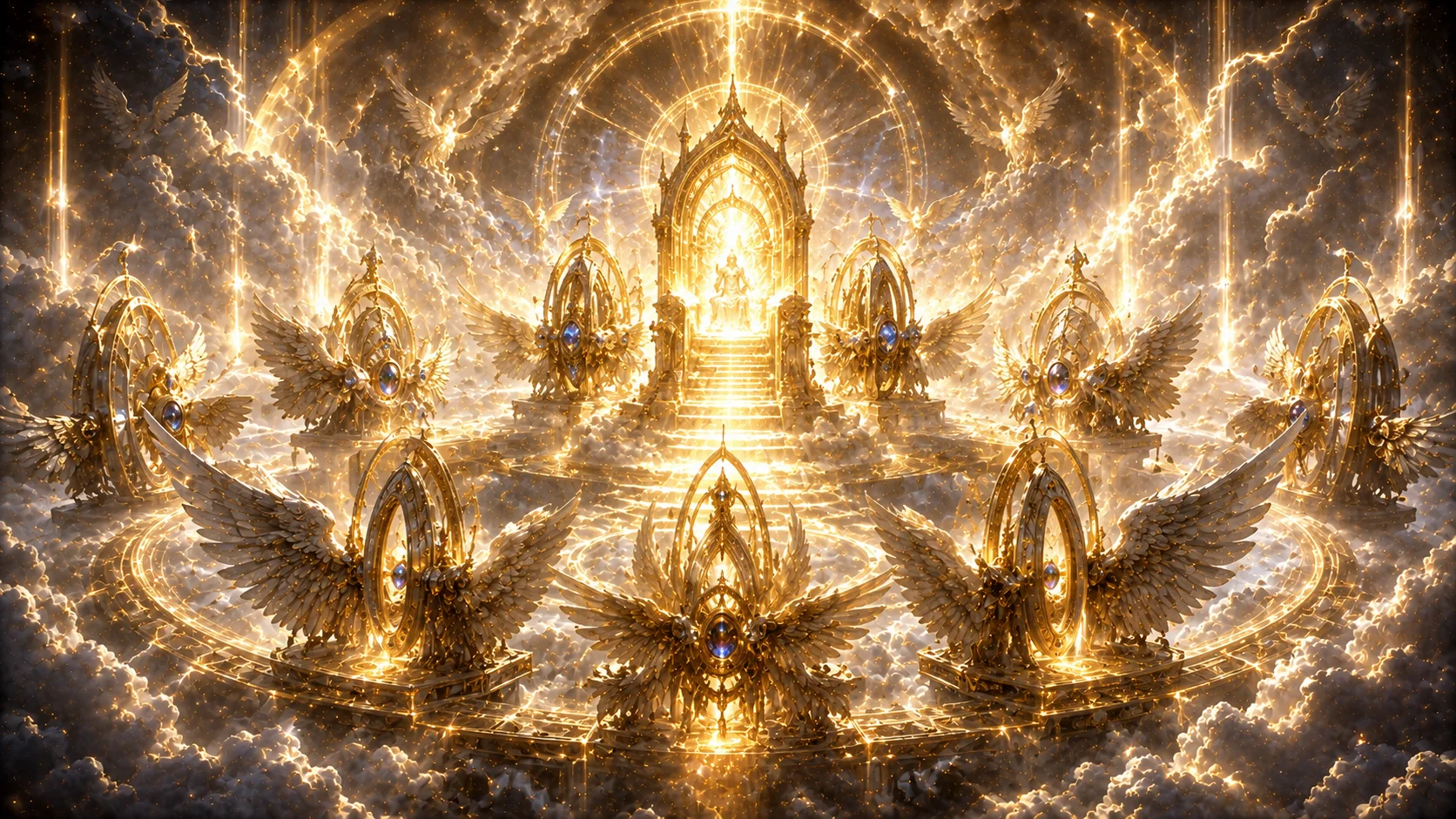
Picture the vision first, because everything else in this article is an argument about what to do with it. Four living creatures, and beside them, wheels — not one wheel per creature but a wheel within a wheel, rimmed all around with eyes, moving in any of four directions without ever needing to turn. It is one of the strangest images in the Hebrew Bible, and centuries of readers who came after Ezekiel could not leave it alone. Out of that vision, and out of a single verse in a letter attributed to Paul, an entire angelic order was assembled: the Thrones, the celestial seats of divine judgment, later ranked with the Seraphim and Cherubim at the very top of heaven's hierarchy.
A Word Borrowed from a Throne Room
The name itself is almost the whole of the evidence. In Greek the word is thronoi, plural of thronos — simply "seats," or "thrones" — carried into Latin as thronus. It is a word for furniture before it is a word for angels: the physical seat of a king or a judge, the object on which sovereign authority is visibly enacted. When early Christian writers needed a name for an order defined by proximity to divine judgment, they reached for exactly that word, and it stuck.
What makes the etymology worth pausing on is what it is not. There is no distinct ancient Hebrew word meaning "thrones" that names an angelic class in the Hebrew Bible. The underlying Hebrew vocabulary for the image later systems attach to the Thrones belongs to something else entirely — ofanim (אוֹפַנִּים), "wheels," and the related galgalim (גַּלְגַּלִּים), "spheres" or "whirlwinds." Thrones, as a named order, is a Greek theological label grafted onto a Hebrew visionary image; the two vocabularies point at the same concept but did not begin as the same word.
Two Verses, and Nothing More
Strip away every later commentary and the entire biblical warrant for an order called Thrones comes down to a single verse. Colossians 1:16, part of Paul's list of everything created through Christ "in heaven and on earth, visible and invisible," reads: "whether thrones, or dominions, or principalities, or powers." That is the sentence the whole choir is built from — one item in a list of four, with no description beyond the bare word itself.
A second passage is cited alongside it: 1 Peter 3:22, which states that after the resurrection, angels, authorities, and powers were made subject to Christ. It confirms that such categories exist and answer to a higher authority, but like Colossians it offers no picture of what a "throne" does or how it differs from a dominion or a power. Everything else — the wheels, the eyes, the stillness, the judgment-seat imagery — was supplied afterward, by readers trying to give a bare word a face.
Wheels Within Wheels
The face they reached for belonged to Ezekiel. In chapter 1, verses 15 through 21, the prophet describes wheels beside the four living creatures of his vision — one wheel intersecting another at right angles, so the assembly could move in any of four directions without turning. Their rims, he says, were full of eyes all around. It is a vision of the Merkabah, the divine chariot-throne: not a winged figure or a robed elder, but a piece of moving, watching machinery beneath the glory of God.
It bears repeating precisely what Ezekiel's own text does and does not say. It never calls these wheels a "choir." It never uses the word ophanim to name a rank of angels, and it never connects them to Paul's later list of thrones, dominions, principalities, and powers. The identification of the ophanim with the Thrones of Colossians is a later theological synthesis — real and influential, but a synthesis all the same, not something Ezekiel's vision states outright.
Eyes That Never Close
The joining did not happen all at once, and not only in Christian hands. Among the Dead Sea Scrolls, the Songs of the Sabbath Sacrifice (4Q405) already treats the ophanim as angels in their own right, giving the wheel-imagery an independent afterlife in Second Temple Jewish thought, apart from any Pauline list.
The later, Ethiopic sections of the Book of Enoch go further still. In chapters 61 and 71, the ophanim appear alongside the Cherubim and Seraphim as a class of celestial beings who never sleep, standing guard before the throne of God — watchfulness made permanent, the eyes on the rims never closing. The Second Book of Enoch, in chapters 20 and 21, describes the visionary Enoch himself witnessing "thrones" during his ascent, and names the ophanim-like beings the "many-eyed ones," placed in the Seventh Heaven. Between the Scrolls and the two Enochic texts, this imagery was circulating as an angelic category centuries before any Christian writer arranged the Nine Choirs.
The Architect of Heaven's Ranks
The systematic arrangement — giving the Thrones a fixed rank rather than a scattered set of allusions — came from a fifth- or sixth-century writer known as Pseudo-Dionysius the Areopagite. His treatise De Coelesti Hierarchia, The Celestial Hierarchy, laid out nine angelic choirs in three triads of three, and placed the Thrones in the very topmost triad, the First Sphere, alongside the Seraphim and the Cherubim.
Within that scheme, the Thrones were given a specific theological job: to bear and support the throne — the seat — of God's own majesty, and to receive the divine will and judgment at the summit of creation and pass it downward through the ranks below — through the Dominions, the Virtues, the Powers, and further still through the Principalities, the Archangels, and the Angels who minister directly to human beings. Where the Seraphim burned with love and the Cherubim bore knowledge, the Thrones were assigned the office of justice: the living foundation on which divine judgment is established before it ever reaches the lower orders, let alone the earth.
A Synthesis, Not a Citation
It is worth being honest about how thin the seam is between these pieces. Pseudo-Dionysius did not discover a lost scripture that named the Thrones and described their wheels; he combined a bare word from Colossians with an image from Ezekiel and a triadic structure of his own devising. The equation of Thrones with ophanim is an interpretive bridge, not a direct textual identity — the sources that discuss it are explicit that no ancient text states the equivalence outright. What survived was the bridge, because it was elegant, and because the theologians who came after Pseudo-Dionysius found it useful and kept building on it.
The Chariot Mystics
Ezekiel's vision did not only feed theological hierarchies; it also became the object of direct religious practice. Merkabah mysticism — the earliest documented form of Jewish mysticism, tracing back to the Second Temple period and continuing into late antiquity — took the throne-chariot vision as its center. Its practitioners, working through a body of writing known as the Heikhalot literature ("palaces"), sought a mystical ascent through celestial halls toward the divine throne itself and the beings that attend it.
This is a different lineage from the Pseudo-Dionysian hierarchy — devotional rather than systematic — but it draws on the same source image. Where Pseudo-Dionysius asked what rank the wheels belonged to, the Merkabah mystics asked how a soul might travel toward them.
A Throne With Wheels of Fire
Ezekiel is not the only place wheels and thrones meet in the Hebrew Bible. Daniel 7:9 pictures God's own throne set among fire: "his throne was like the fiery flame, and his wheels as burning fire." It is cited alongside Ezekiel as further scriptural background for the imagery — evidence that a divine seat with burning, mobile wheels recurs as a shared image within the prophetic tradition, not confined to a single prophet's vision.
The Disputed Cousins
Some later writers have tried to extend the family further. Isaiah 33:7 mentions the erelim, usually translated "valiant ones" or "heroes." Modern angelological writers, notably Matthew Bunson, have proposed that erelim, together with two further terms, abalim and aralim, correspond to a Jewish angelic order roughly equivalent to the Thrones. That correspondence is explicitly disputed rather than settled; it rests on etymological resemblance, and belongs to the same category as the ophanim bridge — a later attempt to find Jewish counterparts for a fundamentally Greek category.
What the Guidebooks Add
The image kept evolving long after the medieval theologians finished their systems. The modern angel-guidebook writer Rosemary Ellen Guiley, in a 1996 work, describes the Thrones as "actual chariots of God," associating them with peace, submission, and cosmic justice, and picturing them as great wheels covered in many eyes. It is a vivid restatement of the wheel-and-eye imagery inherited from Ezekiel and Enoch, but it belongs to a distinct genre — a modern popular synthesis, not a patristic or scriptural source. Worth naming plainly as such, because its confident, decorative detail can read as though it were far older than it is.
The Doctors of the Hierarchy
Pseudo-Dionysius's ninefold system did not stay a private theory. It was carried forward by major Christian theologians who wrote their own systematic treatments of the angelic orders, including the Thrones: Gregory the Great, and later Thomas Aquinas in the Summa Theologica. Both generally affirmed the threefold triadic structure Pseudo-Dionysius had proposed, even where medieval theologians differed among themselves on points of ordering or emphasis. Their engagement is why the Nine Choirs became the standard reference point for Western Christian angelology, rather than remaining one writer's private scheme.
The Thrones carry justice — they are the angels through whom God's perfect equity is dispensed and his sovereign authority made manifest.
Stillness as Office
What every layer of this tradition agrees on, from Ezekiel's watching wheels to Pseudo-Dionysius's hierarchy, is what the Thrones do not do. They do not descend to earth. They are not messengers, and they are not guardians assigned to individual people, the way later folk tradition sometimes imagines other angelic ranks. Their function is upward and inward: to support the throne of divine majesty, to remain in the presence of judgment rather than carry it outward themselves, and to transmit what they hold downward through the ranks of Dominions, Virtues, Powers, Principalities, Archangels, and Angels, so that it eventually reaches the orders that act in the world.
In that sense the Thrones represent something closer to stillness than to action — angels of profound humility before the divine, whose entire being is given over to supporting a seat that is not their own. They stand, in the architecture built by Pseudo-Dionysius, at the boundary between the first triad of angels wholly absorbed in the presence of God and the orders further down that govern the cosmos and minister to humanity directly. The Thrones do not cross that boundary. Their office is to hold the line at the top, so that judgment has somewhere fixed to originate from.
What Remains Unnamed
Return, at the end, to the honest shape of the evidence. There is no ancient Hebrew word that names an angelic order called "Thrones." There is a Pauline Greek word, thronoi, appearing once in a list with no elaboration. There is a prophet's vision of wheels within wheels, rimmed with eyes, that never once calls itself a choir. There is a body of Enochic and Qumran literature that treats those wheels as living, watchful beings, centuries before anyone organized them into a rank. And there is a sixth-century systematizer who bound the word to the image and gave it a fixed seat at the summit of heaven — a synthesis so persuasive it has stood, largely unchallenged, for a millennium and a half. What survives, across all of it, is the image itself: eyes that do not close, wheels that need no turning, and a seat of judgment that heaven never leaves empty.
Sources & traditions
- EncyclopediaWikipedia — Throne (angel)
- TraditionHebrew texts, grimoires and later commentary
Myths change from area to area and from time to time. This chronicle follows the most widely told versions; tellings in other villages, regions and eras may differ.