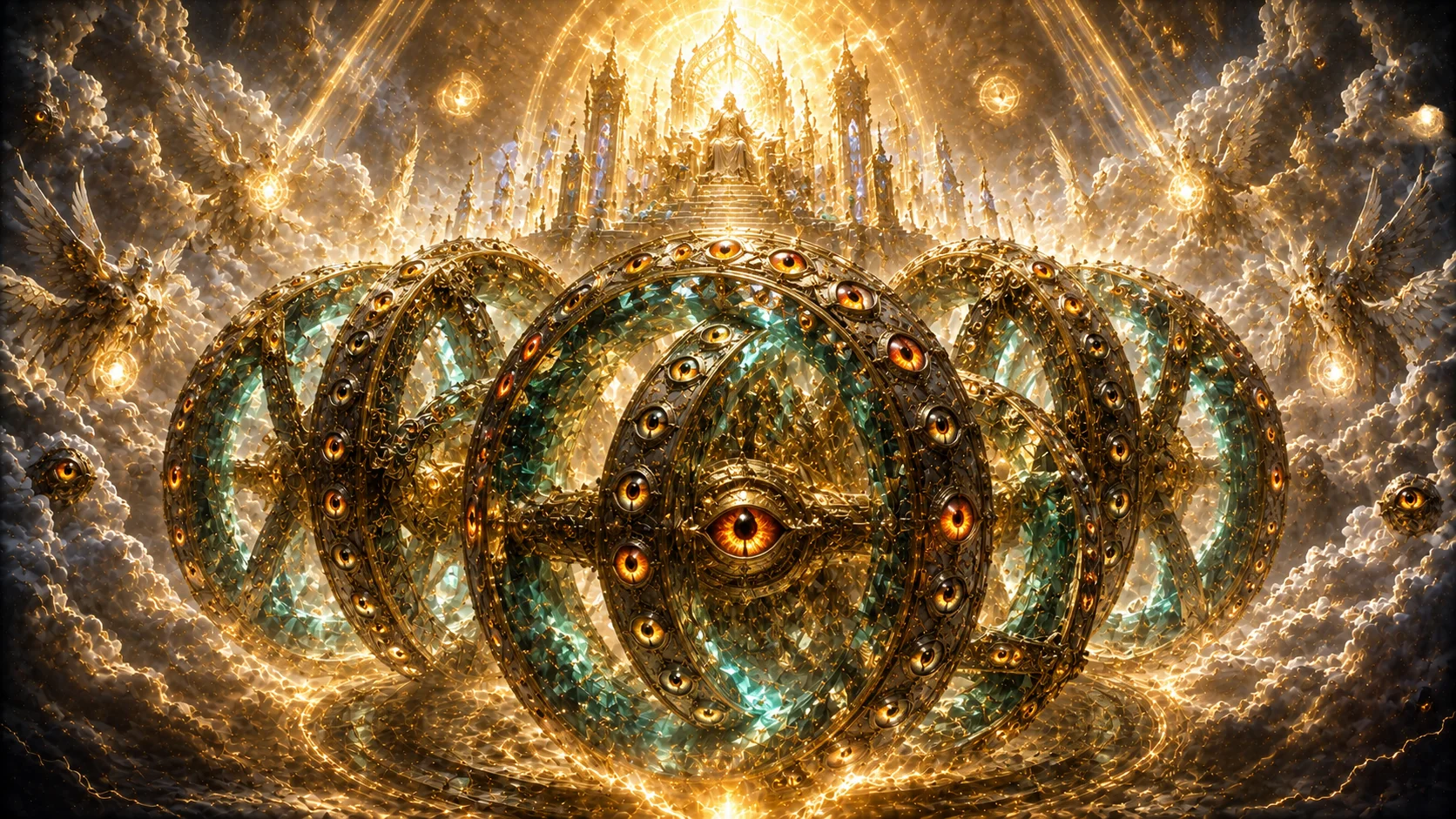
The Ophanim — the “wheels” — are among the strangest and most sublime of the angelic orders: living wheels of the divine Chariot, rimmed with eyes and ablaze like burning coals, that move in perfect accord with the cherubim beneath the throne of God. Their name, from the Hebrew ophan, “wheel,” describes their very form.
The Wheels Within Wheels
Ezekiel’s throne-vision gives the ophanim their unforgettable shape. Beside each of the four living creatures, the prophet saw a wheel upon the earth, “and their appearance was like the gleaming of beryl... a wheel within a wheel.” Their rims were tall and dreadful, “full of eyes all around,” and wherever the living creatures went, the wheels went, for “the spirit of the living creature was in the wheels.” They move in any direction without turning, ascending and descending with the cherubim, the rolling foundation of the divine Chariot.
Eyes That Never Close
The countless eyes that stud the ophanim signify ceaseless watchfulness and the all-seeing knowledge of God whose throne they bear. In the Book of Enoch they appear among the highest classes of angels who never sleep, guarding the Throne of Glory: “the cherubim, the seraphim, and the ophanim, the angels of power... who do not slumber.” They are the sleepless watchers of the immediate presence, eternally vigilant beneath the seat of the Most High.
The Third Choir of Heaven
In the systematized angelic hierarchies, the ophanim are identified with the order of the Thrones, ranked third among the nine choirs, just below the seraphim and cherubim. They embody the divine attributes of justice and authority, the very seat upon which judgment rests. Mysterious even among angels — neither humanoid nor beast but living, eyed, burning wheels — the ophanim are perhaps the purest expression of the otherness of heaven: an order of being so unlike anything earthly that scripture could describe them only as wheels turning within wheels, alight and watching, forever rolling beneath the glory of God.
A Prophet Beside the Chebar Canal
The wheels have an address. Ezekiel gives one at the very top of his book: he was among the deportees settled by the Chebar, an irrigation canal in the alluvial flats of Babylonia, in the fifth year of King Jehoiachin’s exile — roughly 593 BCE. This matters more than it looks. The strangest machinery in the Hebrew Bible was seen by a displaced Jerusalem priest sitting in the heartland of the empire that had just taken his city apart, in a landscape where the gods rode in procession on wheeled carts and the temples belonged to somebody else.
The word itself is stubbornly ordinary. Ophan is simply a wheel — the same noun used for the wheels of Pharaoh’s chariots clogging in the sea, and for the bronze wheels of the wheeled lavers Solomon had made for the Temple, which the text describes with an engineer’s attention: axles, rims, hubs, spokes, all cast in one piece, “like the work of a chariot wheel.” Ezekiel was a priest. He had grown up around sacred objects that rolled. When he reaches for language to describe what he sees blazing out of the northern storm, he does not invent a new word; he uses the shop-floor one, and lets it break under the weight.
Ezekiel also preserves a second name. In the tenth chapter he hears the wheels addressed directly, in his own hearing, by a word he records without ever pausing to explain it: galgal, the whirling thing, the roller. Something similar surfaces in Daniel’s throne-vision, where the Ancient of Days is seated and “his wheels as burning fire.” The image had a life of its own. It was not Ezekiel’s private hallucination but a shared way of imagining the throne of God as something that moves.
The God Who Packed and Left
The single most consequential thing the ophanim ever do is leave. In chapters nine to eleven, Ezekiel watches the Glory of the God of Israel rise from its place above the cherubim in the Jerusalem Temple, pause at the threshold, mount the wheels, cross the eastern gate, and come to rest on the mountain east of the city. God evacuates. The Presence that was supposed to be immovably enthroned between the cherubim of the inner sanctuary gets up and goes — and the wheels are how.
Read against 593 BCE, this is not a horror story but a rescue of meaning. In the ancient Near East a conquered city’s god was carried off with the rest of the plunder; Babylonian and Assyrian kings really did haul divine statues home as loot, and a god who could be crated was a god who could be beaten. Ezekiel’s vision refuses the arithmetic. The God of Israel was not captured with Jerusalem, because he had already departed under his own power, and he is not confined to a building, because his throne has wheels. For a congregation of deportees on a Babylonian canal, the ophanim are the theological answer to the only question that mattered: is he still here, with us, in this place? The wheels say yes. That is why the Chronicler, describing David’s plans for the Temple, can speak of the golden cherubim as a chariot — the throne was always meant to be able to travel.
The Chariot That Could Not Be Taught
Within a few centuries the first chapter of Ezekiel had become the most dangerous page in the Hebrew Bible. The Mishnah rules that certain subjects may not be expounded in public, and it puts the Chariot at the extreme end of the scale: the Work of Creation may not be taught to two, and the Chariot not even to one, unless he is a sage who already understands it of his own knowledge. The vision was not banned; it was restricted to the person who no longer needed it explained.
The rabbis attached a warning story to the discipline: four sages entered the orchard of speculation, and only Rabbi Akiva came out whole — one died, one lost his mind, one abandoned the tradition altogether. Whatever the historical kernel, the moral is precise. Ma’aseh Merkavah, the Work of the Chariot, was understood as a real practice with real casualties, not an academic exercise.
People did it anyway. Among the Dead Sea Scrolls, the Songs of the Sabbath Sacrifice — a cycle of liturgies for thirteen consecutive sabbaths, copied at Qumran and found again at Masada — build slowly, week by week, toward the sanctuary above, and in the later songs the ophanim of the chariot-throne appear as praising beings in their own right, blessing God amid a shimmer of spirits. It is the earliest surviving liturgy that puts the wheels to use rather than merely reading about them: a community synchronising its worship with theirs.
The later Hekhalot literature, the “palace” texts of Jewish visionary mysticism, goes further and gives the wheels an officer. In the work known as 3 Enoch or Sefer Hekhalot, the ophanim are one of the great orders stationed about the throne, and over them stands an angelic prince, Ophanniel, described in the same escalating arithmetic the book applies to all its powers — ranks of faces, hundreds of wings, eyes counted into the thousands. In these texts the ascent is deliberate and perilous: the visionary is a yored merkavah, one who “descends to the Chariot,” passing gate after gate under the scrutiny of exactly the sort of beings Ezekiel saw.
Wheels in the Morning Prayer
Here is the part that surprises most readers: the ophanim are not a dead curiosity. They are named aloud in synagogues every morning of the year. In the Yotzer Or blessing before the Shema, the congregation describes the ophanim and the holy hayyot raising themselves with a great noise, turning toward the seraphim and answering them: “Blessed be the glory of the LORD from His place” — Ezekiel’s own line, lifted straight out of the vision. The daily liturgy takes the prophet’s most private, most restricted experience and hands it to everyone, reframed as a choir the worshipper joins rather than a machine the worshipper inspects.
Ezekiel’s throne-vision is also the prophetic reading for the first day of Shavuot, set beside the giving of the Torah at Sinai — two revelations of the same overwhelming presence, one on a mountain and one over a canal in Babylonia. The early rabbis argued about whether it should be read publicly at all; the Mishnah records both the prohibition and Rabbi Yehuda’s dissent permitting it. The tradition that won says it should be read. The wheels are recited in the presence of the whole congregation once a year, and quietly, in the plural, every single day.
Ten Ranks, and the Philosopher’s Chariot
Jewish tradition never settled on a single angelic hierarchy, but the most influential list is Maimonides’. In the Mishneh Torah he sets out ten ranks of angels, and the ophanim stand second — directly beneath the holy hayyot and above eight further orders, with the cherubim far down the scale, ninth of ten. This is a very different architecture from the Christian one in which the wheels sit third; the two traditions inherited the same beings and filed them in different drawers.
Maimonides then did something bolder. He classes the Work of the Chariot not as visionary scenery but as divine science — metaphysics itself, the highest and most guarded subject there is — and in the Guide of the Perplexed he reads Ezekiel’s vision as a deliberate allegory of the structure of the cosmos, to be decoded rather than gazed at. In the physics he inherited, the heavens are set turning by intellects that move them the way a beloved moves a lover, without themselves stirring. Read through that lens, the wheels stop being furniture in a dream and become an account of why anything moves at all. Later kabbalists took the ten ranks in the opposite direction, pairing the angelic orders with the ten sefirot and folding the ophanim into the map of the divine emanations themselves.
How the Wheels Became Thrones
The Christian identification of the ophanim with the order of Thrones is a genuine translation event, and worth seeing clearly. Paul’s letter to the Colossians lists invisible powers created in Christ — thrones, dominions, rulers, authorities — without describing any of them. Around the year 500, the Syrian author writing under the name Dionysius the Areopagite fused that Greek vocabulary with Ezekiel’s Hebrew furniture and produced the nine-choir scheme the Latin West would use for a thousand years, later systematised by Aquinas and taught in a slightly different running order by Gregory the Great. The Thrones are given the character of pure, unwavering receptivity: they hold God up.
But something is lost in the join. A throne is furniture; it is where you sit and stay. A wheel is the opposite — it exists to go. Ezekiel’s beings are not a seat but a drivetrain, and the whole point of the original vision was mobility. When the wheels became Thrones, the West gained an elegant hierarchy and mislaid the reason the wheels were there in the first place.
Recognising Them in Art
The ophanim are one of the few angelic orders you can identify at a glance, because there is nothing else in sacred art that looks like them. Look for concentric rings — usually two, nested or crossing at right angles — painted in fiery red or cinnabar, winged, and studded with open eyes, tucked into the corners of a mandorla.
The classic setting is the Byzantine and Russian icon type of Christ enthroned in glory, where the enthroned figure sits within layered geometric fields: a red rhombus of fire, a blue-green oval of heaven, and in it the four living creatures of the tetramorph — man, lion, ox and eagle — with the winged, eyed wheels among them. Western manuscript illumination more often puts Ezekiel himself in the frame, dwarfed beneath what he is seeing, and draws the wheels as literal cartwheels sprouting eyes and feathers. Wherever you find cherubim rendered with a wheel at their feet, the wheel is not decoration; it is a distinct order of being.
Spaceships, Spirituals and Biblically Accurate Angels
Few images have travelled as far from their origin. African American spiritual tradition gave the vision its most beloved musical setting in “Ezekiel Saw de Wheel,” a song sung by people who knew exactly what it meant for God to be mobile when the land was not yours. The phrase wheels within wheels left religion entirely and became ordinary English for hidden complication and machination.
The twentieth century supplied a stranger afterlife. From the late 1960s the chariot was recruited into ancient-astronaut speculation, most elaborately by Josef Blumrich, a NASA engineer who said he set out to disprove the idea and instead published a reconstruction of Ezekiel’s vision as a landing craft, complete with technical drawings. It is not scholarship, but it is a revealing symptom: a technological century reading a description of impossible machinery and concluding, inevitably, that it must have been a machine.
Most recently the ophanim became a meme. The internet’s appetite for the “biblically accurate angel” — the burning wheel of eyes that opens with Be not afraid — is a genuine rediscovery in comic form. It is funny because it is true: the sentimental winged human of greeting cards has almost no scriptural warrant, and the actual text is far weirder than anything the joke could invent.
Why the Wheels Endure
Every other angelic order is a version of something we already know — a person with wings, a beast, a face. The ophanim are the moment scripture gives up on resemblance. They are geometry that is alive, mechanism that sees, and the reason they were imagined at all is that a people who had lost their city needed a God who could not be besieged, captured, or left behind.
That is the anxiety underneath the wheels, and it has not aged. The fear of being somewhere God cannot reach — a prison, a hospital, a foreign country, a life that has come apart — is answered by an image of the divine throne mounted on rollers, watching on every side, ready to set out the instant it is needed. The ophanim are not there to be beautiful. They are there to make sure the throne can arrive.
Sources & traditions
- EncyclopediaWikipedia — Ophanim
- TraditionHebrew texts, grimoires and later commentary
Myths change from area to area and from time to time. This chronicle follows the most widely told versions; tellings in other villages, regions and eras may differ.