Sandalphon is one of the most extraordinary figures in Jewish angelology: a towering archangel of immense stature said to have once been a mortal man, the prophet Elijah, taken up to heaven and transformed into an angel. He is the angel of prayer, the weaver of the prayers of Israel into crowns for the divine glory, and the celestial twin of Metatron.
The Angel Who Was a Man
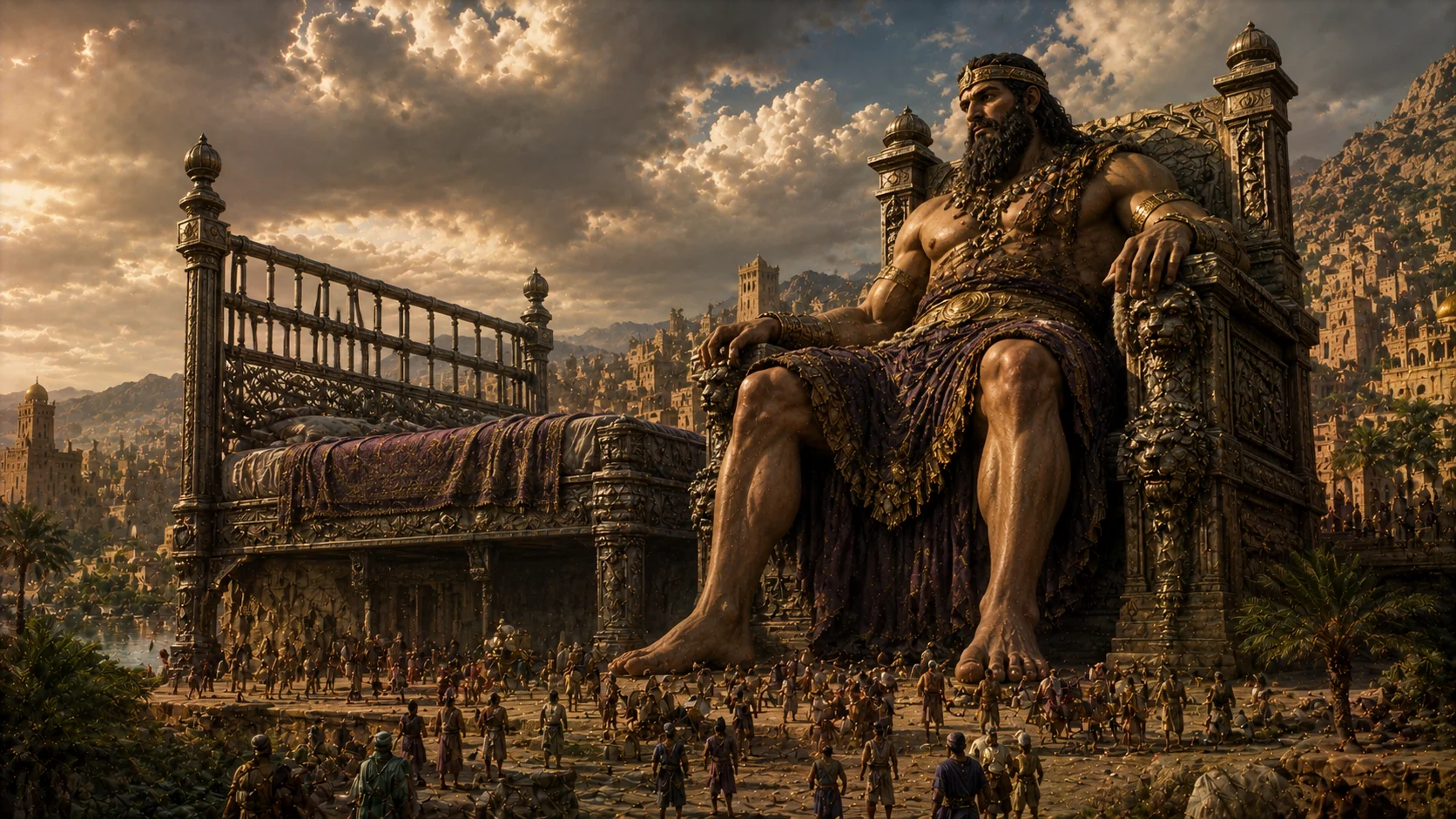
Jewish mystical tradition holds that two human beings were so righteous that they ascended bodily into heaven and were transfigured into great angels: Enoch became Metatron, and the prophet Elijah, swept up in a chariot of fire, became Sandalphon. This origin makes Sandalphon unique — an angel who knows mortal life from within, a bridge between the human and the celestial. The Talmud describes him as a being of such vast height that it would take a journey of five hundred years to traverse it, towering above his angelic fellows.
The Weaver of Prayers
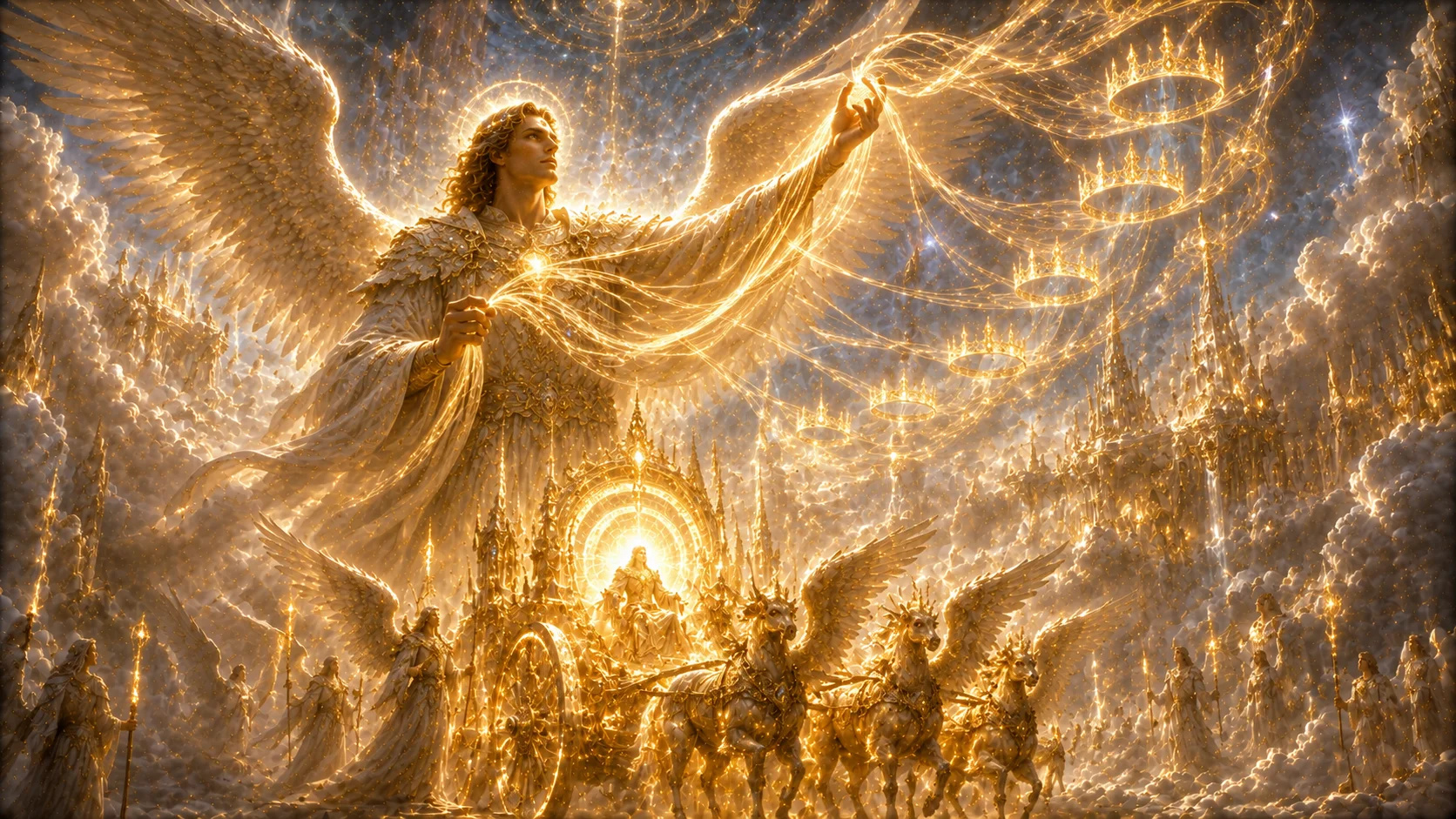
Sandalphon’s great office is the gathering of prayer. He is said to stand behind the divine Chariot, receiving the prayers that rise from the faithful on earth, and to weave them into garlands and crowns that ascend of their own accord to rest upon the head of the Holy One. In this he is the intercessor who ensures that no sincere prayer is lost, but is gathered up and crowned with glory before the Throne. He is also named as the angel set over birdsong and, in some traditions, over the unborn, determining aspects of a child’s destiny.
Twin of Metatron
Sandalphon and Metatron are paired as the two transfigured humans, the highest of angels, often depicted as celestial brothers flanking the divine presence — Metatron the heavenly scribe and prince, Sandalphon the master of prayer and song. In the imagery of the Kabbalah, the two stand at the summit and the foundation of the angelic order. In Sandalphon, Jewish tradition gave heaven a most human face: an angel who had wept and prayed as a mortal, now eternally lifting the prayers of mortals to God.
The Wheel That Stood on the Earth
Sandalphon enters recorded tradition not as a portrait but as a puzzle. In the opening vision of the Book of Ezekiel the prophet sees the living creatures of the divine Chariot, and beside them — strangely, jarringly — one wheel upon the earth. Wheels belong to chariots, and chariots belong to the sky. What is a wheel doing on the ground?
The answer comes in the Babylonian Talmud, in tractate Hagigah, where the wheel on the earth is explained as an angel: a being whose feet rest on the world and whose head reaches the living creatures above. The passage is brief and strange. He stands behind the Chariot, he binds crowns for his Maker, and when a crown is finished he pronounces the divine Name over it — and only then does the crown rise.
That last detail is easy to skim past and deserves not to be. Sandalphon does not set the crown in place. He speaks a Name, and the crown completes the journey alone. The greatest of the angels — the one whose feet touch the ground — is not the one who closes the final distance.
The five hundred years of his stature is not decoration either. In rabbinic cosmology that is the standard measure of the distance from the earth to the firmament: a walk of five centuries. To say that Sandalphon overtops his fellow angels by that span is to say that he alone is as tall as the sky is high. He is the interval between heaven and earth, given a body.
It matters, too, where this teaching sits. The Chariot material was restricted knowledge. The Mishnah forbids expounding the Chariot even to a single student unless that student is wise enough to understand it from his own mind. Sandalphon reaches us through a body of teaching that was never meant to be published — which is part of why the sources about him are so terse, so allusive, and so quickly overgrown by later imagination.
A Name That Does Not End in -el
Look at the great angel names of Jewish tradition and a pattern is immediate: Micha’el, Gabri’el, Rapha’el, Uri’el. Each is a small Hebrew sentence ending in El, God. Who is like God. God is my strength. God heals. God is my light. The name declares the office.
Sandalphon breaks the pattern completely, and so does Metatron. Neither name is Hebrew. Both look like loans out of Greek, absorbed into Jewish angelology during the centuries when Greek was a common tongue of the eastern Mediterranean. For Sandalphon the most frequently proposed derivation is a compound meaning something like co-brother or fellow-brother — which would make his very name a statement about his pairing with Metatron, brotherhood built into the syllables. Others have heard in it the Greek word for a sandal, and readers of the Kabbalah found that resonance irresistible for an angel who stands at the feet of creation. None of these etymologies is certain, and honest scholarship leaves the question open.
What the name suggests, whatever its root, is chronology. Sandalphon does not look like an ancient Israelite figure smuggled forward. He belongs to the late-antique world of the Greek-speaking Near East, to the same centuries that produced the Merkavah mystics and their hymns.
How Elijah Entered the Story
The identification of Sandalphon with the prophet Elijah is the most famous thing about him, and it is worth saying plainly that the Talmud never makes it. The Hagigah passage describes an angel who binds crowns and says nothing whatever about a human origin. The equation with Elijah is a later development, worked out across medieval and Kabbalistic literature, where it settled into a satisfying symmetry beside the older tradition that Enoch, who walked with God and was not, had become Metatron.
The logic behind it is airtight in its own terms. Scripture records only two men who did not die. If transfiguration is possible at all, these are the two candidates, and Jewish tradition already had one of them installed in heaven under a new name. The chariot in Elijah’s ascent supplied the final hook: the man taken up by a chariot of fire becomes the angel who stands behind the Chariot.
Yet tradition is not of one mind here, and the disagreement is more interesting than the neat version. In Jewish practice Elijah has never really left. A cup is poured for him at every Passover seder and a door is opened; a chair is set for him at every brit milah; the prophet Malachi promises that he will be sent before the great and terrible day, and the liturgy of the departing Sabbath still sings for his coming. He is not a memory but an expected guest — the figure who might be the stranger at the door. That living, wandering, thoroughly human Elijah sits uneasily beside a five-hundred-year-tall angel of the Chariot, and different strands of the tradition simply hold the two apart rather than reconcile them.
The Angel at the Bottom of the Ladder
Kabbalah gave Sandalphon a precise address. In the system of the four worlds and the ten sefirot, Metatron is assigned to the upper reaches — commonly to Beriah, the highest of the created worlds. Sandalphon is placed at the very bottom: the archangel of Assiyah, the world of making and action, and of Malkhut, the last sefirah, the point where divinity finally touches the material world.
This is not a demotion. Malkhut is the sefirah of receiving, of the Shekhinah, of divine presence dwelling in the world rather than above it, and everything that flows down the Tree arrives there. An angel stationed at Malkhut is an angel standing exactly where human beings are — which is why the office of gathering prayer belongs to him rather than to some loftier figure. Prayer is collected at ground level, where it is spoken.
Christian esotericism inherited this arrangement wholesale. When nineteenth-century occultists built their own version of the Tree of Life, Sandalphon came with it as the archangel of the lowest sphere, and he holds that post still throughout modern ceremonial magic and the angelology descended from it — a Talmudic footnote about a wheel on the earth, quietly outliving the world that wrote it.
The Problem of the Middleman
An angel who carries prayers upward raises an obvious and uncomfortable question: why would prayer need carrying? Judaism is uncompromising about the address of prayer. Maimonides made it a principle of faith that worship is directed to God alone and to no intermediary — not to angels, not to stars, not to anything in between.
And yet the prayer books contain poems that speak straight to the angels. A penitential piyyut recited in the Selichot season addresses the ushers of mercy and asks them to bring the people’s pleas before the Master of mercy. The Friday-night hymn sung at countless tables greets the ministering angels and, in one of its verses, asks them for a blessing. Both texts have been argued over for centuries; some communities recite them without hesitation, some alter the wording, some leave the verse out entirely. The debate is not a curiosity but a live seam in Jewish practice.
Sandalphon sits at the centre of that tension, and the Talmudic image handles it more elegantly than any argument. He does not receive prayer, and he does not answer it. He gathers what has already been sent, and even the crown he weaves must finish its ascent without him. He is less a middleman than a witness — evidence that nothing was dropped on the way.
Prayers Made of Something
The instinct to give prayer a physical form is far older and far wider than Sandalphon. In the Book of Tobit, the angel Raphael reveals himself as one of the seven who carry the prayers of the righteous into the presence of the Glory. In the Book of Revelation an angel stands at the golden altar with a censer, and the smoke of the incense goes up before God together with the prayers of the saints. Across languages and centuries the same solution recurs: make prayer into a substance — smoke, incense, gold thread, a crown, a garland — so that it can be seen to arrive.
What makes the Sandalphon version distinctive is the craftsmanship. Incense simply rises; anything burnt does that. Crowns must be made. Someone is bent over the work, gathering, sorting, weaving, tying off. The image insists that prayer is not merely received but handled — that individual words spoken in a room somewhere are picked up, examined, and worked into something fit to be worn by God.
An Angel Without a Face
There is almost no traditional Jewish iconography of Sandalphon, and there could hardly be; the tradition that produced him does not make images of the heavenly host. He exists entirely in words, and his only physical attribute is a measurement. Everything else — the wings, the coloured robes, the harp or the loom that modern esoteric art hands him — is later invention, and mostly invention of the last two centuries.
His literary afterlife begins in earnest with Longfellow, who published a poem simply titled “Sandalphon” in the 1850s, retelling the legend of the angel of prayer for a nineteenth-century American readership and imagining the prayers turning to flowers in his hands. It was an unlikely route out of the Talmud and into general Western culture, and it worked.
From there he has gone where old angels now go. Japanese animation borrowed the name for an embryonic creature recovered from a volcano; a long-running mobile role-playing game made a character called Sandalphon into one of its most popular figures; the name recurs across fantasy fiction, comics and games, usually detached from anything the Talmud said. The migration is worth noting without sneering at it. A being invented to explain one strange wheel in one prophetic vision has become common cultural property.
Why the Story Holds
Strip away the height and the crowns and the Greek etymology, and Sandalphon addresses a single fear, one that anybody who has ever prayed will recognise: the fear that nothing was heard. That the words went up into an empty room. That the silence afterwards is not patience but absence.
Notice what the answer carefully does not promise. Not that prayers are granted — only that they are collected, by somebody who stands at the bottom of the sky with his feet on the ground and his hands full of other people’s words. It is a modest consolation, and a durable one, and the reason a figure attested in a few lines of a restricted esoteric text is still being named fifteen centuries later by people who have never opened it.
Sources & traditions
- EncyclopediaWikipedia — Sandalphon
- TraditionHebrew texts, grimoires and later commentary
Myths change from area to area and from time to time. This chronicle follows the most widely told versions; tellings in other villages, regions and eras may differ.